The Deep-Seated Game Between Technical Ideals and Commercial Realities Within Alibaba as Seen Through Lin Junyang's Departure
 03/09 2026
 699
699
By Wang Huiying
Edited by Ziye
"me stepping down. bye my beloved qwen."
On the early morning of March 4, 2026, Lin Junyang's farewell message on the X platform fell like a stone into a lake already rife with undercurrents.
For the technical community, this marked the departure of an open-source talent. For Alibaba, it signified the end of an era characterized by technical ideals and open-source influence, with the Qwen team soon to bid farewell to independent operations.
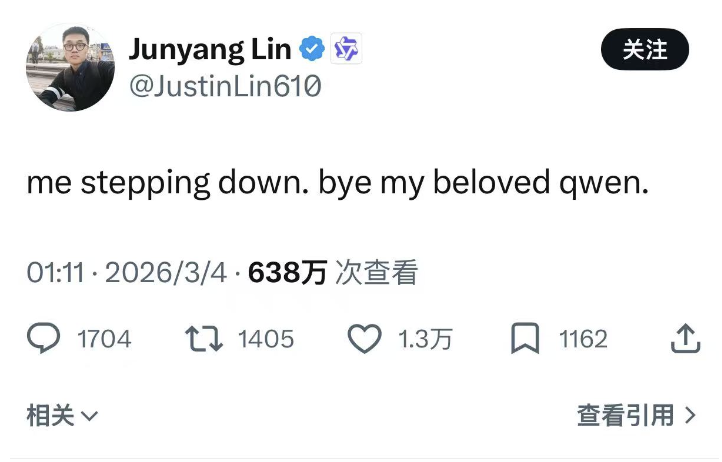
Image source: Lin Junyang's X platform account
On March 5, Alibaba CEO Wu Yongming issued an internal email confirming the approval of Lin Junyang's resignation. Meanwhile, Alibaba stated that the Qwen model team remains stable, with no "mass resignations" occurring, all products and services operating normally, and Qwen maintaining its open-source strategy.
On the same day, Omar Sanseviero, a relevant leader of the Google DeepMind development team, extended an olive branch to Lin Junyang on a social platform.
This abrupt farewell, while seemingly a personal choice, is actually an inevitable outcome following Alibaba's fundamental shift in strategic positioning for large models.
Over the past two years, Qwen's mission has been to catch up. Under the pressure of OpenAI's dominance, Alibaba needed a swift cavalry to prove that China could also create world-class open-source large models. Lin Junyang led the Qwen team to achieve this, becoming Alibaba's youngest P10 in the process.
However, as Qwen transitioned from a pursuer to a leader, Alibaba's expectations evolved. In the group's strategic blueprint, Qwen could no longer remain a geek project hidden away in the laboratory, gazing at the stars. Instead, it had to become a super engine driving Alibaba Cloud's computing power sales and empowering the growth of C-end applications.
Technical influence ceased to be the endpoint but became a means to achieve commercial goals. This transition from a technology-centric to a business-centric approach meant that Qwen had to evolve from an independent unit into an integrated part of the group's operational framework.
This is perhaps an inevitable choice for Alibaba's AI strategy as it enters the stage of commercial-scale deployment. The misalignment between technical ideals and commercial logic has led to a divergence between the persistence of technical talents in foundational models and the group's commercialization goals, representing a core disconnect and strategic growing pains.
1. Lin Junyang's Departure Reflects a Shift in Alibaba's Aspirations
Organizational talent changes are common among giants, but the suddenness of this change lies in its timing—occurring just as the Qwen team underwent adjustments and achieved new milestones.
On the evening before this tweet, the Qwen team had just launched the Qwen 3.5 lightweight model. After its release, Elon Musk praised its "impressive intelligence density," and Lin Junyang subsequently engaged in friendly interactions with him.
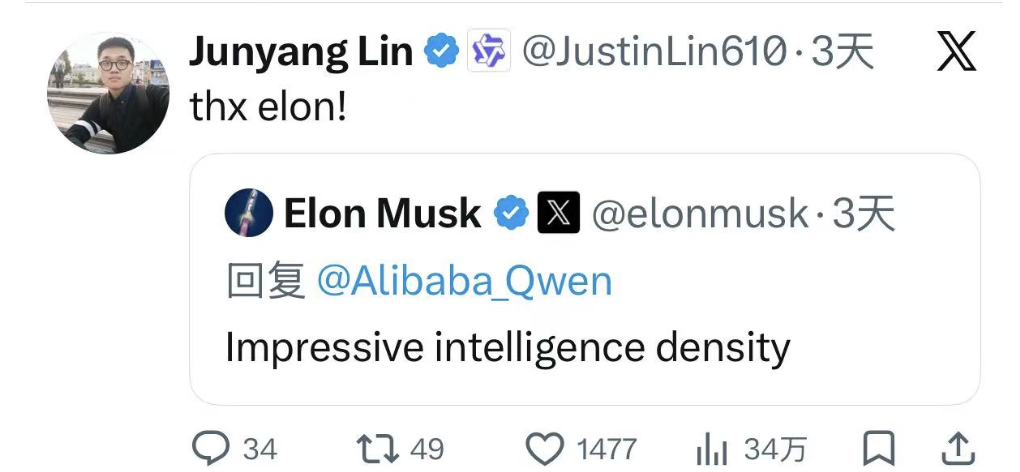
Image source: Lin Junyang's X platform account
From promoting the new model to announcing his departure, Lin Junyang took less than 24 hours. For outsiders, this was an unexpected farewell, but for those familiar with Alibaba's AI organizational ecosystem, the groundwork had already been laid.
According to the LatePost podcast, on the afternoon of March 3, Lin Junyang trailer (yùgào, hinted at) his intention to resign in the Qwen DingTalk group, stating he had "no words to face everyone."
This may stem from differences between the Qwen team and the group's technical roadmap.
According to LatePost reports, the Tongyi Lab plans to split the Qwen team, transforming it from a vertically integrated system covering different training processes and modalities into horizontally divided teams specializing in pre-training, post-training, text, multimodality, etc.
This contradicts the full-stack approach that Lin Junyang and the Qwen team have long advocated and practiced. Over the past two years, Lin Junyang has closely integrated teams for pre-training, post-training, infrastructure, and even multimodality, forming an efficient and collaborative closed loop centered on the agility of "small teams, big closed loops."
Last year, the Qwen model team began forming an Infra team internally to further strengthen the stability of the model's foundation. This also allowed the team to continuously expand its capabilities, overlapping with other parallel teams within the Tongyi Lab.
Currently, Qwen's developed VLA embodied models and text-to-image models like Qwen-image are also being researched by other teams within the Tongyi Lab. According to the LatePost podcast, after the split, the Qwen voice team may merge into the Tongyi Lab's Bailing team, while the text-to-image team may merge into Tongyi Wanxiang.
This organizational adjustment occurred just as Qwen-3.5 made its debut, and feedback from within the group, the Qwen team, and the open-source community contrasted sharply with Qwen-3.5's performance.
According to LatePost reports, some Alibaba executives were not entirely satisfied with Qwen-3.5, released on New Year's Eve, even calling it a "work in progress."
This contrast stems from the asynchrony between commercial goals and technical achievements. In more commercially oriented rankings, the Qwen series has seen a significant decline. As of the end of February 2026, on the overseas well-known large model blind test ranking LMArena, Qwen's flagship model, Qwen3.5-397B, ranked 18th. Last September, Qwen3-Max Preview had once entered the top three on this list.
However, Alibaba has not set commercial KPIs like DAU for the Qwen team. Alibaba states that the goal of the Qwen large model is to continuously pursue the upper limits of model intelligence and achieve AGI.
An unavoidable issue is that the revenue efficiency of the open-source route remains questionable. On the path to achieving AGI, the core goal of Alibaba's large model R&D must ultimately serve the group's commercialization and business growth.
This represents a conflict and misalignment between individual and team goals and organizational objectives. However, to survive within a larger organization, alignment with group goals and service to strategic shifts are necessary.
Alibaba's split of the Qwen team is essentially aimed at integrating it into the "unified" strategic system of Qwen.

Image source: Alibaba Cloud official website
On March 2, Alibaba unified the overall name and core brand of AI as "Qwen." This move aims to avoid confusion caused by multiple names like Qwen, Tongyi Qwen, and Qwen in the past. After unification, the "Tongyi Lab" serves as the organizational name for AI institutions under the Alibaba Group.
While seemingly a brand unification, it actually represents a unification of Alibaba's AI strategy. In the current competition for AI super applications, Alibaba needs to mobilize all resources to enhance its combat effectiveness.
This also means that after the adjustment, Lin Junyang and Qwen face a choice: continue iterating on the model foundation or serve Qwen's C-end business and Alibaba's ecosystem. These are two parallel paths that cannot intersect.
This technically oriented manager clearly chose the former. With Lin Junyang's departure, a deep-seated game between technical ideals and commercial realities has finally surfaced, and Alibaba must find ways to truly synergize its commercial and technical goals internally.
2. Alibaba's Top Management Holds a Meeting, Revealing More Issues
Lin Junyang's departure is like a stone thrown into a lake, with ripples quickly spreading throughout the Alibaba Group.
On the afternoon of March 4, the Tongyi Lab urgently convened an All Hands meeting, attended by Alibaba Group CEO Wu Yongming, Alibaba Chief Talent Officer Jiang Fang, and Alibaba Cloud CTO Zhou Jingren.
This was clearly a meeting to stabilize morale, but the overall atmosphere was not relaxed, as top management faced queries from the Qwen team.
The most direct dissatisfaction from the Qwen team still stemmed from Alibaba's organizational adjustment of Qwen. Frontline employees had just focused on releasing Qwen3.5 when the team was split, compounded by the departure of a core figure and the introduction of new leadership. Understandably, the team harbored some emotions.
Regarding this adjustment, Alibaba's top management defined it as follows: Qwen is not shrinking; this is a team expansion unrelated to any political struggles, requiring the investment of more resources instead.
However, Jiang Fang also admitted that communication was lacking: "This organizational form was not well communicated. The introduction of new personnel will inevitably bring changes in formation, and these are inevitable during the expansion process. We may not have handled it well."
Compared to organizational changes, the Qwen team cared more about the group's resource allocation.
According to Smart Emergence reports, during the meeting, some members directly asked why external clients could smoothly purchase Alibaba Cloud's computing power while the internal team struggled with computing resources and hiring quotas.
In response, Zhou Jingren stated that the team is in a "resource-constrained state," with many historical reasons for the internal-external disparities. He mentioned that overall planning is underway but did not elaborate further.
To dissect these historical reasons, we must go back to 2025 when Qwen formed its Infra team.
As mentioned earlier, the Qwen model team began forming its own Infra team from the middle of last year to train foundational models. This responsibility was originally primarily handled by Alibaba Cloud's AI platform PAI, with inference supported by the Bailian team.
This meant that Lin Junyang led Qwen to internally supplement the infrastructure needed for LLM training, eliminating the need for external team support. Rationally analyzing this move, on the one hand, PAI needed to support the demands of multiple teams simultaneously and could not meet Qwen's rapid iteration needs; on the other hand, Lin Junyang also hoped that Qwen's technical capabilities could stand independently.
At this point, a divergence emerged between technical goals and organizational objectives. Qwen belongs to the Tongyi Lab, which in turn is part of the Alibaba Cloud team. This model of independently developing technical capabilities within Qwen naturally contradicts Alibaba Cloud's division of labor logic and even creates conflicts with peer teams.
The ultimate situation became one where the Qwen team felt constrained by the group's resources, while Alibaba continuously elevated the priority of the Qwen foundational model.
This organizational structure increased communication costs between the project team and group leadership, with synchronization issues arising. According to Sina Technology reports, Wu Yongming also candidly admitted during the meeting, "China's national conditions are unique, and resources are hardly ever satisfactory to everyone. We should have been more aware of resource issues earlier," while stating that Qwen is the top priority and that he has made the utmost efforts as a Chinese CEO.
The most core outcome of this meeting was Alibaba's top management redefining the strategic position of large models. The executive team repeatedly emphasized that the Qwen foundational model is currently the most critical matter for the group, with the large model competition being a concern not just for the Qwen team but for the entire Alibaba Group.
This means that Alibaba's top leadership has thoroughly clarified its AI strategic direction. Whether in foundational model R&D or underlying infrastructure construction, it will be coordinated and advanced at the group level, with a clear goal of "definitely surpassing" competitors.
This pronouncement undoubtedly ends the relatively independent mode of the Qwen team in the past, with Alibaba set to invest more resources and talent into it. Qwen officially enters a new phase where the group fully supports it.
3. Multiple Departures from Lin Junyang's Team: What Impact on Alibaba?
"Brothers of Qwen, keep going as originally planned. It'll be fine."
On the afternoon of March 4, Lin Junyang wrote this on his WeChat Moments. His departure also triggered a domino effect within the Qwen team.
On the same day, Yu Bowen, the post-training leader of Qwen, also officially resigned. According to LatePost reports, his responsibilities will be taken over by Zhou Hao, a former DeepMind senior researcher who joined Alibaba's Tongyi Lab earlier this year, reporting directly to Zhou Jingren.
Another researcher, Kaixin Li, also announced his departure. This core developer involved in Qwen 3.5/VL/Coder, a graduate of the National University of Singapore, stated on social media that under Lin Junyang's promotion, Qwen might have established a technical foothold in Singapore, but with Lin's departure, he had "no reason to stay."
According to LatePost reports, in January of this year, Hui Binyuan, the former head of Qwen Code, had already left Alibaba to join Meta. Subsequently, Lin Junyang took over responsibility for Qwen Code.
Reviewing Qwen's development journey, this team has achieved globally recognized results with far superior R&D efficiency compared to competitors, despite limited resources. Qwen has grown from an internal project into a global open-source model family: with over 600 million downloads worldwide and over 170,000 derivative models, its activity in the open-source ecosystem has long been on par with Meta's Llama series.
Under Lin Junyang's leadership, the team built Qwen's open-source ecosystem, giving Chinese large models a voice in the global community. It is precisely because of this team's accumulation that Alibaba did not fall behind in the first stage of the AI race.
With Lin Junyang's departure now finalized, market attention has shifted to the changes in Alibaba's AI strategy and their impact on the company.
On March 5, the company announced the establishment of a foundational model support team, with Wu Yongming, Zhou Jingren, and Fan Yu jointly coordinating group resources to support foundational model construction. Regarding who will fill Lin Junyang's position, Alibaba has not publicly disclosed any progress.
Wu Yongming stated that developing foundational large models is Alibaba's key strategy for the future. Alibaba will continue to adhere to its open-source model strategy while increasing its R&D investment in artificial intelligence and stepping up efforts to attract outstanding talent.
After the departure of multiple technical personnel, reorganization will take time for any team, and the same applies to Qwen. Recruiting talent more suitable for the Qwen team poses a significant short-term challenge for Alibaba.
Regarding the choice of AI technical route, Alibaba has not changed Qwen's open-source strategy, which means it must continue balancing commercial efficiency and technical route (lùxiàn, approach).
More importantly, in the current market competition, numerous competitors continue to ramp up their R&D of open-source models and accelerate the commercialization of C-end applications. AI has become a global war that tech giants cannot afford to lose.
Going forward, whether the restructured Qwen team can maintain its competitiveness and successfully advance the Qwen strategy will be a critical test for Alibaba.
Alibaba's choice is to entrust AI's fate to organization, processes, and commercial strategy, while Lin Junyang's choice is adherence to technology and ideals. Neither is right nor wrong; it is an inevitable choice between corporate logic and personal development logic.
After all, what ultimately determines Alibaba's AI position is not an individual but the synergy and cooperation of the entire organization. How to convert the visibility Qwen has gained in the open-source community into tangible assets for Alibaba is a crucial step.
(The header image for this article is sourced from the official Alibaba website.)
-
![]()
Doubao Work Unveiled! Domestic AI Leaders Fully Commit to the 'Work' Sector
-
![]()
Who’s Sounding the Alarm on ‘Rushed Vehicles’?
-
![]()
Over 5.3 Billion Yuan in Losses Over Three and a Half Years! Can Yonyou Reverse Its Fortunes Through Streamlining and AI Transformation?
-
![]()
Baidu AI Adopts Free Model: A Strategic Maneuver in Traffic and Monetization
-
![]()
Silicon-Based OLED Pioneer Unveils Financial Results: H1 Shipments Outpace Entire 2025 Volume
-
![]()
AI's First "Lost Summer"
-
![]()
Zeiss Makes Another €2.2 Million Bet: Will Eye Tracking Be the Next Big Thing in the Smart Glasses Industry?
-
![]()
RUNTO Ranking | Global Top TV ODM Factories' Shipment Figures for July 2026