Has the Era of Effortless Profits for Ctrip Come to an End?
 03/09 2026
 528
528

AI on mobile devices can now handle flight and hotel bookings with ease.
Simply open your phone, input your desired travel itinerary, and AI will instantly generate three distinct travel plans. These plans come complete with real-time flight price comparisons, hotel room evaluations, and even the ability to complete bookings directly—all without the need to toggle between multiple platforms.
Heibanjun put this to the test and discovered that Qianwen is integrated with Fliggy and Gaode, both of which are part of the Alibaba Group. Meanwhile, Doubao is linked with service providers such as Ctrip, Douyin, Dianping, and major hotel official websites.
This raises a question: as AI assistants evolve from generating travel plans with a single command to handling both planning and bookings seamlessly, the traditional Online Travel Agency's (OTA) stronghold as a traffic gateway will face unprecedented challenges.
Previously, both Alibaba's Fliggy and ByteDance's Douyin attempted to penetrate the online travel market but struggled to disrupt the established order. However, AI, as an unexpected disruptor, has the potential to reshape the landscape.

Image Source: AI-Generated
Shengbo Research clearly points out that suppliers can reduce OTA commission costs by approximately 14% by directly reaching consumers through AI agents. This is undoubtedly a significant blow to OTAs that have long relied on commission-based revenue.
AI is emerging as a new search engine, and the formation of this super gateway suggests that the traffic logic and the era of easy profits in online travel may no longer be sustainable.
01
Reshaping the Logic of Service Systems
AI has streamlined consumers' travel decision-making and payment processes, but this is not the primary reason for its disruption of Ctrip.
For instance, Heibanjun engaged in a direct conversation with an AI assistant:
"I plan to leave after work next Friday, traveling from Guangzhou to Beijing for three days. I need you to provide the best flight, hotel, and attraction options, along with corresponding purchase links."
Both Qianwen and Doubao swiftly generated travel plans and provided purchase links for some flights, hotels, and attractions. Even when no links were available, natural conversational follow-ups prompted them to generate links immediately.
In contrast, navigating a traditional Ctrip APP page requires searching through a screen full of buttons for the desired service or scrolling down to browse various travel guides. Compared to AI, this process is time-consuming, and the efficiency of individual bookings is low.
In fact, the Ctrip APP also incorporates an AI assistant, but it is not prominently displayed on the home screen. Instead, users must first click the search bar, access "Travel AI" in the middle of the screen, and then pose their question.
After asking the aforementioned question, it redirects to the "AI Itinerary Assistant," which involves too many steps.
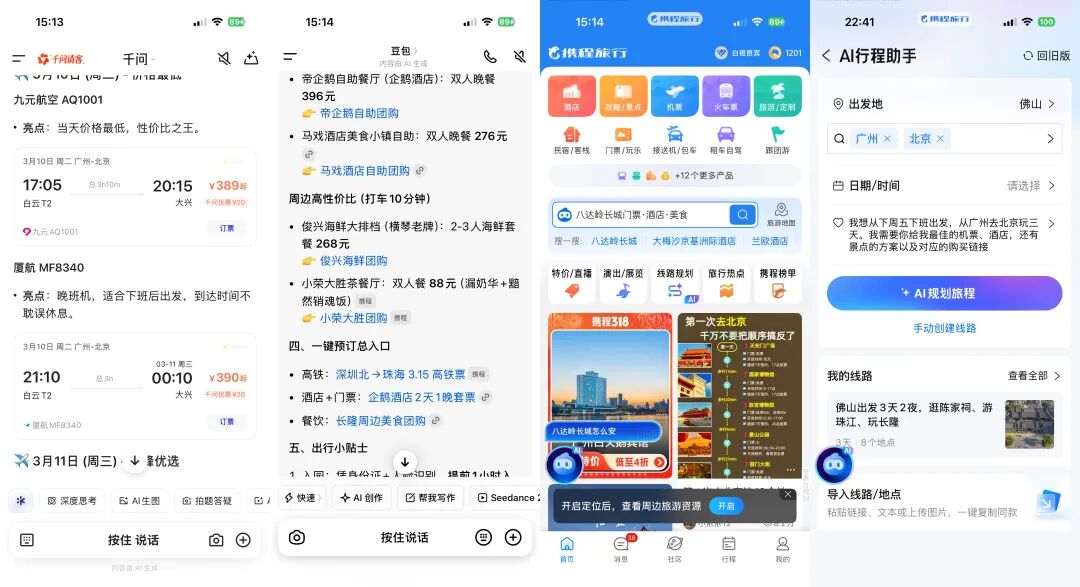
Image Source: Qianwen vs Doubao vs Ctrip
Moreover, the core of this experience lies in the fundamentally different logic of the service system.
The core service logic of OTAs like Ctrip has traditionally been "people seeking services," aggregating diverse and complex services within the APP for users to navigate independently.
AI, on the other hand, adheres to the logic of "services seeking people." With just a single command from the user, AI proactively delivers matching services to the user's doorstep.
AI's core strength lies in precise matching and efficiency enhancements, which are precisely the weaknesses of OTAs.
On traditional OTA platforms, users must repeatedly sift through vast amounts of flight and hotel information, comparing prices—a time-consuming and laborious task. Moreover, the recommended results are often highly similar and fail to meet personalized needs.
AI, however, can accurately interpret users' vague demands through natural language processing and swiftly break them down into subtasks such as destination screening, flight comparisons, hotel matching, and itinerary coordination to generate personalized plans.
More critically, AI is achieving end-to-end closed-loop bookings, completely undermining the intermediary value of OTAs. AI can also automatically compare prices across platforms.
Users are already choosing between these two service systems based on their preferences.
According to the "2025 China Youth Travel Observation Report" by China Youth Daily, 73.5% of young respondents believe that traveling with AI will be the new norm in the future.
Imagine a future where AI dominates users' minds, and platforms like Ctrip are merely one of many supply chains AI can choose from. Will the era of effortless profits begin to crumble?
02
What Constitutes the Core of Effortless Profits?
Why could traditional online travel platforms generate effortless profits?
Over the past decade, China's online travel market has matured, with OTA platforms gradually gaining pricing power and influence in the industry through their traffic advantages, forming a foolproof profit logic.
The rise of OTAs essentially stemmed from addressing the pain point of information asymmetry in the travel industry by building a bridge between consumers and suppliers, thus achieving a high-return, effortless profit model.
Firstly, commission-based revenue is the core profit source, with proportions increasing annually;
Secondly, consumers are implicitly exploited through bundled sales and big data-driven price discrimination as revenue-boosting tactics;
Thirdly, the asset-light model reduces operational costs, with economies of scale continuously amplifying.
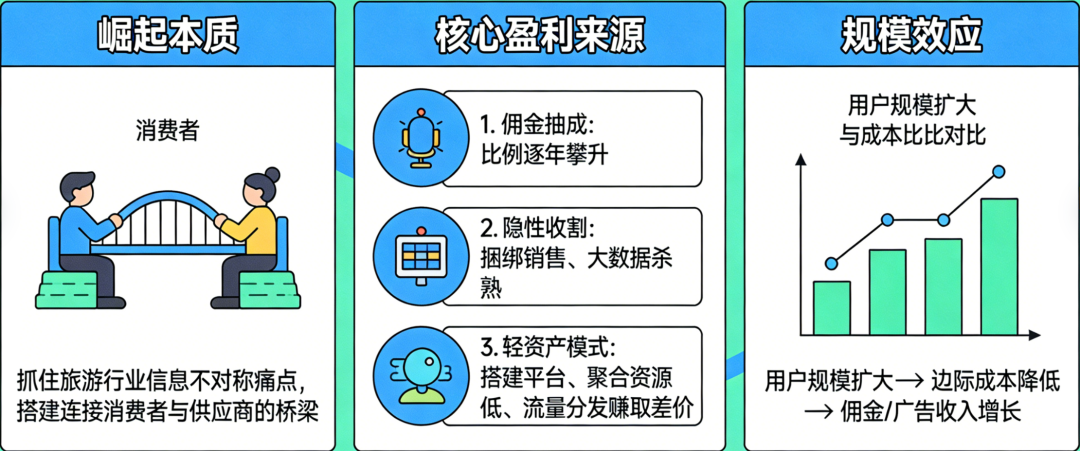
Image Source: AI-Generated
OTAs do not need to invest heavily in building hotels or operating flights. By simply building a platform and aggregating resources, they can earn margins through traffic distribution.
As the user base expands, the platform's marginal costs continue to decline, while commission and advertising revenues grow.
During the era of explosive traffic dividends, the effortless profit model of OTAs was nearly unbeatable.
Consumers relied on platforms for price comparisons and bookings, while merchants depended on platforms for traffic. OTAs reaped the benefits, becoming the digital landlords of the travel industry.
03
What Will AI Disrupt?
Only by proactively adapting can one avoid being eliminated by the times.
Consider the likely trajectory:
As AI direct-connection models proliferate and airlines and hotels establish their own channels, suppliers' distribution choices are no longer limited, significantly reducing their reliance on OTAs. This leads to suppliers actively lowering commission rates and refusing to pay high marketing fees, directly impacting OTA's core profit sources.
Ctrip's 2025 financial report clearly shows this trend: its R&D investment reached 15.1 billion yuan, accounting for 24% of revenue—far exceeding net profit and contrasting sharply with the past asset-light, high-return effortless profit model.
This bluntly indicates that OTAs are being forced out of their comfort zones and investing heavily in technological transformation.
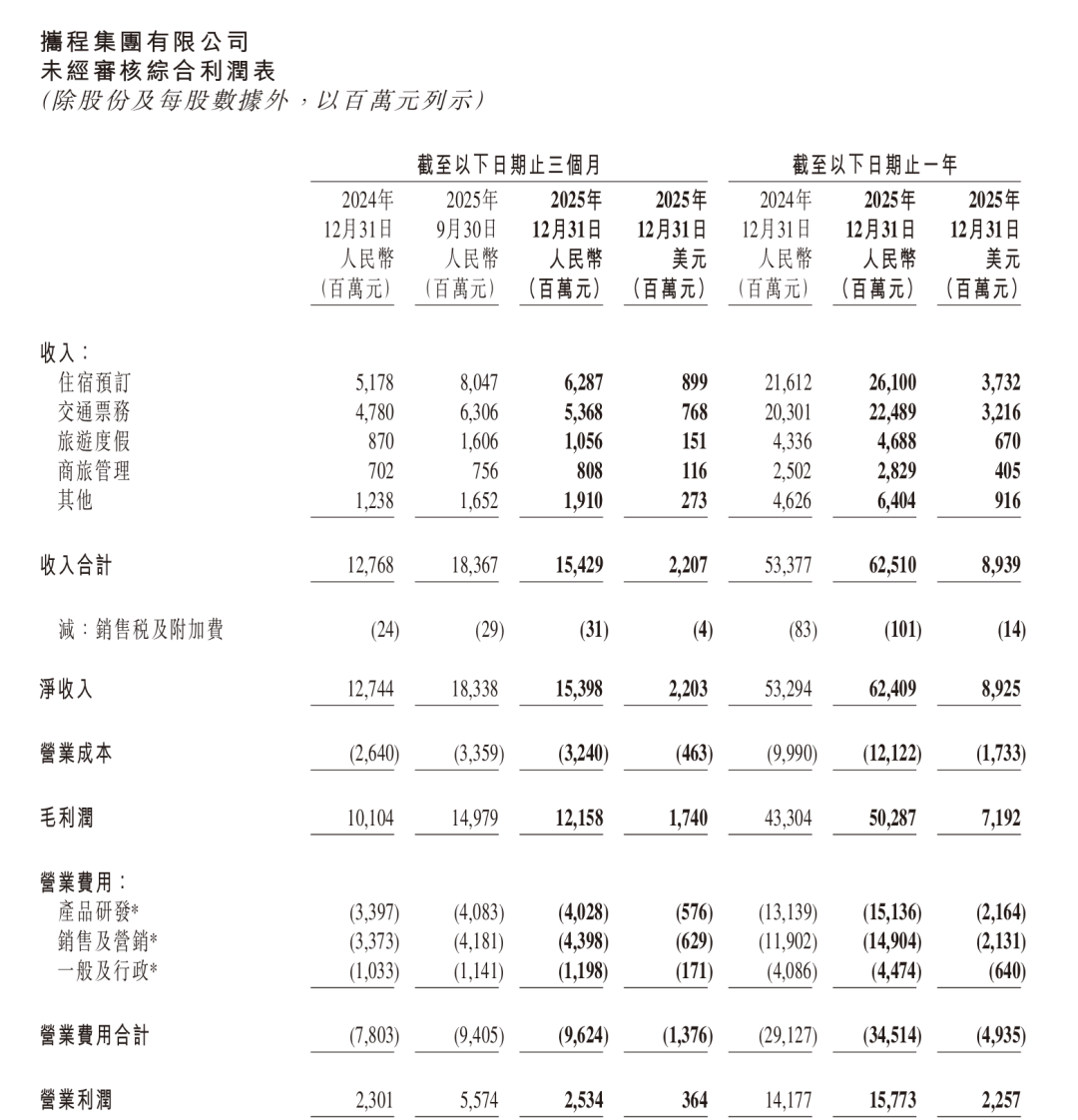
Image Source: Ctrip Financial Report
Next are user stickiness and customer acquisition costs.
As AI becomes the new super gateway, traffic diversion is inevitable.
On one hand, AI's efficient, precise, and bundle sale-free service advantages quickly attract young users seeking convenience, becoming the go-to for standardized bookings;
On the other hand, closed-loop models on content platforms like Douyin and Xiaohongshu allow users to complete bookings while browsing short videos or travel guides, eliminating the need to switch to OTA platforms and further squeezing their market share.
In fact, to counter traffic loss, Ctrip's sales and marketing expenses surged by 25% year-on-year in 2025.
Then there is stricter regulation.
Antitrust investigations target violations such as "exclusive agreements," algorithmic discrimination, and bundled sales. Besides facing hefty fines, OTAs will see some of their implicit exploitation methods curbed.
04
What Is the Future of OTAs?
In the future, OTAs will not disappear but will enter a new phase of value competition.
Judging from Ctrip's actions—a leading player—three response directions can be identified, though their effectiveness remains uncertain:
Firstly, building its own AI ecosystem: Ctrip announced a $500 million investment in developing a vertical travel large model in 2024. However, general-purpose large models already hold a significant advantage in foundational capabilities, and vertical data barriers are gradually being eroded by API openness;
Secondly, deepening supply chain integration: attempting to build barriers through exclusive room inventory and ticket types, but AI assistants can directly connect to supply chain systems, significantly devaluing such exclusive agreements while facing regulatory pressure;
Thirdly, transforming into a service provider: offering customized, high-end services, but this requires a complete restructuring of organizational architecture, shifting from an asset-light to an asset-heavy model, inevitably causing a sharp decline in gross margins.

Image Source: Ctrip Heibanbao
Does this mean AI will completely replace OTAs and wipe out the industry?
In reality, AI is not the terminator of OTAs but a reshaper and accelerator of the industry.
It eliminates outdated models that rely solely on information asymmetry for effortless profits, forcing OTAs to return to their service essence and seek new value growth points.
In the past, OTAs generated effortless profits through information asymmetry, essentially a product of era-specific dividends;
Today, AI breaks down information barriers, forcing OTAs to rethink their value.
To find value, pure transaction matching faces fierce competition and lacks a strong moat. OTAs may need to explore their value by becoming industry infrastructure and enabling industrial development.
At the same time, AI's capabilities are still evolving, and its ability to further replace existing services in the industry remains uncertain.
Therefore, for some time, OTAs and AI will coexist and complement each other.
In the future, only OTAs that can create unique value, empower industrial development, and enhance user experiences will survive the transformation.
-
![]()
Doubao Work Unveiled! Domestic AI Leaders Fully Commit to the 'Work' Sector
-
![]()
Who’s Sounding the Alarm on ‘Rushed Vehicles’?
-
![]()
Over 5.3 Billion Yuan in Losses Over Three and a Half Years! Can Yonyou Reverse Its Fortunes Through Streamlining and AI Transformation?
-
![]()
Baidu AI Adopts Free Model: A Strategic Maneuver in Traffic and Monetization
-
![]()
Silicon-Based OLED Pioneer Unveils Financial Results: H1 Shipments Outpace Entire 2025 Volume
-
![]()
AI's First "Lost Summer"
-
![]()
Zeiss Makes Another €2.2 Million Bet: Will Eye Tracking Be the Next Big Thing in the Smart Glasses Industry?
-
![]()
RUNTO Ranking | Global Top TV ODM Factories' Shipment Figures for July 2026