OpenClaw Goes Viral, Even Reaching Tencent
 03/10 2026
 596
596
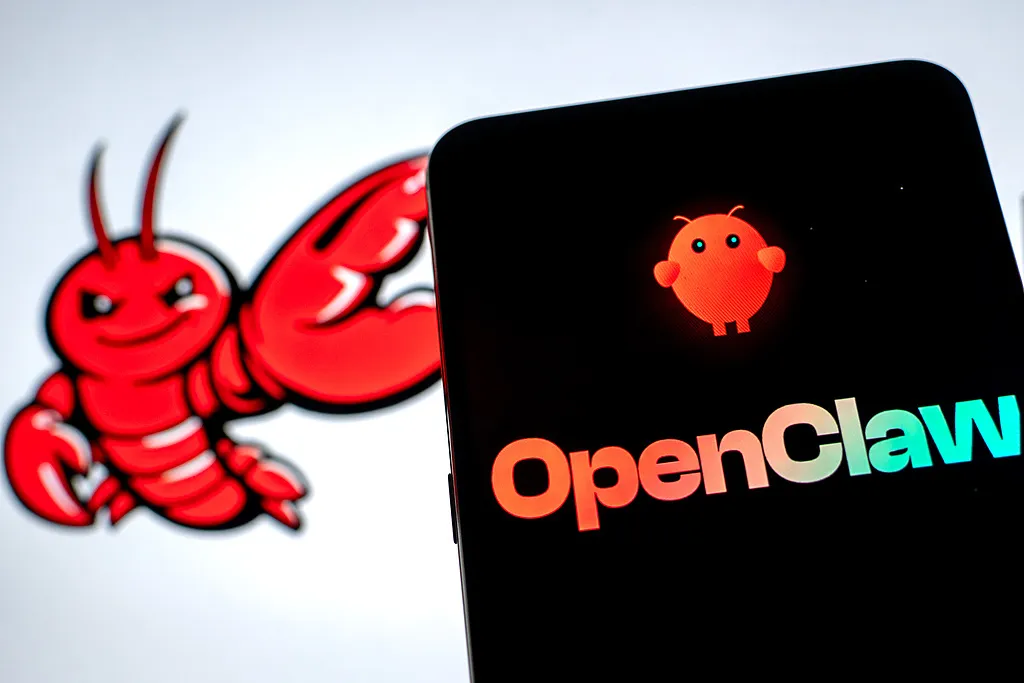
The Craze for 'Raising Lobsters' Catches the Attention of Pony Ma.
A few days ago, Tencent installed OpenClaw for free for users at its Shenzhen office building, attracting nearly a thousand developers and AI enthusiasts, with even the elderly, children, and paid line-standers in attendance.
This semi-philanthropic event, which 'sneaked in private interests,' also created a sensation akin to 'giving away free eggs' in the AI era. Even Pony Ma remarked in a Moments post: 'I didn't expect it to be this popular.'
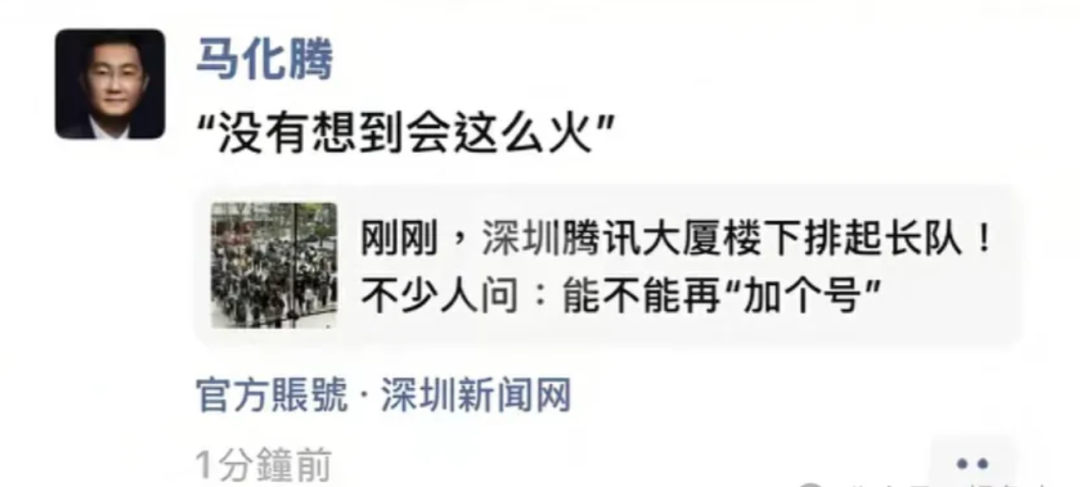 Figure | Screenshot of Pony Ma's Moments post · Internet
In a video report by another local media outlet, industry insiders were also rarely seen to have liked the post by Tang Daosheng, CEO of Tencent Cloud and Smart Industries Group (CSIG).
Lobsters May Be 'Raw,' but the Trend Is 'Cooked'
It should be noted that this open-source AI Agent, originally named Clawdbot/Moltbot, is nicknamed 'lobster' due to its icon. Training and using OpenClaw are thus jokingly referred to as 'raising lobsters.'
However, configuring its local deployment environment is complex, with a high barrier to practical use. Many platforms now offer paid on-site installation services.
Cloud providers such as Tencent Cloud, Alibaba Cloud, JD Cloud, Volcano Engine, and Baidu Intelligent Cloud have launched simplified cloud-based deployments and full cloud services for OpenClaw to promote their own businesses, allowing users to install it with one click and use it out of the box. Smartphone manufacturers like Xiaomi are also beta-testing their 'mobile lobsters.'
The core reason for OpenClaw's viral success is that it accomplishes the crucial leap of AI from 'chat (chatbot)' to 'execution (Agent).' The human-computer collaboration model it demonstrates breaks conventions: it operates in the user's personal environment, such as a local computer or personal server, with interactions in the familiar form of chatting and dialogue.
This is like giving AI 'hands' and 'feet,' enabling it to understand instructions, operate the computer autonomously, and complete tasks.
Additionally, it possesses complete operational permissions and long-term memory, allowing it to remember users' personal habits, akin to a capable personal AI assistant. As netizens put it: 'It's not an assistant; it's a digital employee.'
The value of this transformation lies not only in bridging the 'last mile' of AI implementation but also in achieving a paradigm shift in AI, potentially sparking a productivity revolution.
The imaginative space of 'the future is now' has also triggered a bottom-up technological frenzy. Gao Wen, an academician of the Chinese Academy of Engineering and director of Pengcheng Laboratory, lamented at a high-level conference: 'Now everyone is in such a hurry, afraid they'll miss out on raising 'lobsters.''
However, we must soberly recognize that this lobster is still very 'raw,' with obvious shortcomings, far from the miraculous hype by some course sellers. Issues such as security vulnerabilities (system-level risks, data leaks), high usage costs (Token consumption, hardware requirements), and technical instability (infinite loops, misoperations) are all problems that need to be addressed for OpenClaw's widespread adoption.
Especially at the security level, the Ministry of Industry and Information Technology promptly poured cold water, issuing an urgent reminder: 'Lobsters,' under default or improper configurations, are highly prone to security issues such as cyberattacks and information leaks.
The MIIT advised relevant units and users to thoroughly verify public network exposure, permission configurations, and credential management during deployment and application, close unnecessary public network access, and improve security mechanisms.
Even so, this still-immature lobster has genuinely caught Pony Ma's attention. The signal behind this is clear: AI competition has effectively entered the Agent era, focusing on scenario implementation and task execution capabilities.
While model parameters are important, solving the usability and security issues of Agents is the key variable in mastering the next generation of AI entry points.
The Pressure on Tencent's AI
In response to the impact of 'lobsters,' Tencent acted swiftly.
Besides QQ and Tencent Cloud promptly opening lobster interfaces, today (the 9th), two Tencent business groups directly released three products/updates compatible with OpenClaw. These include QClaw from the Tencent PC Manager team and WorkBuddy, Tencent's version of 'lobster,' launched alongside an update to its lightweight cloud service.
Among them, QClaw is a local AI assistant built on OpenClaw, installable with one click—essentially an OpenClaw 'skin'; WorkBuddy is compatible with OpenClaw skills, retaining powerful automation capabilities and offering a 'deploy-free, download-and-use' experience.
However, speed does not equate to strength. Calmly assessing the situation, Tencent's AI currently faces a delicate predicament.
As I previously analyzed, Tencent's DNA lies in 'social' and 'connection.' This determines that Tencent's AI core mission is not to 'seek' or 'seize' new entry points and scenarios externally like ByteDance or Alibaba but to address internal AI anxiety.
That is, to complete the AI transformation and upgrading of various products without compromising user experience and to leverage AI to empower and reconstruct its vast, complex business ecosystem.
As Pony Ma put it at Tencent's 2025 staff conference, Tencent's AI core revolves around product long-term competitiveness and user experience.
Take Yuanbao as an example; its unique approach in the AI battle during the Year of the Horse Spring Festival was to integrate into Tencent's product ecosystem. It appears as a Yuanbao contact in WeChat, a Yuanbao avatar in Tencent Meetings, a Yuanbao plugin in QQ Browser, and an AI interactive assistant in the comment sections of various Tencent products.
These attempts aim to make Yuanbao an atomic AI capability, a fundamental module integrated into more Tencent products.
 Figure | Crowds 'raising lobsters' in line outside Tencent's building · Internet
Overall, Tencent's AI strategy focuses on three core scenarios: social, gaming, and finance, adhering to a 'social anchor, ecological penetration, long-run layout' approach.
However, this restrained strategy requires tremendous internal coordination and profound organizational transformation, posing significant challenges. Currently, Tencent's AI has exposed numerous issues.
For instance, in terms of products, the WeChat ecosystem has become a 'sweet shackle,' with AI remaining merely a plugin within the ecosystem, lacking independent native hits. Users leave after use, failing to form rigid demand.
Internally, there is also internal friction. The horse-racing mechanism has led to severe data silos across BGs (Business Groups), and WeChat's social data is subject to compliance restrictions, unable to be converted into high-quality training data.
In terms of pace, the 'internal first, external later' approach has caused Tencent to miss the best window for C-side breakthroughs, lagging in the intelligent agent track, always following the market instead of leading it.
OpenClaw: A 'Stress Test' for AI Giants
This explains why Tencent's AI has not yet developed its own 'OpenClaw' but was able to deploy and integrate it ahead of competitors after the lobster craze.
In my view, Pony Ma's 'I didn't expect it' hides two core meanings:
One is awe at AI's development trends. Lobsters are not the first 'task-performing' AI Agents on the market, but their open-source, lightweight, execution-focused model quickly provides users with a channel to interact with computer operating systems. This factually proves that AI Agent task execution capabilities are the next must-compete core track and are being rapidly popularized.
The other is a wake-up call about its own gaps. Tencent's AI is not only constrained by its business ecosystem, unable to produce market-leading phenomenal products, but also lags significantly behind market expectations in AI implementation pace. This is Tencent's AI's current reality.
Pony Ma's 'I didn't expect it' is also a top-down strategic pressure, forcing Tencent's AI to shift from steady 'defensive internalization' to more proactive 'offensive moves.'
Currently, Tencent needs more than just open interfaces; it must break free from ecological constraints, create its core AI products that can truly 'perform tasks,' and accelerate technology implementation.
For Tencent, Pony Ma's 'surprise' is also a rare transformation opportunity. With the WeChat ecosystem, abundant cash flow, and solid technical foundations, Tencent has accumulated many advantages through its long-run layout, albeit being overly steady and slow-paced.
Under the intelligent agent wave, as long as it breaks Inherent inertia (I'll keep this as is for now, as it seems to be a specific term or typo in the original), accelerates implementation, and addresses shortcomings in open-source ecosystems and C-side products, it can gain a firm foothold in the new competition.
In a sense, OpenClaw's viral success is a collective 'stress test' for AI giants after AI entered the Agent stage. It validates the core value of AI Agents, clarifying for the industry and AI vendors the real user demand for 'executable, implementable' AI, while also brutally exposing the strategic shortcomings of these giants.
At the same time, it is certain that the industry's ultimate winner will not be a single open-source project; this is a long-distance race of execution, perseverance, and long-termism. Both AI vendors and ordinary users should not be swayed by this AI hype. As we pursue efficiency gains, we must confront realistic issues such as security risks, usage costs, and technical stability.
References:
ifanr, 'Tencent Is Going Head-to-Head with OpenClaw Today'
Tang Chen's Classmate, 'AI Race Among Giants: ByteDance, Alibaba, Tencent 'Fighting' During Spring Festival'
-
![]()
Doubao Work Unveiled! Domestic AI Leaders Fully Commit to the 'Work' Sector
-
![]()
Who’s Sounding the Alarm on ‘Rushed Vehicles’?
-
![]()
Over 5.3 Billion Yuan in Losses Over Three and a Half Years! Can Yonyou Reverse Its Fortunes Through Streamlining and AI Transformation?
-
![]()
Baidu AI Adopts Free Model: A Strategic Maneuver in Traffic and Monetization
-
![]()
Silicon-Based OLED Pioneer Unveils Financial Results: H1 Shipments Outpace Entire 2025 Volume
-
![]()
AI's First "Lost Summer"
-
![]()
Zeiss Makes Another €2.2 Million Bet: Will Eye Tracking Be the Next Big Thing in the Smart Glasses Industry?
-
![]()
RUNTO Ranking | Global Top TV ODM Factories' Shipment Figures for July 2026