After Computing Power and Electric Power, the Next Core of AI Competition: 6G Technology
 03/10 2026
 695
695

As the curtain rises on the “15th Five-Year Plan,” sixth-generation mobile communication (6G) has been listed as one of the six key future industries, signaling China's charge toward the strategic high ground of next-generation information networks.
Public information indicates that 6G is expected to establish a new network featuring deep integration of communication, sensing, computing, and intelligence, as well as seamless coverage across air, space, and ground. It will not only connect people, machines, and objects but also extend to vast intelligent entities, ultimately achieving the intelligent interconnection of all things.
01. What is Sixth-Generation Mobile Communication?
From a definitional perspective, sixth-generation mobile communication technology, or 6G, is a new generation of mobile information networks that deeply integrates communication, sensing, computing, and intelligence, with seamless coverage across air, space, and ground. It represents a significant leap from “mobile communication networks” to “mobile information networks.” Here, the “G” stands for “Generation.” Each numerical increment—3G, 4G, 5G—signifies a decade-long update and iteration of mobile communication systems.
According to CCTV News, 6G will enable the converged innovation of multiple technologies, including communication, sensing, computing, and intelligence. Its service scope will expand from people, machines, and objects to intelligent entities, and its service space will upgrade from ground-based to integrated air-space-ground coverage, ultimately achieving the “intelligent interconnection of all things.”
Regarding 6G's capability metrics, the China Mobile 6G Transmission Technology White Paper categorizes them into two types: enhanced capability metrics and new capability metrics. The former includes peak data rates (targeting Tbps-level), user experience rates (targeting Gbps-level), spectral efficiency (expected to exceed 5G by at least 2x), area traffic capacity, connection density (supporting up to 108 connections per square kilometer), mobility, latency (reduced to sub-millisecond levels), reliability, security, privacy, and resilience, representing a qualitative improvement over 5G. The latter includes positioning accuracy (centimeter-level or even sub-centimeter-level), interoperability, sustainability, AI capabilities (covering the full AI workflow from data collection and distributed model training to inference), sensing capabilities (such as imaging, target detection, and environmental monitoring), and coverage.
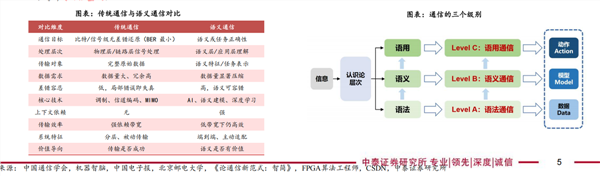
From a developmental necessity perspective, traditional communication technologies (1G to 5G) essentially follow a “bit transmission” paradigm, with the core task of losslessly transporting bitstreams from source to destination. The network acts as a mere “transporter” without understanding the meaning of the transmitted content. Moreover, the traditional “bit transmission” model based on Shannon's theorem is gradually revealing its limitations when faced with challenges such as high-frequency band resource scarcity, surging star-to-ground data transmission volumes, and the growing complexity of massive IoT scenarios. Relying solely on traditional methods like increasing bandwidth or boosting power is not only costly but also unsustainable.
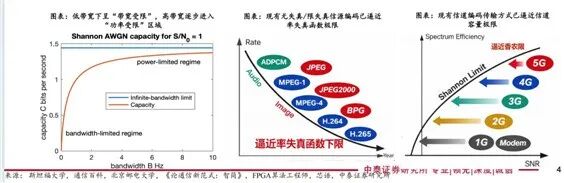
Against this backdrop, an emerging technology called “semantic communication” is transitioning from laboratory research to practical applications, poised to become a key force in breaking through the development bottleneck of 6G satellite internet.
The core of semantic communication lies in “transmitting meaning, not words.” Unlike traditional communication, which focuses on lossless bitstream transmission, semantic communication leverages AI technology to extract core semantic features of information at the transmitter, significantly compressing redundant data. At the receiver, it reconstructs consistent content by relying on shared knowledge bases and generative models. This approach achieves a fundamental shift from “symbol transportation” to “semantic understanding.” Research confirms that by introducing “semantic bases” as a metric unit, semantic communication can, under specific conditions, surpass the channel capacity limits of the classical Shannon formula, providing theoretical support for transmitting more effective information within limited bandwidth.
02. Autonomous Driving, Embodied Intelligence, and Satellite Communication: The Three Core Application Scenarios for Future 6G
However, even the most advanced technologies must find practical application scenarios to realize their value. If the core of the 5G era was “connecting people,” then the mission of the 6G era is to extend this connective power from human fingertips to every corner of the physical world. Among these, autonomous driving, embodied intelligence, and satellite communication are regarded as the three core application scenarios for future 6G, as they represent the ultimate pursuit of future society in terms of latency, perception, and coverage for mobile communication.
Autonomous driving is the ultimate testbed for “low latency and high reliability.” It is no longer satisfied with the isolated intelligence of individual vehicles but aspires to achieve “collective intelligence” among vehicles and between vehicles and roads through 6G networks. When vehicles need to react to sudden situations within one millisecond, only the theoretical latency limits of 6G can make such “remote control” more reliable than human intuition, thereby constructing a near-zero-accident transportation system.
Embodied intelligence is the ideal carrier for “integrated communication and sensing.” Future robots will no longer be mere mechanical devices executing fixed programs but intelligent entities capable of operating in homes and factories. They require 6G networks to endow them with perception capabilities surpassing human vision, transmitting “sixth sense” data such as touch and force in real-time to cloud-based brains, enabling seamless mapping between the physical and digital worlds, and granting robots truly “dexterous hands” and “thinking bodies.”
Satellite communication shoulders the ultimate dream of “global coverage.” Whether it's oceanographic expeditions, mountain rescues, or high-altitude flights, 6G's integrated space-ground networks will completely eliminate the digital divide. It is not just about providing signals in uninhabited areas but about constructing a “digital foundation” integrating air, space, land, and sea, enabling autonomous trucks to traverse uninhabited regions and embodied intelligent probes to land on the moon.
03. What Are the Core Competitive Strengths of the Industry?
Meanwhile, these exciting application scenarios also impose unprecedented demands on 6G networks: ultra-low latency, integrated communication and sensing, and global coverage. To realize these visions, breakthroughs in core technologies are essential, which is precisely where the industry's core competitive strengths lie—AI-native networks, integrated communication and sensing, and high-frequency band technologies will jointly form the solid foundation of 6G.
First, AI-native networks represent a paradigm shift in communication. Their core lies in natively and deeply integrating AI into wireless access network architectures, protocols, and business processes, transforming networks from passive, static, connection-centric data pipelines into active, dynamic, service-centric distributed “intelligent agent” clusters. This supports cutting-edge scenarios such as embodied intelligence and high-precision industrial internet control. Therefore, AI-native network architecture capabilities are a core anchor point and technological high ground for 6G standards. Whoever dominates the architectural definition, technical standards, and core ecosystem of AI-native networks may control the “operating system” and “app store” of future intelligent networks, thereby defining the rules of the global digital economy.
Second, integrated communication and sensing endow wireless signals with “super vision.” Traditional base stations only handle transmission, whereas 6G base stations will function like precise radars, leveraging the characteristics of high-frequency signals to achieve precise positioning, imaging, and pose recognition of surrounding environments and objects while communicating. This enables networks not only to connect the world but also to “understand” it, providing critical physical-layer data entry points for constructing digital twin cities and enabling all-weather autonomous driving.
Finally, the development and utilization of high-frequency band technologies (such as terahertz bands) provide 6G with unprecedented ultra-wideband spectrum resources. This is not only the foundation for achieving Tbps-level peak data rates but also the physical prerequisite for supporting high-precision sensing measurements in integrated communication and sensing, enabling instantaneous transmission of massive data and ultra-high-precision environmental reconstruction.
These three technologies mutually support each other: AI imbues networks with intelligence, integrated communication and sensing broaden cognition, and high-frequency bands provide bandwidth and precision, jointly constructing 6G into a powerful entity that connects intelligence, perceives the physical world, and transmits authenticity.
In terms of relevant companies, Zhongtai Securities points out: China Mobile Communications Corporation (CMC): Focuses on cutting-edge topics such as semantic communication, 6G technology evolution, and satellite internet construction, collaborating to develop a blueprint for mutual growth;
CICT Mobile: As a domestic full-stack core supplier and standard leader in the satellite internet field, the company covers the entire chain, including on-board payloads, ground systems, terminals, and standard formulation. It is expected to accelerate and drive the development of semantic communication in the future;
FiberHome Telecommunications Technologies Co., Ltd.: The company has successfully developed a highly integrated, low-power on-board routing and switching system for low-Earth orbit satellite platforms. Additionally, the first batch of on-board routing equipment developed by the company for a large-scale communication constellation has successfully formed an in-orbit network, positioning it to benefit from 6G construction and drive progress in semantic communication;
ZTE Corporation: As a global leading provider of comprehensive information and communication technology solutions, ZTE offers a complete range of end-to-end products and integrated solutions across the ICT industry. Through its full series of wireless, wired, computing, energy, and terminal product solutions, along with professional services, ZTE is poised to benefit from 6G development and drive the commercialization of semantic communication.
In conclusion, as 6G extends its reach from the ground to space and penetrates from the physical world into digital twins, what awaits us is not merely a leap in network speed but a new civilization form (translated as “form” or “paradigm”) where the physical world and digital consciousness deeply fuse.
Autonomous driving will reshape urban mobility, embodied intelligence will endow machines with touch and soul, and satellite communication will bridge the digital divide in every corner of the Earth. AI-native networks, integrated communication and sensing, and terahertz technologies are no longer cold terms; they will weave into a neural network that perceives with precision, transmits authenticity, and nurtures intelligence. In this unprecedented transformation, whoever holds the key to semantic interaction will dominate the operating system of the future intelligent world. What 6G initiates may be an era where everything can perceive, interconnect, and become intelligent.
- End -
-
![]()
Proposed to Raise 955 Million Yuan through Private Placement! Huicheng Vacuum Boosts Localization of Ultra-Precision Optical Coating Equipment
-
![]()
Cash Flow Soars 13-Fold! What Major Strategic Move is Wuhan Five Square Optoelectronics Planning?
-
![]()
Leaked Design of vivo X500: Reverts to Circular Camera Module in Top-Left Corner, Pays Homage to Classic X90 Aesthetic
-
![]()
DeepSeek Shows Signs of Foraying into Code Agents, Launches WeChat Official Account Focused on Harness
-
![]()
Auto Companies Deny Claims That ‘Cooperation with Huawei Is Non-Essential’, as Huawei Transforms into a ‘Public Platform’
-
![]()
Starship to Independently 'Return to the Launch Tower': SpaceX's Ambitions Extend Beyond Rocket Building to Dominating Space Transportation
-
![]()
Starship Set to Independently 'Return to the Launch Tower': SpaceX is Revolutionizing Space Transportation, Not Just Building Rockets
-
![]()
Anthropic and OpenAI Face Off Against Deepseek