WeChat Agent Delayed, Tencent Uses 'Lobster' as a Temporary Solution
 03/16 2026
 679
679

Directly Using 'Money Power'
Tencent can finally 'legitimately' raise 'lobsters.'
On March 15, Jen Zhu, the founder of OpenClaw, confirmed in a post on the social platform X that Tencent Cloud has become one of the official sponsors of the open-source AI project OpenClaw. The relevant information has been publicly displayed on OpenClaw's GitHub platform, with Tencent Light Cloud prominently featured in the sponsor list.
OpenClaw founder Peter Steinberger also reposted the announcement about Tencent becoming a sponsor, stating, 'love a good redemption arc.'
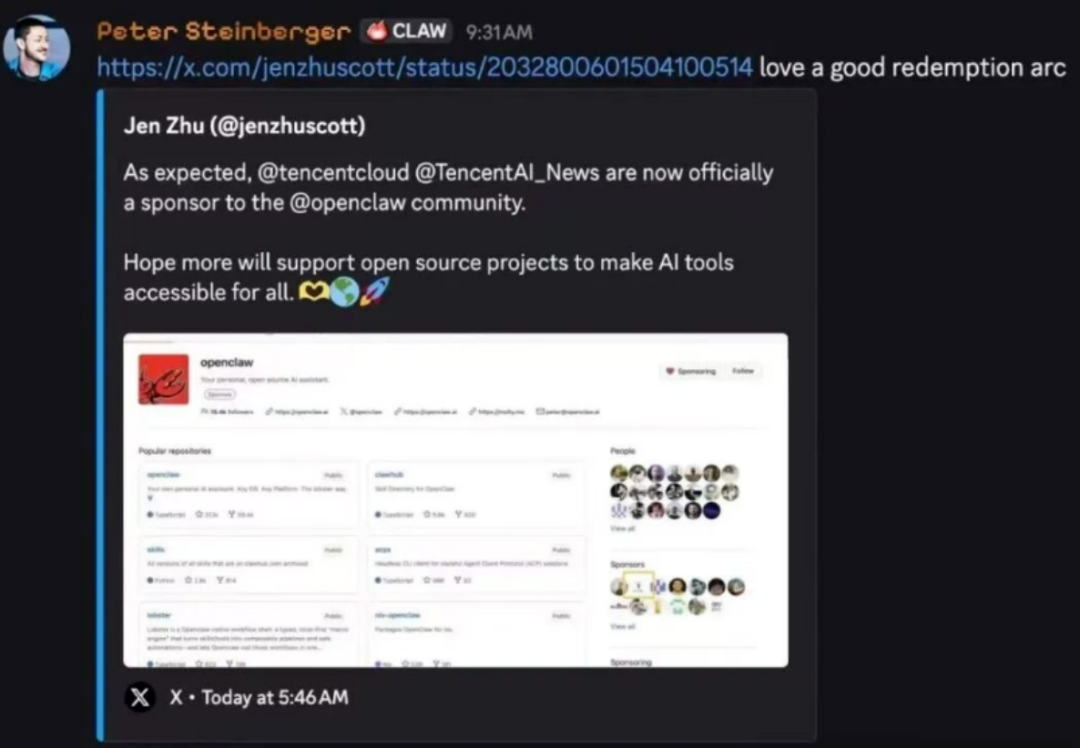
This official announcement marks a successful resolution to the earlier controversy between Tencent and OpenClaw and signals that both parties will collaborate to promote the widespread adoption of open-source AI technology. Additionally, Tencent's Agent strategy may advance further through this opportunity.
So, how did this crisis PR, which ended on a positive note, begin? Why has this open-source 'lobster' created such a stir among tech giants? What progress has been made on Tencent's social sector Agent?
01
Tencent Gets Burned Trying to 'Eat the Lobster'
Facing the same trendy open-source 'lobster,' Tencent was criticized for its unseemly behavior, while Baidu was welcomed with open arms. This was not merely a simple PR misunderstanding.
The incident traces back to March 11, when Tencent Cloud proudly announced the launch of a platform called SkillHub.
SkillHub was marketed by Tencent as an AI skill community tailored for Chinese users, packed with over 13,000 'lobster' skills. However, those familiar with the situation quickly noticed something suspicious in the small print at the bottom right corner of SkillHub's official website: 'Skill data sourced from ClawHub.'
News of this quickly spread across the ocean. Users directly messaged OpenClaw founder Peter Steinberger on social media, asking if he knew that Tencent had created a skill center that scraped all the skills from ClawHub.
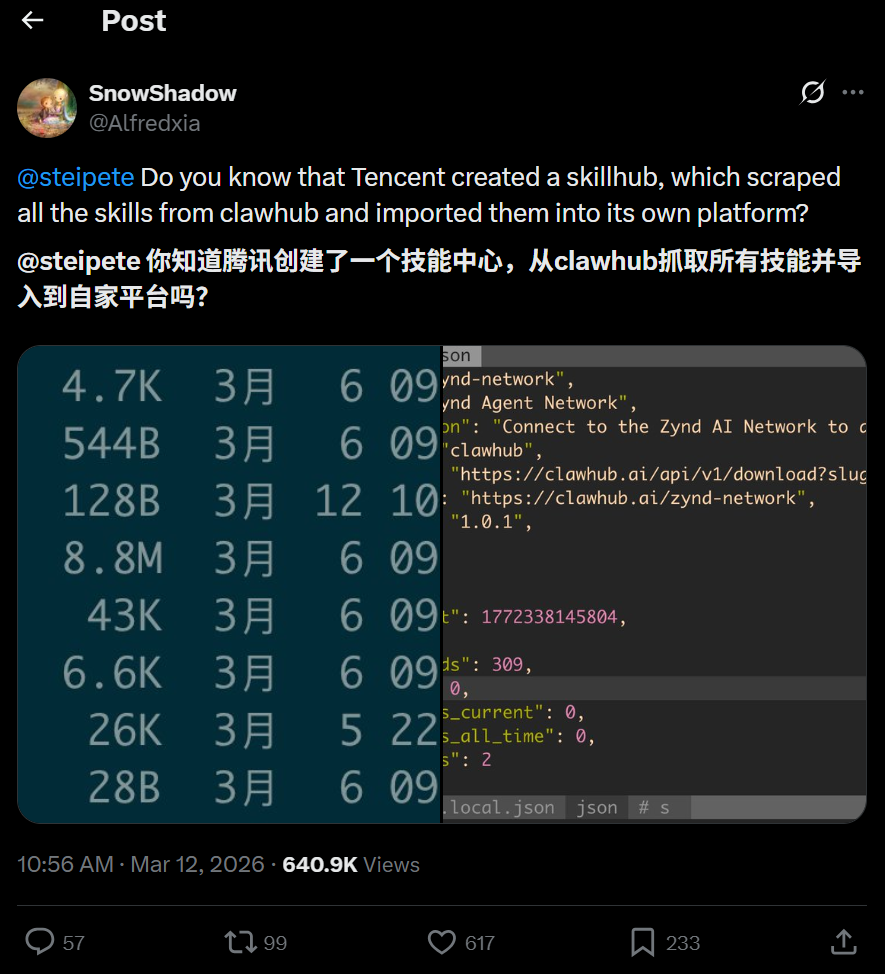
The founder's temper flared instantly. Not long before, he had received a baffling email complaining about his rate limits preventing them from scraping data quickly. Shortly after, he publicly called out Tencent on X, stating that he only learned about SkillHub's existence on the platform.
In addition, Peter Steinberger tagged Tencent Hunyuan, asking, 'Want to help instead of driving my server costs into five figures?'
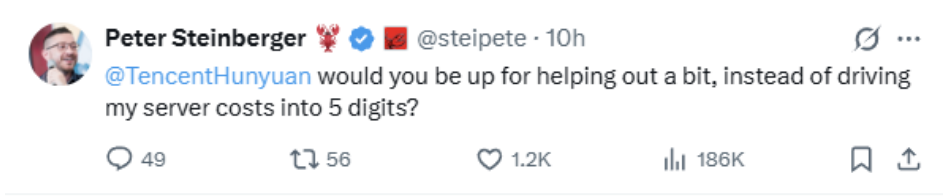
Faced with widespread criticism, Tencent AI's official team quickly responded with a defense rooted in 'engineer thinking.' Tencent claimed it was not 'maliciously scraping or copying' and that the platform's creation was solely to address access speed and availability issues for domestic users, with full source attribution.
To prove it wasn't overloading the other party's servers, Tencent released hard data: In its first week, SkillHub handled 180GB of download traffic and 870,000 requests for domestic users but only pulled about 1GB of data from the official source through technical means. The implication was clear: Not only did it not overload the source website, but it also offloaded massive Chinese traffic.
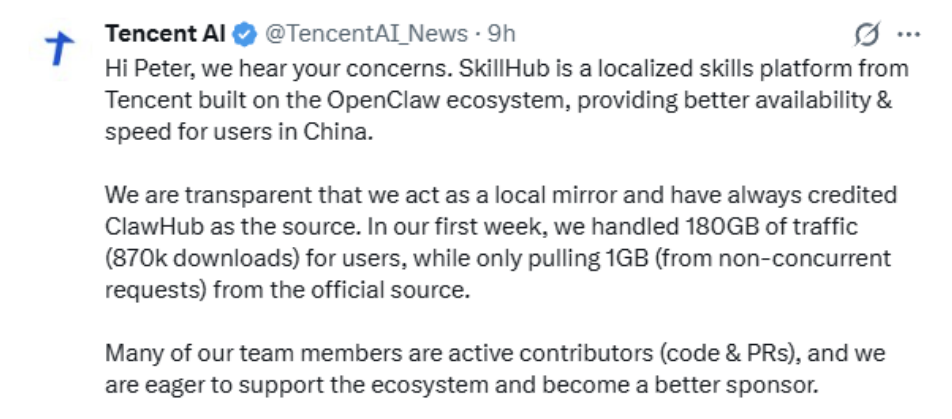
From a purely technical standpoint, Tencent's actions were not only justifiable but also commendable for its impressive CDN caching technology. Moreover, OpenClaw operates under the MIT open-source license.
In the coding world, the MIT license essentially means, 'Do whatever you want, just keep the copyright notice.' Legally, Tencent's approach was flawless. However, the business world doesn't operate solely on legalities, and the open-source community is a realm that highly values ethics and rules.
As a trillion-dollar tech giant, using someone else's hard work to enrich your ecosystem without so much as a heads-up—and then trying to prove you were 'helping divert traffic' when confronted—naturally sparked backlash among Chinese netizens. Some mocked Tencent for being petty, while others felt it embarrassed domestic companies.
In contrast, Baidu came out of this controversy looking like a winner.
While Peter Steinberger was lashing out at Tencent, his attitude toward Baidu did a complete 180. Baidu not only set up 'lobster markets' offline to help install OpenClaw but also publicly flaunted its relationship with the founder on X.
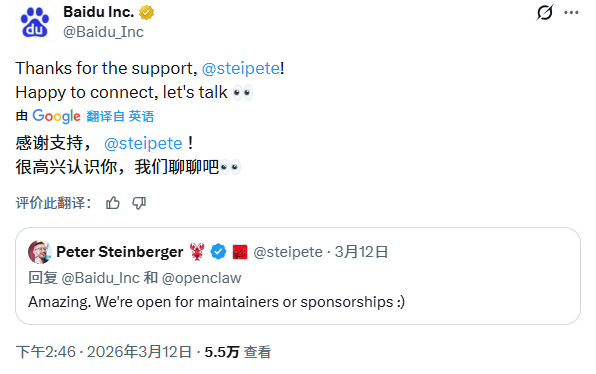
When mentioned, Baidu humbly expressed its desire to connect and explore potential collaboration for future development, even ironing out details in private messages. This approach earned the founder's enthusiastic embrace, who asked if Baidu could go beyond deployment and participate in development support. While Tencent was being excoriated, Baidu was treated like royalty. As industry commentators noted, there's no absolute right or wrong here, but there are clear distinctions.
Now, with substantial sponsorship funds arriving, this transnational (cross-border) farce triggered by the 'mirror site' has finally come to a dignified close.
However, Tencent's actions revealed a sense of urgency. A trillion-dollar giant, eager to corner the market on open-source skills and developers, risked alienating the community by 'rebranding' their work.
Behind this awkward maneuver lies Tencent's deep anxiety about securing an entry point in the AI Agent race.
It fears being left behind in the battle for the next super entry point. Tencent's hasty and defensive moves in external ecosystems reflect the immense pain it's experiencing in its internal core domains. This raises the question the entire tech circle has been waiting for: What's holding up the super Agent carrying the future of the Penguin Empire?
02
The Late 'Protagonist' and the Lessons It Must Learn
No matter how lively the 'lobster' scene gets externally, it can't hide the embarrassment of a delayed launch.
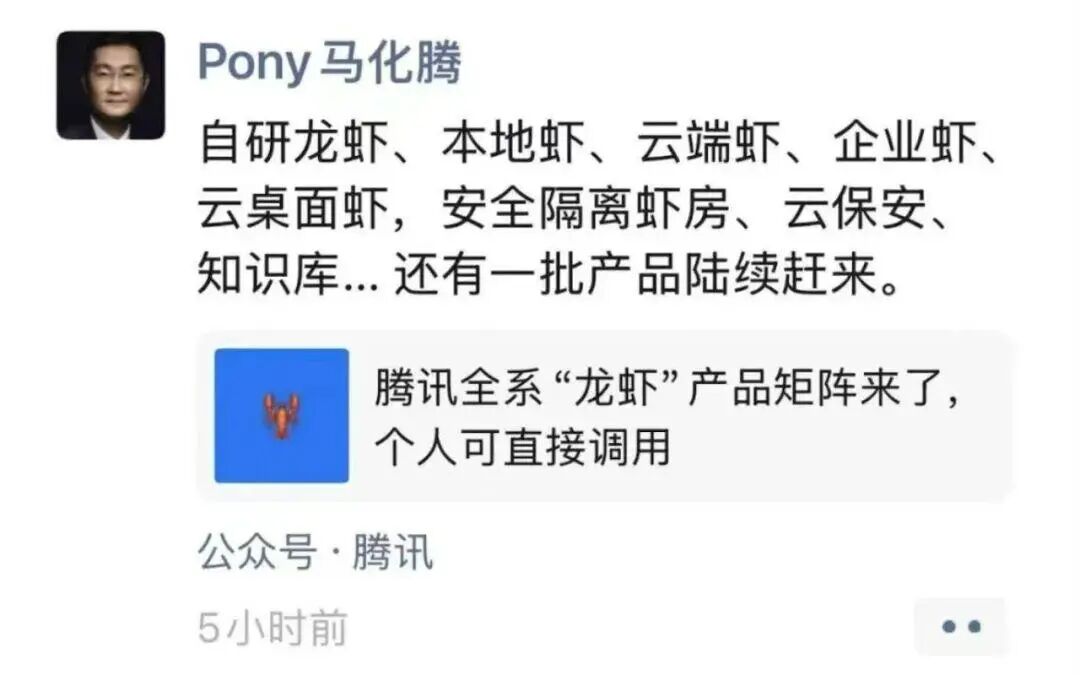
Over the past two weeks, the 'lobster-raising' craze sparked by OpenClaw has been in full swing. Even the usually reserved Pony Ma took to Moments to publicly express support, enthusiastically introducing Tencent's grand lobster-raising plans: 'Self-developed lobsters, local lobsters, cloud lobsters, enterprise lobsters, cloud desktop lobsters, secure isolated lobster rooms, cloud security guards, knowledge bases... and a batch of products on the way.'
Behind this high-profile display lies Tencent's grander ambition.
According to reports from The Information and APPSO, Tencent is secretly developing a new AI Agent for WeChat. This Agent will directly integrate millions of mini-programs within the WeChat ecosystem. Tasks like hailing rides, ordering food, buying groceries, booking tickets, and paying bills—currently requiring users to navigate step-by-step—could soon be delegated to the Agent.
If successful, it could theoretically serve WeChat's 1.4 billion monthly active users, becoming China's most widely covered AI Agent product. The project reportedly began in the first half of 2025 and is now a high-priority, top-secret initiative. Internal plans call for grayscale testing by mid-2026, with a gradual rollout starting in Q3.
However, while the blueprint is enticing, an awkward truth remains: The legendary 'WeChat Agent,' central to Tencent's AI strategy, has already been delayed.
If you've followed Tencent and capital market trends closely, you'll notice a telling detail.
In Q4 2024, Tencent's capital expenditures (Capex) surged, even surpassing Alibaba's at the time. Industry insiders revealed that Tencent went on a shopping spree, stockpiling large quantities of NVIDIA H20 GPUs.
This unusual move was widely interpreted as preparing computational power for the imminent launch of WeChat's super Agent—gathering resources before deployment.
However, the anticipated 'big move' never materialized. Instead, after 2025, Tencent's Capex spending fell short of market expectations. This 'early riser but late arrival' rhythm (pace) fueled speculation: Had WeChat Agent hit a major roadblock internally?
This guesswork persisted due to Tencent's silence and its AI initiatives' apparent slowdown. Recent developments, however, have shed light on the puzzle: Tencent isn't short on GPUs—it's short on the expertise to leverage them.
This has been Tencent's greatest pain point over the past year.
Compared to Alibaba's aggressive advancements with Tongyi Qianwen and ByteDance's remarkable progress with Doubao, Tencent's Hunyuan team has long resembled a 'patchwork' assembly.
According to The Information, the Hunyuan team wasn't a clearly defined independent entity but a loose alliance scattered across search, advertising, recommendation, and other business lines.
This led to a classic 'big company ailment': Some excelled in search optimization, others in ad recommendations, but none functioned like OpenAI's dedicated 'regular army' focused on foundational model research.
Moreover, resource competition among different model projects was fierce, with internal teams vying for computational power, talent, and scenarios. The result? Fragmented resources and diluted outcomes, making it hard to deliver impactful products.
This 'trial-and-error, piecemeal' approach scattered resources and diluted computational power. Consequently, when executives demanded a GPT-5-caliber foundational model to support WeChat Agent, they found themselves with many models but none truly 'battle-ready.'
The GPUs were stockpiled, but the models lagged. This is the core reason behind WeChat Agent's delayed debut.
Tencent clearly recognized the gravity of this issue. On December 17 last year, the company underwent a rare organizational overhaul.
It established new AI Infra, AI Data, and data computing platform departments to strengthen its large model R&D system and core capabilities. It also brought in Yao Shunyu, a 27-year-old 'genius scientist' and former OpenAI researcher, as Chief AI Scientist.
Industry insiders told Super Focus that this wasn't just a personnel appointment but a strong signal of 'course correction.'
Having a scientist born in 1998 report directly to Martin Lau and lead both AI Infra and large model departments is nearly unheard of in a company that values seniority. This shows Tencent's urgency and its resolve to shift from 'engineering fixes' to 'hardcore tech breakthroughs.'
But new questions arose: Can the young leader and the newly restructured team bridge the technical gap accumulated over the past two years in a short time?
After all, large model R&D isn't about hosting a dinner party—it requires time and accumulation. Whether Yao's OpenAI experience can take root in Tencent's complex environment and shoulder WeChat Agent's heavy burden remains a big question mark.
Nevertheless, Tencent still holds a trump card its rivals lack: its social ecosystem.
No matter how high Alibaba's model scores or how aggressively ByteDance promotes its apps, neither has a 'native environment' as frequent, sticky, and universally covered as WeChat.
This is why, even with WeChat Agent's 'difficult birth,' the market remains willing to wait.
The preheat (warm-up) for lobster-raising and WeChat Agent has begun, even if the main act hasn't arrived yet. The stage is set, marking Tencent's official entry into the 'Token Wars' alongside Alibaba and ByteDance.
For Tencent, this is a battle it cannot afford to lose. In 2026, with organizational structures streamlined and technical gaps closed, its stockpiled GPU network will finally operate at full throttle to claim territory.
- END -
-
![]()
Doubao Work Unveiled! Domestic AI Leaders Fully Commit to the 'Work' Sector
-
![]()
Who’s Sounding the Alarm on ‘Rushed Vehicles’?
-
![]()
Over 5.3 Billion Yuan in Losses Over Three and a Half Years! Can Yonyou Reverse Its Fortunes Through Streamlining and AI Transformation?
-
![]()
Baidu AI Adopts Free Model: A Strategic Maneuver in Traffic and Monetization
-
![]()
Silicon-Based OLED Pioneer Unveils Financial Results: H1 Shipments Outpace Entire 2025 Volume
-
![]()
AI's First "Lost Summer"
-
![]()
Zeiss Makes Another €2.2 Million Bet: Will Eye Tracking Be the Next Big Thing in the Smart Glasses Industry?
-
![]()
RUNTO Ranking | Global Top TV ODM Factories' Shipment Figures for July 2026