Former ByteDance Executive Raises Hundreds of Millions for Chip Venture
 03/30 2026
 673
673
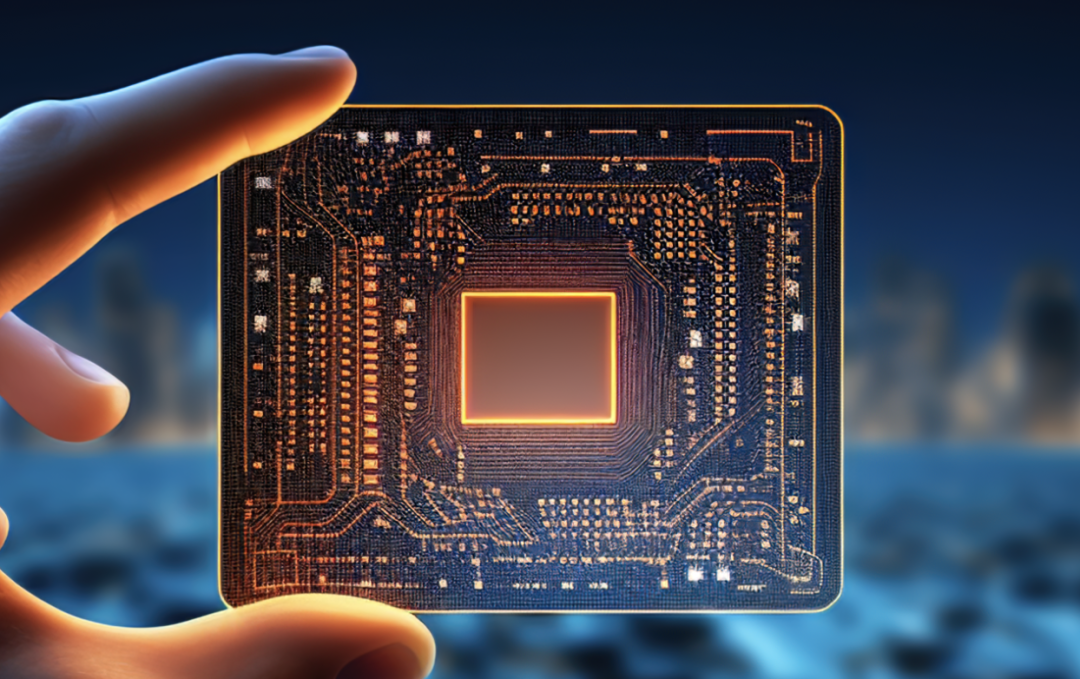
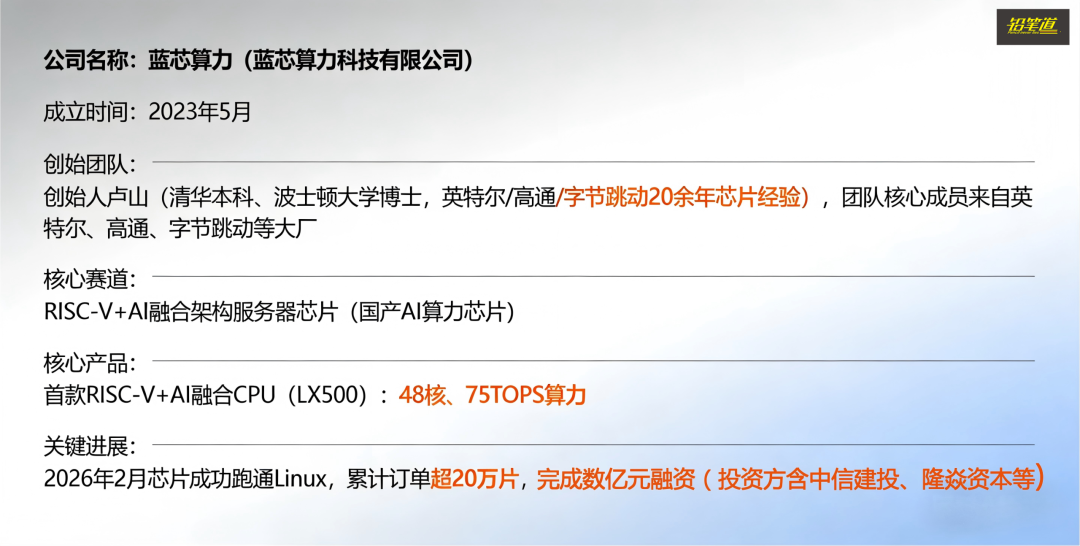
Lu Shan, a former executive at ByteDance, has established a chip company, Lanxin Computing, and has recently secured hundreds of millions in funding.
Lanxin Computing specializes in RISC-V (fifth-generation reduced instruction set computing) AI computing chips, which are particularly well-suited for large-scale model inference.
Lanxin Computing has already secured orders exceeding 200,000 units from companies such as Lenovo, China Mobile, and Tencent Cloud.
- 01 - From Humble Beginnings
This is another entrepreneurial tale featuring a Tsinghua University alumnus.
Lu Shan, the founder of Lanxin Computing, earned a bachelor's degree in automation from Tsinghua University and later obtained a Ph.D. in electrical and computer engineering from Boston University in the United States.
He spent over two decades working on high-performance CPU and SoC (system-on-chip) design at leading international chip companies such as Intel and Qualcomm.
In 2019, Lu joined ByteDance's chip team at its San Diego office, focusing on RISC-V architecture and server chip development.
The challenges in China's computing industry are clear: high-end server chip architectures are nearly entirely controlled by ARM and x86, both of which require licensing fees for each chip. In Lu's view, the open-source, royalty-free, and extensible RISC-V architecture offers a realistic way to break this existing structure.
RISC-V involves no licensing fees, and its architecture can be freely used, enabling companies to tailor it to their specific needs. Different instruction set combinations can be designed for various application scenarios, reducing reliance on external architectures and enhancing autonomy for China's chip industry.
At the time, the industry generally doubted that RISC-V could support high-performance AI servers. The reasons were straightforward: RISC-V had mainly been used in low-power scenarios, such as IoT devices, with limited performance potential. Additionally, the software ecosystem was underdeveloped, with gaps in toolchains and application support.
In May 2023, Lu resigned to start Lanxin Computing, determined to pursue the integration of RISC-V and AI.
Building on the RISC-V open-source instruction set, Lanxin Computing developed a new chip architecture that combines general-purpose computing CPUs with dedicated AI computing units. This allows a single chip to handle different tasks simultaneously, filling the gap in mid-to-high-end computing power.
Its breakthroughs are primarily in two areas.
First, performance and energy efficiency. The team deeply optimized the instruction set, achieving approximately a 30% performance improvement under the same power consumption. This enables the chip to support more demanding tasks, such as large-scale model training.
Second, "customization on demand." The chips are not one-size-fits-all but are designed modularly. Different versions can be tailored for various clients. For example, Lanxin Computing collaborated with Gaowei Technology to develop CPUs for banks, focusing on low latency and security to meet domestic substitution requirements.
Commercialization has also advanced rapidly.
By May 2025, the multi-core SoC had successfully operated in a simulation environment, with plans for tape-out within the year. By 2026, orders corresponding to the production target had surpassed 200,000 units. Clients included fintech company Gaowei Technology, cloud provider Tencent Cloud, and operator China Mobile.
If progress continues smoothly, centralized procurement may begin in 2027. In a market long dominated by x86 and ARM, the company is attempting to carve out a differentiated path.
- 02 - Booming Demand for Computing Power
Lanxin Computing's ability to secure multiple rounds of funding within a year and its commitment to the RISC-V+AI track stem from its alignment with several critical industry trends.
1. Booming Demand for AI Computing Power, Widening Gap
Whether it's individuals using AI chatbots or enterprises deploying large-scale models, everything relies on "computing power," which is as essential as electricity.
According to IDC and Inspur Information, domestic AI computing demand grew by 74% in 2024 compared to the previous year, more than three times the growth rate of general computing power. By 2026, computing demand is expected to double, with the market size reaching $33.7 billion.
Most notably, in February 2026, domestic AI model usage per week surpassed that of the U.S. for the first time, exceeding 5 trillion instances. Among this, "inference computing power" for processing AI requests accounted for over 70%.
Traditional chip solutions are too expensive and slow to keep up with such massive demand. The market urgently needs more efficient and cost-effective computing chips—exactly what Lanxin Computing aims to provide.
2. Domestic Substitution is Essential
For a long time, server chips have been dominated by x86 and ARM architectures. A significant portion of high-end chips in domestic data centers relies on imports.
RISC-V offers an alternative path. As an open-source instruction set, it requires no hefty licensing fees. Companies can independently develop based on it and control core technologies.
Its growth has been rapid. From inception to shipping 10 billion chips, RISC-V took only 10 years—about 11 years faster than ARM and 20 years faster than x86.
By 2024, global RISC-V chip shipments reached tens of billions, with over half coming from Chinese vendors. Application scenarios are also expanding, entering high-end fields like servers and intelligent computing centers.
Policy is also driving this shift. In 2026, autonomous computing power and intelligent computing clusters were included as key directions in new infrastructure initiatives. RISC-V is gradually becoming a more certain technological route for domestic substitution.
- 03 - Breakthrough for Domestic Computing Chips
Today's computing power competition is no longer just about chip specifications.
More critical are architecture, ecosystem, and full-stack industrial chain capabilities.
In the server chip space, ARM remains the mainstream choice. Its strength lies not in single-point performance but in ecosystem maturity. Most servers and cloud platforms can use it directly without extensive adaptation.
Market data reinforces this. In Q2 2025, ARM's global server chip market share reached 25%, up 8 percentage points from the previous year.
ARM's barrier is not just technical but an entire established ecosystem.
However, ARM is too expensive.
Full architecture licensing fees can reach tens of millions of dollars, posing a significant long-term burden. More critically, control is limited. With core technologies held by overseas companies, domestic firms struggle to make deep modifications and customizations, restricting many capabilities.
The domestic computing power camp is no longer just about making a single chip but extending across the entire chain: from design and manufacturing to software adaptation and final deployment, forming a complete system.
Specific products are emerging: Lanxin Computing's LX series, Alibaba's XuanTie chips, Sophgo's specialized chips, and Huawei's Ascend are all representatives of this camp.
The domestic camp's focus is not just on chips but on ecosystems.
Lanxin Computing collaborates with Lenovo to launch RISC-V-compatible complete machine devices; Sophgo Technology deeply integrates with Alibaba Cloud to enable faster chip access to cloud platforms; Huawei's Ascend series spans from chips to servers and applications, directly deploying across industries.
Manufacturing capabilities are also catching up. Foundries like SMIC provide stable production, ensuring continuous chip mass production without complete reliance on overseas foundries.
Compared to ARM, domestic solutions offer three advantages: greater controllability, lower costs, and flexible customization.
Different companies are finding their niches. Lanxin targets critical industries like banking and power; Sophgo focuses on industrial scenarios; Huawei's Ascend targets high-end computing power.
Some SMEs and data centers have already started shifting to domestic solutions, driven by lower costs and enhanced security controllability.
This article does not constitute any investment advice.
-
![]()
The Allure of 'Acquisition Spree': Li Shufu's Left Turn, Xu Jiayin's Right
-
![]()
Strategic Transformation Yields Results: Phoenix Optics Reports 10.9% YoY Rise in Core Net Profit for H1 2026
-
![]()
Three Key Growth Trajectories Synergize! Crystal-Optech Reports 3.478 Billion Yuan in Revenue for H1 2026
-
![]()
Semi-Annual Report Sparks XPENG Motors Buzz
-
![]()
1.6 Billion Big Order Secured! SeeYA Technology's Revenue Soars by 287.87% in the First Half of the Year
-
![]()
Baidu's Profits Plunge by 68%: Unraveling the Mystery Behind the Numbers
-
![]()
Baidu’s Profits Tumble by 68%! Where Has All the Money Gone?
-
![]()
Hynix’s Taobao Store Shuts Down Abruptly: What Should Customers Do About Warranty Services for Memory Modules?