13 Times Breaking World Records! How Does Qingdao's 'Unmanned Terminal' Lead the Global Port Autonomous Driving Revolution?
 03/30 2026
 752
752
Introduction
While traditional terminals still rely on 'manpower-intensive tactics' to sustain operations, the fully automated container terminal on the south bank of Qingdao's Qianwan Port Area has already achieved the miracle of 'efficient operation without a single person in sight.'
As China's first fully independent automated terminal, it has demonstrated its technological prowess to the world with 13 hardcore achievements in breaking world records for loading and unloading efficiency.
Behind the leap from 'manual terminal' to 'smart mega-port' lies a profound transformation involving technology, efficiency, and the future.
Let's discuss this with 'Unmanned Vehicle Is Coming' (WeChat Official Account: Unmanned Vehicle Is Coming)!
(For further reading, please click: 'Port Autonomous Driving: The 'Breakthrough Code' and 'Overseas Adventure Guide' for a Trillion-Dollar Market')
I. From 'Manpower-Intensive Tactics' to the 'Unmanned Realm': Qingdao Port's Self-Transformation
There was a time when ports were noisy and rugged: towering cranes, bustling crowds, roaring trucks, and workers navigating through steel giants, completing each loading and unloading operation with experience and courage.
While this model exuded a sense of power, it was also constrained by human limits, safety hazards, and efficiency bottlenecks.
The birth of Qingdao Port's fully automated container terminal completely overturned this traditional scene.
This 'unmanned terminal' boasts an impressive hardware lineup: a 2,088-meter shoreline, a water depth of -20 meters at the terminal front, and 6 berths capable of accommodating the world's largest 200,000-ton container ships with ease.
However, the real awe comes from its 'soft power'—
Here, there is no dense (intensive) manual operation; instead, 18 automated quay cranes, 83 automated guided vehicles (AGVs), and 94 high-speed rail-mounted gantry cranes work tirelessly 24/7 under the command of the 'super brain,' collaborating seamlessly.
The disruptive changes are reflected in every number: overall operational efficiency has increased by 30% compared to traditional terminals, and more amazing (astonishingly), human resources have been reduced by 80%.
This means that complex operational processes that once required the coordination of hundreds of people are now precisely scheduled by intelligent systems, with human engineers stepping back to monitor, optimize, and provide decision support.
The average single-crane operational efficiency has reached 62.62 natural boxes per hour. Behind this figure lies precise calculations and seamless coordination happening every second, representing 'Made in China's Intelligence' continuously pushing the limits of global port efficiency.
Breaking world records 13 times is no accident but the inevitable result of a systematic self-revolution.
II. The 'Super Brain' and 'Agile Limbs': Decoding the Technological Secrets Behind Efficiency Records
How has Qingdao Port's 'unmanned realm' managed to top the world 13 times? The answer lies in a set of fully self-developed 'neural networks' and 'motion systems.'
Core 'Brain': A-TOS and A-ECS Systems
The terminal's 'central nervous system' consists of the self-developed A-TOS (Terminal Intelligent Operation and Control System) and A-ECS (Equipment Intelligent Control System).
A-TOS acts as a super dispatcher, not only receiving vessel forecasts and container information but also processing thousands of variables in real-time—from vessel berthing plans and container slot allocations to AGV path planning and yard operation sequences.
Since 2025, the terminal has further focused on the synergy between the dual systems and integrated artificial intelligence large models to upgrade algorithms and computing power, making this 'brain' even smarter and more agile.
Efficiency ' artifact ' (Wonder Tool): Vacuum-Type Automatic Mooring System
If the intelligent system is the brain, then the vacuum-type automatic mooring system is the 'magical tentacle' that allows the terminal to 'grasp' giant vessels.
Traditional mooring with ropes requires manual operation by workers, taking 20-30 minutes and being highly susceptible to wind and wave impacts, posing significant risks.
In contrast, the technology adopted by Qingdao Port uses vacuum adsorption principles to secure multi-ton vessels firmly at the berth within 30 seconds, akin to applying 'Velcro' to the ship.
This breakthrough not only drastically reduces non-operational time but also gains a precious 'head start' advantage for the efficient operation of all subsequent processes.
Intelligent 'Limbs': Autonomous AGVs and Efficient Equipment
The 83 automated guided vehicles (AGVs) serve as the 'main force' for horizontal transportation at the terminal.
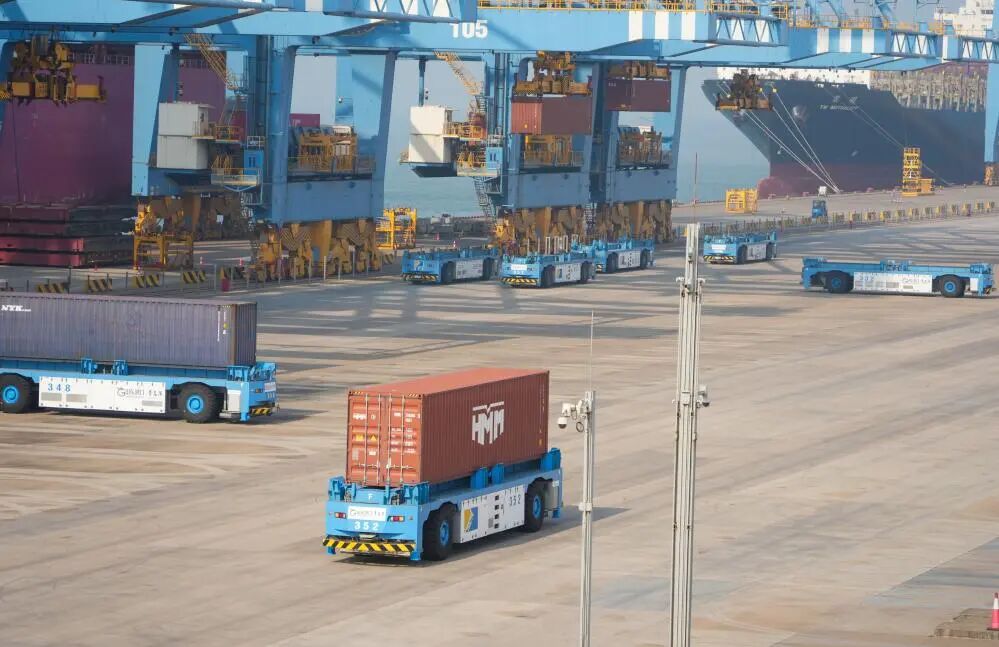
No longer the early-stage AGVs that required buried magnetic nails for navigation, these are intelligent mobile robots equipped with LiDAR, visual sensors, and BeiDou high-precision positioning.
Under the command of the A-ECS system, they can autonomously plan paths, avoid obstacles, and precisely dock, transporting containers from the quay cranes to designated yard locations without any human intervention.
They form a highly coordinated 'robot army' with 18 automated quay cranes (responsible for ship-to-shore loading and unloading) and 94 high-speed rail-mounted gantry cranes (responsible for yard loading and unloading).
The collaboration precision of this army reaches the centimeter level, ensuring the high-speed, accurate, and collision-free flow of containers within the complex logistics network.
III. Port Autonomous Driving: Evolution from 'Automatic Guidance' to 'Omni-Domain Intelligence'
Qingdao Port's 83 AGVs offer an excellent window into the evolution of port autonomous driving technology. Port autonomous driving is undergoing a profound transformation from 'single-point automation' to 'omni-domain intelligence.'
1.0 Era: Fixed-Path AGVs
In the early days of automated terminals, such as the EUROMAX terminal at the Port of Rotterdam in the Netherlands, AGVs mostly relied on magnetic nails or wires buried beneath the road surface for tracking navigation, with fixed paths, poor flexibility, and high infrastructure modification and maintenance costs.
2.0 Era: Natural Navigation AGVs (Qingdao Port's Current Stage)
New-generation automated terminals like Qingdao Port have adopted natural navigation technologies based on LiDAR SLAM (Simultaneous Localization and Mapping), visual recognition, and BeiDou/GPS fusion positioning.
AGVs no longer rely on fixed tracks; they can perceive the environment in real-time, autonomously plan optimal paths, and have greatly enhanced flexibility and adaptability. This is equivalent to upgrading from a 'tram' to a 'self-driving car.'
3.0 Era: Vehicle-Road Coordination and Mixed Traffic Intelligence
The future is already here.
Some leading ports are testing more advanced models: for example, combining autonomous driving container trucks (not limited to AGVs within the terminal) with the terminal's intelligent road system to achieve 'vehicle-road-cloud' integrated coordination.
Through 5G and V2X (Vehicle-to-Everything) technologies, vehicles can proactively perceive intersection conditions, receive scheduling instructions, and safely and efficiently coexist with manned vehicles within the terminal area.
This breaks down the physical boundaries between automated and traditional terminals, allowing autonomous driving technology to extend to a broader terminal logistics chain.
4.0 Era: Omni-Domain Intelligence and Autonomous Decision-Making
The ultimate vision is to build a 'virtual port.'
All equipment (quay cranes, AGVs, rail-mounted gantry cranes, autonomous container trucks), vessels, and containers exist as digital twins in the cloud system.
Artificial intelligence large models not only schedule equipment but also predict global shipping network fluctuations, optimize the entire port's throughput strategies, and automatically perform preventive maintenance on equipment.
Autonomous driving transportation tools will become self-circulating 'blood cells' within this vast intelligent organism.
Qingdao Port's practice is at a critical juncture of advancing from the 2.0 to the 3.0 era.
Its self-developed systems and continuously breaking efficiency records prove that China has transitioned from 'following' to 'keeping pace' and even 'leading' in the high-end field of port autonomous driving.
IV. Sailing Toward Maritime Strength: How Smart Ports Empower New Quality Productive Forces and a Maritime Power
The glorious achievements of Qingdao Port's 'unmanned terminal' hold significance far beyond breaking a few world records. It serves as a vivid testament to China's cultivation of new quality productive forces and the construction of a maritime power, releasing tremendous energy across multiple dimensions.
1. Empowering Global Trade 'Acceleration'
Ports are the lifeblood of globalized trade.
A 30% increase in efficiency means significantly shorter vessel stay (dwell) times at ports and notably reduced logistics costs.
For 'Made in China,' this translates to faster access to global markets and improved supply chain resilience.
Qingdao Port's efficient operation acts as a 'turbocharger' for the foreign trade engines of the Beijing-Tianjin-Hebei region, the Yellow River Basin, and even the entire northern hinterland.
2. Driving Industrial Chain Upgrades with a 'New Engine'
The construction of automated terminals has spurred the development of an entire frontier industrial chain, including high-end equipment manufacturing, artificial intelligence, the Internet of Things, and big data.
Behind those precise quay cranes, intelligent AGVs, and powerful systems lie the relentless efforts of countless Chinese tech companies.
This terminal itself serves as a massive 'innovation incubator' and 'industrial demonstration site.'
3. Reshaping Port Operation 'New Models'
Reducing human resources by 80% does not simply replace workers; it liberates human labor from dangerous and repetitive physical tasks, redirecting it toward higher-value positions such as technical maintenance, system optimization, and data analysis.
This drives the upgrading of the port workforce structure, attracting more highly skilled talent to the industry.
Meanwhile, 'unmanning' brings about a leap in intrinsic safety levels, completely eliminating the risks of human-machine cross-operations in traditional terminals.
4. Contributing 'Chinese Solutions' and 'Chinese Standards'
As a fully domestically produced and independently developed automated terminal, Qingdao Port's success breaks foreign technological monopolies and forms a complete set of independent intellectual property rights.
Its technical standards and operational models are becoming replicable and exportable 'Chinese solutions,' providing new options for port upgrades along the 'Belt and Road' and global smart port construction, enhancing China's voice in the global shipping and port sector.
In conclusion, 'Unmanned Vehicle Is Coming' (WeChat Official Account: Unmanned Vehicle Is Coming) believes:
Sailing toward the sea and thriving through intelligence.
Qingdao Port's fully automated container terminal, this 'unmanned realm' that continuously refresh (breaks) its own and the world's records, is not only a milestone in China's journey from a port power to a port giant but also a window into observing the future of industry.
What do you think, dear readers?
References: Xinhua News Agency report 'See How This 'Unmanned Terminal' Breaks World Records 13 Times' by Journalists: Lu Jinbo, Xu Suhui, Li Ziheng
#UnmannedVehicleIsComing #AutonomousDriving #SelfDriving #UnmannedVehicles
-
![]()
Net Profit Surges 13.65% Year-on-Year! Yutong Optics Reports RMB 1.782 Billion in H1 Revenue
-
![]()
Q2 Net Profit Slashes Losses by 80%! Has Costar Emerged from Its Darkest Hour?
-
AI Agents: The Paradigm Shift from 'Conversation' to 'Execution'
-
NVIDIA Takes Bold Strides to Lead in Both Hardware and Software Realms
-
![]()
It's Hard to Build Cars, Even Harder to Build Humans, and XPENG is Doing Both
-
![]()
Valuation Soars by $57 Billion: Three Entrepreneurs Born in the 1980s Forge an AI Unicorn Now Suddenly on the Market
-
![]()
How Can We Achieve the Goal of 100,000 Hydrogen Vehicles by 2030?
-
![]()
July Online Market for Consumer-Grade Sports Cameras: Robust Double-Digit Growth in Sales Volume and Value, Mid-Range Products Fuel Market Expansion