For AI Firms, Failing to Provide Tokens to Employees Would Be a Faux Pas
 03/30 2026
 704
704

Token incentives serve a dual purpose: they act as both a reward and a motivator.
By She Zongming
Suddenly, much like the shrimp craze, thousands of claw machines are dispensing tokens.
Without a doubt, "Token" has become the hottest tech buzzword in the AI community these days.
A few years ago, if you constantly talked about tokens, people might have given you strange looks after the initial confusion and muttered under their breath, "crypto scammer."
But today, if you claim ignorance of what a token is, many might size you up as if you were a relic from ancient times, saying, "Are you pretending you've never heard of the Han Dynasty, let alone the Wei and Jin periods?"
Not knowing about tokens today is akin to being unaware of the metaverse or Web3.0 five years ago, or not understanding alignment granularity, empowerment, closed loops, and leverage points ten years ago—it marks you as someone who is "just now getting online."
Remember: computing power is power, and tokens are the currency.
Token quotas are emerging as the "new stock options" for this generation of internet professionals.
01 /
The notion of tokens becoming the "new stock option" isn't just idle speculation on my part—it's a sentiment echoed by Huang Renxun, the "Yellow Sage in a Leather Jacket," AI pioneer, and chief advocate of "Token Economics."
At NVIDIA’s GTC 2026 conference, Huang predicted that tokens would soon become a pivotal negotiation chip in Silicon Valley recruitment, much like stock options were in the past.
Huang might have drawn inspiration from Tomasz Tunguz, a renowned Bay Area venture capitalist.
As you know, tech companies traditionally lured talent with the "old three": salary, bonuses, and stock options. Their compensation systems were long built around the framework of "base salary + performance bonuses + equity options."
However, in February of this year, Tomasz Tunguz noted that tech startups had begun incorporating inference computing costs into engineers' compensation packages, making it the "fourth pillar" of salary.
Surely, with a name starting with 'T,' the next step might be to advocate for including paid use of platforms like TikTok, Tinder, Twitch, and Taobao as company benefits?
And a report in The New York Times this past weekend confirmed his assertion—issuing token quotas to employees is gradually becoming an industry norm.
The report highlighted an Ericsson engineer who revealed that his token costs on Claude had already surpassed his salary, with the company covering the expenses.
Companies like OpenAI, Anthropic, Google, Meta, and Microsoft are generous with token allocations for their employees.
Domestic tech companies are no exception. On March 17, Alibaba launched an internal program to provide employees with token quotas, offering free use of tools like Wukong and Qoder and reimbursing expenses for external AI development tools. Around the same time, Tencent was reported to provide employees with token quotas worth up to 220,000 yuan annually.
UCloud distributed free tokens to employees, while Kunlun Wanwei offered a monthly 100-dollar token subsidy—all aimed at supporting employees in their endeavors.
It seems that not providing employees with tokens would be embarrassing for an AI company.
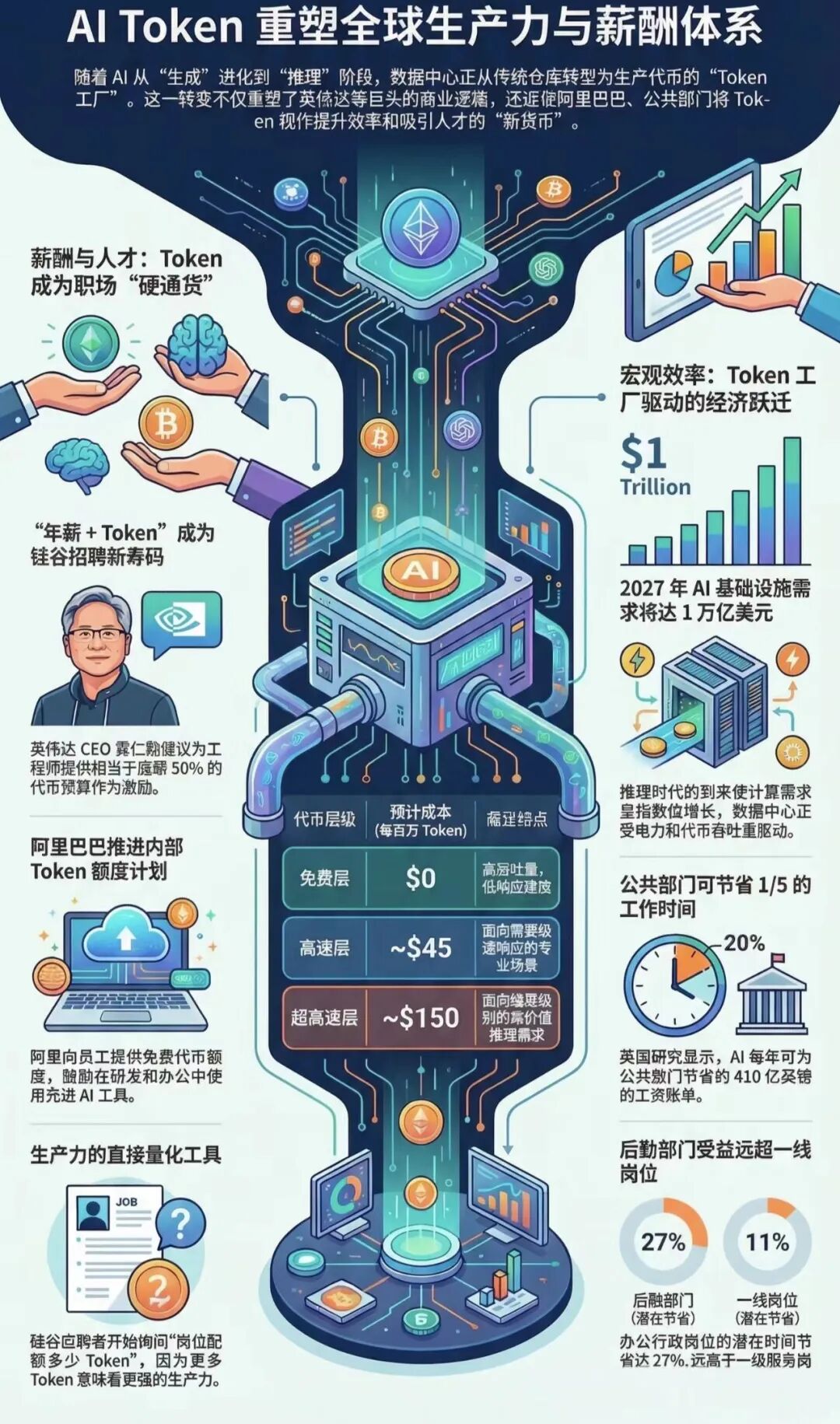
▲ Tokens are reshaping the salary structures of many companies.
If meal allowances, afternoon tea, and ride reimbursements represent the "Old Money" style of the internet era, then the way AI newcomers provide employee benefits seems to revolve around tokens.
Following this trend, I can envision the scene: In September 2028, outside the Yunqi Conference venue, many aunts from Xiaoshan, Hangzhou, stand at the entrance holding signs—'Looking for a son-in-law, no car or house required, just a lengthy token consumption bill.'
02 /
Token incentives may sound appealing, but it won't be long before Huang Renxun, who compared tokens to stock options, is labeled a "modern-day Huang Shiren."
Why? Let me explain with an analogy—
The boss says to employees, "I'll give each of you a car, with fuel costs reimbursed monthly."
The employees cheer.
Then the boss adds, "But you must use it to haul goods for the company every day."
Now, many fall silent.
Granting stock options and issuing tokens both involve resource allocation, aiming to retain key talent, boost employee output, and benefit the company. However, one is a long-term value equity distribution, while the other is a core production resource allocation—there's a difference.
Long-term value equity distribution corresponds to sharing company ownership, aiming to bind employees to the company's growth long-term. Even if employees leave, vested options remain.
Core production resource allocation corresponds to providing resource usage rights, focusing on empowering employees to work more efficiently. Overall, it's like a "computing power voucher"—it expires, can't be accumulated, and forget about transferring, selling, or cashing it out.
That's why tech media outlet TechCrunch poured cold water on the "token benefits" narrative with an article titled "AI Tokens: A New Signing Bonus or Just a Shift in Operating Costs?"
The article cited Jamaal Glenn, a former venture capitalist and now CFO of a company, who said, "Your token budget won't appreciate, won't count in your next salary negotiation, and won't be factored in if you switch jobs."
This makes sense: if a company cuts your base salary and stock options under "budget adjustments," you can pull out the Contract Law. But if they reduce your token quota, the law can only shrug.
Simply put, token incentives have a dual nature: they are both a reward and a motivator.
They're a reward because providing employees with unrestricted AI resource access lets them work more efficiently and achieves value recognition through contribution verification.
This way, algorithm debugging, model training, APP calls, and agent development won't suffer from "insufficient computing power, difficult work."
That's why Thibault Sottiaux, head of OpenAI Codex engineering, revealed that more job seekers now ask not just about salary during interviews but also about "how much inference computing resources they'll get." Many small and mid-sized AI startups, both domestically and abroad, use "token allocations" in job postings to signal their eagerness to hire talent.
They're a motivator because, as Huang Renxun said on the All-In podcast, "If an engineer earning 500,000 dollars a year tells me at year-end they only used 5,000 dollars in tokens, I'll be furious."
No "pure benefit" comes with KPIs requiring employees to "fully enjoy" it—if it does... then there's a "trap" behind the benefit.
Programmers on Zhihu see it clearly: "Give you a cyber apprentice, and the day it learns is the day you're out." Online jokers aren't subtle either: "Every token you burn speeds up your colleague's exit."
The rhetoric is extreme, but with some employees immune to the carrot, token incentives' "reward + motivator" nature is inevitably viewed dialectically.
03 /
On one hand, contemporary tech companies are offering employees a very novel kind of "salary"—tokens. On the other hand, tokens could become the noose for a hanging or the needle for a self-inflicted wound.
This naturally leaves workers "suffering in a sea of love and hate," lamenting, "in this world, it's hard to escape fate."
In my view, with high costs for leasing computing power, calling large models, and using professional AI tools, and with token quotas directly determining employees’ work permissions, R&D space, and output efficiency—and with algorithm fine-tuning, data cleaning, model optimization, and prompt engineering results hard to measure with traditional KPIs or project progress, while token incentives allow contribution tracking and quantification via internal digital systems—it's entirely understandable for companies to issue tokens to employees.
Let's face it: with computing power in short supply and costs sky-high, how many employees could afford unrestricted token use? Using coarse-grained, unfair traditional assessment and incentive mechanisms to grade AI engineers would likely meet with resistance.
But when issuing tokens, tech companies should avoid two mistakes from the "wrong answer collection."
First, "token-based salaries."
Although tokens are called the "fourth pillar" of compensation, it wouldn't be reasonable for companies to actually include them in employee salaries or even reduce normal salaries accordingly.
Remember: employees use tokens to boost work efficiency—and thus the company's efficiency. From this perspective, tokens are like office supplies such as computers and software—production costs, not salary components.
You can't whip a mule to run while counting the whip's cost as part of the mule's compensation, can you?
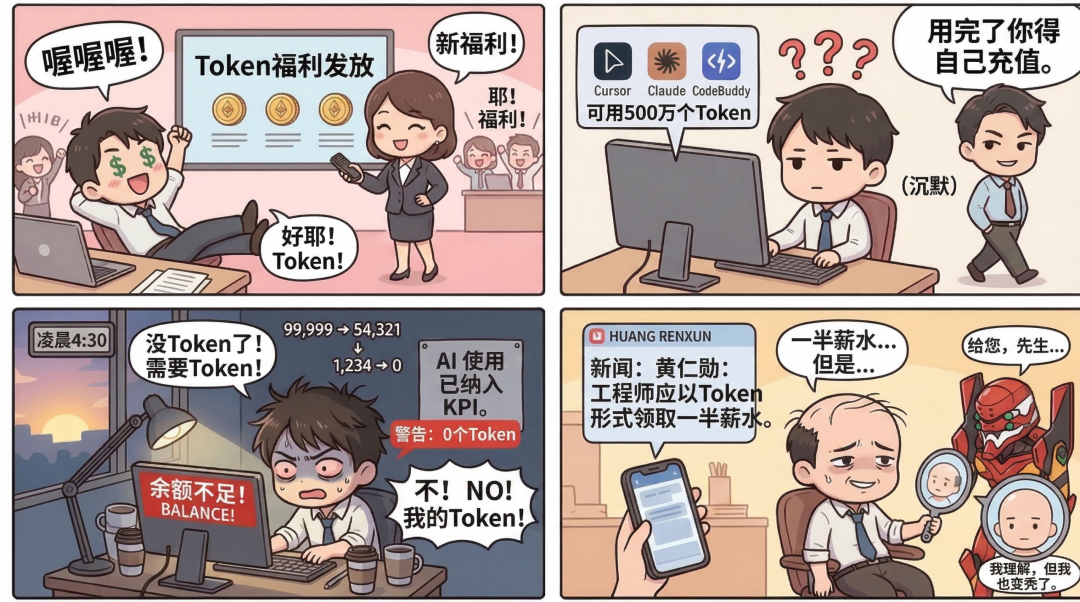
▲ This cartoon satirizes companies' "token-based salary" approach.
Second, "token-burning tournaments."
The New York Times report mentioned internal leaderboards at Meta, OpenAI, and other companies, where engineers compete based on token consumption, with real-time tracking of each employee's AI usage. Both Meta and Shopify use token usage as a key metric for employee performance.
Software engineer Gergely Orosz bluntly stated that in large tech companies, "not using AI at breakneck speed is becoming a career risk, regardless of output quality."
Assuming "more computing power consumed = higher productivity" and expecting "big tokens to create miracles" isn't entirely unreasonable.
But productivity depends more on contextual understanding and problem-framing abilities and may not scale linearly with increased computing power.
The emergence of the "tokenmaxxing" phenomenon reveals many issues: if you base employee performance evaluations on how many tokens they burn, employees may inflate token consumption data unnecessarily to meet KPIs and retain quotas.
Today, an OpenAI engineer can burn 210 billion tokens (equivalent to reading the entire Wikipedia content 33 times over). Tomorrow, I could overheat the server room's CPUs—it's all about padding the numbers.
But aside from driving up HOLO asset prices (e.g., electricity grids), I don't see the point.
Burning few tokens might equal laziness or lack of initiative, but burning many doesn't equal being a high achiever. Obsessing over token usage just fuels ineffective internal competition.
Fortunately, domestic tech companies haven't gone that far.
04 /
I oppose "token-based salaries" and "token-burning tournaments," but that doesn't mean I oppose tech companies giving employees tokens.
It's inevitable—even if some criticize it as "tech capitalism" or "digital Taylorism."
According to Huang Renxun, tokens are the energy of the AI era. Engineers need tokens like factories need electricity or miners need explosives. An engineer who doesn't burn tokens is like one designing chips with paper and pencil—not saving money, but wasting their potential.
Jing Kui, CEO of Genspark, put it even more starkly: "The efficiency gap between companies can no longer be measured in percentages. In the era of AI employees, companies that give employees unrestricted token access will run 10x, 20x—even 100x faster than others. This isn't just a competitive advantage. It's a civilizational divide."
In his view, granting employees unrestricted token access is like removing drive shafts and installing independent motors at the organizational level. "This isn't just a cost decision. It's a structural one—it tells you you're redesigning the factory, not just changing the power source."
Fundamentally, issuing tokens to employees is a necessary adaptation of production relations amid productivity transformation.
In the industrial era, core production resources were factories, equipment, and raw materials. In the internet era, they were hardware, software, and digital products. In the AI era, they are computing power, data, and tokens.
Forget industrial-era salary systems and assessment mechanisms—even internet-era ones only fit the internet-era industry logic. In the AI era, incentive and evaluation models must break free from old frameworks and deeply bind with industry core production resources.
In other words, the combination of talent and tokens has become the core logic of AI business implementation.
From an industry competition standpoint, with token incentives becoming common practice, companies that don't follow suit will likely leave the table.
After all, if you won't even spare tokens, how can you attract top talent?
Warren Buffett said, "There's no undo option for AI." The same goes for issuing tokens to employees—once the trend is set, there's no turning back.
For employees, even if tokens double as new stock options and novel performance management tools, and using tokens accelerates the training of their "silicon-based replacements," the best approach might be to accept it.
Personally, I believe the AI replacement scenarios described in Citrini Research's "2028 AI Crisis Report" will inevitably arrive—being replaced by AI is the fate of most people. Tech companies issuing tokens to employees just speeds up the process.
But there's no point in resisting—it's useless.
All we can do is become "skilled AI humans" and trust that "the stronger AI becomes, the more valuable skilled AI humans will be." AI will drive down prices for replaceable jobs but raise them for irreplaceable ones.
05 /
Looking beyond individual companies, I foresee several possible futures for token resource allocation across society.
The utopian version: Tokens become the "electricity subsidy" of the AI era, with everyone sharing in the token dividend.
Sam Altman believes that in the future, "Universal Basic Compute" might replace "Universal Basic Income"—instead of dollars, everyone might own shares of GPT-7’s computing power, which they can use, sell, or donate themselves.
That is to say, token is no longer a privilege for employees of a few AI companies, but a basic right for every citizen. The government or platforms allocate token quotas to everyone for purposes such as education, healthcare, and creative endeavors, thereby mitigating the wave of unemployment caused by AI.
In a dystopian vision, Tokens could morph into a novel form of digital shackles, where human employees appear to wield Tokens, yet are, in reality, manipulated by them.
Within companies, a rigid Token hierarchy emerges: executives enjoy unlimited quotas, middle management receives adequate allocations, and frontline employees must meticulously budget their usage. Token consumption data becomes a tool for comprehensive employee surveillance, tracking everything from work efficiency to political inclinations. Human employees are reduced to what Musk refers to as the 'biological bootloader for silicon-based intelligence,' merely deciding how to allocate computing power rather than generating value—a task left to intelligent agents.
A more plausible scenario, however, is that Token quotas gradually diminish, giving way to more sophisticated business models.
As computing power transitions from a scarce resource to infrastructure—akin to broadband today—tech companies no longer need to treat Tokens as special privileges but can integrate them into standard IT budgets. Employees will no longer obsess over Token allocations, instead using AI as effortlessly as they do electricity or water.
Regardless of the outcome, I hope we retain the freedom that algorithms cannot quantify—whether our Token quotas are generous or meager.
Operated by | Li Wan
-
![]()
The Allure of 'Acquisition Spree': Li Shufu's Left Turn, Xu Jiayin's Right
-
![]()
Strategic Transformation Yields Results: Phoenix Optics Reports 10.9% YoY Rise in Core Net Profit for H1 2026
-
![]()
Three Key Growth Trajectories Synergize! Crystal-Optech Reports 3.478 Billion Yuan in Revenue for H1 2026
-
![]()
Semi-Annual Report Sparks XPENG Motors Buzz
-
![]()
1.6 Billion Big Order Secured! SeeYA Technology's Revenue Soars by 287.87% in the First Half of the Year
-
![]()
Baidu's Profits Plunge by 68%: Unraveling the Mystery Behind the Numbers
-
![]()
Baidu’s Profits Tumble by 68%! Where Has All the Money Gone?
-
![]()
Hynix’s Taobao Store Shuts Down Abruptly: What Should Customers Do About Warranty Services for Memory Modules?