1.8 Billion Yuan Secures AR Unicorn! This Optical Giant is Reshaping the Industrial Value Chain
 03/30 2026
 680
680
On March 29, Conant Optics unveiled its plan to invest 180 million yuan in the latest funding round of Rokid, an AR/AI unicorn, acquiring a stake of no more than 5%. This move aims to bolster its foothold in the smart glasses industry chain.
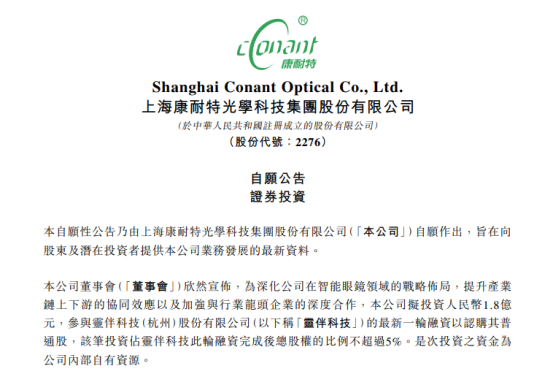
This investment transcends mere financial backing. As the smart glasses industry chain stands on the brink of explosive growth, Conant Optics, a globally recognized resin lens manufacturer, extending an olive branch to the leading AR device company, signifies a profound integration between traditional optical manufacturing and the cutting-edge AR technology sector. This collaboration is poised to catalyze subsequent technological synergy and business execution.
The implications of this event extend far beyond the capital realm—the optical industry's value chain is undergoing restructuring, with the integration of lenses and optical engines emerging as pivotal in shaping the trajectory of next-generation smart terminals. Conant Optics explicitly stated in its announcement that this investment is intended to "deepen the company's strategic presence in the smart glasses arena and enhance synergy along the industry chain."
In fact, a foundation for business cooperation has already been laid between Conant Optics and Rokid. The announcement revealed that the company has already embarked on business collaborations with Rokid, leveraging its global production capacity and rapid delivery capabilities to provide relevant support.
The elevation from business cooperation to strategic investment marks a qualitative shift in the relationship between the two entities. This strategic move secures medium- to long-term orders for Conant from leading domestic brands and constructs a formidable "technology + scenarios" moat.
For Rokid, a frontrunner among domestic AR device manufacturers, securing strategic investment from a key upstream component supplier significantly enhances supply chain stability and cost control. For Conant Optics, this not only binds a leading customer but also grants it an "entrance ticket" to participate in defining cutting-edge products and technological R&D.
It's noteworthy that this investment underscores the inevitable convergence of two technological trajectories: the rigid demand for refractive correction in traditional optometry and the technological evolution of AR display optics.
The AI glasses industry currently grapples with a significant challenge—inventory replacement. Public data indicates that approximately 1.5 billion pairs of traditional glasses are sold globally annually, yet the vast majority of myopic individuals face the dilemma of "double wearing" when donning smart glasses. If a portion of these myopic users can be converted into smart glasses users, a substantial incremental market will be unlocked.
Recent industry trends suggest that giants like Meta have commenced designing dedicated smart glasses solutions for myopic users, striving to transform smart glasses from fashionable gadgets into daily essentials for the myopic population.
This is precisely where Conant Optics' unique ecological niche advantage lies. With over two decades of deep involvement in optometry, its expertise in refractive solutions is the linchpin for AR glasses to penetrate the mass consumer market. By investing in Rokid, Conant Optics aims to seamlessly integrate its professional fitting services and lens technology into Rokid's product ecosystem, achieving a harmonious blend of display and vision correction solutions.
Moreover, at the core optical module level of AR glasses, Conant Optics' precision machining capabilities offer ample room for expansion. The potential for technological synergy extends beyond traditional lenses. With the maturation of Micro LED and waveguide technologies, full-color, lightweight AR displays are becoming a reality.
Driven by the explosion of AI computing power fueling hardware upgrades on the edge side, and with industry chain leaders like Sunny Optical successively launching mature solutions, it is widely anticipated that waveguides made of high-refractive-index materials, such as silicon carbide (SiC), will enter mass production around 2027.
SiC waveguides boast significant advantages over traditional glass solutions in terms of refractive index, heat dissipation performance, and thinness, and are expected to become the mainstream technological path for mid-to-high-end AR glasses. Leveraging its precision machining expertise in optical lenses, Conant Optics is poised to play a pivotal role in the cold processing, coating, and other links of AR waveguides in the future.
It is foreseeable that as technological solutions converge, leading brands will increasingly opt to deeply bind with suppliers possessing large-scale delivery capabilities and profound optical technology accumulation, with order resources further concentrating on core suppliers.
Ultimately, the 180 million yuan investment represents a prudent strategic布局 (layout) for Conant Optics, but for the entire optical industry, it serves as a clarion call—announcing that traditional optical manufacturing enterprises are set to become the architects defining the next generation of interactive endpoints.
As technological solutions converge, with Micro LED plus waveguides becoming the standard for mid-to-high-end products and orders from leading brands concentrating on core suppliers, the Matthew effect in the optical industry will intensify. Future competition will transcend single lens parameter comparisons, evolving into a systematic contest of optics, algorithms, and scenarios.
-
![]()
AI Enters the Second Half: Models Are No Longer Scarce, What’s Truly Scarce Are Computing Power, Scenarios, and Trust
-
![]()
Rediscovering Momentum After Years of Obscurity: What Fuels Changhong TV's Resurgence?
-
【In-depth】Current Market Status and Key Enterprise Analysis of Confocal Fluorescence Microscopes in 2026
-
![]()
Avita Releases Updated Prospectus: Projecting Over 120,000 Vehicle Sales and Over 60% YoY Revenue Growth by 2025
-
![]()
Navigating the Electric Wave: Mercedes-Benz Embraces the Three-Pointed Star, Audi Sheds the Four Rings
-
![]()
BYD Delegates Power, Geely Centralizes It: Which Transformation is Better Suited for the Future?
-
![]()
National Standard for Agent Interconnection Released: Why Might the Physical World Still Be Unreachable Despite Unified Interfaces?
-
![]()
Mobile Imaging: As Capabilities Grow, So Do the 'Add-Ons'—Why?