The Metaverse Dream Fades, Sora Exits, and AI Begins to Shift from Virtual to Real
 04/07 2026
 547
547

©New Game
In the foreign tech sphere, there is a growing trend of shifting from virtual to real applications.
In late March, Meta announced it would stop supporting updates for Horizon Worlds. Outsiders are saying that Zuckerberg's 'metaverse dream,' which cost $83.5 billion, may be waking up.
On April 1st, OpenAI completed a new round of funding, reaching a valuation of $852 billion, but its star video generation project, Sora, was shut down. The raised funds are primarily for AGI infrastructure.
During CES 2026, Huang Renxun predicted that the next wave of artificial intelligence would be physical AI, where AI would move from the virtual world into the physical world, autonomously completing complex tasks. However, in his two-hour speech, he repeatedly mentioned the diversity, complexity, unpredictability, and edge cases of the real world, stating, 'Without real-world data, embodied intelligence can only be an illusion.'
Scarce scenario data has become a bottleneck problem.
At the same time, we also found that behind OpenAI's financing stand major companies like Amazon and Microsoft, with both sides binding in advance in terms of technology and application scenarios.
This investment logic is also reflected domestically. Not long ago, a financial influencer revealed that Meituan had early on invested in over 40 hard technology-related companies, including well-known players and 'hidden champions' in the industry such as Galaxy General, Zhipu AI, X Variable, Tashi, Moore Threads, and Axera Intelligence.
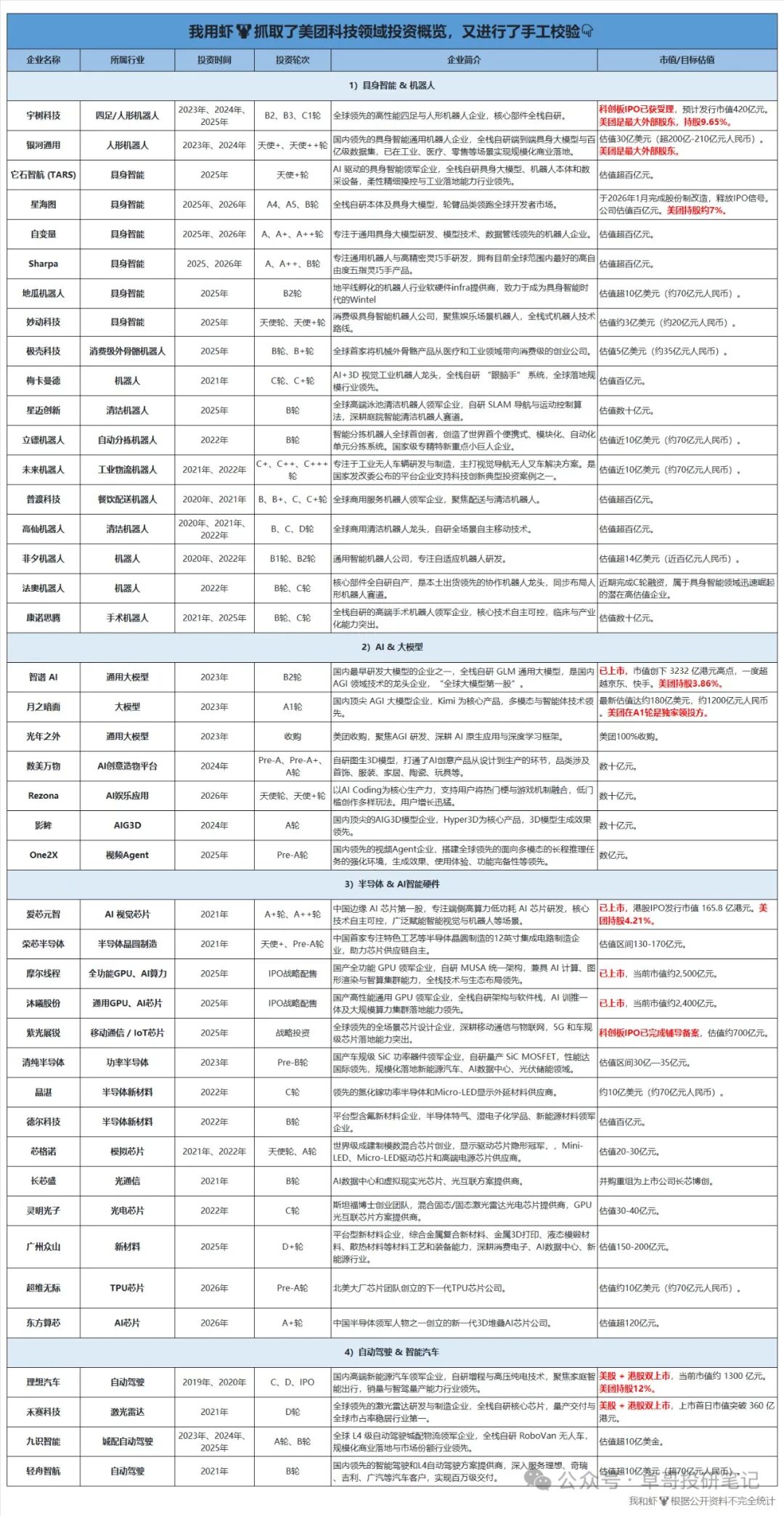
Image Source: Zhuo Ge's Investment Research Notes
Considering the shifts among overseas giants, these domestic unicorns aligning early with local life service giants may not just be about money.
A 99% Physical Data Gap Hinders AI 'Implementation'
Currently, 'scenario hunger' is accelerating.
Jiang Zheyuan, founder of Songyan Power, once stated that the biggest challenge in the field of embodied intelligence is data. Xi Yue, co-founder of Xingdong Era, believes that collecting real-world scenario data is difficult and requires scenario providers to open permissions, 'while existing alternative solutions have limitations.'
Zhang Peng, co-founder of Zhipingfang, bluntly stated that the industry must prioritize real-world scenario data—achieving data reflow (which means data feedback or circulation) through products actually deployed in the field, with the accumulated data being 'the most valuable data asset.'
This is just the tip of the iceberg in heated discussions within the industry.
With the maturity of language large models, 'intelligent' entities have emerged in virtual worlds. However, to enter the physical world and 'work,' they lack extensive scenario connectivity and data interaction. As Wang Xing illustrated at a Meituan management communication meeting, 'Even if Einstein were a secretary and asked to book a restaurant, he still wouldn't know if there were seats available. This isn't an intelligence issue but an information issue.'
When data sources shift from the internet to the real world, data itself becomes an extremely scarce resource. This is partly because real-world scenarios are rare and mostly closed; on the other hand, the speed at which large models collect data in real-world scenarios is far slower than in virtual worlds.
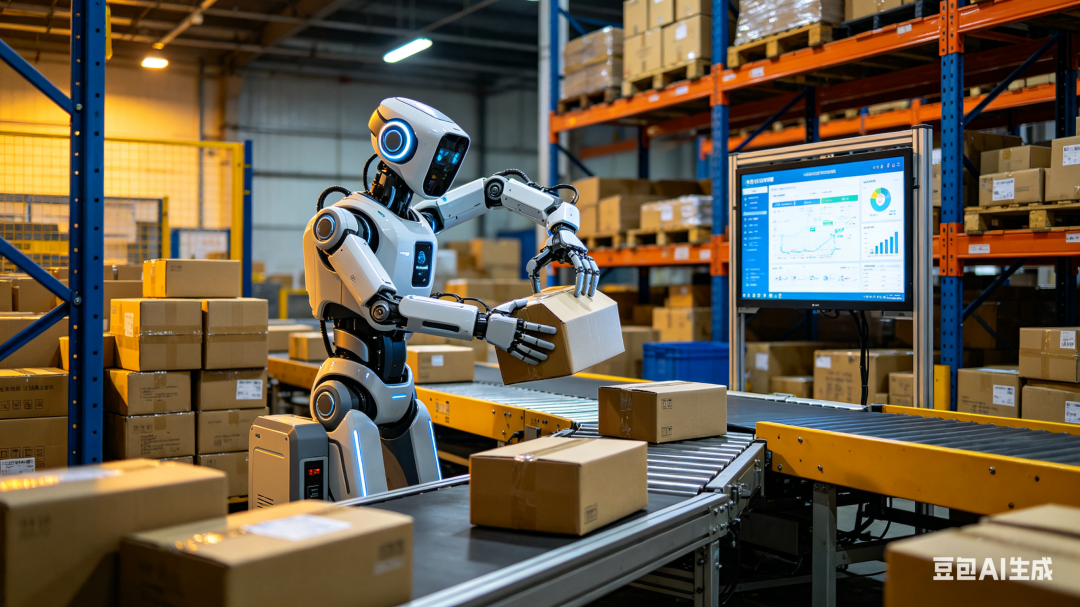
Data from CSDN, a globally renowned Chinese IT technical exchange platform, shows that embodied intelligence requires hundreds of petabytes of physical interaction data, with a current Stock gap (which means existing data gap) exceeding 99%.
Under such developmental circumstances, large model R&D in overseas markets has quickly 'rolled' into the next phase. Tech giants including NVIDIA, Tesla, and Meta are attempting to build highly realistic virtual worlds to train AI, known as the 'world models' they are currently exploring. In the domestic market, similar attempts are also underway, with leading companies like Unitree Technology and Galaxy General developing their own 'world models' to enhance the 'generalization' capabilities of embodied intelligence.
However, the core advantage of leveraging 'world models' lies in efficiency improvements. At the 2026 Yabuli Forum, Wang Xingxing, founder of Unitree Technology, pointed out that the current biggest bottleneck for robots is insufficient generalization capabilities, 'if thousands of robots are deployed to collect data for ten hours daily, the data scarcity problem could be solved.'
Yet, there is always an irreparable gap between virtual and real worlds. No matter how realistic the virtual world is, it cannot fully replicate the complexity of the physical world, a consensus in the current industry.
The industry generally believes that training data collection in virtual worlds must be combined with real machine data to truly solve the 'last mile' execution problem. Whether constructing a 1:1 simulated world or collecting real-world data, real-world scenarios are a necessary condition. From this perspective, it's not hard to understand why so many hard technology companies have long-term collaborations with Meituan, as most of them have practical needs for scenario training and application implementation.
The 'Last Mile' of AI: Not Just About Scenarios
In fact, explorations in some scenarios have already sparked significant 'fireworks.'
For example, Meituan's investments are characterized by a clear industrial mindset, typical of strong resource commitment. In 2023, Meituan participated in the Angel+ round of financing for Galaxy General, and by 2024, the two sides had formed a strategic partnership, exploring multiple scenarios including offline retail and warehousing logistics.
The accumulation of scenario data has already translated into application value.
In 2025, over ten pharmacies in Beijing used Galbot robots for 24-hour medication sorting, with the model expanding nationwide. Through Meituan's business introductions, Galaxy General is advancing explorations of unmanned front warehouses with merchants on Meituan Yaomao (Meituan's medicine delivery platform), having already signed orders for 100 robots and delivered dozens.
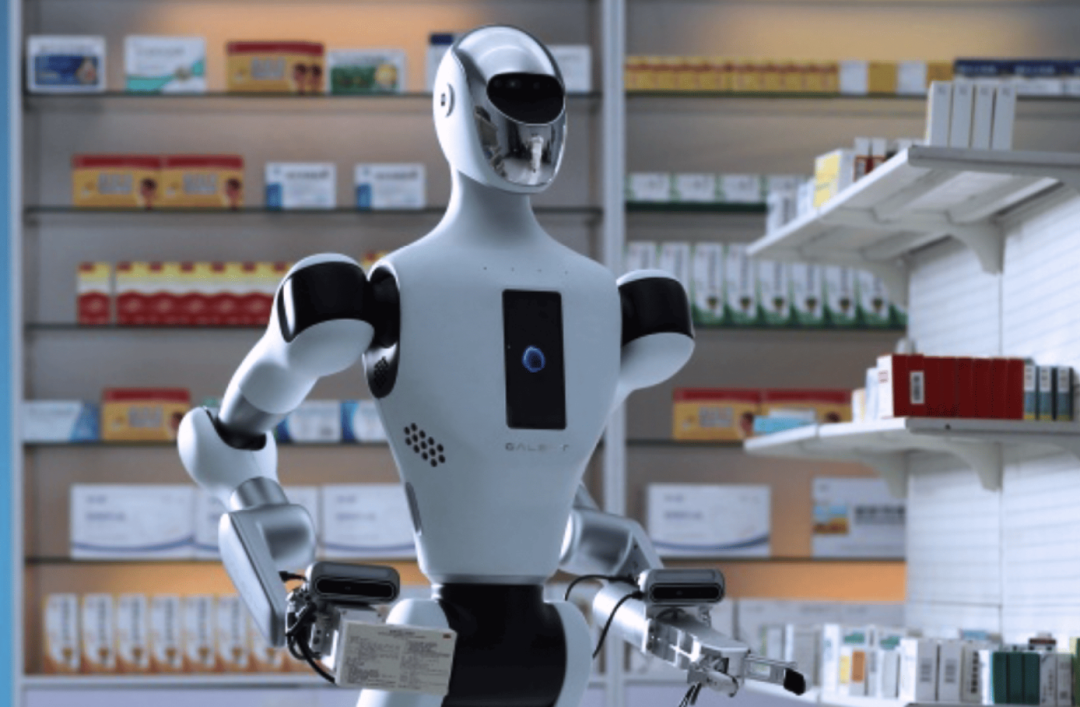
Galbot by Galaxy General working in a pharmacy
On the other hand, Lipiao's sorting robots have already 'joined' Meituan Yaomao's Guangzhou and Wuhan warehouses; Qiyu Innovation has collaborated with Meituan Xiaoxiang to complete mapping and modeling of warehouses, while their products also help Meituan merchants generate 3D displays in their on-site businesses...
However, there are currently few domestic platform companies capable of integrating hard technology into multiple businesses through an 'investment + scenario collaboration' model. On one hand, hard technology 'implementation' favors online ecosystem business models, which struggle to provide scenarios for 'executing offline tasks.' Meanwhile, integrating these technologies into offline businesses is not achieved overnight and requires platforms to have ' bearing capacity ' (which means the ability to undertake or integrate), with accumulated understanding and conversion experience in business and technology.
It is reported that over a decade ago, Meituan began investing in drone and autonomous vehicle-related businesses. Drones have opened over 70 drone routes domestically and internationally, and autonomous vehicle deliveries are leading the industry, with orders exceeding 5.5 million.
Based on Meituan's self-developed multimodal LongCat series large language models and open-source models, the platform has incubated AI assistants for consumers like 'Xiaomei' and 'Xiaotuan,' as well as a series of AI tools for merchants like 'Daishu staff officer ' (Daishu Advisor) and 'Smart Shopkeeper,' the latter helping over 3.4 million merchants effectively reduce operational costs. Meituan has also installed Daishu Butler claw for some merchants, with the first batch of 'shrimp-loading' merchants already achieving AI data capture and operational efficiency improvements.
These scenarios and self-developed technologies applied in actual businesses have formed multiple mature 'technology micro-ecosystems,' akin to a motherboard filled with expansion slots, capable of inserting many cutting-edge 'function cards,' providing ready-made application scenarios and data reflow (data feedback or circulation) for hard technologies such as chip computing power, LiDAR, robot joints, visual recognition, and autonomous driving.
For example, by the end of 2025, Hesai's perception and positioning LiDAR received mass production designation from Meituan's drones, achieving deep integration of LiDAR technology with low-altitude logistics scenarios. The two sides began collaborating four years earlier, exploring the application of multiple long-range LiDARs in autonomous delivery businesses.
In January this year, X Variable robots completed the entire process of autonomous delivery in real-world scenarios: not only accurately retrieving meals from Meituan delivery boxes, folding cardboard boxes, and placing them back into a recycling slot as low as 7cm, but also entering indoors through glass doors from outdoors, autonomously identifying floors, pressing elevator buttons, and delivering the food on time.
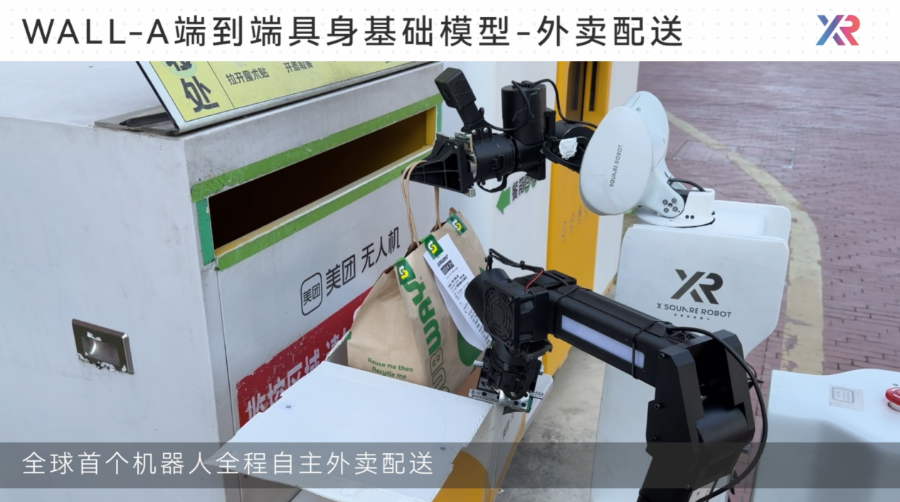
The breakthrough here is that these robots have not only stepped out of virtual worlds but further ventured beyond assembly line-dominated enclosed spaces into more complex external environments. They no longer repeat fixed actions but autonomously make decisions and adjust actions based on environmental changes.
This is also a direct manifestation of the scenario value being deeply unlocked.
What Kind of AI Foundation Grows Depends on Original Genes
From this perspective, Meituan's complex ecological scenarios determine that their hard technology capabilities will penetrate deeply into the intricate network of catering, utilities, High and low staggered (which means varied heights and layouts) of commodity shelves, and noisy streets and alleys, much like capillaries.
Over the past decade, Meituan has connected online user demands with offline services through fulfillment capabilities, informatization, and point-to-point communication by BD teams. In this process, Meituan's food delivery, retail warehousing, dining-in, and consumer review businesses have gradually permeated every aspect of life services.
Entering the AI era, technology continues to drive efficiency improvements and iterations in these businesses. This highly fragmented market, filled with communication and Connection cost (which means connection or integration costs) and closely related to many people, has become a natural AI training ground with multiple subtle links.
For example, a single food delivery service involves multiple scenarios such as merchant meal preparation, user demand matching, route planning, residential area analysis, stair climbing/elevator riding, etc.; dining-in requires attention to information and reviews for decision-making, user consumption experiences, and merchant operational experiences; travel services are divided into multiple scenarios such as business, tourism, and family visits, requiring route settings based on different needs and preferences, completing related hotel and ticket bookings, and tourist attraction planning; while the rapidly developing retail business has optimization needs in areas like front warehouses and fresh produce.
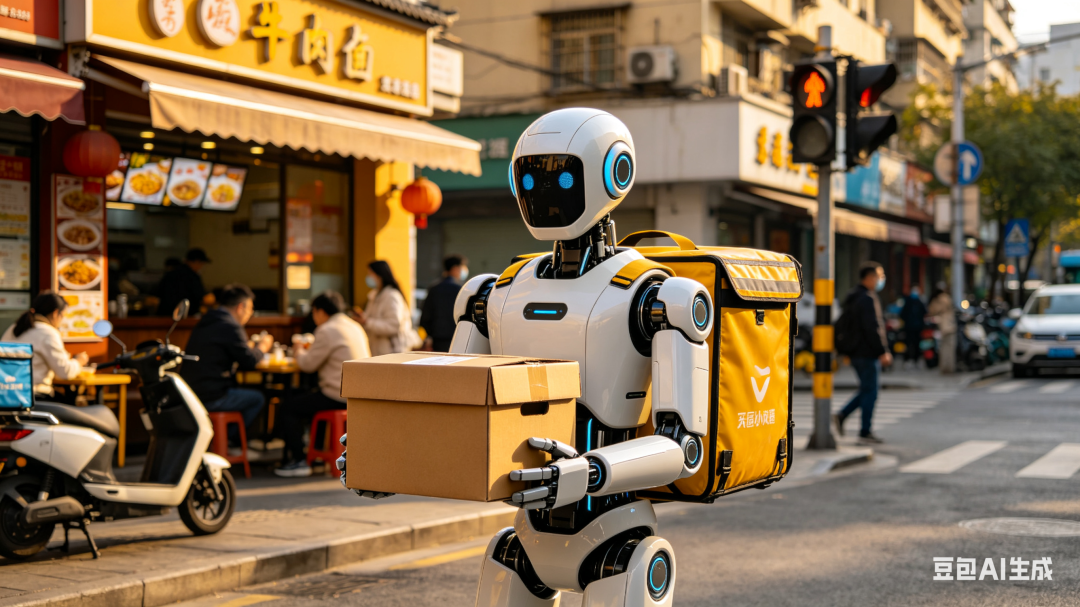
These business scenarios may all undergo a new round of efficiency improvements through technological breakthroughs.
This not only means enhanced user experiences but also signifies that the 'connectivity' infrastructure built in the informatization era is being upgraded to an 'executive' foundation in the AI era.
This upgrade aligns with Meituan's long-term goal of 'helping everyone eat better and live better.'
From this perspective, Meituan's continuous investments in hard technology are also paving the way for future AI super entrances. The execution capabilities supported by hard technology are essential AI infrastructure that must be solidified.
Wang Xing said that to enable AI to land in the physical world and create an 'AI foundation for the physical world,' he must also see the unique value of 'execution efficiency' and 'delivery capabilities' for his own business and market competition. Without the support of information and scenarios, no matter how intelligent AI is, it cannot grow limbs and work on the ground.
Therefore, AI's shift from virtual to real is not just a slogan momentarily popular in the industry; it has already echoed in the most down-to-earth places in China—such as delivery boxes, front warehouses, restaurant kitchens, and street-corner pharmacies. As the market enters an era of competing on 'task effectiveness,' those who understand the physical world better may hold 'seats' that even Einstein couldn't book.
-
![]()
The Allure of 'Acquisition Spree': Li Shufu's Left Turn, Xu Jiayin's Right
-
![]()
Strategic Transformation Yields Results: Phoenix Optics Reports 10.9% YoY Rise in Core Net Profit for H1 2026
-
![]()
Three Key Growth Trajectories Synergize! Crystal-Optech Reports 3.478 Billion Yuan in Revenue for H1 2026
-
![]()
Semi-Annual Report Sparks XPENG Motors Buzz
-
![]()
1.6 Billion Big Order Secured! SeeYA Technology's Revenue Soars by 287.87% in the First Half of the Year
-
![]()
Baidu's Profits Plunge by 68%: Unraveling the Mystery Behind the Numbers
-
![]()
Baidu’s Profits Tumble by 68%! Where Has All the Money Gone?
-
![]()
Hynix’s Taobao Store Shuts Down Abruptly: What Should Customers Do About Warranty Services for Memory Modules?