Embodied Intelligence: The Horn of the Great Voyage Sounds, Exchanging Space for Time
 04/14 2026
 633
633
Editor: Lv Xinyi
An intriguing phenomenon is emerging in embodied intelligence.
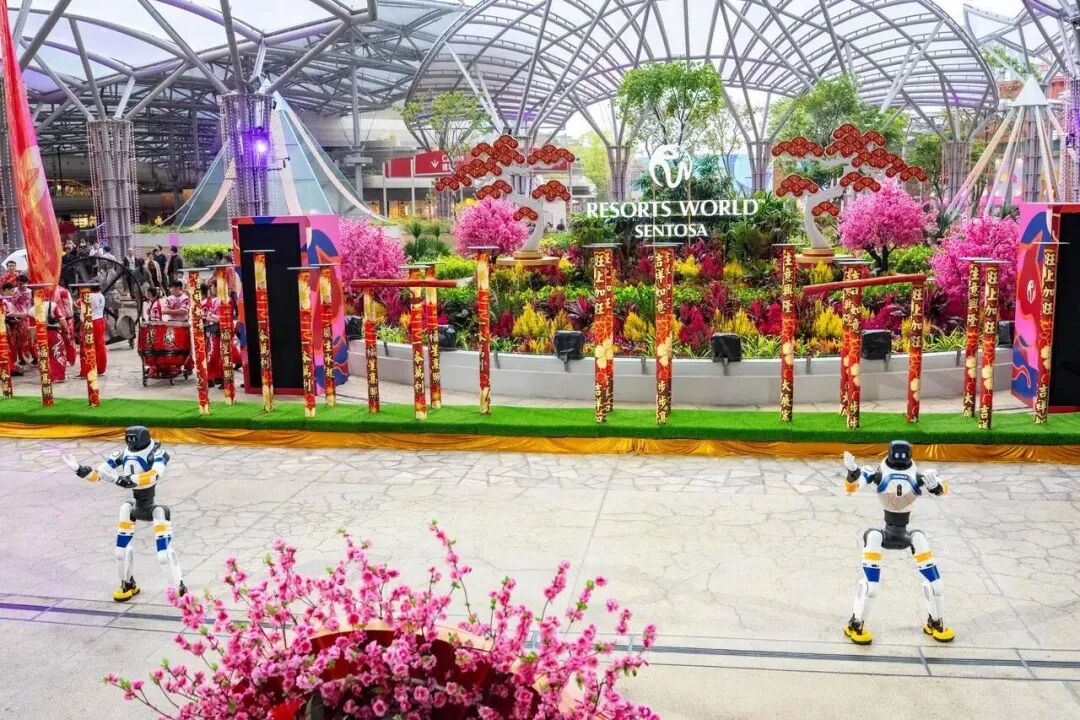
On one hand, Chinese embodied intelligence companies are rapidly expanding overseas: leading humanoid robot firms are entering the U.S., European, and Middle Eastern markets to open new revenue streams, quadrupedal robots are accelerating deployments in Singapore, Japan, and South Korea, and dexterous hand manufacturers are securing large orders in global research and industrial sectors. In disclosures from some companies, the proportion of overseas revenue is rising rapidly.
On the other hand, overseas robotics companies are also significantly moving closer to China: German precision manufacturing giant Schaeffler has established an embodied intelligence robotics company in Taicang, German robotics firm Neura Robotics has set up its China headquarters in Hangzhou and is large-scale (massively) recruiting engineering teams, while Sunday in the United States plans to build a team in China this year...
This is not simply an 'overseas expansion wave' or 'China entry wave'—it is a rare two-way flow.
The underlying logic of both approaches converges on the same essence: 'exchanging space for time.' Domestic companies are tapping into new global markets to validate general-purpose technological capabilities and gain a head start in commercializing next-generation intelligent hardware. Meanwhile, overseas companies leverage China's complete supply chain ecosystem, vast deployment scenarios, and engineer dividends to accelerate mass production, optimize costs, and gain a competitive edge over peers in their original regions.
This industrial logic has repeatedly played out in past manufacturing upgrades but is now evolving into a far-reaching reshaping of the global industrial landscape on the next-generation tech main track of embodied intelligence.
If the consumer electronics era saw the global industry form a fixed division of labor chain of 'design-manufacturing-distribution,' the embodied intelligence era is thoroughly breaking down these rigid geographical boundaries, initiating a reordering of industrial capabilities based on technology, supply chains, scenarios, and capital across all dimensions.
This two-way flow is merely the prologue to this grand global industrial restructuring. Ultimately, there will be no distinction between 'Chinese enterprises' and 'overseas enterprises'—only global players capable of integrating the world's best resources and building core competitiveness. And this bidirectional journey that begins now has already laid the most critical foundation for the future industrial endgame.

There is a bias in the industry: Companies going overseas are seen as deserters from domestic commercial wars.
They simplify a complex commercial behavior with a purely zero-sum framework, a reductionist and one-sided attribution.
A metaphor might be more apt: Embodied intelligence is undergoing a great voyage, and these overseas-bound companies are the navigators of this era, discovering new continents and opening up new commercial spaces.
China is one of the most densely populated regions globally for embodied intelligence startups. The rapid concentration of technical teams, capital strength, supply chain networks, and manufacturing capabilities has resulted in a rare engineering advance (advancement) speed in this field. However, density brings not only efficiency but also means competition is compressed prematurely into an immature market. In other words, the domestic market exhibits a typical characteristic: competition intensity far exceeds commercial maturity.
Current domestic robot demand remains primarily in research, education, demonstration projects, and data collection scenarios. These needs are driven by clear policy directives and customer inertia, featuring long procurement cycles and limited scale. While they form a continuously expanding commercial closed loop , their imagination is ultimately constrained. Companies can prove technological capabilities in these scenarios but struggle to validate the long-term value of their products as production tools. Meanwhile, capital-driven scale competition, upfront investments by companies to secure ecological positions, and premature commercialization of immature products have pushed the industry into fierce competition before orders are fully released.
The result is occasional price wars within the industry, with profit margins continuously compressed, and the market already showing signs of turning red.
Therefore, a high-quality scenario with a large supply gap and strong willingness to pay has become a prerequisite for healthy enterprise development. Against this backdrop, going overseas has gradually shifted from an optional strategy to a realistic choice.
Notably, the key to overseas markets lies not in scale but in the clarity of economic logic.
In regions such as Europe, the United States, Japan, and Singapore, high labor costs and aging populations create long-standing workforce gaps. The decision to deploy a robot can be clearly translated into a cost-efficiency calculation. Customers are no longer purchasing 'technology demonstrations' but production tools that can replace human labor.
More importantly, while demand-side maturity exists overseas, the supply side has significant gaps. Overseas robot manufacturers lack mass production capabilities, supply chain density, and engineering efficiency, failing to form a cohesive system. This positions Chinese companies not just as market entrants but as suppliers filling critical capability gaps.

Customers are no longer buying 'technology demos' but measurable productivity tools. Many Chinese companies are completing commercial validation in these environments. Deep Robotics' quadrupedal robots conduct 24/7 inspections in North American warehousing systems, operate long-term in large Middle Eastern infrastructure projects, and handle security and maintenance in Southeast Asian parks. Zhiyuan Robotics' humanoid robots and Aoyi Technology's dexterous hand products enter industrial production lines or service systems through partnerships with local system integrators. These deployments are often not short-term pilots but directly embedded into customer operational workflows, becoming indispensable components.
The deeper motivation lies in the relatively 'unburdened' competitive environment overseas. Companies can occupy niche application scenarios, establish service networks and data accumulation, and generate positive cash flow before forming global brand advantages. This path more closely resembles the 'external validation-feedback development' model common in early-stage tech industries.
Roborock Technology serves as a successful case study, achieving six consecutive years of over 100% compound revenue growth and securing top market share in several countries. Yu Hao, in an interview, candidly stated, 'These countries aren't China or the U.S. Our experiments show that China and the U.S. are the most competitive because they're strategic must-win markets. It's easier to become number one in overlooked countries, and they quickly generate cash flow.'
Thus, Chinese companies' global expansion is not merely about growth but about finding an environment where robots can truly operate as productive forces, circulating, evaluated, and deployed through commercial logic while generating solid economic returns.

'You're not a robotics expert until you've been to Shenzhen'—this has become gospel in Silicon Valley investment circles over the past two years. Of course, it's not just Shenzhen; robotics hubs like Beijing, Shanghai, and Hangzhou attract batches of foreign investors seeking to understand China's robotics landscape, the true face of this track (sector).
On March 23, Mercedes CEO Ola Källenius encapsulated the automotive industry's competitive landscape: 'If you want to play football, you play in the Champions League. In terms of automotive competition intensity, the current Champions League is in China.'
This sentiment applies equally to the embodied intelligence sector.
If Chinese companies go overseas to seek demand, overseas companies enter China primarily to 'learn' in this embodied intelligence champions league.
For long, 'entering China' was often interpreted as sales-oriented, but in embodied intelligence, this logic is changing. 'Entering China' now represents a capability layout (deployment), viewing China as a comprehensive platform for R&D, manufacturing, and application validation.
The robotics industry is inherently a highly complex systems engineering challenge. Transitioning from laboratory prototypes to mass-producible commodities requires simultaneously addressing structural design, control systems, electronic hardware, software architecture, and supply chain management. Delays in any single area can slow overall progress, and these capabilities often cannot be developed internally by a single company.
China holds unique advantages in this regard. The Pearl River Delta and Yangtze River Delta form the world's most densely packed manufacturing and supporting networks, with concentrated clusters of component suppliers, processing factories, and testing institutions within limited regions. This allows R&D teams to complete design modifications, prototype fabrication, and iterative validation in extremely short cycles, dramatically shortening the path from concept to mass production—an engineering efficiency difficult to replicate in many countries.
Two intriguing cases illustrate this: Hillbot, founded by a Chinese entrepreneur in the U.S., whose CEO Han Zheng previously confessed at BlueRun Ventures' 2025 RMB Fund Partner Annual Meeting: 'I used to envy domestic robotics companies for their proximity to supply chains and rapid iteration speeds. So this year, we started bringing core R&D teams back to China.' Recently, network reports suggest his co-founder and CTO Su Hao will return to teach at Fudan University as a professor and Ph.D. supervisor in electronic information.
Another highly representative case: Schaeffler's establishment of a robotics company in Taicang, Jiangsu, is no coincidence. As a key node in the Yangtze River Delta manufacturing system, Taicang has long hosted numerous German companies, earning the nickname 'Germany's industrial microcosm in China.' Precision manufacturing, automotive components, and automation equipment supply chains are highly concentrated here, providing a complete industrial foundation from components to system integration. Schaeffler's entry aims to complete technology-to-product conversion within this mature industrial ecosystem.
Meanwhile, China possesses a vast pool of engineering talent. Engineers in automation, embedded development, mechanical design, and production management are not only abundant but generally possess large-scale manufacturing experience. This talent structure enables rapid assembly of interdisciplinary teams to integrate complex systems into producible goods rather than keeping them at the laboratory stage.
More critically, China offers an intensely realistic application environment. High-density cities, massive logistics networks, and strict cost constraints require deployed robots to demonstrate long-term operational stability. Products surviving such environments often meet global deployment thresholds, akin to autonomous vehicles tested in 'hellish' scenarios like Chongqing or Wuhan—once they conquer these, other challenges pale in comparison.
Additionally, China's market itself harbors enormous potential demand. Aging populations and industrial upgrading pressures make automation an irreversible trend, with countless enterprises seeking solutions to reduce human dependency. For overseas companies, establishing local teams in China means not only accessing supply chains but also directly participating in this industrial upgrade wave.
Thus, for many overseas robotics firms, China is not merely a sales destination but resembles productive infrastructure. It simultaneously provides R&D support, manufacturing capabilities, testing scenarios, and future customers, enabling accelerated progression from technology validation to industrial deployment.

Viewing Chinese companies' overseas expansion and overseas firms' entry into China through a unified lens reveals a deeper transformation: The global competition in embodied intelligence is not a direct confrontation between enterprises but a competition between different production systems.
Unlike internet or pure software industries, embodied intelligence represents a productivity tool that must embed within the real physical world. A robotic system capable of large-scale deployment requires not just algorithmic capabilities but also mechanical and control technologies, stable supply chains, mature mass production systems, long-term operational scenarios, and sustained service capabilities. The absence of any single element can confine products to demonstration stages, preventing true societal integration.
The challenge lies in the global dispersion of these elements. The U.S. leads in foundational models and software ecosystems but lacks manufacturing cost and engineering conversion efficiency advantages. Europe boasts deep industrial traditions and systems engineering experience but lacks flexible, high-density supply chain networks. Japan maintains long-term precision manufacturing leadership but faces limited domestic market scale, unable to support large-scale experimentation. China offers the world's most complete manufacturing system and engineering talent pool but continues searching for sufficiently high-value, sustainable application scenarios.
Consequently, no single country can complete independently (independently complete) the industrialization of embodied intelligence. Enterprises' cross-border resource allocation represents not mere commercial expansion but an inevitable choice under real-world constraints. They must acquire missing critical capabilities in different regions to assemble a complete, operational system.
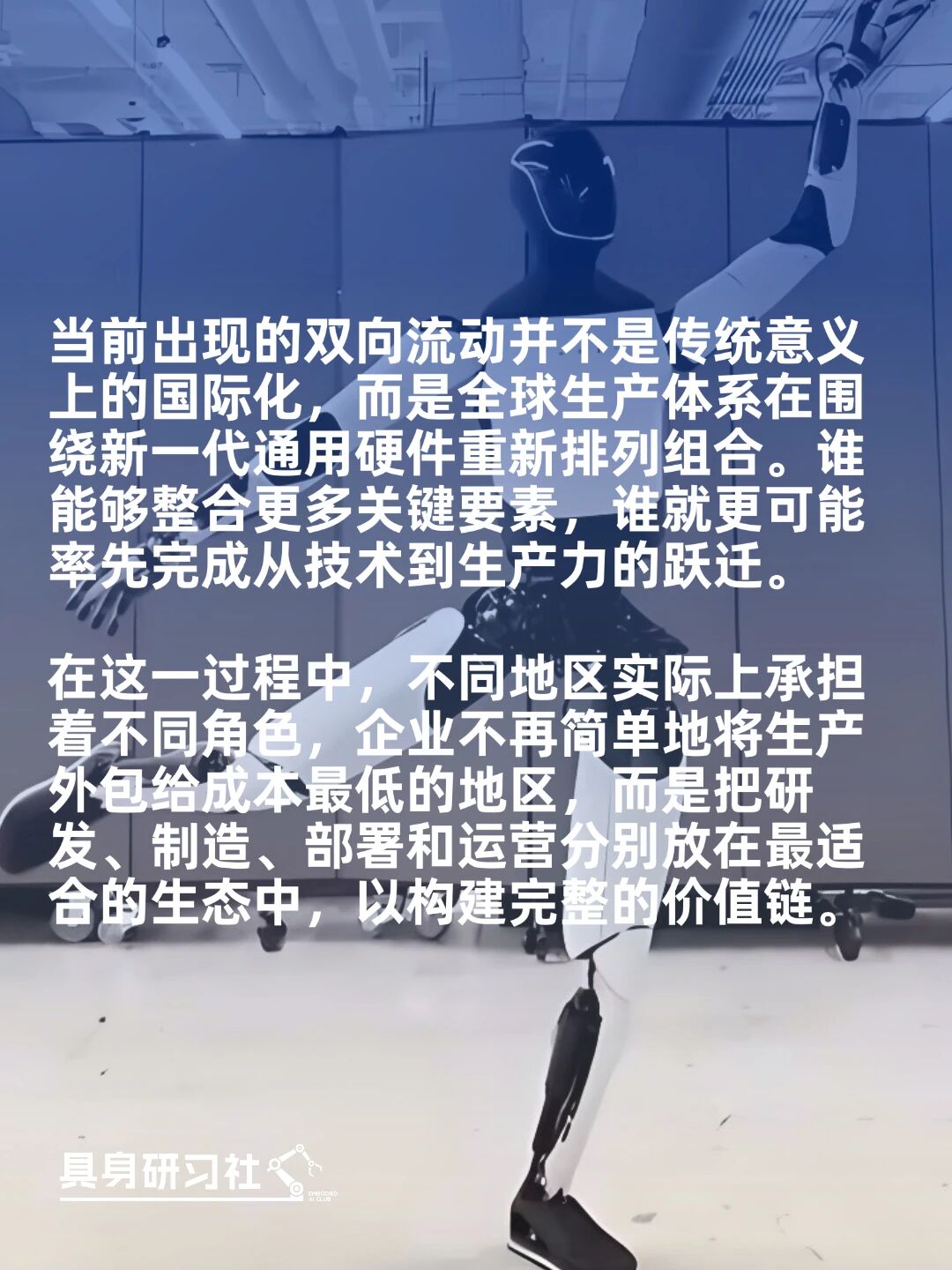
From this perspective, the current two-way flow does not represent traditional internationalization but a global production system's reconfiguration around next-generation general-purpose hardware. Those integrating more key elements will likely achieve the first leap from technology to productivity.
In this process, different regions effectively assume distinct roles. Companies no longer simply outsource production to the lowest-cost regions but strategically place R&D, manufacturing, deployment, and operations in the most suitable ecosystems to construct complete value chains.
Thus, the embodied intelligence industry is forming a capability-driven global division of labor. The competitive focus shifts from owning the most advanced single technology to efficiently integrating transnational resources and establishing sustainable production and service systems. In other words, the ultimate winners may not be the most technologically advanced firms but those completing the global productivity puzzle first.
Future embodied intelligence giants will likely emerge from companies deeply engaged in globalization.
-
![]()
Wang Huiwen, Former Meituan Executive, Achieves 20-Fold ROI, Supports 24 AI Startups
-
![]()
Another AI Computing Power Unicorn Launches IPO! Founded by a Changjiang Scholar
-
![]()
OFILM Holdings Secures Zhongke Daojing, Marking a Significant Leap in the Optical Communication Industry!
-
What Will Be the Next Key Battleground for Large Models After AI Coding?
-
![]()
Leapmotor's Sales Soar, Yet Hidden Concerns Loom
-
![]()
China’s Action Camera Market Soars: 3.12 Million Units Sold in Six Months, DJI Secures 74% Dominance
-
![]()
Zhang Yiming: Strategic Retreat as a Path Forward
-
![]()
Exploring Charging for Some Features of QianWen App: Can It Follow the Path of Doubao?