2026 China EV100 Forum: Black Sesame Technologies’ Huashan A2000 Clears U.S. Review in 11 Months, Achieves Breakthrough in Edge AI Computing for Domestic Production
 04/14 2026
 719
719
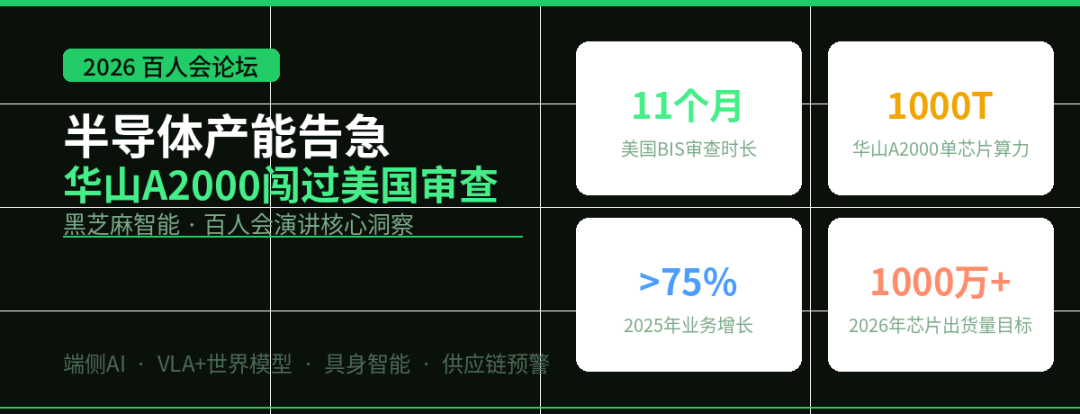
A chip has endured an 11-month review process under U.S. export control regulations before finally securing approval. This, in itself, is a significant signal.
At the 2026 China EV100 Forum, Shan Jizhang, the founder and CEO of Black Sesame Technologies, shared far more than just details about a single chip. Starting with an analysis of technological trends in embodied AI, he highlighted a structural risk that has largely been overlooked: semiconductor capacity is nearing its physical limits. This is not merely a cyclical fluctuation but a clear indication for the entire industry to rethink and restructure its supply chain.
After reading this article, you will gain insights into: why the combination of VLA and the World Model may surpass human driving capabilities, the specific issues plaguing the semiconductor supply chain, the six core breakthroughs of the Huashan A2000, and the next strategic frontier for Black Sesame Technologies.
VLA + World Model: Why Shan Jizhang Believes AI Can Outperform Human Driving

Shan Jizhang opened the forum with a bold assertion: the integration of VLA (Visual-Language-Action Model) with the World Model represents the most promising technological pathway for advanced intelligent driving in the future, with the potential to outperform human driving capabilities.
Here's the rationale: VLA is responsible for perceiving the current environment, learning from historical driving patterns, and determining the next course of action. Meanwhile, the World Model predicts how every target on the road—be it pedestrians, vehicles, or obstacles—will interact over the next 5 to 10 seconds. Together, they empower AI to both "see the present" and "predict the future."
He drew a parallel with AlphaGo: AI surpassed human capabilities in Go not by memorizing human moves but by predicting future board positions after each move. The value of VLA + World Model for driving follows the same principle. Crucially, this architecture is not confined to the cloud—Shan explicitly stated that both the World Model and VLA would be deployed simultaneously on the edge, directly within vehicles. This places immense demands on chip computing power.
Semiconductor Supply Chain Crisis: A Structural Issue, Not a Cyclical Fluctuation

This segment of Shan Jizhang's speech was the most alarming for the entire industry—and also the easiest to overlook.
He pointed out that cloud computing chips from companies like NVIDIA, Google, and Huawei have already pushed chip area close to the physical limits of lithography, making further performance gains through size increases impossible. Some companies have even resorted to using entire wafers for single computing chips—a desperate and unsustainable move.
Meanwhile, demand for in-vehicle computing power is skyrocketing—some companies are already discussing deploying thousands of TOPS of onboard computing power, further straining demand for advanced manufacturing capacity. Advanced manufacturing capacity is already fully booked.
Shan's judgment is clear: DDR price hikes and chip capacity shortages are structural issues, not short-term cyclical fluctuations. His advice: Chip manufacturers, Tier 1 suppliers, and automakers all need to proactively diversify their supply chains rather than waiting for shortages to occur.
This conclusion is directly supported by the development of the Huashan A2000—designed precisely to deliver maximum AI computing efficiency within limited chip area on the edge.
Huashan A2000: Six Breakthroughs in a Chip That Waited 11 Months
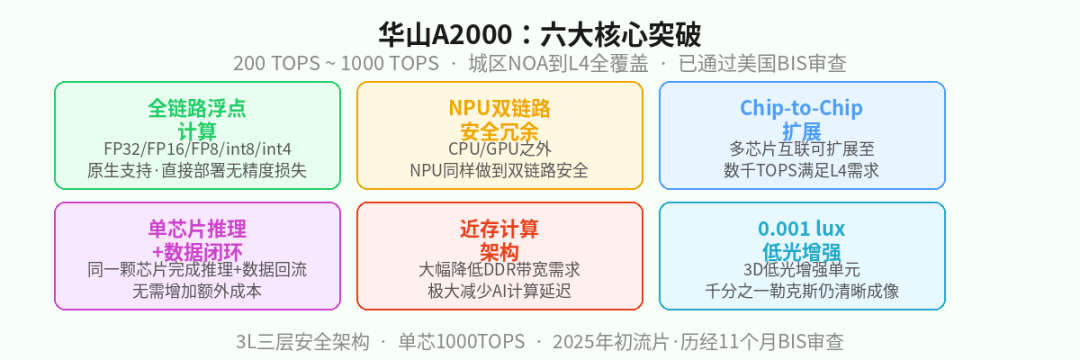
The Huashan A2000 completed tape-out in early 2025 but underwent an 11-month review due to its performance and integration levels exceeding U.S. chip export control (BIS) thresholds. It finally received approval late last year. This detail alone underscores the chip's exceptional performance level.
Shan introduced six core technological features, each addressing critical industry pain points:
① Full-chain floating-point computing—supports FP32, FP16, FP8, int16, int8, int4, natively compatible with all mainstream AI model formats, enabling direct deployment without quantization loss.
② NPU dual-link safety redundancy—not just CPU and GPU redundancy, but also dual-link redundancy for NPU neural network computing, a rarity in the industry.
③ Chip-to-Chip scalability—multi-chip interconnection allows overall computing power to scale to thousands of TOPS, meeting high-performance demands for L3 and L4 autonomous driving.
④ Single-chip inference + data closed loop—the same chip handles inference while completing data feedback, eliminating additional hardware costs, critical for robotics and intelligent driving.
⑤ Near-memory computing architecture—significantly reduces reliance on DDR bandwidth, directly cutting AI computing latency. This design is particularly valuable amid current DDR price hikes.
⑥ 0.001 lux low-light enhancement—a 3D low-light enhancement unit enables clear imaging in extremely dark environments (0.001 lux) while supporting direct AI processing of image sensor raw data.
Computing power range: 200 TOPS to 1,000 TOPS per chip, covering everything from urban NOA to full L4 autonomy. A three-layer safety architecture (3L) ensures hardware isolation security.
Five Milestones, Mapping a Decade of Growth
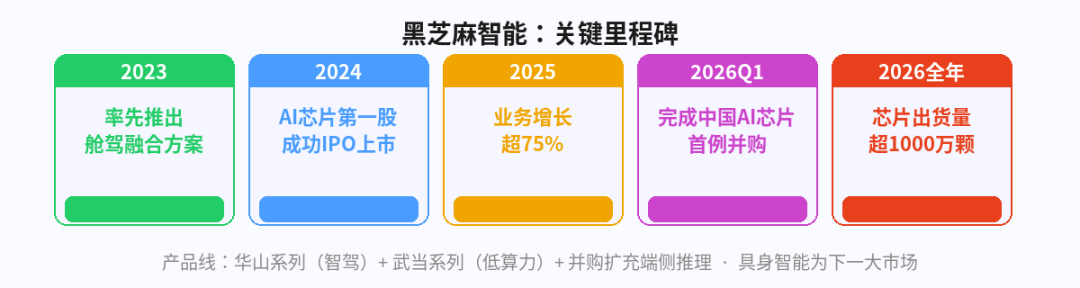
Shan quickly reviewed the company's key milestones at the forum, packing in dense information:
In 2023, Black Sesame Technologies pioneered a cockpit-driving fusion solution and achieved mass production—over two years ahead of Horizon Robotics' Yu Kai, who announced a similar plan for April of the same year at the same forum.
In 2024, the company successfully went public, becoming the first A-share AI chip and intelligent driving chip stock.
In 2025, business growth exceeded 75%, with Shan projecting even faster growth in 2026.
Early 2026, completed the first acquisition in China's AI chip industry, further enriching its edge inference product line.
2026 full-year target: Ship over 10 million chips.
Next Battlefield: Edge Inference + Embodied AI
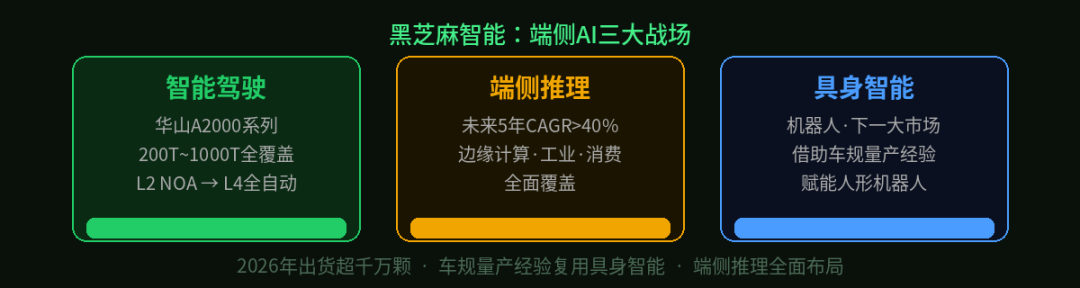
While intelligent driving remains Black Sesame's foundation, Shan made clear it is not the endpoint.
The overall edge inference market is expected to grow at a compound annual rate of over 40% in the next five years—covering edge computing, industrial, consumer electronics, and other scenarios. Post-acquisition, Black Sesame now offers full coverage.
Embodied AI, or robotics, was labeled by Shan as "the next very large market." His reasoning is pragmatic: The engineering experience Black Sesame gained in automotive-grade mass production—high reliability, safety redundancy, extreme environment adaptation—is naturally suited for robotics.
Black Sesame's product matrix: Huashan series (high-computing-power autonomous driving) + Wudang series (low-computing-power ADAS) + acquired edge inference product lines—covering the full edge spectrum from intelligent driving to robotics.
After reading this, you now have:
① A technological assertion: VLA + World Model deployment on the edge is a feasible path to surpass human driving capabilities, with AlphaGo's logic now replicating in autonomous driving.
② A supply chain warning: Semiconductor capacity constraints are structural, not short-term; DDR price hikes signal the need for immediate supply chain diversification by automakers and Tier 1 suppliers.
③ A chip that waited 11 months: Huashan A2000's six breakthroughs, 200T–1000T full coverage, full floating-point + near-memory computing + NPU dual-link safety.
④ A clear strategic roadmap: Intelligent driving foundation + edge inference expansion + embodied AI layout, advancing on three fronts simultaneously with a 2026 shipment target of 10 million chips.
Shan left one final statement in his speech, revealing the underlying logic of the entire edge AI chip sector:
"The World Model and VLA will be deployed simultaneously on the edge, in vehicles—this places extremely high demands on chip computing power."
Computing power is not the goal; enabling AI to truly run in vehicles is.
This article is based on the speech transcript of Shan Jizhang from Black Sesame Technologies at the 2026 China EV100 Forum, incorporating insights and AI skills to objectively present core information and industry trends, providing information and inspiration for the sector. It does not represent Vehicle's stance.
*Unauthorized reproduction or excerpting is strictly prohibited.
-
![]()
Wang Huiwen, Former Meituan Executive, Achieves 20-Fold ROI, Supports 24 AI Startups
-
![]()
Another AI Computing Power Unicorn Launches IPO! Founded by a Changjiang Scholar
-
![]()
OFILM Holdings Secures Zhongke Daojing, Marking a Significant Leap in the Optical Communication Industry!
-
What Will Be the Next Key Battleground for Large Models After AI Coding?
-
![]()
Leapmotor's Sales Soar, Yet Hidden Concerns Loom
-
![]()
China’s Action Camera Market Soars: 3.12 Million Units Sold in Six Months, DJI Secures 74% Dominance
-
![]()
Zhang Yiming: Strategic Retreat as a Path Forward
-
![]()
Exploring Charging for Some Features of QianWen App: Can It Follow the Path of Doubao?