ByteDance and Honor Forge 'Device Partnership': Who Holds the Advantage?
 04/14 2026
 381
381
Doubao Hardware Secures a 'Mainstream Ally'
Is Another Smartphone Giant Poised to Join ByteDance's 'Device Ecosystem'?
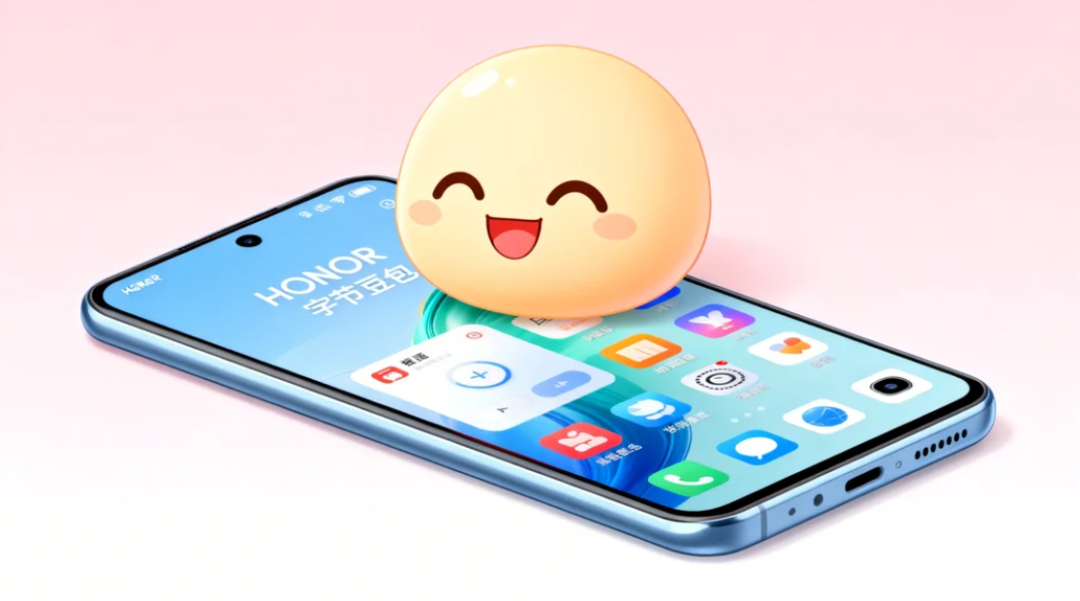
On April 13, Lanjing News reported that sources close to the matter revealed Honor is in advanced talks with ByteDance about collaborating on the 'Doubao Phone.' It was also disclosed that prior to ByteDance's partnership with ZTE for the first-generation Doubao Phone, its initial outreach was directed at Honor.
At the time, Honor approached the collaboration cautiously, recognizing the inherent risks of deep system-level integration. As an exploratory engineering device, the Doubao Phone could adopt a more daring technological approach. However, with Honor's user base numbering in the hundreds of millions, any stability, compatibility, or security issues in new services could trigger widespread malfunctions and user dissatisfaction, making risk management challenging.
Nevertheless, the two companies already have deep-rooted AI collaboration: in June of the previous year, Honor became the first to integrate the Doubao large language model, and in October, their partnership expanded to enhance the YOYO assistant with multi-scenario service capabilities such as online Q&A, intelligent image recognition, and creative photo editing, all powered by the Doubao model.
Additionally, Fang Fei, President of Honor's Product Line, publicly endorsed the technical direction of the Doubao Phone, stating, 'The Doubao Phone assistant supports general-purpose scenarios and automates tasks through UI Agent, aligning with Honor's AI strategy of transitioning from specific tasks to generalized execution.'
So, why is Honor, a highly competitive smartphone maker, rumored to be collaborating with ByteDance? And what are ByteDance's strategic ambitions in this partnership?
01
Honor and ByteDance: A Symbiotic Alliance
By 2026, the significance of AI-driven devices is self-evident, but the key players are now limited to smartphone manufacturers and internet giants.
Among internet companies, ByteDance has already launched the first Doubao Phone with Nubia. Alibaba's 'Qianwen' AI assistant is set to fully enter the AI hardware sector this year, with planned products including AI glasses, AI earphones, and AI rings—but not smartphones. In the future, the internet's 'device-making faction' will likely consist of just these two companies.
In contrast, the smartphone industry is not a flat playing field like the internet sector; it is stratified into three tiers based on market position.
At the apex are Apple, Huawei, and Xiaomi—the conservative titans with both financial muscle and absolute 'ecosystem sovereignty.'
These first-tier smartphone makers emphasize full-stack independence. Suggesting that Doubao take over Huawei's intent recognition hub, control Xiaomi's 'human-vehicle-home' ecosystem, or infiltrate the iOS core would be seen as somewhat presumptuous.
Thus, ByteDance must look downward for potential partners.
This led to the first-generation Doubao Phone's trial with a niche brand like Nubia. In December 2025, ByteDance and Nubia jointly launched the Nubia M153 Doubao Phone assistant technology preview version, limited to 30,000 units as engineering prototypes, priced at 3,499 yuan, which quickly sold out. The social media buzz was indeed intense, with second-hand market prices soaring to tens of thousands of yuan.
However, in the eyes of industry insiders, the evolution of AI devices cannot rely on hype alone. It demands massive token consumption and real daily interaction data from millions of users to 'feed' the system. A few tens of thousands of units from niche models barely scratch the surface.
Since top-tier players are unattainable and bottom-tier players lack sufficient data, the number of hardware manufacturers ByteDance can approach is indeed limited.
ByteDance's breakthrough point lies in the second tier, where Honor, OPPO, and vivo reside. Among these manufacturers facing growth headwinds, Honor's situation and strengths align well with ByteDance's needs.
Honor inherited a vast downstream channel from Huawei, a competent hardware team, and a base of hundreds of millions of active users. However, in today's fiercely competitive smartphone market, the old barriers built on specifications and screen refresh rates are visibly eroding.
Honor has also considered developing the next-generation on-device large model. In October 2025, Honor released the Magic8 series, partnering with Volcano Engine to inject multi-scenario service capabilities such as online Q&A and intelligent image recognition into the YOYO assistant based on the Doubao large model. However, the costs of the AI era far exceed those of the 2010s.
According to the Financial Times, ByteDance's preliminary capital expenditure plan for 2026 is around 160 billion yuan, with about 85 billion yuan earmarked for AI chips. What second-tier smartphone manufacturers can achieve with 10-20 billion yuan is insignificant compared to the giants.
Thus, Honor faces a dilemma: forging ahead alone would likely result in a mediocre outcome, while not doing so would leave it far behind the first tier in system experience, widening the gap.
This anxiety may have prompted Honor's early secret contacts with ByteDance. However, as a smartphone giant, Honor has more constraints and concerns than Nubia.
Nubia is a small player; if it fails, it fails. It can afford to engage in aggressive technological experiments with ByteDance. But Honor has over 100 million users relying on it. System-level AI is not just an ordinary app; it requires extremely high-level permissions and even deep management of users' in-app scheduling chains—a responsibility Honor simply cannot shoulder lightly.
Today, as both sides return to the negotiating table, Nubia's tens of thousands of engineering prototypes have validated the basic software-hardware handshake logic, reducing the probability of technical collapse to a controllable level, making it an opportune time for collaboration talks.
Once this alliance is substantially finalized, Honor will completely offload the enormous burden of endless iteration for foundational large models and can instead focus on competing in areas like screen hinges, imaging modules, and supply chains.
For ByteDance, the goal is not just to earn some petty cash from token interface fees within this shell but to seize an opportunity on par with Google.
02
Can ByteDance Become the Next Google Through Honor?
Honor has a clear strategy, but what does ByteDance stand to gain?
Earlier reports from Jiemian News stated that while collaborating with Nubia, ByteDance also engaged with smartphone manufacturers like vivo, Lenovo, and Transsion, offering very generous terms.
In the collaboration, ByteDance would waive custom development and token fees, instead allowing smartphone manufacturers to directly participate in traffic distribution, membership subscriptions, and revenue sharing from 'secondary traffic.'
Waiving token fees may not have seemed significant when Nubia's prototypes were released, but by April 2026, when even a few context searches or Openclaw activations could burn through tens of yuan in tokens, the value of this concession has become deeply apparent.
ByteDance not only waives token fees but also subsidizes R&D teams to help smartphone manufacturers with system adaptation. On the surface, this seems like pure 'welfare,' but it is not a losing proposition. This time, Zhang Yiming is not targeting the meager API margins at the frontend but an opportunity to define the future.
On May 1, 2024, the daily average call volume for the Doubao large model was 0.12 trillion, but by April of this year, it had surged to 120 trillion, growing 1,000-fold in 23 months.
Many media outlets have hailed the arrival of the MaaS (Model as a Service) spring, suggesting that selling tokens alone could lead to substantial profits.
However, this calculation is flawed. Tan Dai, President of Volcano Engine, revealed that the core driver of the recent rapid growth in Doubao large model usage is the explosion of AI video creation and the accelerated adoption of AI agents. In other words, most tokens are consumed in ByteDance's internal business scenarios and high-frequency C-end user calls, not in commercial procurement by external enterprise clients.
Relying solely on selling tokens would not even cover ByteDance's data center electricity costs, let alone recoup its hundreds of billions in computing investments.
So, where is the commercial closed loop for large models? In 2025, Volcano Engine already provided the answer to the first stage: using large model token consumption to drive sales of the underlying IaaS (Infrastructure as a Service) layer—a classic case of 'the wool comes from the pig.'
In the AI device scenario, selling servers in the cloud is obviously not feasible; smartphone manufacturers would not buy your cloud hosts. Thus, ByteDance slightly modified this approach: instead of using tokens to drive cloud services, it uses waived token fees to exchange for 'traffic distribution rights' and 'secondary traffic revenue sharing' within smartphone systems.
In other words, ByteDance is not interested in earning petty hardware-level token licensing fees from Honor. What it wants is to position itself as a toll collector for all local services, e-commerce, and transportation providers—much like Google in the previous era.
Of course, this is also a highly profitable deal for Honor.
Traditionally, when a smartphone manufacturer sells a device, the hardware profit is settled, and the transaction is essentially over. At most, they earn some installation fees by pre-installing a few apps or take a cut from game co-publishing in the app store. But this one-time transaction business model is truly just a one-time deal.
Now, ByteDance comes along and says, 'We won't charge you for technology, and we'll help you turn your phone into the smartest AI device. Moreover, for services like ride-hailing, ticket booking, and food delivery distributed through this system brain, the 'traffic tax' earned from commissions will be shared between ByteDance and Honor.'
On one side is an assembly plant stuck in hard-fought hardware competition with razor-thin margins, and on the other is an ecosystem operator with tens or even hundreds of millions of high-net-worth users continuously generating long-term service subscription fees. Anyone can see which path to choose.
Thus, when the President of Honor's Product Line publicly affirmed Doubao's technical path, it reflected the entire Honor leadership's keen desire for this long-term business model.
However, all of this is speculation based on past history and current circumstances. Whether Honor will truly embrace ByteDance and whether it can follow in the footsteps of Seres' collaboration with Huawei in the automotive market to achieve success remains unknown.
What is certain, however, is that if we set aside the 'independent innovation' filter, in today's fiercely competitive device market, finding a wealthy new partner to latch onto is likely the most comfortable and clever way to survive.
- END -
-
![]()
Breaking News | Core Chip Team Member Unexpectedly Changes Jobs! OpenAI Transforms into Anthropic's Talent Hub, with Over 15 Ex-OpenAI Core Members Now Holding Key Roles at Anthropic
-
![]()
When European Factories Face Idle Capacity, Chinese Brands Offer a ‘Traditional Chinese Remedy’
-
![]()
SEER Robotics Passes IPO Hearing: How Valuable Is the 'First Robot Brain Stock?'
-
![]()
5 Years, 170 Billion Yuan Wealth Vanishes: Where Did Wei Jianjun Go Wrong?
-
![]()
What Exactly Has Changed with the AI That Automatically Opens a Browser to Search Xiaohongshu?
-
![]()
Over 3,000 Heat-Related Deaths Daily, Yet India Imposes Ban on Chinese Air Conditioner Imports: Unraveling the Underlying Motives
-
![]()
Second-Hand Car Prices Plummet: Are Gasoline Vehicles on the Verge of Collapse?
-
![]()
800V vs. 48V: Which Reigns Supreme? Online Clash Between Executives Intensifies Debate Over Li Auto and NIO's Suspension Systems | MIRROR Pro