In-depth Inventory: Eight Major Scenarios for Humanoid Robots: Demand Still Lies Beneath the Iceberg
 04/14 2026
 568
568
Editor: Lv Xinyi
If we view human society as a vast operational system, then the technological evolution of the past century has essentially been about continuously rewriting the division of labor within this system.
Steam engines and electricity enabled machines to take over physical labor, while computers and the internet began processing information. Today, robots are taking on humans' ability to act autonomously in the physical world. AI endows robots with a 'brain,' gradually transforming them from tools into automated execution modules capable of perception, judgment, and even altering reality.
Many refer to 2026 as the year robots will truly come into practical use. While it remains uncertain whether they will indeed land smoothly, this notion captures a turning point of change. Robots are moving out of laboratories and capital narratives, escaping carefully designed demonstration environments, and entering real and complex production and living scenarios.
These scenarios penetrate deeply into the intricacies of various industries, forming a vast and intricate network in both visible and invisible corners.
Today, we aim to outline the contours of this network by listing various scenarios for robot applications. While we cannot cover them all, we can still glimpse the opportunities and unfinished gaps within these scenarios, as well as how they will rewrite the division of labor and collaboration in human society.
Factories are the earliest and most deeply penetrated settings for robots. Although traditional industrial robots and collaborative robots have accomplished certain industrial automation tasks, they still suffer from limited generalization capabilities. Therefore, other forms of robots are needed to complete tasks in spatially constrained, complex operations, hazardous environments, or situations requiring mobility and perception.
When goods enter a factory, robots can classify, handle, and stack them, assist with loading and unloading machine tools, and ensure the orderly flow of materials in space. In production, the value of robots is more evident in their 'flexibility.' For example, they can perform complex component grinding, polishing, and laser cutting in delicate operations, as well as handle irregular surfaces like automotive bodies, ship structures, and storage tank pipelines for tasks such as spraying, sandblasting, welding, and cleaning.
In assembly, robots can handle the installation of non-standard components, such as dashboard, seat, door panel, and wiring harness assembly in automotive manufacturing; simultaneously, in high-precision industries like semiconductor and electronics manufacturing, robots undertake tasks such as chip assembly and precise alignment.
In quality inspection, robots' efficiency advantages are particularly evident. Based on visual recognition systems, robots can detect scratches, bubbles, color differences, and dimensional deviations, and verify whether screws are tightened and components are missing. Compared to sampling inspection mechanisms, machine vision is closer to 'full inspection,' effectively improving overall yield rates.
Whether in industrial manufacturing or e-commerce, warehousing and logistics are indispensable links. The 'goods-to-person' system actively transports shelves, bins, or pallets to operators nearby. AMRs (Autonomous Mobile Robots) and driverless forklifts can plan paths in real-time and dynamically respond to environmental changes; within specific warehouse operations, robots can handle tasks ranging from unloading and scanning for identification, allocating storage locations, picking, packing, inventory counting, to sorting flexible objects. It is foreseeable that future warehousing systems will no longer consist of standalone devices but will instead be intelligent networks integrating multiple processes autonomously.
Besides directly participating in production and logistics, robots also undertake some 'support tasks,' such as production line inspections and industrial wastewater testing. In some niche industries, robots often appear as customized solutions deeply aligned with process flow (industrial processes). For example, in light manufacturing sectors like embroidery, a complete automation solution can be constructed, ranging from automatic bobbin changing and intelligent winding to automatic fabric clamping.
Despite the rich variety of scenarios in industrial environments, practical implementation still faces numerous difficulties. Each scenario varies greatly, requiring alignment between complex real-world environments and robot solutions. Additionally, operational efficiency and stability must be ensured to achieve commercial viability.
The demand for robots in industry is also shifting. While speed and precision were emphasized in the past, companies now focus more on whether robots can autonomously complete tasks and possess the ability to migrate and adapt across different scenarios.
The service sector's robot application scenarios are more dispersed than those in industry and are closer to everyone's daily experience.
In retail settings, robots perform functions such as greeting, guiding, product explanations, and shelf organization. They can also provide real-time recommendations based on user behavior data, forming a sales approach similar to e-commerce's 'interest-based recommendations.'
In dining and hospitality, robot applications cover visitor guidance, order-taking, cooking, plating, beverage preparation (e.g., coffee), kitchen cleaning, and room service delivery. They not only handle transactional work but also add novel interactive experiences for users.
The cultural and entertainment sector is one of the most active areas for robot applications. Robots frequently appear in stage performances, cultural tourism scenarios, interactive performances, and guided tours. In recent years, their applications have expanded further into film and television appearances and gaming interactions, such as robotic dogs joining live-action CS games for confront (combat). Sports coaching is also being explored: tennis, table tennis, and running applications require high levels of perception, decision-making, and dynamic response capabilities, with most still in early stages.
The household scenario is where robots are most anticipated but also where the gap between reality and imagination is the widest. From demonstration videos, the range of capabilities seems impressive: floor cleaning, surface wiping, laundry sorting, clothing folding, cooking, dishwashing, waste sorting, gardening operations, and even flying robots for window cleaning. However, current consumer products primarily fulfill basic needs such as companionship (including pet companionship), entertainment, and cargo transport. The bottlenecks lie not only in multi-task generalization capabilities but also in practical constraints like price, safety, and privacy.
Extending further from households to building and property management scenarios, cleaning robots, inspection robots, and even customer service robots have opportunities to form more continuous and stable service systems in highly standardized environments.
Elderly care and companionship represent scenarios demanding higher capabilities from robots. Besides interaction abilities and complex scenario handling, long-term interaction with the elderly or patients requires meeting stricter standards in safety, reliability, and compliance.
Specifically, elderly care robots can assist with daily living tasks such as serving tea and water, feeding, medication reminders, turning over, and toilet care; simple physiotherapy and massage; walking assistance and fall detection; and emotional companionship through activities like chatting and playing chess. These tasks require robots to meet far higher standards in safety, reliability, and compliance than ordinary scenarios, as they serve the most vulnerable and trust-dependent populations.
The primary medical application scenarios for robots include surgery, rehabilitation, nursing, and auxiliary diagnosis (assisted diagnosis).
Surgical robots are among the more mature forms. Doctors sit at a control console and issue commands via operating handles, which the robot translates into finer instrument movements. Applications cover laparoscopic surgeries in urology, gynecology, and general surgery, as well as surgeries in orthopedics, dentistry, ophthalmology, and vascular interventions, supporting remote surgery. This collaborative approach significantly enhances operational precision and stability, especially for surgeries requiring prolonged high concentration.
Rehabilitation robots can acquire patient data by configuring various sensors to optimize rehabilitation plans. When combined with brain-computer interfaces, patients' motor intentions can directly drive exoskeletons or electrical stimulation for active rehabilitation. Dietary care robots assist disabled patients with eating; quadrupedal emergency transport robots can carry stretchers for rapid evacuation and automatically perform first aid during movement; micro internal robots are already used for diagnosing gastrointestinal diseases and are expected to be applied in drug delivery and disease treatment in the future.
Robots can also integrate into hospitals' daily workflows, including logistics robots transporting specimens or medications within the hospital, intelligent medical waste robots handling waste disposal and disinfection, and medical disinfection robots autonomously patrolling and disinfecting hospital areas.
Robots have the potential to compensate (address) the shortage of high-quality doctors, nurses, and rehabilitation therapists, accumulate data on surgical paths and rehabilitation movements, and gradually make data-driven healthcare a reality. However, high research and development costs, lengthy approval cycles, and strict qualification standards mean commercialization in this field requires patience.
The growing demand for high-quality, refined agricultural operations provides opportunities for robot applications in agriculture. Robots not only enhance agricultural production efficiency but also reduce operational and labor costs to some extent, supporting the stable supply of high-quality agricultural products.
In crop farming, robots have gradually covered tasks such as plowing, sowing, fertilizing and spraying, harvesting and leaf picking, hybrid pollination, weeding, and fruit transport and greenhouse handling. Flying or wheeled robots can patrol fields, using visual recognition to detect pests and diseases for early intervention; during grain storage, they can also perform inspection, leveling, and sampling tasks, improving management efficiency and precision.
In animal husbandry scenarios, especially large-scale farming, robots can significantly reduce labor input for daily tasks like livestock feeding and milking, as well as handle routine inspections, cleaning, and disinfection. For aquaculture, underwater robots can inspect fish cages, monitor fish conditions and underwater environments, and perform automatic feeding.
Although agricultural robots help amortize costs over the long term, their upfront investment is high, accompanied by a certain learning curve and usage threshold, which to some extent restricts their large-scale adoption. However, in the long run, as agricultural scale increases and labor structures change, agricultural robots with sustained operational capabilities and data-driven abilities still possess clear development space and application opportunities.
In teaching scenarios, robots can act as knowledge explainers, oral practice partners, and programming enlighteners, integrating gaming mechanisms into the learning process. They can assist with grading assignments in classrooms or participate in teaching and interaction in different roles, such as a teacher summoning Newton to explain the law of universal gravitation. Additionally, robots supporting social-emotional learning are attracting increasing attention in early education and special needs classrooms.
In scientific research (non-algorithm-validation research), robots primarily handle highly repetitive and standardized experimental operations, such as pipetting, cell culture, and reagent weighing. Robots not only reduce risks of human contamination and misoperations but also enable high-throughput experiments, accelerating material and drug screening processes. They can also handle toxic or flammable reagents under unattended conditions, reducing safety hazards. Currently, fully automated laboratories dominated by robots have emerged, capable of covering the entire workflow of experimental operations, data collection, and result analysis.
More profound impacts come from extending scientific research into extreme environments: deep-sea biological detection, seabed mapping, polar sample analysis, and even space-based aerospace operations, space station servicing, space debris cleanup, and cosmic exploration. Robots extend human perception and operational capabilities to places that are difficult to reach.
With the rapid development of AI for Science, the way scientific discoveries are made is gradually changing: experimental designs are generated by AI, robots execute them, and the resulting data is fed back to models for optimization, forming a closed loop. The promotion of this process can accelerate experimental progress but also carries certain risks, such as high dependence on data, which may lead the system to continuously reinforce erroneous directions if the data is biased; additionally, the black-box nature of experimental processes may weaken researchers' understanding of intermediate mechanisms.
Autonomous vehicles are viewed by some as precursors to embodied intelligence or as one of its forms. They are essentially mobile robot systems with perception, decision-making, and execution capabilities. Besides them, various robots with autonomous mobility also fall into this category.
Low-speed unmanned delivery vehicles operate on park roads, urban feeder roads, and non-motorized lanes; outdoor delivery robots mainly navigate pedestrian scenarios like sidewalks, residential areas, and commercial streets, solving the last few hundred meters for food delivery and parcels. Automatic parking robots support vehicles from underneath or externally, completing unmanned parking and retrieval.
Some cities are experimenting with humanoid robots for traffic management, such as Shenzhen's robotic traffic police, which can perform traffic direction, discourage uncivilized behavior, and conduct safety promotion (public safety announcements).
In the long term, mobile robots may reshape current transportation and logistics models, becoming a new type of infrastructure. However, allowing these robots to operate on roads still faces reliability challenges. While experience from autonomous driving can be leveraged, more unstructured road conditions require redesigning pedestrian avoidance logic, safe parking strategies, etc.
As a sector long reliant on manual labor, construction has relatively low automation levels. However, with changes in labor structures and increased safety requirements, robots are gradually entering construction and maintenance: bricklaying, drilling, rebar tying, concrete and paint spraying; structural crack detection, high-altitude and confined space inspections; and specialized demolition robots that allow remote building demolition through crushing and cutting, producing less noise and dust than traditional methods.
However, the challenge for robots entering construction scenarios is that construction sites are highly unstructured and potentially hazardous, with significant variations between different projects, which imposes high demands on the generalization capabilities of robots. Furthermore, if one considers purchasing robots, the return on investment period is uncertain. Perhaps, in the future, robot leasing covering this field will bring more possibilities.
Extending this to urban scenarios, robots are expected to gradually evolve into service-oriented infrastructure supporting urban operations. In terms of urban infrastructure services, robots can undertake tasks such as cleaning public areas, assisting in waste classification and recycling, and patrolling. Urban underground systems also require robot maintenance, including sewer inspection and cleaning, cable and communication shaft inspections, and underground space structural inspections.
Tunnel construction robots may be used during the construction of infrastructure such as bridges and tunnels. During the daily operation of bridges and tunnels, inspection robots can also perform automatic detection. These tasks are highly regular and have a relatively standardized environment, making them scenarios where robots can more easily achieve stable operation.
In scenarios such as security patrols, fire rescue, and earthquake search and rescue, robots play the role of replacing humans to 'take the lead in risky situations.' The stability of quadrupedal robots in complex terrains and the continuous operational capabilities of unmanned devices in high-temperature and toxic environments make them key tools in these scenarios.
Whether it is fires, explosions, earthquakes, chemical spills, or nuclear radiation accidents, robots can enter hazardous areas before humans to detect the environment and perform specific operations to assist in personnel rescue.
Since energy itself contains immense power, its related scenarios often involve hazards. Whether it is nuclear power plants, oil and gas platforms, or mines and natural gas pipelines, they are generally accompanied by risk factors such as high temperatures, high pressures, and flammability and explosiveness, making them suitable for robots to replace human labor.
In power systems, robots are driving the evolution of substations toward unmanned operation, capable of tasks such as meter reading, appearance inspection, infrared thermal imaging, and gas leak detection. In the field of new energy, robots can undertake tasks ranging from equipment installation in photovoltaic power plants to the cleaning and maintenance of wind turbines and solar panels.
Ships transporting crude oil or chemicals are exposed to corrosive environments for extended periods. Spraying or wall-climbing robots can be used for coating operations inside and outside the ship's hull; pipeline robots can penetrate long-distance oil and gas transmission networks to monitor corrosion and leaks. Nuclear power plants, due to their high-risk nature, are natural environments for robot applications. Drilling, crushing, handling, and inspection in mines, as well as routine inspections on oil and gas platforms and during transportation, are also within the scope of robot coverage.
The ocean is a major scenario for energy development. Whether it is the exploration of seabed mineral resources, the inspection and maintenance of seabed oil and gas pipelines, the laying and inspection of seabed cables, or the cleaning and structural inspection of offshore drilling platforms, these tasks occur in deep-sea environments where it is difficult for humans to stay for extended periods, making them more suitable for robots to complete.
The demand for robots in the energy sector arises, on the one hand, from the rigid need for safe substitution, as hazardous environments inherently exclude humans. On the other hand, the efficiency pressures brought about by the rapid increase in energy demand in the AI era also contribute. The combination of these factors makes it easier to achieve a commercial closed loop in this scenario.
However, on the other hand, the more complex and hazardous the environment, the narrower the margin for error. This means that the energy sector imposes almost stringent requirements on the reliability, stability, and environmental adaptability of robots.
Conclusion
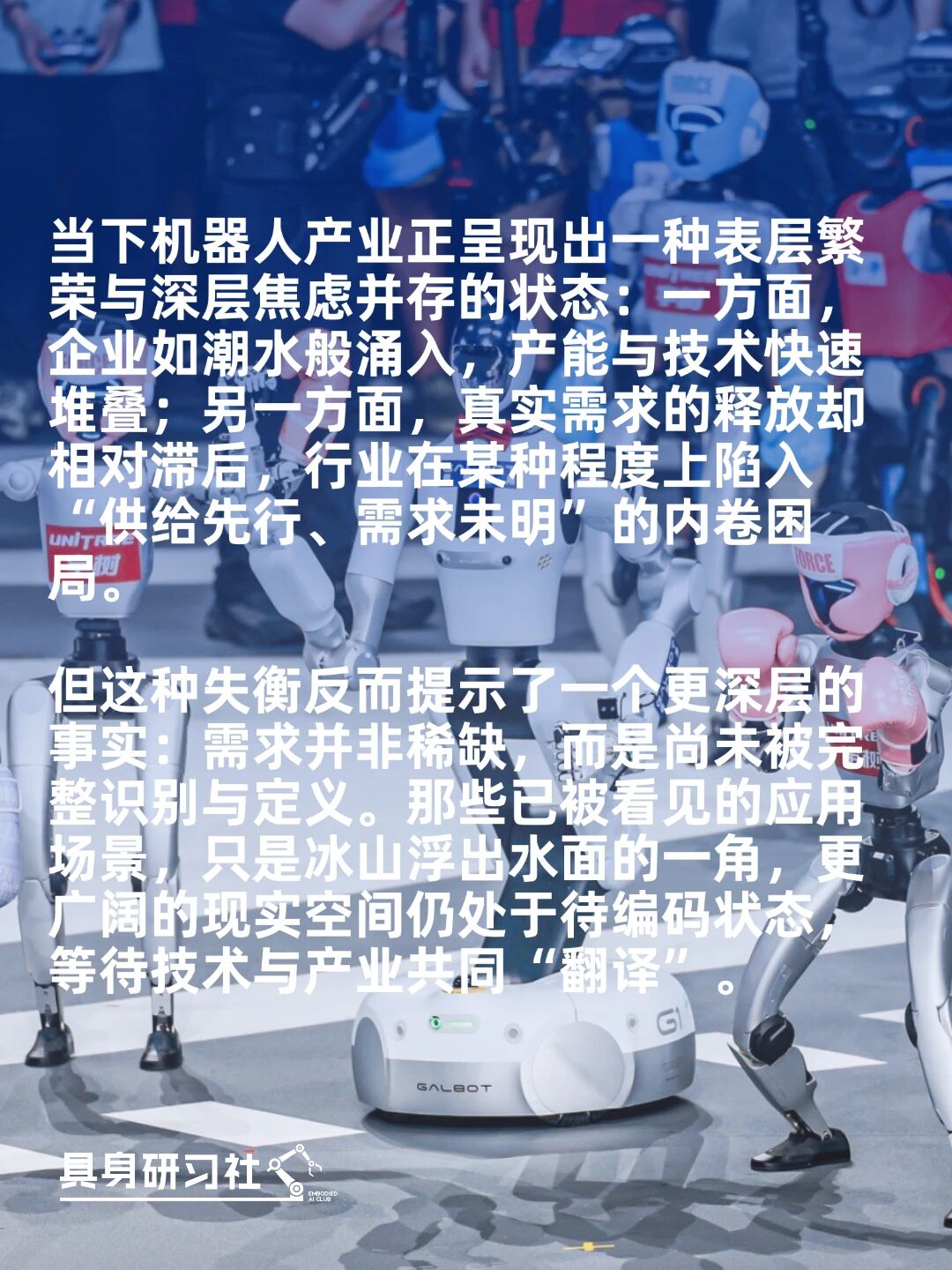
Currently, the robotics industry is experiencing a state of superficial prosperity coexisting with deep-seated anxiety: on the one hand, companies are flooding in, with rapid accumulation of production capacity and technology; on the other hand, the release of real demand is relatively lagging, and the industry is, to some extent, trapped in an involution dilemma of 'supply preceding, demand unclear.'
However, this imbalance instead suggests a deeper truth: demand is not scarce but has not yet been fully identified and defined. The application scenarios that have already been seen are just the tip of the iceberg, with a broader reality space still in an uncoded state, waiting for technology and industry to jointly 'translate.'
-
![]()
Wang Huiwen, Former Meituan Executive, Achieves 20-Fold ROI, Supports 24 AI Startups
-
![]()
Another AI Computing Power Unicorn Launches IPO! Founded by a Changjiang Scholar
-
![]()
OFILM Holdings Secures Zhongke Daojing, Marking a Significant Leap in the Optical Communication Industry!
-
What Will Be the Next Key Battleground for Large Models After AI Coding?
-
![]()
Leapmotor's Sales Soar, Yet Hidden Concerns Loom
-
![]()
China’s Action Camera Market Soars: 3.12 Million Units Sold in Six Months, DJI Secures 74% Dominance
-
![]()
Zhang Yiming: Strategic Retreat as a Path Forward
-
![]()
Exploring Charging for Some Features of QianWen App: Can It Follow the Path of Doubao?