Trump's TACO Move Looms, Risk Sentiment Set for Gradual Rebound!
 04/14 2026
 616
616
From the start of 2026 through to the end of the first quarter, risk appetite has witnessed significant fluctuations, a stark contrast to the collective AI asset euphoria of 2025. This shift can be attributed to a series of contentious moves by Trump, the swift progression of AI technology, and fluctuations in US dollar liquidity.
But to what extent are these changes driven by short-term war risk sentiment, and how much do they reflect long-term trends? Post the rapid market style transition, what investment prospects does 2026 hold? Dolphin Research aims to provide a concise exploration of these questions in this weekly strategy report.
1. What Defines the Ultimate Trade of 2026?
As we step into 2026, the market is still reeling from the AI frenzy. The launch of OpenClaw, the integration of diverse skills within models, and their practical productization have significantly boosted AI's cognitive penetration. Consequently, concerns have arisen among investors regarding the long-term viability of SaaS assets, leading to a widespread sell-off in software stocks amidst doomsday predictions.
Simultaneously, as major players ramp up their capital expenditures, not only has the industrial internet's SaaS sector taken a hit, but the consumer internet has also felt the pinch. These companies are either major contributors to the current AI infrastructure build-out or are perceived as lagging behind in the AI race.
Within Dolphin Research's observation portfolio, the hardest-hit have been industrial internet SaaS stocks, while the top performers have been production material stocks benefiting from AI-driven capital expenditures. Consumer internet firms, burdened by heavy capital outlays, face short-term revenue-expenditure mismatches or have seen their business models disrupted by AI, resulting in widespread valuation adjustments.
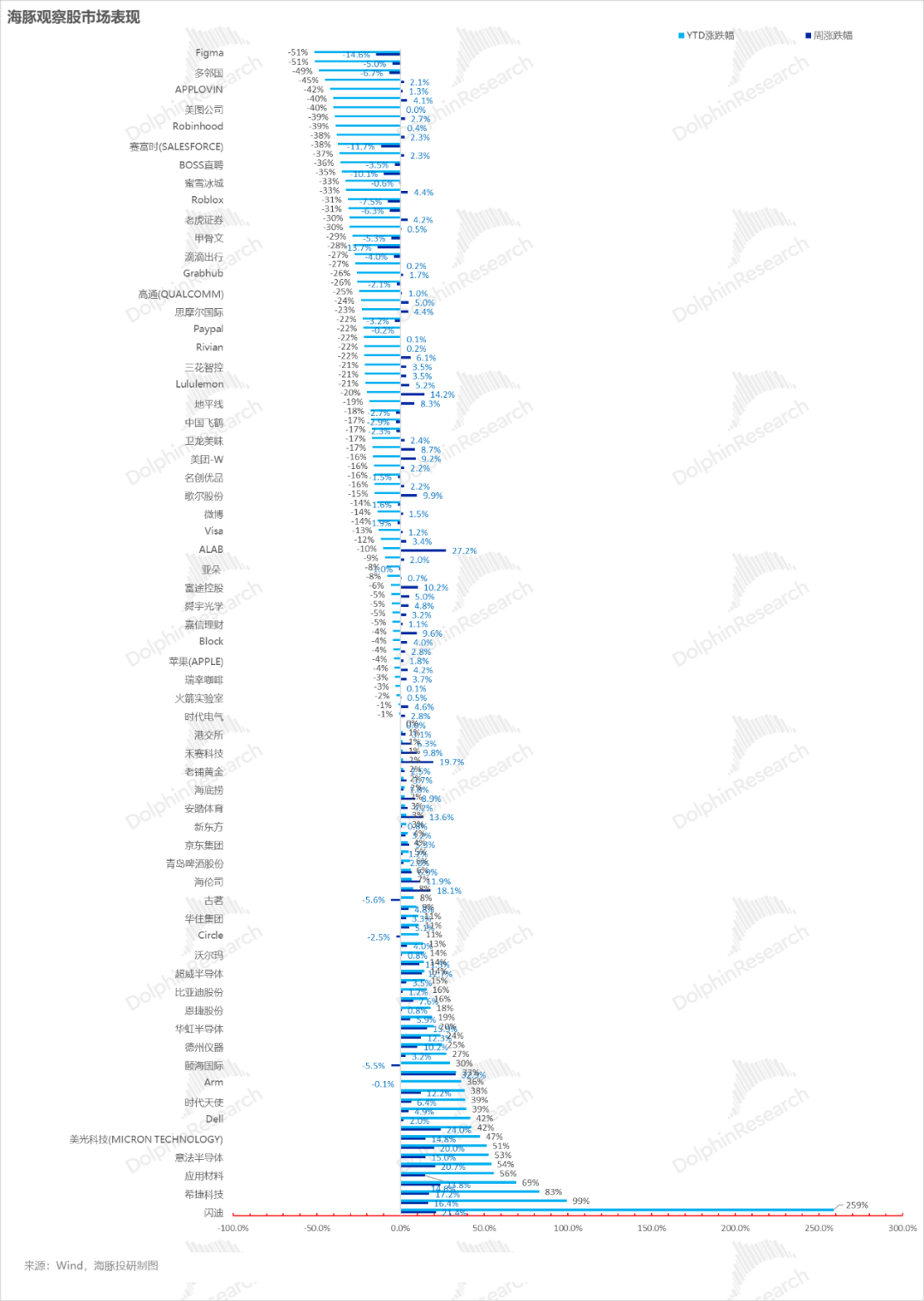
Two influential market forces are taking shape: politically, from the US's decapitation strike on Venezuela to its "epic fury" against Iran, actions are targeting "energy, resources," and "energy transportation chokepoints."
Coupled with the severe mismatch in power infrastructure during AI infrastructure development, traditional energy and industrial resources, such as energy, non-ferrous metals, and other resources, have surged even more fiercely than semiconductor production material stocks.
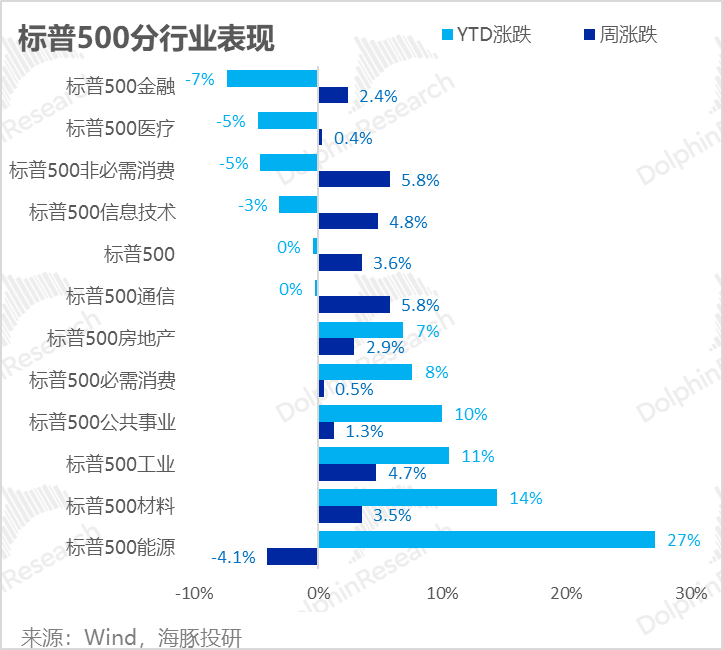
In essence, unlike 2025, when the focus was on comparing model superiority (e.g., Google) and leveraging AI for revenue growth and efficiency gains, leading to the rise of Palantir and even Meta, 2026 sees the market seeking high certainty amidst macroeconomic uncertainty. In the short term, the question is: who clearly benefits from AI capital expenditures? In the long term, if AI truly replaces human labor, what demands will it permanently reshape?
For these two queries, short-term certainty lies in memory prices, already reflected in the market, and upstream capital expenditure equipment and network stocks along this chain.
Long-term, AI's replacement of human labor implies computational power supplanting brainpower. Computational power requires electricity, while brainpower relies on carbohydrates. Thus, the future "silicon-based intelligence" of power + computational power suggests that AI will fundamentally reshape future energy demand.
Energy and commodities may undergo a protracted transformation, but they represent a long-term, sustained investment opportunity.
Dolphin Research believes that the revaluation of energy and commodity resources will be a time-consuming process.
However, the dynamics between traditional internet and AI—whether they will cooperate or disrupt each other, who will bear the infrastructure risks, and how business models will evolve—will take time to unfold. When internet assets are excessively undervalued, trading opportunities emerge.
Thus, for 2026 investment themes, Dolphin Research identifies sustained opportunities in energy and commodity-related assets. In the AI era, the competitive symbiosis between traditional internet assets and AI also presents opportunities for buying low and selling high amidst stock price fluctuations.
2. TACO Process: Focus on the Outcome, Not the Journey
The Trump administration has clearly recognized the pivotal role of energy in the ultimate AI showdown. Hence, as soon as the tariff trade war abates, it launches an energy scramble. Ignoring the twists and turns of war and negotiations, and the duration of the conflict, let's examine the current state of the US economy:
a. At the consumer level, household wealth appreciation has been overly reliant on asset appreciation. Prolonged equity market sluggishness not only affects asset returns but also erodes consumption willingness in the real economy.
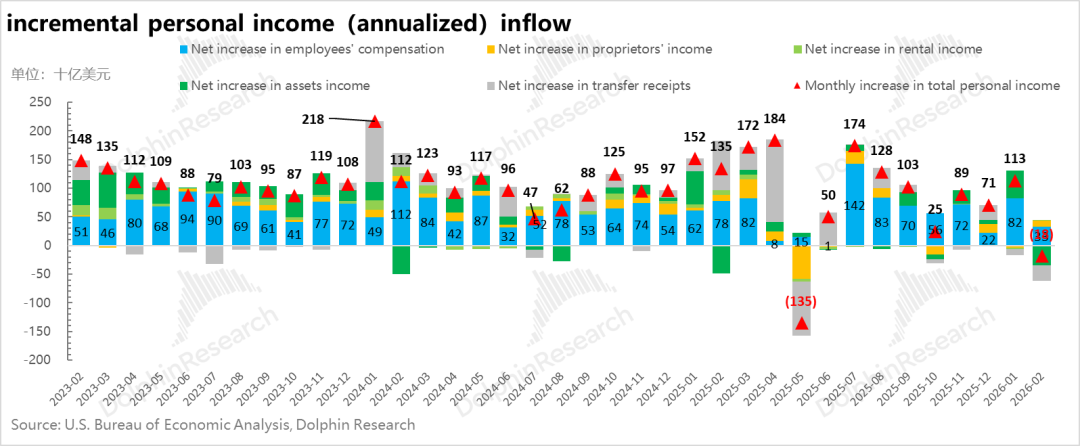
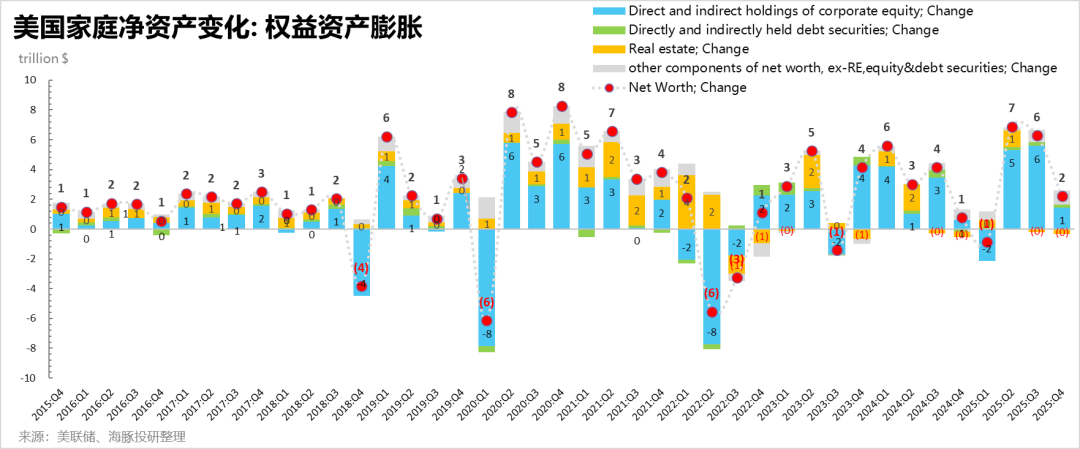
b. Sustained high oil prices will fuel inflation expectations. Given the current US fiscal high-interest payment pressures, using high oil prices to inflate and burden residents is unsustainable for US fiscal borrowing.
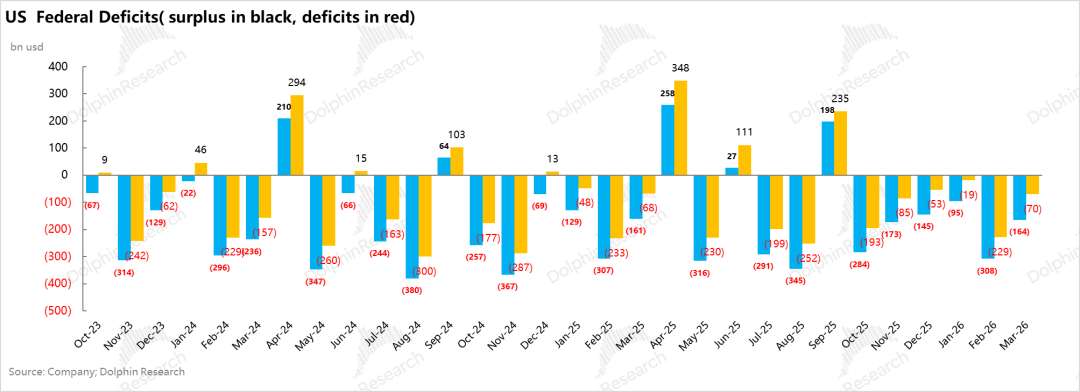
This implies that regardless of whether Iran wins or loses the war, or if it shifts from high-intensity to prolonged, low-intensity conflict, the Trump administration will strive to restore Hormuz Strait navigation before elections, crafting a narrative of "victory" through paper peace.
US midterm elections see each party select candidates from March to June, followed by a two-party competition period from June to October to "discredit the opponent's candidates." Prolonged unresolved wars clearly disadvantage the ruling party.
Thus, between mid-April and June, we should witness a de-escalation in the Hormuz Strait situation. Market fluctuations during negotiations offer opportunities to buy undervalued assets, unlike at the war's onset when excessive optimism and risk accumulation prevailed.
3. Portfolio Performance
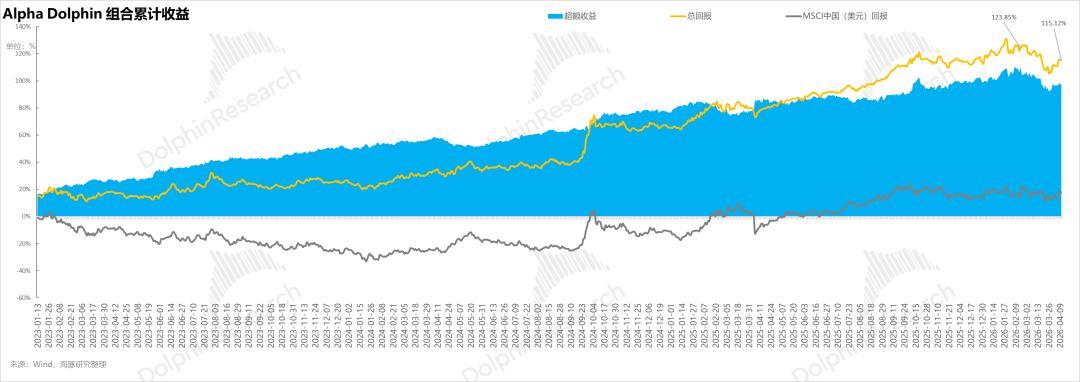
Last week, the Dolphin Research virtual portfolio, Alpha Dolphin, made no adjustments. It gained 2%, underperforming the CSI 300 (+4.4%), MSCI China Index (+3.1%), Hang Seng Tech (+3.9%), and S&P 500 (+3.6%).
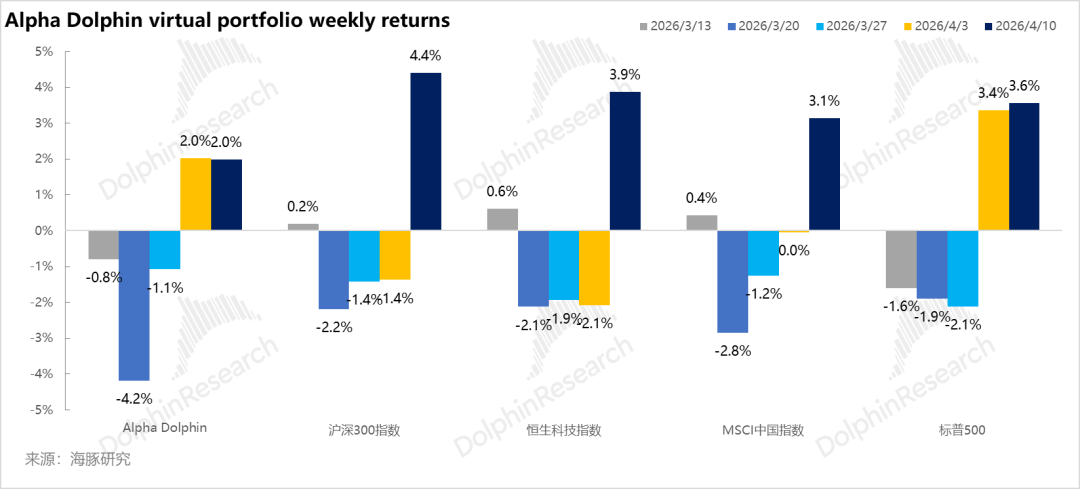
Since its inception testing (March 25, 2022) until last weekend, the portfolio's absolute return stands at 115%, with an excess return of 97% compared to MSCI China. From a net asset value perspective, Dolphin Research's initial virtual assets of $100 million have grown to exceed $218 million by last weekend.
4. Individual Stock Performance Contributions
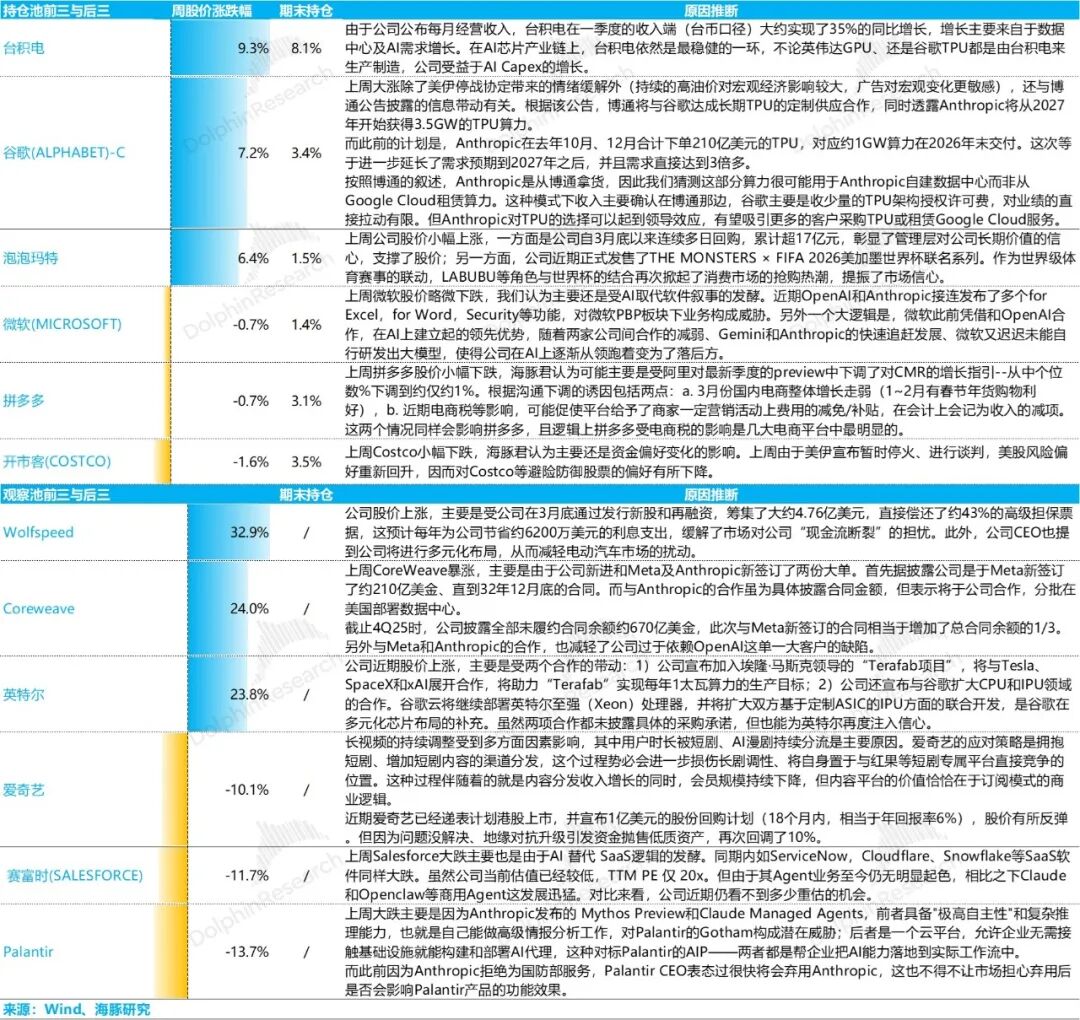
Last week, as the war gradually entered negotiable stages, various assets generally recovered. The primary recovery in the virtual portfolio was in high-quality AI assets.
Considering the portfolio has not been adjusted for some time and investment logic has significantly evolved in 2026, Dolphin Research will prioritize rebalancing and active management in the coming period.
5. Asset Portfolio Allocation
The Alpha Dolphin virtual portfolio's asset allocation details have been published in the Changqiao App's "Dynamic - Depth (Research)" section under the same-titled article.
6. Key Events This Week:
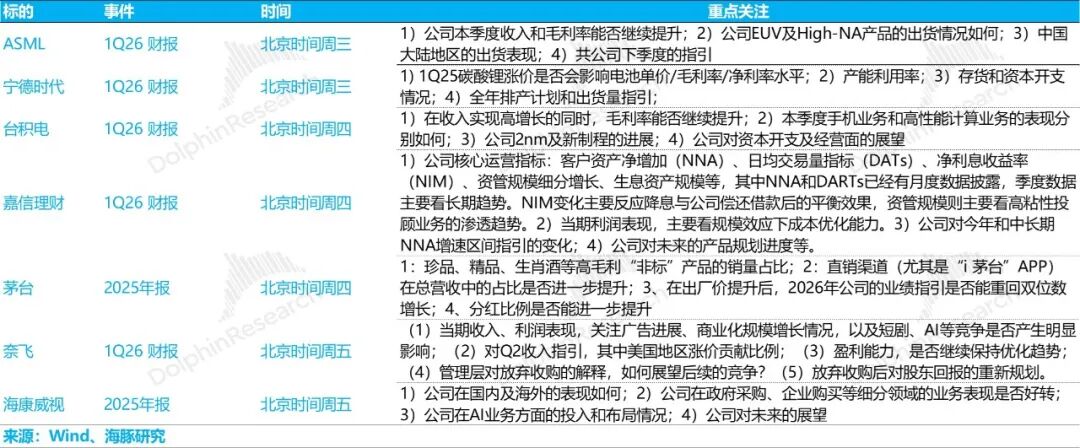
As we enter mid-April, the US stock market gradually transitions into earnings season. Two semiconductor giants, ASML and TSMC, are set to release earnings, along with other key companies like CATL and Netflix. Key points to watch are summarized below:
- END -
// Reprint Authorization
This article is an original piece by Dolphin Research. Reproduction requires authorization.
// Disclaimer and General Disclosure
This report is intended for general comprehensive data purposes, catering to users of Dolphin Research and its affiliates for general reading and data reference. It does not take into account the specific investment objectives, product preferences, risk tolerance, financial status, or unique needs of any recipient. Investors must consult independent professional advisors before making investment decisions based on this report. Any investment decisions made using or referencing this report's content or information are undertaken at the investor's own risk. Dolphin Research shall not be held responsible for any direct or indirect losses arising from the use of this report's data.
The information and data in this report are sourced from publicly available materials and are for reference only. Dolphin Research strives to ensure, but does not guarantee, the reliability, accuracy, or completeness of this information and data.
The information or views mentioned in this report shall not be considered or construed as an offer to sell securities or an invitation to buy or sell securities in any jurisdiction. They also do not constitute recommendations, inquiries, or endorsements of relevant securities or related financial instruments. The information, tools, and materials in this report are not intended for distribution to jurisdictions where such distribution, publication, provision, or use contradicts applicable laws or regulations or requires Dolphin Research and/or its affiliates or associated companies to comply with any registration or licensing requirements in such jurisdictions, or to citizens or residents of such jurisdictions.
This report solely reflects the personal views, insights, and analytical methods of the relevant creators and does not represent the stance of Dolphin Research and/or its affiliates.
This report is produced by Dolphin Research, with copyright solely owned by Dolphin Research. No institution or individual may, without prior written consent from Dolphin Research, (i) make, copy, reproduce, duplicate, forward, or any other form of copies or replicas in any way, and/or (ii) directly or indirectly redistribute or transfer to other unauthorized persons. Dolphin Research reserves all related rights.
-
![]()
Wang Huiwen, Former Meituan Executive, Achieves 20-Fold ROI, Supports 24 AI Startups
-
![]()
Another AI Computing Power Unicorn Launches IPO! Founded by a Changjiang Scholar
-
![]()
OFILM Holdings Secures Zhongke Daojing, Marking a Significant Leap in the Optical Communication Industry!
-
What Will Be the Next Key Battleground for Large Models After AI Coding?
-
![]()
Leapmotor's Sales Soar, Yet Hidden Concerns Loom
-
![]()
China’s Action Camera Market Soars: 3.12 Million Units Sold in Six Months, DJI Secures 74% Dominance
-
![]()
Zhang Yiming: Strategic Retreat as a Path Forward
-
![]()
Exploring Charging for Some Features of QianWen App: Can It Follow the Path of Doubao?