Monthly Salary Offer of 30,000 Yuan for AI Talent Hijacked: Has the AI Talent Dividend Era Dawned?
 04/14 2026
 637
637

Author: Tang Fei
Editor: Li Xiaotian
"We're eager to hire AI experts, but the cost is simply prohibitive."
These words were spoken by Jing Yang, the head of recruitment at a listed gaming company based in Beijing. "Fresh graduates specializing in AI are in extremely high demand. In previous years, offering a monthly salary of 10,000-15,000 yuan for a novice AI Golang engineer was considered generous. This year? Many have received job offers of 30,000 yuan even before completing their theses."
It's not just fresh graduates; seasoned AI professionals are also in the midst of a fierce bidding war. Jing Yang revealed that over the past four years, she hadn't witnessed a single instance of "talent being poached," but this spring alone, it happened four times within just two months.
"We targeted a game designer who had been deeply involved in an AI-related project. We offered a monthly salary of 30,000 yuan, and the candidate accepted, agreeing to start the following week. However, another company swooped in with an offer of 36,000 yuan and snatched him away. This candidate's previous salary was only 23,000 yuan, and our raise was already above market standards," Jing Yang recounted.
It appears to be widely acknowledged that in the AI boom, "securing talent" equates to "securing the future."
Yet, if we merely glance at the headlines, it seems as though global tech giants are in retreat—Amazon, Oracle, Meta, NetEase, Tencent, and ByteDance have all announced layoffs in succession. On social media, some voice complaints, others express anxiety, some switch careers, and pessimists even declare that "pursuing a computer science degree is a dead end."
On one hand, there are mass layoffs affecting thousands; on the other, companies are desperately seeking talent, fearful of losing candidates to competitors by even a moment's delay. The reason behind this stark contrast is straightforward: it's not that there are fewer jobs, but rather that the skill requirements for jobs have evolved.

Globally, China and the United States are undeniably at the forefront of AI.
The "Global AI Enterprise Technology Innovation Index Report 2026," released at the end of March 2026, selected 100 of the most innovative AI companies worldwide. China accounted for 51, while the US had 37, collectively monopolizing 88% of the global top tier.
Nevertheless, it is precisely these two countries that are experiencing both layoffs and hiring sprees amid the current AI boom—a "Song of Ice and Fire."
Let's first examine China. Early this year, Maimai Gaopin released data indicating that from January to February 2026, the number of newly posted AI jobs in China surged by 12 times year-on-year, accounting for 26.23% of all new economy sector jobs. In other words, one in every four new jobs is AI-related.
Among these, industry "luminaries" are the most sought-after strategic resources. Tencent poached Yao Shunyu from OpenAI, Xiaomi hired Luo Fuli from DeepSeek, and ByteDance successfully recruited Yu Bowen, the post-training lead for Alibaba's Tongyi Lab's Qwen large model. These names may be unfamiliar to the general public, but within the AI community, each is a heavyweight.
More noteworthy, however, is the attitude of major companies toward fresh graduates and interns.
At Alibaba, 80% of campus recruitment positions are AI-related, with daily intern salaries of 500 yuan for roles in algorithms, AI R&D, and AI products. ByteDance's Seed campus recruitment program offers "virtual shares" to new hires, granting fresh graduates a "shareholder" identity from day one. Tencent released over 10,000 intern positions this year, declaring that salaries for the 2026 intern cohort would have "no upper limit."
Data from Zhaopin for the first three weeks after the Spring Festival shows a 39.2% year-on-year increase in AI engineer positions for fresh graduates, compared to a 22% increase for all positions. The demand growth for fresh graduates in AI exceeds the overall average by 17 percentage points, underscoring companies' emphasis on and the talent gap for AI fresh graduates.
In terms of salary, the average monthly recruitment salary for fresh AI engineer positions has reached 17,038 yuan, making it a high-quality choice with both value and development potential for fresh job seekers.
You might wonder, how valuable can an intern be? The answer: In AI, a talented young person can be more valuable than an average full-time employee.
Firstly, young people lack "path dependency" and are willing to try anything new. For instance, Sam Altman founded OpenAI at the age of 28, betting on large language models.
Secondly, young people dare to become "obsessed" with new things, and this near-fanatical persistence is often a prerequisite for success.
In Yao Shunyu's doctoral dissertation acknowledgments, he wrote, "In 2019, I proactively contacted my advisor, saying, 'Language models like GPT-2 look promising and might be directly applied to solving text-based games.' Over the next five years, I not only achieved fruitful research results but also forged a mentor-friend relationship with my advisor." He began his "obsessive" research into language models at 19 and became a top expert in the field five years later.

Now, let's turn our attention to the United States. Data disclosed by Business Insider shows that monthly salaries for AI-related internships and research-based short-term programs have surged to the $7,000–$18,000 range, equivalent to approximately 49,000–126,000 yuan. Leading companies offer annual salaries of 2–3 million yuan for top AI PhDs.
Specifically, OpenAI interns in San Francisco can earn up to $18,300 per month; Google DeepMind interns receive a base annual salary of $113,000–$150,000, along with the same medical, dining, and transportation benefits as full-time employees; Meta offers multiple 12–24-week research internships for PhD candidates or those with equivalent research backgrounds, with salaries ranging from approximately $7,650–$12,000 per month; Amazon offers robotics algorithm interns an hourly wage of $107.
Even Steve Huffman, CEO of Reddit—a social platform not primarily associated with AI—publicly stated, "We need to hire more fresh graduates." His reasoning is simple yet direct: This generation is AI-native, having grown up with code at their fingertips and algorithms in their minds, synchronized with AI's evolution.
Huffman even calculated: (Fresh graduates) using AI tools to learn programming are twice as fast as traditional methods; their understanding of large language models is more intuitive than that of "old engineers." Most importantly, they are "zero-depreciation," free from traditional industry mindsets.
"If you don't hire them now, you'll never find them later," Huffman asserted. "The best fresh graduates must be locked in immediately after graduation; otherwise, they'll take their projects elsewhere." This is both a talent grab and an investment in the future.

If we solely consider the numbers, China is not lacking in AI talent.
The Economist tracked the educational backgrounds of researchers who published papers at the 2025 Conference on Neural Information Processing Systems (NeurIPS). It found that 50% of AI researchers began their careers in China (up from 29% in 2019), while the proportion of researchers starting in the US dropped from 20% to 12%. This indicates a reshuffling of the global pipeline for top AI research talent.
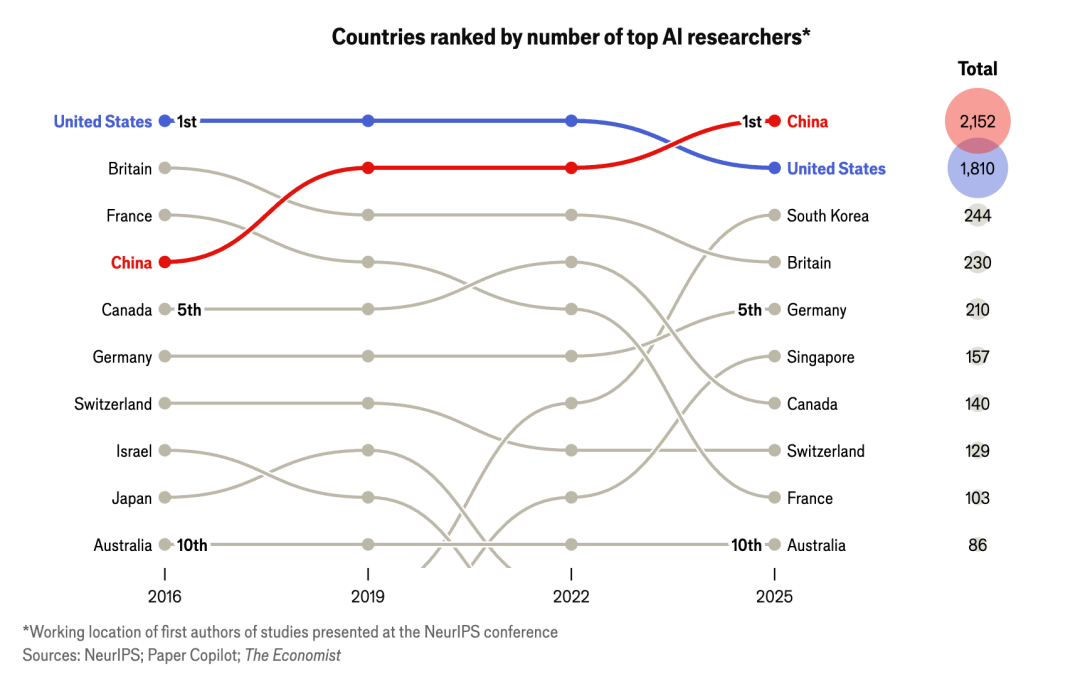
More telling is that among the top 10 undergraduate institutions of NeurIPS 2025 paper authors, nine are Chinese universities. Graduates from Tsinghua University alone accounted for 4% of all NeurIPS researchers, while MIT, the top US institution, accounted for just 1%.
This seems sufficient to demonstrate that China is becoming the most critical source of global AI talent.
On the other hand, China leads globally in both the quantity and quality of AI research papers. In 2025, data from the World Intellectual Property Organization showed that China had become the largest holder of AI patents worldwide, accounting for 60%.
Curiously, despite our leading quantity and quality, anxiety persists.
One source of anxiety is employers, especially big companies, over-competing for top-tier talent. Leading companies offer annual salaries of up to 1 million yuan for top AI talent, often targeting these "genius youths" before they even graduate. However, for the vast majority of ordinary AI or computer science graduates, the threshold for entering big companies keeps rising.
Jing Yang mentioned that companies now prioritize AI skills above prestigious university backgrounds (211, 985) or big-company experience. "New hires must be AI-literate—art, design, technology, marketing, everyone is the same. This is a hard requirement across the market," she said.
Ma Jin, a computer science undergraduate graduating in June, told Xiaguang Society that despite his major, his ordinary undergraduate status puts him at a disadvantage in Beijing's competitive job market.
"Especially after AI became popular this year, even the village aunties know it can replace humans in many tasks, making me even more aware of the tough job market. To improve my chances, I haven't stopped since the Spring Festival. I've earned certificates like Alibaba's DAMO Academy AI Trainer, iFLYTEK's Intelligent Agent Engineer, and IBM's AI Educator—all through free learning and exams. I've also started paid courses for DeepLearning AI, Columbia's Large Language Model certificate, and Stanford's AI Engineer certificate, with exams scheduled for April.
"The past two months, though I haven't attended school, have been more stressful than final exams. These online courses range from a few days to a couple of months, and my daily life consists of nothing but attending classes and preparing for exams," Ma Jin said. "Recently, I heard in class group chats that big companies prefer graduates with humanities backgrounds, so I enrolled in the 'Chinese Grotto Culture: History and Value Inheritance' training program, which also offers a certificate upon completion. I hope to join a team like *Black Myth: Wukong* someday.
Despite his efforts, Ma Jin's job search hasn't gone smoothly—he hasn't even secured an internship.
He's not alone in his anxiety. According to him, none of his 70 classmates have landed internships at major companies. Besides those like him who are "certificate-hunting" for job opportunities, some have started preparing for the civil service exams.
A similar scenario is unfolding across the ocean.
The AI Talent Report released by the US Council of Economic Advisers (CEA), a White House economic policy advisory body, states, "The US AI talent gap has surpassed 4 million, triggering a 'red alert' for talent shortages. International students, especially from China, have become the backbone of the US AI field."
Two main factors contribute to this massive gap: First, visa policies have tightened sharply—in 2025, H-1B application fees soared to $100,000, disproportionately affecting Chinese and Indian tech talent. Second, mass layoffs have triggered talent outflows. Since 2025, US tech companies have laid off approximately 98,000 employees, with giants like Amazon, Microsoft, and Meta continuously cutting jobs. The resulting anxiety and unstable career prospects have accelerated the talent exodus.
To fill the 4 million talent gap, the US has proposed a series of AI talent supply strategies: First, strengthen domestic cultivation by increasing enrollment in AI-related majors, boosting teaching resources, and raising university admission and graduation rates to expand the potential AI talent pool. Second, lower immigration barriers and optimize H-1B visa and green card policies to attract international AI talent while retaining domestic AI graduates. Third, divert talent from other industries by increasing AI research funding, optimizing industrial policies, and removing barriers to attract professionals from other fields into AI.
But policy adjustments take time, while companies' hiring needs are urgent.
Zooming out, the AI talent shortage is not just a China-US issue but a global predicament.
According to the IFF Global AI Competitiveness Index Report, the current global AI talent pool stands at approximately 3 million, with 32.6% in R&D and technical roles. By 2030, the global AI talent gap could exceed 2.8 million, nearly doubling from current levels.
2.8 million is equivalent to the population of Chicago, the third-largest city in the US—and this is just the gap, not the total.
Against this backdrop, the talent war among companies will only intensify. Those that can secure top graduates early will gain an edge in the technological competition of the coming years. Those that lag in hiring may be left behind.
As *The Economist* noted in its article "The AI talent war is becoming fiercer," talent is the "oil" of the AI era. From an economic perspective, the talent war is essentially a contest of "factor mobility." Talent is not a static resource but a "flowing asset" that chases marginal returns.

So, what kind of talent are big companies vying for?
The recruitment requirements of Jingyang Company are that candidates must be able to use AI and have a very deep understanding and knowledge of AI. In short, 'We are hiring people who can use AI, who embrace change. I believe those who can research AI, learn AI, and apply AI well are scarce.'
Jingyang took the game art position as an example. For instance, if each artist can produce 80 images per month, while another employee can produce 100 images per month with the help of AI, their efficiency differs by more than 20%. The one who does not advance will eventually be eliminated.
'People who use AI well can improve efficiency. Suppose there are 10 people in a department, and all of them increase their efficiency by 20%, then this team will be highly competitive in the entire market,' she said.
In a speech, Zeng Ming, Chairman of the Academic Committee at Alibaba Group and Dean of Education at the Zhejiang Hupan Entrepreneurship Research and Study Center, outlined the "three shared traits of talent in the AI era".
The first trait is exceptional metacognitive ability. Such individuals excel in abstract modeling, can discern the core of problems, and are inclined to think using first principles. This explains why those proficient in applied mathematics are especially sought after in the AI age; they possess the rare skill of translating the real world into mathematical models.
The second trait is self-driven motivation and curiosity. These individuals derive pleasure from transforming the world; the concept of "lying flat" (a term referring to a lack of ambition or effort) is foreign to them. Genuine entrepreneurs in Silicon Valley now embrace a "9-12-7" work ethic—working from 9 a.m. to 12 a.m., seven days a week—driven not by pressure but by passion.
The third trait is the capacity for rapid learning and boundary-crossing. One individual can now perform the duties of seven or eight traditional job roles, adapt to multiple positions, and even single-handedly support a company.
When we delve into the core of talent competition amidst the AI wave, it becomes clear that talent is the primary resource, and innovation is the primary driving force. Whoever secures top AI talent will be poised to shape future technological standards, industrial ecosystems, and even global discourse.
For individuals, evolving towards being "composite, scenario-based, and globalized" may be the optimal path to adapt to a rapidly changing world.
As the AI revolution progresses, there are also those who adopt a cautious stance amidst widespread anxieties.
A headhunter from a prominent company, with over a decade of industry experience, shared their insights: "I've witnessed numerous trends. Twenty years ago, during the heyday of the mobile phone market, iOS and Android developers were in high demand. Ten years ago, product managers were all the rage, with training courses popping up everywhere, making it seem like anyone could become one. Seven or eight years ago, during the blockchain craze, talent in digital currencies and encryption technologies was scarce. Five years ago, with the rise of live-streaming e-commerce, everyone scrambled to hire data analysts and product selectors. But looking back now, each industry trend lasted only a few years, and the pace of training people clearly can't keep up with the frenzy of hiring."
"Ordinary people shouldn't always chase trends. The reason they remain ordinary is their slow reaction time and lack of foresight. By the time everyone recognizes something as a trend, it's already too late to jump on the bandwagon. So, for many, the best career strategy is not to chase trends but to excel in what they're currently doing or what genuinely interests them," the headhunter concluded.
-
![]()
Tesla Restructures Its Balance Sheet
-
![]()
Accelerating the High-Speed Interconnection Upgrade of AI Computing Clusters! JONHON Releases ELSFP External Light Source Optical Connectors
-
![]()
Breaking the overseas blockade of volumetric holographic materials, this optical enterprise secures nearly 100 million yuan in financing!
-
![]()
Why Does Jensen Huang So Openly Praise China’s AI?
-
![]()
"Wudang" Unveiled: Arm China's Next-Gen AI VPU Redefines Video Encoding
-
![]()
From Energy Conservation and Carbon Reduction to AI Decision-Making: GECON East Intelligence and Chery Group Explore a New Green and Smart Paradigm for Automobile Manufacturing
-
![]()
WAIC 2026 Observation | AI Accelerates Towards the Core of Industries, Industrial AI Enters a Critical Phase
-
![]()
Volkswagen China Fires the First Shot in Foreign-Funded 'White Box Delivery'!