HappyHorse: Alibaba’s Strategic Comeback
 04/14 2026
 457
457

Source | Bohu Finance (bohuFN)
Author | Lu Fei
Recently, a model named HappyHorse-1.0 soared to the top of the Video Arena rankings, outperforming industry leaders such as ByteDance’s Seedance 2.0 and Kuaishou’s Kling 3.0. As speculation mounted over the model’s origin, Alibaba quickly claimed ownership, expressing gratitude for the attention and confirming that HappyHorse is indeed their creation.

Anonymous submissions for ranking are a common practice in the industry, designed to prevent brand bias in testing results and leverage suspense to attract attention. Both outcomes were precisely what Alibaba needed at this juncture.
The departure of Lin Junyang, a key figure from the Qwen team, while raising awareness of Alibaba’s contributions to the open-source model community, also sparked fresh doubts about Alibaba’s AI investments.
The establishment of Alibaba’s ATH Business Division marked the beginning of a counterattack. From March 30 to April 2, within just a few days, the Tongyi Laboratory released three flagship models: Qwen3.5-Omni, a full-modal interaction model; Wan2.7-Image, a visual generation model; and Qwen3.6-Plus, a large language model. Just one day after its release, the Qwen3.6-Plus model, specializing in programming capabilities, surged to the top of the daily rankings on the large model API platform OpenRouter.
Last week, Alibaba launched a second counterattack with a new wave of organizational adjustments. First, a Technical Committee was formed, led by Wu Yongming, with members including Zhou Jingren, Wu Zeming, and Li Feifei. Second, the Tongyi Laboratory was upgraded to the Tongyi Large Model Business Division, headed by Zhou Jingren, while Lei Yanqun, a seasoned executive from the China Supplier team, was appointed CEO of Taobao Flash Sales.
These moves signify a heightened focus on large model R&D within Alibaba, with HappyHorse serving as a high-profile technological showcase.
01 A Narrative Interruption
Over the past year, from a third-party commercial perspective, Alibaba and ByteDance have emerged as the twin stars of China’s AI landscape.
Alibaba’s investment in large models has been consistent and clear—a comprehensive approach. The company has steadily advanced its plans.
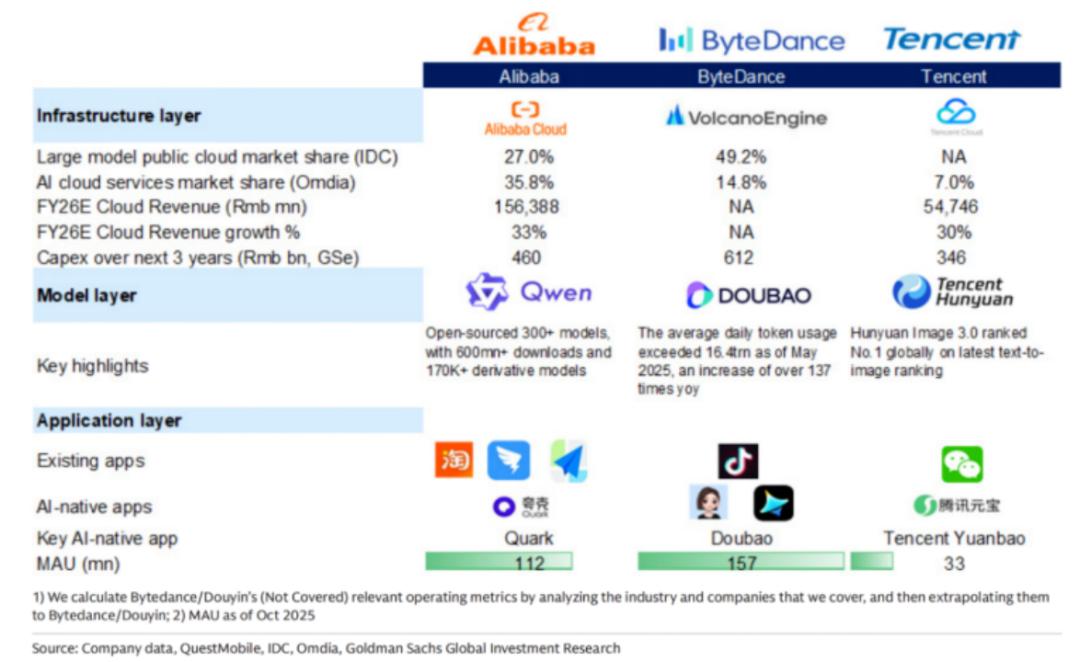
According to a previous Goldman Sachs report, Alibaba leads in external AI cloud revenue at the enterprise level, holding a market share of 35.8%, compared to ByteDance’s 14.8% and Tencent’s 7%.
In terms of models, the Qwen series is the most influential open-source model; in the B-end market, Alibaba assists enterprises in transforming and restructuring their production and operations through the Alibaba Cloud BaiLian platform; at the C-end application level, apps like Kuake and Qianwen have been launched, while sibling company Ant Group has accelerated its entry, introducing “Lingguang” for office scenarios and “Afu” for lifestyle services, comprehensively covering user needs from search and creation to finance and daily interactions.
Even at the hardware level, Alibaba launched the “Kuake AI Glasses,” integrating seamlessly into the Alibaba ecosystem and selling over 3,000 units in just three days.
However, the viral success of ByteDance’s Seedance 2.0 during the Spring Festival and Lin Junyang’s departure threatened to disrupt this narrative.
On one hand, there was internal friction within the group.
According to previous reports by 36Kr, during a group meeting following the resignation of the Qianwen large model lead, Zhou Jingren, responding to questions about internal computing power shortages, admitted that the team was indeed “resource-constrained” due to historical reasons, with overall planning underway for the future.
This reflected a lack of internal consensus at Alibaba at the time, leading to common pitfalls where “model teams complained about insufficient computing power, cloud teams complained about models being too heavy, and platform teams felt adaptation was poor.”
It also raised questions: In the AI era, can bottom-layer model R&D succeed if the founder either understands the technology personally (able to digest papers and discuss with frontline researchers) or delegates to knowledgeable individuals, relying on systems and strategies?
Sentiment in the secondary market was clear. Over the past two months, Alibaba’s stock price has retracted by approximately 30%-40% from its peak, significantly underperforming other tech stocks. Even with continued growth in cloud and AI revenue, doubts about Alibaba’s AI narrative have increased. Meanwhile, ByteDance’s valuation has soared, ascending to become Anthropic's "counterpart."
Thus, whether through the establishment of ATH or new organizational and personnel changes, Alibaba is undergoing a power restructuring to better adapt to the AI era.
First, the Tongyi Laboratory was upgraded to the Tongyi Large Model Business Division, with Zhou Jingren taking full charge while stepping down from his CTO role.
Within Alibaba, Zhou Jingren is a cross-cloud, cross-algorithm, and cross-business figure, with a track record as Alibaba Cloud’s CTO that speaks for itself, both in terms of model performance and commercialization. However, in the past, Zhou had to oversee both Alibaba Cloud’s overall technology and large model R&D, stretching his attention thin. The current adjustment places the most technically knowledgeable person at the forefront, further strengthening and focusing model development.
Second, responsibilities for model technology, cloud infrastructure, and business operations were further clarified. The Technical Committee’s three members—Zhou Jingren handles technical exploration and pursues model limits; Li Feifei enhances infrastructure efficiency and cost structures; Wu Zeming coordinates AI integration with other businesses.
Alibaba aims to clearly communicate to the market that “AI-first” remains its top strategy, with top-tier model development holding the highest priority.
02 Why HappyHorse?
The reason HappyHorse is seen as a high-profile technological demonstration is that it did not originate from the Tongyi Laboratory, which was at the center of previous controversies, but from the Innovation Business Division under ATH.
After the establishment of the ATH Business Group, each of the five divisions has distinct functions. The Tongyi Laboratory pursues model capability limits; the MAA Business Line builds model service platforms; the Qianwen Business Division focuses on C-end AI assistants; the Wukong Business Division focuses on creating B-end AI-native work platforms; and the Innovation Business Division explores various AI innovation applications, rapidly validating new models and markets.
According to reports, the main research force behind HappyHorse comes from the Future Life Laboratory of the former Taotian Group, led by Zhang Di, the former vice president of Kuaishou and former technical lead of Kling AI. Backed by Alimama, this innovation project received support in terms of computing resources. “HappyHorse used Alibaba’s top-tier internal cards for ranking submissions, referred to internally as ‘big cards,’ specifically H100s.”
The video generation track (competitive arena) is currently one of the hottest fields.
Seedance 2.0’s debut shocked the industry, even prompting foreign practitioners to seek domestic phone numbers. With its simple creation process and realistic visual effects, Seedance 2.0 became the tool of choice for many content creators and short drama teams. Tan Dai, president of Volcano Engine, stated that producing a high-quality animated drama previously cost over 10,000 yuan per minute, but now, with Seedance 2.0, costs can be reduced by 4,000-5,000 yuan per minute.
This technology has sparked an industrial wave. According to DataEye Research Institute estimates, the national animated drama market size will reach approximately 16.8 billion yuan in 2025 and is expected to grow to 24.4 billion yuan in 2026, with AI driving rapid supply-side capacity growth. The leader of the Internet Thieves’ Guild shared in a livestream that AI-generated animated dramas can now produce up to a thousand episodes per month.
However, Seedance 2.0’s bottlenecks are also evident. On social media, many users complain about waitlists of up to 100,000 people, with waiting times of several hours to generate a 15-second video, and no guarantee of success.
Some creators also note that while the “waitlist” situation for Seedance 2.0 has eased recently, it comes at the cost of degraded video quality, with some “intelligence reduction” issues.
For example, Seedance 2.0’s fast version, while capable of clearly presenting subject structures and basic camera movements, tends to exhibit physical distortions when handling multi-person interactions or fine texture requirements, making it more suitable for single tasks. For ordinary users, the impact from the standard to fast version may be minimal. However, for short drama and animated drama practitioners, where previously two or three generations would yield usable material, now seven or eight may be needed to select one viable option.
Thus, on April 8, ByteDance chose to indirectly raise prices: prices remained unchanged, but monthly points (points) for basic, standard, and premium memberships were reduced from 1,080, 4,000, and 15,000 to 725, 2,210, and 6,160, respectively.
At least in the video generation track (competitive arena), ByteDance maintains an advantage, but the gap has not widened further.
It is reported that during the beta testing phase, Alibaba Cloud has begun recommending “HappyHorse” to its clients. While Alibaba will face the same issues as Seedance 2.0 once services open, the later-arriving HappyHorse has more time to make judgments and pricing decisions.
At that point, Alibaba will once again face ByteDance head-on in the video generation battlefield.
The cover image and accompanying illustrations in the article are owned by their respective copyright holders. If the copyright owners believe their works are unsuitable for public browsing or should not be used without compensation, please contact us promptly, and our platform will immediately make corrections.
-
![]()
Tesla Restructures Its Balance Sheet
-
![]()
Accelerating the High-Speed Interconnection Upgrade of AI Computing Clusters! JONHON Releases ELSFP External Light Source Optical Connectors
-
![]()
Breaking the overseas blockade of volumetric holographic materials, this optical enterprise secures nearly 100 million yuan in financing!
-
![]()
Why Does Jensen Huang So Openly Praise China’s AI?
-
![]()
"Wudang" Unveiled: Arm China's Next-Gen AI VPU Redefines Video Encoding
-
![]()
From Energy Conservation and Carbon Reduction to AI Decision-Making: GECON East Intelligence and Chery Group Explore a New Green and Smart Paradigm for Automobile Manufacturing
-
![]()
WAIC 2026 Observation | AI Accelerates Towards the Core of Industries, Industrial AI Enters a Critical Phase
-
![]()
Volkswagen China Fires the First Shot in Foreign-Funded 'White Box Delivery'!