Traditional Eyewear Powerhouses Will Miss Out on Profits from Apple’s AI Glasses
 04/14 2026
 485
485
While the entire extended reality (XR) industry grapples with challenges related to microdisplay brightness and waveguide production yields, Apple, the tech behemoth, has opted for a low-key yet pragmatic approach. It is now confirmed: Apple’s upcoming AI glasses will entirely forgo a traditional display.
To outsiders, the omission of a display might appear as a step backward in Apple’s technological prowess or an attempt to mimic Rayban Meta. However, we believe this move is a calculated decision by Cook's team, taking into full consideration the existing supply chain infrastructure.
The highly anticipated fusion of high-quality augmented reality (AR) technology with a lightweight form factor and extended battery life may not become a reality until 2030. Therefore, rather than persisting in the struggle to enhance the wearability of heavy devices like the Vision Pro, it would be wiser to pivot directly and vie for the defining standards in the metaverse track (Meta track).
Consequently, Apple will never tread the same commercial path as Meta.
Today, we have released three articles offering diverse perspectives on Apple’s new AI glasses. This marks the final installment of today’s Apple series—let’s delve into how Apple intends to profit from these glasses.

01 Apple May Eschew Channel Profit Sharing
Currently, the business models in the Sino-US AI glasses sector essentially represent a 'compromise between hardware and software.' Tech giants supply system-on-chips (SoCs) and computational power, while traditional eyewear powerhouses contribute the frame (chassis) and distribution channels.
Meta, the frontrunner, heavily relies on EssilorLuxottica’s distribution network and Ray-Ban’s brand legacy. As followers, Google and Samsung have opted to forge deep partnerships with Warby Parker. Domestic eyewear companies, too, have their unique strategies, but the core essence remains unchanged.
However, Apple’s N50 has disrupted this status quo and is poised to rewrite the rules. Sources have unequivocally stated that Apple retains complete autonomy over the glasses’ design. Behind this seemingly mundane decision lies Apple’s highly aggressive commercial and distribution strategy:
Competing for Bill of Materials (BOM) Definition Rights: Traditional eyewear giants often wield control over industry barriers related to frame materials and ergonomics. Had Apple collaborated with them, it would have inevitably had to compromise on industrial design (ID).
To firmly grasp hardware definition rights, Apple’s test prototypes directly employ high-end acetate fiber materials—more durable and textured than conventional injection-molded plastics. Paired with four distinct frame styles (refer to this article: 'After all this waiting, is this it? Apple AI glasses’ appearance design disappoints, but the surprise lies here') and a variety of color options like black and ocean blue, Apple aims to leverage the industrial design prowess of its Vision Products Group team to outshine traditional eyewear companies.
Closed-Loop Retail Network: The core bargaining chip of giants like EssilorLuxottica is their global network of offline optometry stores, which is one reason why Meta must collaborate with them. However, Apple does not require such partnerships. Apple already boasts the world’s most efficient physical direct sales network—the Apple Store.
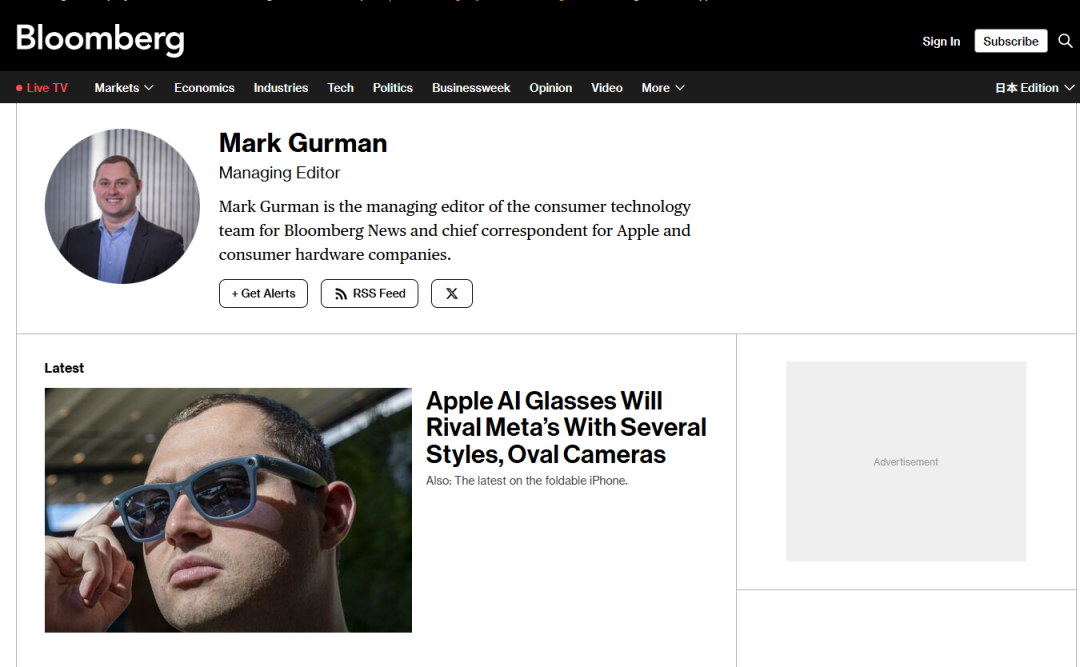
Gurman highlights that Apple’s extensive retail network constitutes one of its core competencies. Apple does not need to share the majority of profits with external physical eyewear stores; it has ample confidence to entice consumers into Apple Stores to select a pair of AI glasses, just as they would choose an Apple Watch band.
Avoiding dilution, restriction, or degradation by external sales channels not only bolsters profits but also aids in maintaining a consistent and unified Apple brand tone.

02 Visual Data Transfer Node
If going solo is about controlling hardware profits, then the screenless design of the N50 serves as Apple’s underlying perceptual foundation for Apple Intelligence.
As previously mentioned, the N50 is not an isolated computing platform; it is a pivotal component of Apple’s 'AI Wearable Trident' strategy. The other two elements are next-generation AirPods and a rumored neck-worn device equipped with a camera. The sole objective of this combination is to leverage computer vision technology to interpret the user’s surroundings, providing Siri and Apple Intelligence with more comprehensive perceptual capabilities.
Under this rationale, the vertically arranged elliptical camera system on the N50 is not merely for video recording. This elliptical module, complete with an indicator light, essentially functions as an 'external environmental sensor' for the iPhone and Siri on the user’s face. When the user dons the N50, it will capture visual data in real-time through deep integration with the iPhone, enabling more advanced map navigation and visual reminders.
Rather than referring to it as a pair of glasses, it would be more accurate to describe it as an 'all-weather online, ultra-low-power visual data transfer node.'
03 Cultivating Wear Habits with Hardware
We believe Apple’s objective is crystal clear: before the advent of true AR glasses in 2030, utilize a high-quality acetate fiber chassis paired with a robust Apple ecosystem to cultivate the habit of wearing Apple hardware on the face. Once users become accustomed to Siri’s hands-free interaction through the glasses and the Apple Store’s fitting process, Apple can dominate this new hardware category in the next decade, much like it did with the Apple Watch.
Although Meta enjoys a first-mover advantage and Google boasts a vast Android ecosystem, Apple’s entry with the N50 is fundamentally reshaping the rules through a supply chain approach entirely independent of the traditional eyewear industry. The wolf has indeed arrived.
Last year, we consistently predicted that competition in the AI glasses arena would intensify in 2026-2027. I regret to inform you that we must now remove the 'will'—Huawei is in, Apple is in, and the track is already ablaze with competition. If AI glasses were once a flourishing garden, they now confront a series of formidable hurricanes.
At this juncture, Planet Jun composes two lines of poetry for you: 'Do not lament the tough times and bad luck; true dragons emerge amidst the storms.'
Text / R Star
-
![]()
Proceed with Caution Before Entering the Indian Auto Market: Even Musk Faced Challenges, What Makes Chery Think It Can Succeed?
-
![]()
EU Intends to Engage in Trade War with China Amid Chinese Cars Nearing 10% of Monthly Sales in Europe
-
![]()
Shenzhen Rolls Out 'Ten Measures' for New Energy Vehicle Insurance: Integrates Innovative Risk Factors and Adopts Battery-Body Separation Model
-
![]()
If You Can’t Drive a Ferrari Yourself, What’s the Point of Owning One?
-
![]()
ByteDance Clarifies: 'No Car Production, No Investment in Saido!' Seres' Stock Price Plummets to New Lows!
-
![]()
New Energy Vehicles Boast Over 60% Penetration Rate: Joint Venture Automakers Must Accelerate Their Efforts
-
![]()
Why Are New Energy Vehicles Becoming Increasingly 'Bulky'?
-
![]()
Over 12 Years, the Average Passenger Vehicle Has Gained Nearly 400 kg, Sparking Netizens' Queries: When Will New Energy Vehicles Revert to Their 'Standard Size'?