HappyHorse Stages a 'Surprise Return', Signaling Alibaba’s Initial Strategic Transformation
 04/16 2026
 551
551

By Jin Ye
Source / Node AI
Recently, the mysterious video large model HappyHorse has sparked significant excitement within the tech community.
Yesterday, Alibaba officially took credit for HappyHorse, announcing that it originates from its newly established AI core business group, Alibaba Token Hub (ATH).
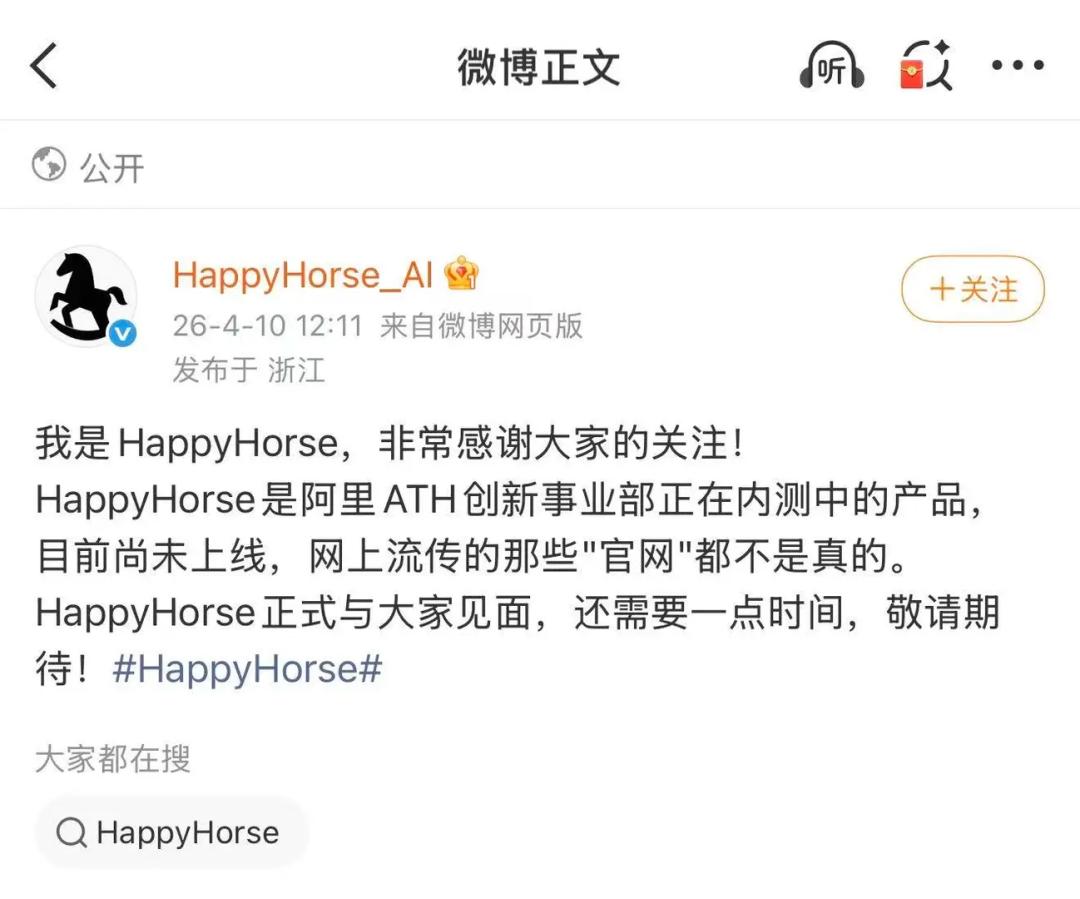
Previous analyses have hinted that 'HappyHorse' is likely an Alibaba innovation.
Node AI has uncovered two compelling pieces of evidence: Firstly, HappyHorse's technical methodology closely mirrors that of Alibaba's Tongyi Lab. Secondly, Zhang Di, recognized as the 'father of Kling,' is reported to have led the team in completing this product within a mere five months after rejoining Alibaba in late 2025. However, some sources suggest that the product was actually developed by Zheng Bo's team at ATH, rather than Zhang Di's team. Zheng Bo, Alibaba's Vice President, has previously managed Taobao's search and recommendation algorithms, served as CTO of Alimama, and led algorithm technology for Taobao and Tmall, with a focus on large models, multimodal systems, and decision intelligence.
Irrespective of its precise origin, one conclusion is evident: The ATH Business Group is taking its mission seriously.
Two Strategic Shifts in Rapid Succession
On March 16, Alibaba established the ATH Business Group with a clear nine-word mandate: Create Tokens, Deliver Tokens, Apply Tokens.
Just three weeks later, Alibaba introduced the Group Technology Committee, dedicated to top-tier technical design and resource coordination.
From an external viewpoint:
The initial adjustment centralized AI operations to clarify leadership responsibilities.
The subsequent adjustment dismantled departmental barriers to enhance collaboration.
The Group Technology Committee is chaired by Wu Yongming, with members Zhou Jingren, Wu Zeming, and Li Feifei. Zhou Jingren, serving as Chief AI Architect and leading the Tongyi Large Model Business Unit, while Li Feifei oversees Alibaba Cloud's technology and AI cloud infrastructure. Wu Zeming serves as the committee's convener and focuses on the Group CTO role.
The roles of these three individuals warrant a closer look.
Zhou Jingren's emphasis on models underscores Alibaba's commitment to 'model sovereignty.'
The Tongyi Large Model now acts as the brain of Alibaba's AI ecosystem. From Qwen1.0 to 3.6Plus, Qianwen has ascended to the global top tier, while Alibaba Tongyi has established a significant lead in open-source ecosystems worldwide. As of the report's publication, Tongyi has open-sourced over 300 models, amassed over 600 million global downloads, and spawned 170,000 derivative models—all ranking first globally. Concurrently, over 1 million enterprise clients have integrated Tongyi's large models, broadening ecological coverage and forming scalable B-side monetization capabilities.
Li Feifei ('Feidao') oversees computing power, indicating Alibaba's intention to merge cloud and AI operations.
His appointment is not merely an additional role—he now serves as both Alibaba Cloud CTO and AI infrastructure leader. In the industry, all cloud giants have been integrating AI capabilities into their cloud services over the past two years. AWS offers Bedrock and Claude, Azure provides the OpenAI suite, and Google Cloud has Gemini. Li Feifei's 'dual identity' conveys a straightforward message: Future Alibaba Cloud will be AI Cloud, and AI capabilities will constitute its competitive edge. The era of separate teams operating independently has ended.
Industry insiders informed Node AI that while debates raged in 2025 over whether model vendors should venture into the cloud business or vice versa, by 2026, the answer became clear: The 'model vendor + cloud vendor' partnership model is becoming an industry norm.
Wu Zeming leads AI inference platforms and business implementation. While theoretically straightforward, this business is challenging in practice, as it determines whether investments can be recouped.
He must integrate AI capabilities into all business scenarios, including Taobao, Alipay, and Xianyu. Success depends on his execution.
Prior to this restructuring, Alibaba's AI operations encountered significant turbulence. In early March, Tongyi Lab planned to spin off the Qwen team, and Lin Junyang, a key figure behind Qwen, abruptly departed. Wu Yongming convened an emergency all-hands meeting with senior executives to stabilize morale.
This incident served as a wake-up call for Alibaba: The AI battle among giants is not waged by individual businesses but through group-wide collaboration. Compared to the previous fragmented approach with redundant resource investments, this adjustment significantly enhances organizational efficiency.
What Exactly Is Alibaba's Strategy?
Node AI discovered that amid these two strategic shifts, Tongyi Lab released three flagship models in four days: Qwen3.5-Omni (a full-modality interaction model), Wan2.7-Image (a visual generation model), and Qwen3.6-Plus (a large language model), covering full-modality understanding, image generation, and programming intelligence—three critical capability areas.
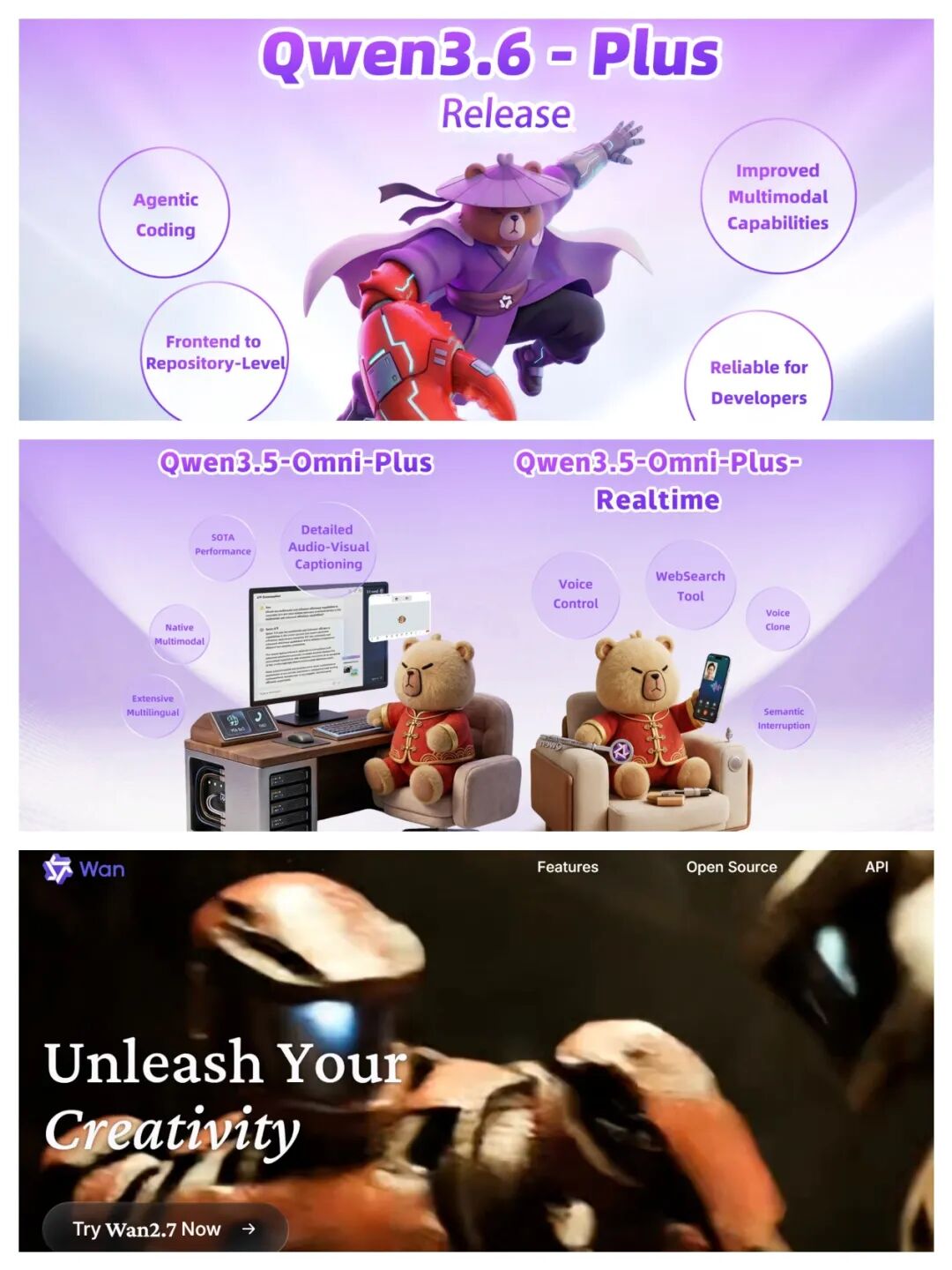
Thus, HappyHorse should not be viewed as a mere video large model update—it represents Alibaba's inaugural 'show of force' following its organizational restructuring.
Alibaba's primary objective is to expedite AI commercialization.
In recent years, Alibaba's biggest challenges have not stemmed from a lack of funds, talent, GPUs, computing power, technical reserves, or even scenarios. Its real issue lies in its enormous scale, fragmented business operations, and lengthy decision-making chains, which have kept its technical capabilities dispersed.
Each business unit excels individually, but collectively, they struggle to mount a unified, group-level technical campaign. Cloud operations, e-commerce, local services, and DAMO and Tongyi Labs operate in silos, often resulting in localized prosperity but overall sluggishness.
In the AI era, sluggishness is the greatest risk.
This competition differs from the mobile internet era, which focused on products, traffic, and channels. Slow adoption or higher spending could be offset. In the large model race, success hinges on computing power scheduling, model iteration, engineering systems, data loops, and commercialization. A failure in any link directly impacts the entire operation. Moreover, this round offers few spectator seats—once leading companies establish technical platforms and ecological momentum, latecomers face prohibitively high costs to catch up.
Two years ago, the large model competition centered on parameters and technical benchmarks, where laboratory strength determined influence. Today, the focus has shifted to integrating model capabilities with business scenarios to achieve closed-loop R&D and commercialization. Organizational synergy is key to unlocking this loop.
Consider industry peers:
Tencent dissolved AI Lab and merged its forces into the Hunyuan Large Model, leveraging WeChat's 1.2 billion monthly active users to drive AI adoption in social scenarios.
ByteDance's AI assistant 'Doubao' has surpassed 100 million monthly active users. Backed by Douyin and Toutiao's traffic pools, Doubao quickly transformed AI from a 'geek tool' into a 'mass companion.'
Everyone is exploring how to achieve commercial closure in their respective domains.
Recently, Alibaba CEO Wu Yongming set an ambitious financial target: Surpass $100 billion in annual revenue from cloud and AI commercialization within five years. In FY2026, Alibaba Cloud's external commercialization revenue just exceeded RMB 100 billion. Growing from RMB 100 billion to $100 billion implies a sevenfold revenue increase in five years, requiring annual growth exceeding 40%. Achieving this would essentially recreate another Alibaba.
Thus, Alibaba must leverage organizational reform to accelerate growth; otherwise, meeting this target will prove extremely difficult.
Alibaba's Third Attempt at Platformization
Over two decades ago, Alibaba platformized merchants, selling transaction opportunities—the 'utilities' of the e-commerce era. A decade ago, it platformized computing power, with Alibaba Cloud selling cloud 'utilities.' Today, as models and computing power become commoditized, all AI services will be billed based on Token consumption, akin to utilities. Efficient, low-cost Token generation and utilization have become new competitive focal points.
In the short term, Alibaba's technical resources will rapidly converge toward AI. Research and development capabilities previously scattered across business lines will be unified and centrally coordinated. The message is clear: Model updates will accelerate, cloud product capabilities will strengthen, and inference services and business implementation will pick up pace.
In the medium term, internal organizational power dynamics are reshaping. Technical teams' influence will rise, while business units unable to leverage AI will decline. This is harsh but inevitable—once a company enters a technology-driven cycle, resources tilt toward departments closest to the core engine. Traffic-driven departments once held sway, followed by platform teams; now, AI infrastructure and model platforms take center stage.
In the long term, e-commerce remains Alibaba's foundation, cloud defined the past decade's growth, and AI will determine whether it stays at the table for the next decade. If the Tongyi ecosystem succeeds, Alibaba will evolve from a traditional internet platform into a comprehensive AI platform spanning models, cloud, applications, and enterprise services. Securing this position would rewrite its valuation logic, market narrative, and talent appeal.
Of course, the greatest risk lies not in technology but in organizational execution. Strategic insights are abundant among major corporations; the challenge lies in translating group consensus into unified action. Now that Alibaba has established its Technology Committee and elevated ATH's strategic role, if departmental silos, resource allocation inconsistencies, and misaligned business priorities persist, this adjustment could become another well-intentioned but ineffective reform.
However, Alibaba's logic is clear: As Tokens become a universal resource, scale and distribution efficiency determine pricing power. This 'utilities' business has evolved from commodities to computing power and now to Tokens. The medium changes, but the platformization strategy remains constant. This battle offers no retreat.
*Cover image generated by AI
-
![]()
Wang Huiwen, Former Meituan Executive, Achieves 20-Fold ROI, Supports 24 AI Startups
-
![]()
Another AI Computing Power Unicorn Launches IPO! Founded by a Changjiang Scholar
-
![]()
OFILM Holdings Secures Zhongke Daojing, Marking a Significant Leap in the Optical Communication Industry!
-
What Will Be the Next Key Battleground for Large Models After AI Coding?
-
![]()
Leapmotor's Sales Soar, Yet Hidden Concerns Loom
-
![]()
China’s Action Camera Market Soars: 3.12 Million Units Sold in Six Months, DJI Secures 74% Dominance
-
![]()
Zhang Yiming: Strategic Retreat as a Path Forward
-
![]()
Exploring Charging for Some Features of QianWen App: Can It Follow the Path of Doubao?