Can Qianwen AI Glasses Break Through with Software-Hardware Synergy Amidst Intensifying Competition?
 04/22 2026
 435
435
By Wang Huiying
Edited by Ziye
In the wave of AI large models, what is the hottest terminal in the consumer technology track?
AI glasses will undoubtedly be one of them.
Over the past two years, global giants like Google and Meta, along with domestic tech companies such as Alibaba, ByteDance, and Xiaomi, as well as smart glasses brands like Rokid, Thunderbird, and XREAL, have fueled a surge in the AI glasses sector.
On April 15, 2026, Qianwen AI Glasses S1 went on sale and topped the bestseller lists on Tmall, JD.com, and Douyin within 10 hours, with the initial stock quickly selling out.
Just over a month earlier, the Qianwen AI Glasses G1 series had completed its spot (spot) sale. Data from XR Research Institute showed that G1 captured 70% of the online AI glasses market share in its first week.
More intriguing than the sales figures is Alibaba's rebranding of its AI glasses from Kuake to Qianwen. Alibaba is paving the way for its AI hardware ambitions through a unified branding strategy.

Image source: Alibaba's official website
Looking at the market, this timing is far from calm. IDC forecasts that China's smart glasses market shipments will exceed 4.9 million units in 2026, up over 77% year-on-year.
As human-computer interaction paradigms undergo transformation and the dominance of smartphones loosens, AI glasses are seen as the next-generation terminal paradigm closer to AI implementation.
While competitors are either launching products or focusing on cost-effectiveness, Alibaba's position is unique. It lacks hardware expertise and smartphone terminal synergy but possesses model capabilities and Alibaba's consumer ecosystem.
As the industry awaits the "iPhone moment" for AI glasses, Alibaba's chances of success remain uncertain.
1. Consolidating Kuake under Qianwen: Alibaba doubles down on AI glasses
If you bought a pair of Kuake AI Glasses S1 in late 2025 and a pair of Qianwen AI Glasses S1 in April 2026, placing them side by side on a table would likely leave you puzzled.
The two pairs of glasses look strikingly similar.
They share the same dual-flagship chipset—Qualcomm Snapdragon AR1 + BES2800 from BesTech—along with identical binocular Micro-LED dual-optical display solutions, Sony IMX681 cameras, and 287mAh dual-battery hot-swappable designs.
Even upon disassembly, the motherboard layouts are nearly identical. In other words, Qianwen S1 and Kuake S1 have almost no differences in hardware.
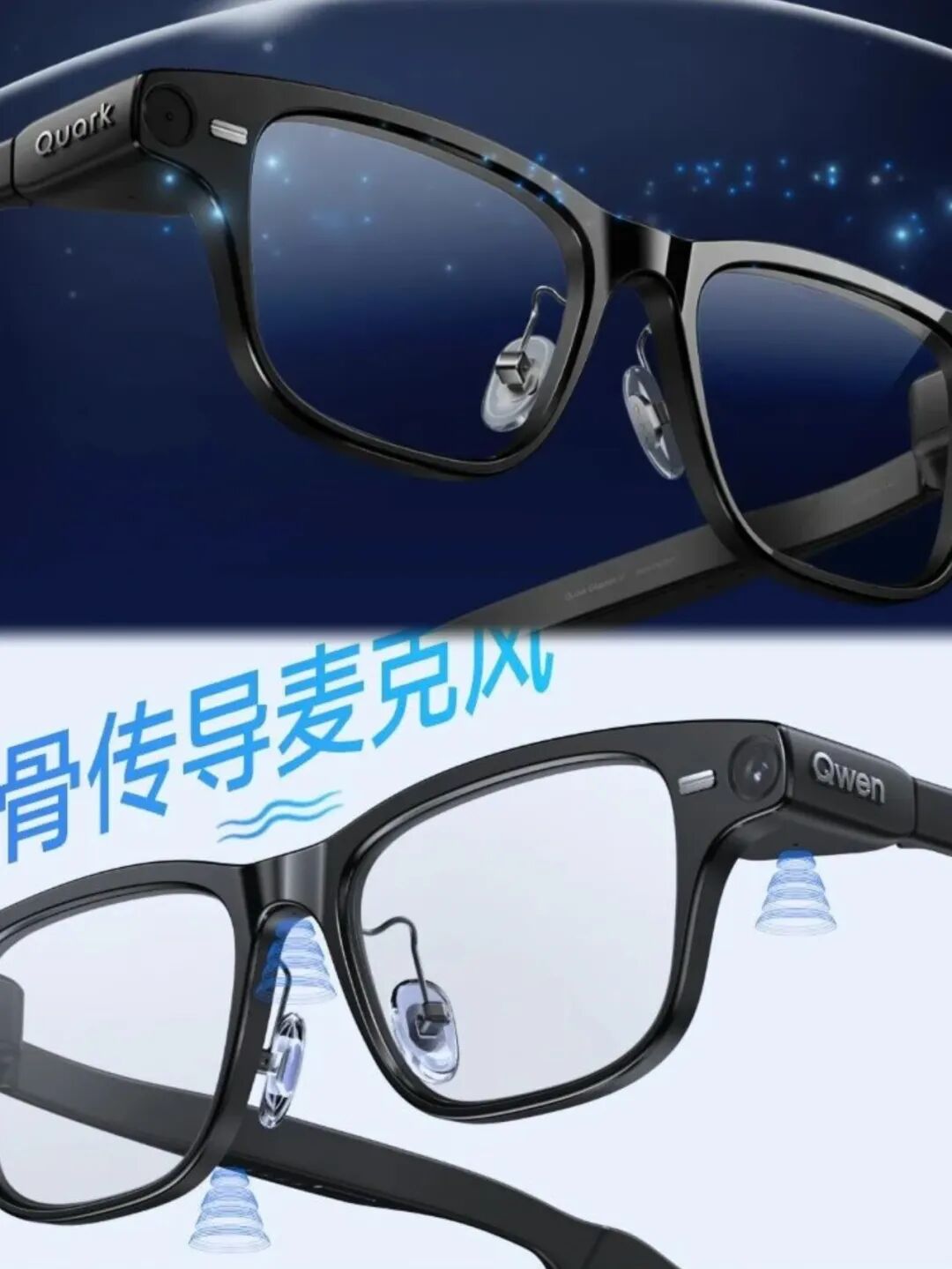
Image source: Kuake and Qianwen's official WeChat accounts
Notably, Alibaba opted for Micro-LED micro-displays + binocular diffractive waveguide solutions, more suitable (more suitable) for outdoor bright-light scenarios than the industry's predominant Micro-OLED route, supporting personalized display position adjustments. It also introduced China's first adjustable image distance technology, allowing users to adjust imaging distance to reduce visual fatigue.
So why did Alibaba use two brands for the same hardware? The answer may lie in the software.
Compared to Kuake S1, Qianwen S1's most significant upgrade comes from its operating system.
According to official introductions, Qianwen S1 comes pre-installed with the latest Qianwen large model, supporting multimodal voice and visual interactions. Its AI functions deliver instant results. In contrast, Kuake S1 defaults to Kuake OS and requires OTA upgrades to access the Qianwen large model.
This direct integration of the large model elevates S1's positioning to an AI daily assistant, emphasizing daily tasks and lifestyle services with real-time AI availability.
Essentially, this hardware consistency paired with software upgrades reflects Alibaba's determination to unify its AI business brands.
Over the past few years, Alibaba's AI business, while comprehensive, has been fragmented. Tongyi focused on B-end large model infrastructure, Qianwen on open-source communities, and Kuake on C-end applications. Each business line operated independently, leaving C-end users confused about Alibaba AI's core.
This dispersed layout aided early exploration but became a stumbling block as AI application competition intensified. While rivals like Doubao and Yuanbao consolidated their brand images, Alibaba AI's fragmented branding hindered recognition.
By late 2025, Alibaba had clarified its strategy. The group established the ATH Business Group, merging the Smart Information and Smart Connectivity Business Groups to encompass Tongyi Labs, MaaS business lines, Qianwen Business Unit, Wukong Business Unit, and AI Innovation Business Unit, led personally by Group CEO Wu Yongming.
In December 2025, Alibaba merged the Smart Information and Smart Connectivity Business Groups to form the new Qianwen C-end Business Group, encompassing Qianwen App, Kuake, and AI hardware C-end businesses.
In March 2026, Alibaba further unified its AI strategy by consolidating B-end and C-end large model brands under "Qianwen." Tongyi Labs focused solely on R&D, while Qianwen flew the brand flag.
Under this strategy, Alibaba prioritized the Qianwen brand, with all future AI glasses products to be uniformly named "Qianwen AI Glasses."

Image source: Alibaba Cloud's official website
Notably, Kuake AI Glasses and Qianwen AI Glasses share the same algorithm, software, and hardware teams. Already-launched Kuake glasses will receive the same functional updates as Qianwen glasses, ensuring Kuake S1 users aren't "left behind"—their glasses will gradually evolve into Qianwen S1 through OTA upgrades.
Following Qianwen's brand unification, Alibaba's AI hardware strategy became clearer. Qianwen G1 entered the entry-level market with a subsidized price of 1,997 yuan, capturing 70% of the online market share in its first week. Now, Qianwen S1 positions itself as a flagship model at 3,499 yuan, elevating the brand's prestige.
However, brand unification is just a strategic move. For Alibaba's AI software and hardware to truly synergize, success hinges on AI glasses products winning consumer approval.
2. Software leads, hardware follows
If brand unification addressed "how" Alibaba AI products compete, the "why" deserves deeper reflection.
"AI glasses are the center of the next-generation human-computer interaction revolution and the entry point for AI. They hold more imagination than smartphones," said Song Gang, head of Qianwen AI Hardware, when introducing Qianwen G1 earlier this year. For Alibaba, AI glasses are never an isolated hardware product but a key to breaking free from Mobile Internet era (mobile internet era) entry dependencies and safeguarding its ecosystem moat in the AI era.
In the mobile internet era, Alibaba's software ecosystem strengths were undeniable. Taobao, Flash Sale, Alipay, Gaode, and Fliggy covered nearly every aspect of daily life. However, the pain point of entry dependence persisted.
To experience Alibaba's software ecosystem, users first needed to download apps from app stores, whose revenue-sharing policies eroded Alibaba's profit margins.
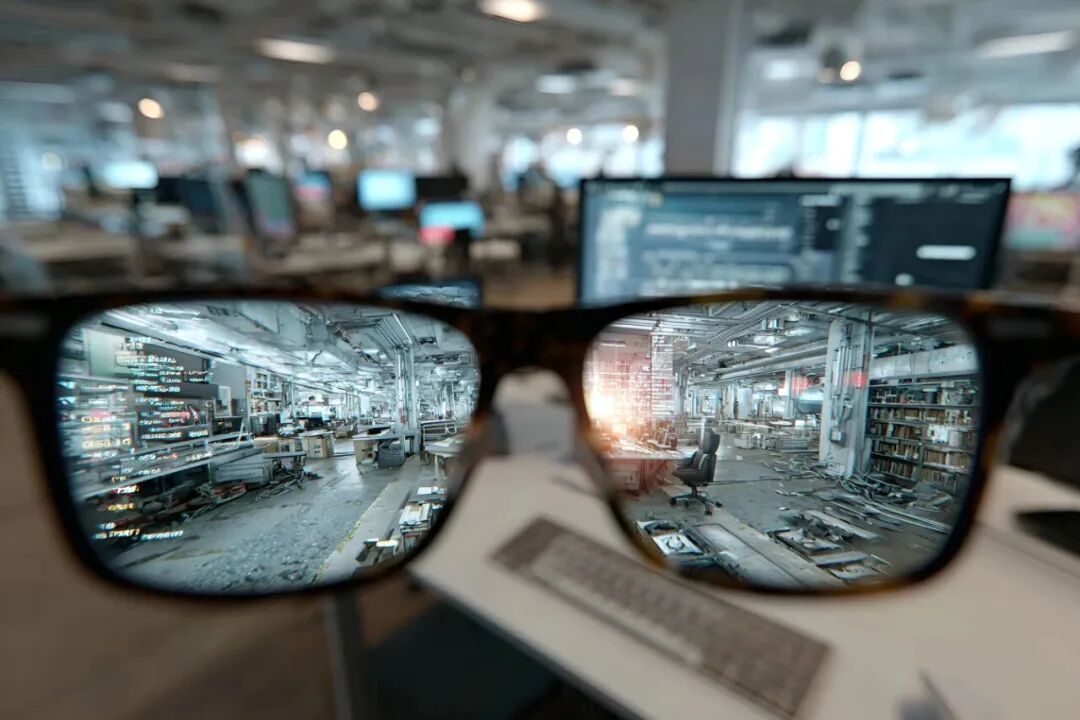
The large model era offers new possibilities to break this predicament (predicament). As human-computer interaction shifts from touchscreen taps to "language + visual" multimodal interactions, AI glasses—with their first-person perspective, all-day wearability, and multimodal perception—are widely seen as the most promising successors to smartphones.
For Alibaba, this represents a fresh opportunity. In Alibaba's logic, "using AI to handle tasks" is its biggest differentiator from other hardware vendors. All product definitions and plans prioritize this ultimate goal.
This AI task-handling logic is already taking shape in Qianwen S1's user experience.
According to consumer reviews, the "glance-to-pay" function is most closely tied to daily life. At convenience store checkouts, users need only glance at the QR code—the glasses automatically recognize it, and with a voice confirmation, Alipay completes the payment with a "beep."
Another more imaginative scenario is AR navigation. Gaode's travel services feature exclusive AR navigation and integrated itinerary planning, creating a head-following navigation experience. When users wearing the glasses turn their head left, the arrow follows left, aligning perfectly with their line of sight (line of sight).
Such daily application scenarios have become standard for AI glasses players. To stand out, deeper innovation is needed.
On social platforms, some consumers reported speaking to Qianwen S1 and hearing real-time translations in their "own voice"—not a robotic synthetic voice—with replicated tone, speed, and even emotional nuances.
Beyond AI-cloned simultaneous interpretation, Qianwen S1 supports more flexible usage modes. Users can disable translation audio and display subtitles instead, avoiding interference from mixed original and translated voices. In noisy environments or situations where audio playback is inconvenient, a "silent translation" mode can be activated.
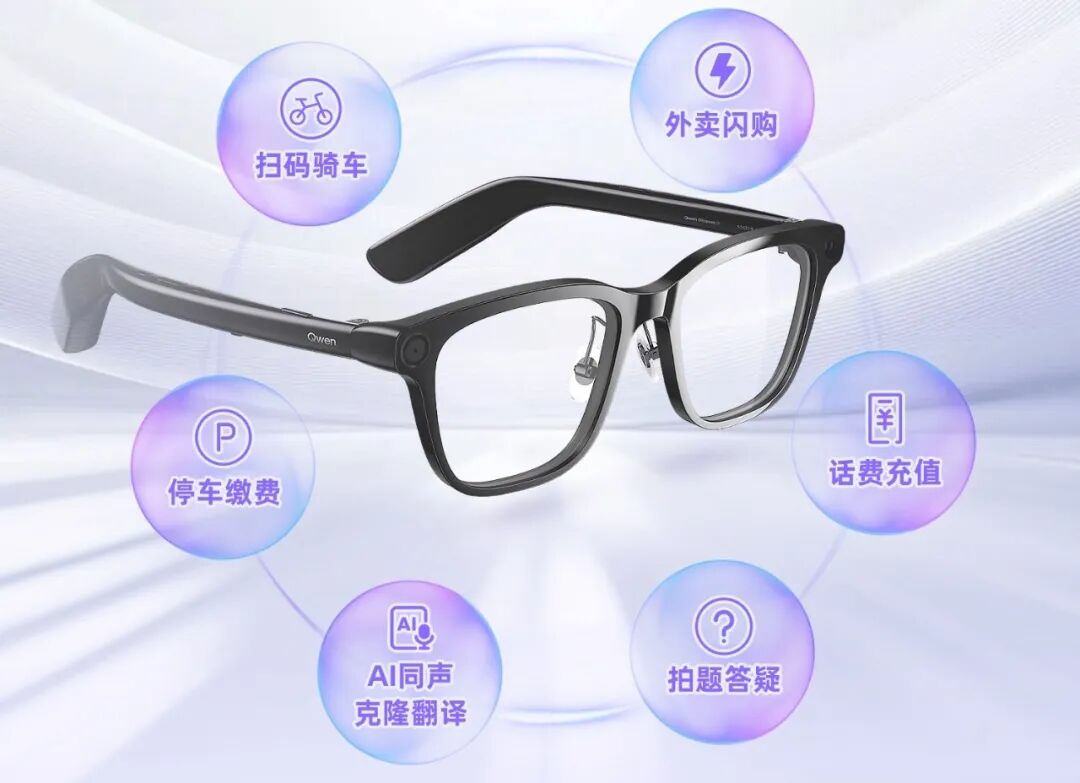
Image source: Qianwen's official WeChat account
Moreover, after a meeting, S1 doesn't just transcribe recordings but automatically organizes speech threads, distinguishes viewpoints from different speakers, and outputs a structured meeting summary with to-do items—or even a mind map.
Overall, Alibaba S1's core competitiveness (competitive edge) lies not in a single standout function but in its native integration of Alibaba's ecosystem services via MCP, rather than shallow third-party API calls. Users wearing Alibaba AI glasses can voice their needs, and the glasses execute them.
As Song Gang, head of Qianwen AI Hardware, emphasized, "AI task-handling will become a rigid demand ( rigid demand ) for AI glasses." The confidence behind this statement stems from Alibaba's full-scenario ecosystem closed loop (closed loop), its core moat in the AI glasses layout (layout).
For a cross-border player like Alibaba, succeeding in the next-generation terminal entry war requires leveraging its ecosystem and AI strengths while addressing hardware R&D and operational shortcomings. More importantly, it must patiently understand users' core needs.
3. How far is AI glasses from their "iPhone moment"?
As Qianwen S1 delves deeper into AI task-handling scenarios, the critical question remains: How close are AI glasses to their "iPhone moment"?
Making AI glasses truly affordable and appealing to consumers isn't about stacking hardware specs but reaching an experiential tipping point where users can't go back. For Alibaba, this tipping point is becoming clearer—not through hardware performance surpasses but via ecological experience moats.
In Alibaba's ideal scenario, Qianwen AI glasses will become users' "all-weather AI assistants."
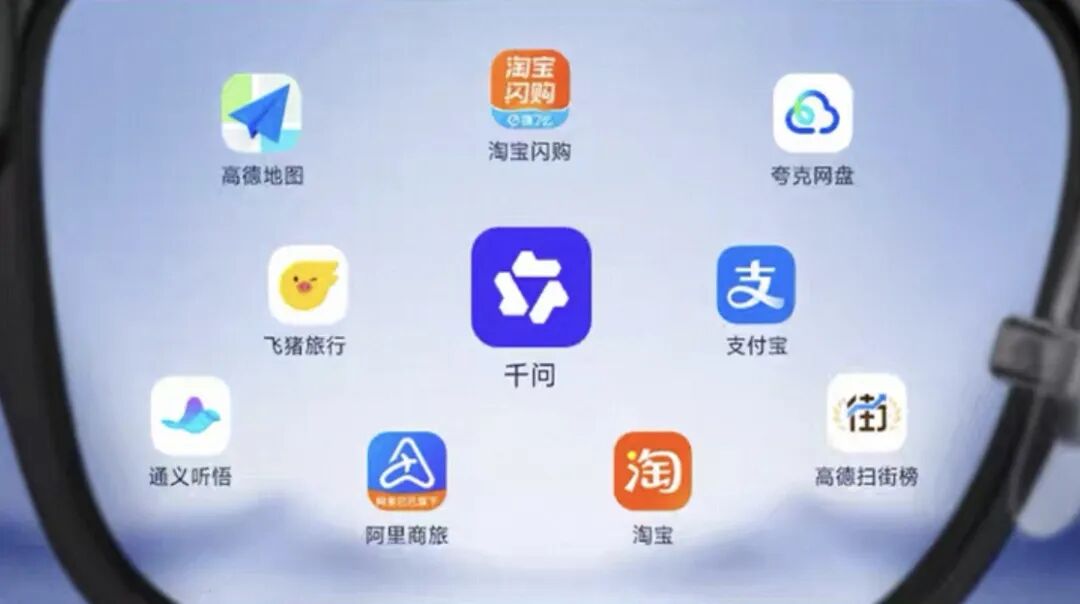
Image source: Qianwen's official flagship store
In the morning, the glasses plan your route using Gaode based on your schedule and real-time traffic. At noon, glancing at a restaurant menu automatically triggers large model analysis of nutritional balance, followed by password-free Alipay payment. In the afternoon, they generate meeting minutes and sync them to DingTalk. In the evening, when shopping, a single voice command retrieves Taobao for price comparisons and orders.
Once this closed loop runs smoothly, glasses will no longer be smartphone peripherals but independent terminals. Users may find handling tasks on a phone screen more cumbersome without their glasses—perhaps the next-generation AI terminal transformation Alibaba envisions.
To achieve this ideal, Alibaba must overcome three hurdles.
The first is wearing comfort. No matter how powerful the ecological experience, if users feel nose pain after two hours, it's all for naught. The industry consensus is that all-day wearability requires a weight below 40 grams, while Qianwen S1 hovers around 50 grams. Reducing weight without sacrificing battery life and computing power demands systemic breakthroughs in optical solutions, battery technology, and chip integration.
The second is scenario depth. While Alibaba has begun building AI scenarios, covering more fragmented daily moments requires deeper adaptation of Alibaba-group apps.
After all, only when enough native AI experiences naturally occur on the glasses will users truly become dependent.
The third is user mindset. Consumers still perceive AI glasses as geek toys or productivity accessories, far from mass-market "one-per-person" status. All players must work on lowering prices, expanding channels, and leveraging social sharing to encourage trial.
Horizontally, these three hurdles are common across the AI glasses industry.
Achieving smooth multimodal performance requires heavy investment in AI interaction and AR/XR technologies. Mass adoption demands pricing within consumer reach.
Lightweight design, high performance, and low cost once formed an industry "impossible trinity." According to XR Vision data, the average return rate on JD.com and Tmall was 30% in 2025, soaring to 40–50% on Douyin—roughly one return for every two sales.
Additionally, the industry faces severe privacy compliance challenges. AI glasses' cameras and microphones enable first-person real-time recording, raising privacy leakage risks for both nearby individuals and the wearer's personal data.

Meanwhile, scaling up supply chain production remains a major issue. Core components like Micro LED displays, diffractive waveguides, and dedicated AR chips suffer from low yield rates and insufficient capacity, driving up costs and limiting mass production. Compared to smartphones' billion-unit market scale, AI glasses supply chains are still in early stages. Achieving consumer-grade mass production will take time.
More importantly, on the road to waiting for the industry's 'iPhone moment', Alibaba is facing an increasingly competitive market.
According to data released by Omdia, global AI glasses shipments are expected to reach 8.7 million units in 2025, representing a significant year-on-year increase of 322%. Among them, the Chinese mainland market accounts for 10.9% of the global AI glasses market, with shipments nearing 1 million units, making it the second-largest market globally after the United States.
As hardware parameters continue to iterate and the number of players entering the market increases, the competitive landscape of the AI glasses sector is evolving. Amidst the homogenization competition, finding killer scenarios has become a consensus among players.
While Meta leverages fashion to open up the market, ByteDance attracts attention with content, and smartphone manufacturers rely on their supply chains to maintain their foothold, Alibaba's path seems more challenging. Defining hardware through its ecosystem will not yield immediate results, but once successful, Alibaba's AI glasses have the potential to emerge as a latecomer leader.
Until then, Alibaba needs to focus on distributing hardware, collecting data, testing scenarios, and waiting for the industry's 'iPhone moment' to arrive.
(The header image of this article is sourced from the official Qianwen flagship store.)
-
![]()
Wang Huiwen, Former Meituan Executive, Achieves 20-Fold ROI, Supports 24 AI Startups
-
![]()
Another AI Computing Power Unicorn Launches IPO! Founded by a Changjiang Scholar
-
![]()
OFILM Holdings Secures Zhongke Daojing, Marking a Significant Leap in the Optical Communication Industry!
-
What Will Be the Next Key Battleground for Large Models After AI Coding?
-
![]()
Leapmotor's Sales Soar, Yet Hidden Concerns Loom
-
![]()
China’s Action Camera Market Soars: 3.12 Million Units Sold in Six Months, DJI Secures 74% Dominance
-
![]()
Zhang Yiming: Strategic Retreat as a Path Forward
-
![]()
Exploring Charging for Some Features of QianWen App: Can It Follow the Path of Doubao?