Let's Imagine: What If DeepSeek and Kimi Merged?
 04/29 2026
 483
483
London, 1854. Michael Faraday scattered iron filings in the basement of the Royal Institution and gently tapped the cardboard. The filings arranged themselves into elegant arcs within the invisible magnetic field—arcs he called "lines of force," marking the birth of a new language in physics.
That same autumn, William Thomson wrote a set of partial differential equations at the University of Glasgow, mathematically reformulating Faraday's intuition and integrating the concept of "fields" into Newtonian mechanics. Thomson believed only equations could truly capture natural laws.
These two ways of understanding the world competed and nourished each other throughout the Victorian era, propelling electromagnetism from laboratory conjecture to mathematical precision and then engineering application in just half a century. This culminated in Maxwell's equations, which became the foundation of the Second Industrial Revolution.
A century and a half later, a similar story quietly unfolds in China's AI sector.
On April 20, 2026, Moonshot AI released Kimi K2.6. Four days later, on April 24, DeepSeek open-sourced V4. These two trillion-parameter open-source models dominated the top two spots on global authoritative rankings in the same week, marking another head-on collision in their technological paths over the past 16 months.
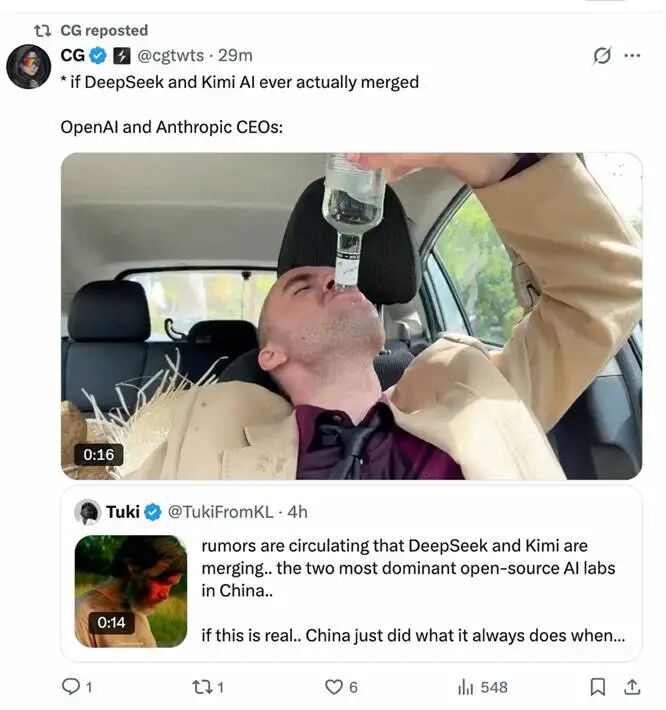
After the Nth technical clash, mere comparisons have grown tiresome. Recently, a playful question appeared on X, accompanied by a meme: How would the CEOs of OpenAI and Anthropic react if Chinese open-source companies like DeepSeek and Kimi merged?
Upon reflection, this question isn't so far-fetched in China's internet history. Since Youku and Tudou's landmark merger in 2012, every few years, the top two players in a track (sǎidào, niche) have moved from rivalry to partnership under the influence of capital and tech giants, transforming internal competition into collective strength to face larger external battles.
Could DeepSeek and Kimi follow this path? Let's indulge in a thought experiment: What if they merged?
01 Technical Synergy: A Full-Stack Foundation Rivaling Silicon Valley
The high degree of technical interoperability between DeepSeek and Kimi forms the basic premise for this merger hypothesis. If merged, the first outcome would be a model platform covering the entire pipeline: "training-inference-deployment-application."
First, their architectural synergy runs deep.
DeepSeek's MLA attention mechanism, introduced in V3, drastically reduced KV cache overhead through low-rank compression, addressing the fundamental challenge of "memory as cost" in long-context inference. In July 2025, Kimi's trillion-parameter K2 model directly adopted and scaled MLA, proving its viability at scale.
By April 2026, the script flipped. DeepSeek's V4 replaced the decade-old Adam optimizer with a second-order optimizer called Muon, whose effectiveness Kimi had first validated at the trillion-parameter scale during K2's training and publicly documented in systematic technical disclosures.
Second, at the capability level, their divisions of labor are clear and highly complementary.
DeepSeek V4 reduced per-token inference compute to 27% of V3.2's and compressed KV cache to one-tenth, turning million-token contexts from technical demos into universal infrastructure. Kimi K2.6 focused on long-range task execution and agent orchestration, supporting 300 sub-agents in parallel, 4,000 tool calls, and 13 hours of uninterrupted coding. OpenRouter data showed K2.6 topping API call rankings after release, with DeepSeek close behind—both ranking among the global top five.
In multimodality, Kimi K2.6 stood as the only model in the global open-source top five supporting image and video understanding, while DeepSeek consistently led in high-order reasoning, mathematics, and code evaluation. The two exhibited strong complementarity in this domain.
Finally, their hardware ecosystem choices align closely.
DeepSeek V4 explicitly announced Huawei Ascend 950 support in the second half of 2026, diversifying its tech stack beyond NVIDIA CUDA. Kimi's models employed INT4 quantization, more friendly to domestic chips, and its new Prefill-as-a-Service technology supported both domestic and existing NVIDIA chips, reducing reliance on CUDA. As a single entity, they could more efficiently bridge domestic models with domestic computing power.
Together, these three layers reveal DeepSeek's recent focus on "making models cheaper" and Kimi's on "enabling models to handle critical tasks." The merged platform would thus combine extreme inference efficiency with deep productivity integration, directly rivaling OpenAI and Anthropic's closed-source model-plus-product matrices.
Technical complementarity is the phenomenon. The deeper cause lies in people. Both DeepSeek and Kimi's founders adhere to first-principles thinking, with identical underlying philosophies.
Liang Wenfeng's roots lie in quantitative engineering. A Zhejiang University graduate without overseas study experience, he accumulated capital through algorithmic trading before pivoting to AGI research. This path taught him to deconstruct problems to their fundamentals, eliminate redundancies, and achieve equivalent results with minimal resources. His rationale for open-sourcing follows the same logic: "In the face of disruptive technology, moats built through closed-sourcing are temporary." The tone is calm, the logic sharp.
Yang Zhilin's identity is that of a computational determinist. With a Tsinghua undergraduate degree and a CMU PhD, he built academic reputation through works like Transformer-XL. He defines large models' essence in six words: "Compression generates intelligence." In his view, finding superior compression methods to express equivalent information density with fewer tokens enables approaching higher intelligence despite compute constraints. He compares it to an arithmetic sequence: for 10,000 numbers, the ideal compression stores only the pattern and the first and last terms, reconstructing the rest. What he seeks is the "arithmetic pattern" within large models.
One approaches engineering limits, the other logical essence—both paths converge. This explains the technical synergy between DeepSeek and Kimi.
An industrial truth is emerging: they are jointly building a standard open-source tech stack—MoE architectures, MLA attention, Muon optimizers, multimodal capabilities, agent frameworks, and domestic chip adaptations. The rapid adoption of open-source models in real-world applications indicates this stack is becoming China's de facto large model standard.
In other words, if DeepSeek and Kimi merged, creating a full-stack technology base rivaling OpenAI and Anthropic would be the floor, not the ceiling. The deep collision of these two computational spirits would dramatically accelerate evolution in the open-source large model world.
02 Business Convergence: Compute, Revenue, and Global Narrative Control
Technical synergy runs deep, but stopping there would realize only half the merger's value. Both companies face identical commercial bottlenecks: insufficient compute, small revenue scale, and fragmented global narratives.
First, compute. DeepSeek's V4 pricing note stated: "Limited by high-end compute, current Pro service throughput is constrained. Prices are expected to drop significantly after Huawei Ascend 950 super-nodes ship at scale in H2 2026." Internally at Kimi, a saying circulates: "Compute is the only constraint on business growth. At least 10x current demand remains unmet."
Post-merger, chip procurement, data center construction, and domestic adaptation investments would no longer duplicate, enhancing bargaining power with suppliers like NVIDIA and Huawei. More critically, a unified tech stack means domestic chips need only adapt to one standard, drastically reducing ecosystem fragmentation costs.
Next, revenue. Within 20 days of Kimi K2.5's release, revenue exceeded 2025's annual total, with overseas revenue surpassing domestic. Monthly paying user growth exceeded 170%. For K2.6, API input pricing rose from 4 to 6.5 RMB per million tokens (+58%), the first increase in the K2 series. DeepSeek, known as the "price cutter," priced V4 Pro input at 12 RMB per million tokens, with a limited-time 75% discount (3 RMB) until May. While extreme low pricing rapidly attracted developers, it also compressed profit margins.
A unified pricing system with sustained, reasonable cost reductions could help Chinese open-source models shift from undercutting each other to collaborative pricing, establishing a firmer value anchor in international markets.
On global expansion, Cursor repackaged Kimi K2.5, Cloudflare adopted Kimi as a primary model, Perplexity listed Kimi as its sole Chinese model, and Japan's Rakuten built Rakuten AI 3.0 on DeepSeek. Both have established initial user mindshare overseas.
Post-merger, a unified brand and developer relations strategy would reduce overseas cognitive costs, preventing two Chinese open-source models from cannibalizing each other in the same ecological niche. A stronger unified brand would yield vastly different bargaining power and partnership terms with overseas cloud providers, chipmakers, and top enterprise clients.
03 Talent Strategy: Uniting Top Researchers Under a Long-Term Technical Vision
DeepSeek and Kimi are China's most lean and talent-dense AI startups, both under relentless poaching pressure from tech giants.
Over the past year, DeepSeek systematically lost at least five core members across foundational models, inference, OCR, and multimodal teams. Kimi endured a six-month technical silence in mid-2025 amid employee attrition.
Both teams share a similar technical ethos. Both prioritize foundational technology research: DeepSeek, with roots in Hundsun Quantitative, emphasizes engineering optimization and cost control; Kimi, led by Tsinghua-CMU researchers, fosters academic exploration and frontier innovation.
A merged entity would form a composite team spanning quantitative engineering, academic research, and product implementation, achieving research depth in optimizers, attention mechanisms, and residual connections that could rival OpenAI and Anthropic's research divisions.
A larger merged platform could offer top researchers more compelling equity stakes and long-term technical visions. When company valuation nears or exceeds OpenAI and Anthropic levels, the risk of individual defections to ByteDance, Tencent, or Alibaba for higher salaries would drop significantly.
This highlights a key metaphor of the merger hypothesis: large model startups must confront talent poaching. Rather than let tech giants pick off core members one by one, why not expand the chessboard?
04 Capital Puzzle: Bridging the Gap Between Technical Strength and Commercial Valuation
Financially, both companies' funding rhythms exhibit clear complementarity.
DeepSeek had never taken external funding until April 2026, when its valuation soared from at least $10 billion to over $20 billion in initial external rounds. Opening financing reflected external pressures outweighing internal independence preferences.
Kimi completed three funding rounds from late 2025 to early 2026, with valuation jumping from $4.3 billion to $18 billion. On March 26, 2026, Bloomberg reported Moonshot AI was considering a Hong Kong IPO alongside a $1 billion funding round.
Their financial profiles now contrast: one newly open to external capital with an unclear valuation anchor, the other proven in paid models but constrained by compute resources. This complementarity forms a potent bargaining chip in merger valuation negotiations.
Post-merger valuation must reference global AI pricing benchmarks. As of April 2026, OpenAI's post-money valuation exceeded $850 billion, while Anthropic reached $380 billion in primary markets (with unlisted equity prices even surging past $1 trillion on secondary platforms, overtaking OpenAI). In contrast, even summing DeepSeek and Kimi's current valuations yields less than 1/20th of Anthropic's.
This stark gap reflects the massive valuation discount both companies suffer due to incomplete tech stacks, resource constraints, and business models.
05 Unified Front: From Open-Source Disruptors to Rule Setters
In global AI, Chinese open-source models now serve as benchmarks for hardware progress. Meta's Muse Spark blog directly compares against DeepSeek and Kimi; Jensen Huang showcased DeepSeek R1 and Kimi K2.5 on NVIDIA's GTC 2026 stage to demonstrate next-gen Blackwell Ultra performance.
Yet overseas developers face a "Chinese open-source model mosaic" rather than a clear brand. Unified branding, APIs, and tech roadmaps would drastically reduce global developers' cognitive and migration costs.
For DeepSeek and Kimi specifically, their dual leadership brings attention but also strategic narrative fragmentation. A merger could consolidate China's open-source voice into a clearer brand.
Moreover, in ecological competition, Silicon Valley is rapidly closing off. OpenAI no longer discloses training details, Anthropic and Google guard core methods jealously. Meta maintains an open-source narrative with Llama but lacks the transparency of Chinese firms.
DeepSeek and Kimi's technical reports and open-source code form the most critical public knowledge assets for the global open-source community. Their repeated technical clashes, while competitive on the surface, drive a virtuous cycle in open-source ecosystems—a dynamic nearly impossible among Silicon Valley's top firms. Post-merger, this synergy would transform from tacit understanding to explicit system, further amplifying appeal to global developers.
On pricing power, the two Chinese firms currently depress each other's commercial value through competition. Only with unified pricing and developer ecosystems can Chinese open-source models transition from disruptors to rule setters.
06 The Impassable Wall: A Beautiful Hypothesis, But Merger Nearly Impossible
Having logically progressed this far, we must confront reality: such a merger is almost impossible. We're merely indulging in a thought experiment.
First, founder independence forms the first barrier. Both Liang Wenfeng and Yang Zhilin are fiercely technical founders who've built highly capable teams. DeepSeek has funded itself entirely through Hundsun Quantitative's capital until now. Liang's independence is legendary in investment circles. As one close associate put it: "This isn't a target you can acquire with money. Cash ranks lowest among Liang's selection criteria." Yang Zhilin pulled his company from a $4.3 billion valuation trough to $18 billion in three months, executing a complete V-shaped recovery.
Two individuals from Guangdong, eight years apart in age. One emerged from the quant circle, the other reached the pinnacle of academia. Expecting either to take a secondary role in a merger is nearly futile.
Secondly, shareholder interests are difficult to reconcile. Tencent has participated in multiple rounds of investment in Kimi and is currently in contact with DeepSeek; Alibaba appears on the investment lists of both companies. Strategic investments by major firms are essentially hedges on both sides, rather than efforts to create a single dominant player. Forcibly pushing for a merger would significantly reduce the strategic flexibility of Tencent and Alibaba in the AI sector. More critically, DeepSeek has never previously introduced external capital, and Liang Wenfeng has near-absolute control over the company. Kimi, on the other hand, has undergone multiple rounds of financing and has a diverse shareholder base, resulting in a governance structure far more complex than DeepSeek's.
More critically, regulatory scrutiny may not approve the merger. After the merger, the combined entity might dominate China's open-source model landscape, instantly marginalizing other independent large-scale model companies in the open-source sector. Antitrust review would become an insurmountable hurdle. What China's AI sector needs is a healthy competitive ecosystem, not a giant in the open-source domain.
There is also a deeper reason. Competition itself is the most efficient innovation mechanism. Looking back over the past 16 months, multiple instances of technological convergence precisely confirm that competition accelerates innovation. If this pursuit of progress were to become internal iteration within a single company, it might lose the sense of urgency driven by external pressure. Silicon Valley's OpenAI and Anthropic also stimulate each other; although closed-source, the logic of competition remains the same.
Diversity in the open-source ecosystem is far more important than uniformity. Global open-source models require the coexistence of multiple technological pathways. If China were left with only one open-source giant, a misstep in technological direction could risk the collapse of the entire Chinese open-source ecosystem. Having more trees provides greater resilience against risks.
07 Conclusion: Competition is Evolution
Over a century of industrial history has repeatedly validated a principle: The most robust systems do not cram all components into a single engine but allow different engines to serve as beacons for each other in the same waters. True industrial maturity does not come from all companies merging into a single behemoth but from multiple companies learning from and evolving alongside each other in competition, ultimately forming an ecological force stronger than any individual company.
Global AI competition has evolved from a contest of singular technologies to an ecological confrontation. In this confrontation, China does not need a single super-giant in the open-source domain but rather several peaks that reflect and inspire each other. They are rivals, yet also each other's best reference points.
Much like Faraday's lines of force and Thomson's equations—one intuitively grasping the shape of the world, the other logically deducing the framework of truth—they ultimately converge in Maxwell's equations yet never merge into a single entity. Their independence allows each other's brilliance to be measured against a clear reference.
On the long journey toward AGI, going it alone may allow for rapid progress; but only those teams willing to share the torch with fellow travelers can traverse the uncharted wilderness blocked by snow.
-
![]()
Tesla Restructures Its Balance Sheet
-
![]()
Accelerating the High-Speed Interconnection Upgrade of AI Computing Clusters! JONHON Releases ELSFP External Light Source Optical Connectors
-
![]()
Breaking the overseas blockade of volumetric holographic materials, this optical enterprise secures nearly 100 million yuan in financing!
-
![]()
Why Does Jensen Huang So Openly Praise China’s AI?
-
![]()
"Wudang" Unveiled: Arm China's Next-Gen AI VPU Redefines Video Encoding
-
![]()
From Energy Conservation and Carbon Reduction to AI Decision-Making: GECON East Intelligence and Chery Group Explore a New Green and Smart Paradigm for Automobile Manufacturing
-
![]()
WAIC 2026 Observation | AI Accelerates Towards the Core of Industries, Industrial AI Enters a Critical Phase
-
![]()
Volkswagen China Fires the First Shot in Foreign-Funded 'White Box Delivery'!