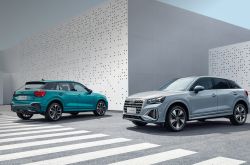
Why Are Young People Choosing 'Reverse Car Upgrades'?
 04/29 2026
 555
555
Gradually downgrading to more practical cars, embracing increasingly self-fulfilled lifestyles.
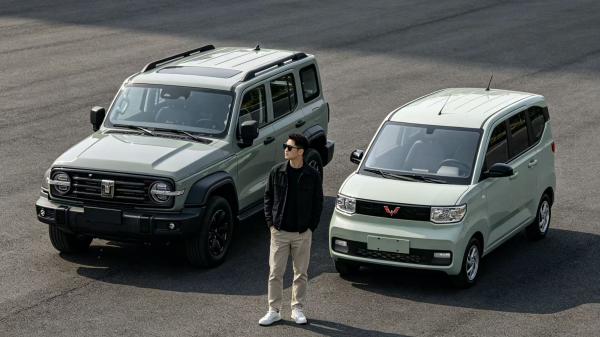
For most people, how do they demonstrate their success? Upgrading to a more luxurious car is often seen as the ultimate symbol.
However, a growing number of young people are not only shunning upgrades when changing cars but are instead opting for less prestigious models. Among them, car owners from the 'cross-platform swap group,' 'consistent energy swap group,' and 'brand-loyal swap group' are all transitioning from larger vehicles to smaller ones, and from luxury brands to more affordable options.
Is the reason these car owners are choosing reverse upgrades because they are experiencing financial difficulties? Not necessarily. They may be doing so due to high energy and maintenance costs, the inconvenience of driving and parking large vehicles, and the fact that new small car models now boast better features than some mid-to-high-end vehicles.
In addition to these three reasons, the increasing popularity of reverse car upgrades may also be linked to changes in China's demographic structure. The rising number of one-person households has led car owners to prioritize their own driving experience over the need to impress others or accommodate rear-seat passengers.
With this shifting trend, car companies are also focusing more on the small car market, using cost-effective products to attract young people opting for reverse upgrades.
Young people choosing reverse car upgrades may not be doing so out of financial necessity but rather because they are making wiser choices.
Reverse Car Upgrades: Which Group Do You Belong To?
After driving the same car for many years, how should one approach upgrading? Most people's initial thought is to move up to a better car.
After all, as time passes, many people's savings grow, and if they don't upgrade their car, won't they face ridicule?
However, an increasing number of young people are now doing the opposite. Instead of upgrading, they are actively downgrading to smaller cars. From the perspective of upgrade methods, they can be roughly divided into three groups:
The first group is called the 'cross-platform swap group,' which is the most mainstream within the reverse upgrade camp.
In recent years, new energy vehicles have been continuously innovating. When some gasoline car owners prepare to upgrade, they bypass mid-to-high-end gasoline cars like BBA and instead opt for domestic small electric cars.
Yangyang, from a four-person household, drives a BMW X5. Although the large business car looks impressive, she always feels uneasy driving it.
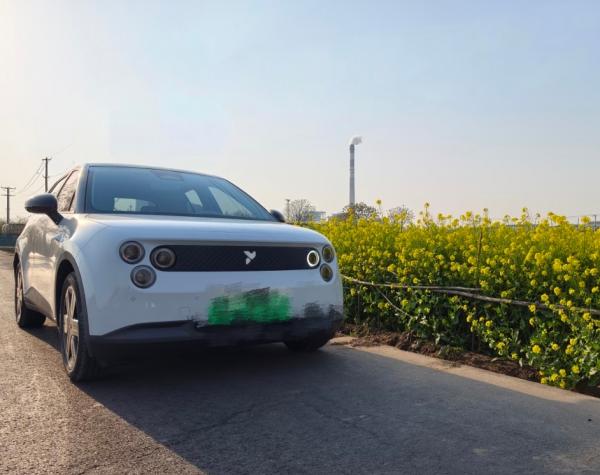
After buying a new house, she decided to trade in her seven-seater BMW SUV for a NIO Firefly. Although the swap from large to small creates a stark contrast, she doesn't mind at all.
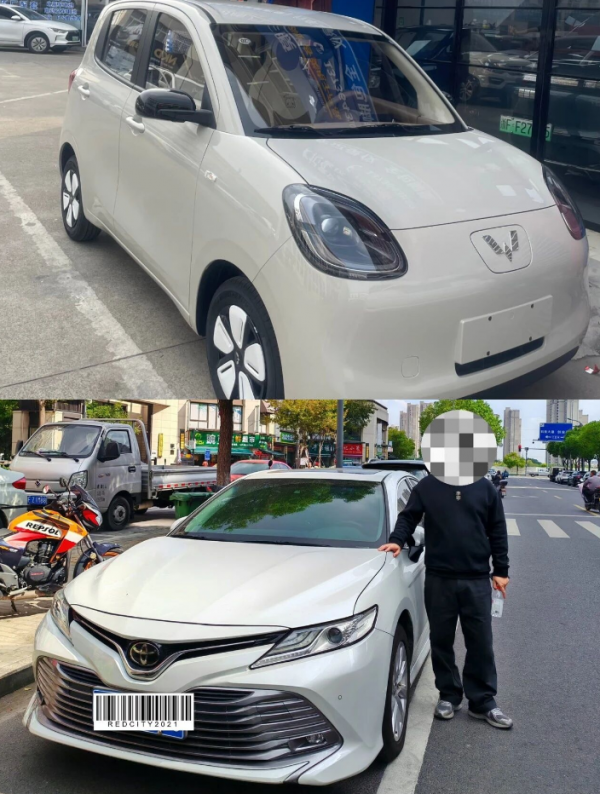
In 2020, Maomao bought a Toyota Camry 2.0. When he was ready to upgrade in 2025, he searched the market but didn't find a higher-class gasoline car he liked. Instead, he became interested in the Wuling Hongguang MINIEV.
His family didn't understand this unconventional choice, but Maomao insisted on taking the road less traveled. In the end, he spent 33,000 yuan to buy a zero-kilometer used car of the same model.
The second group is called the 'consistent energy swap group.' When these car owners opt for reverse upgrades, their method of energy replenishment remains unchanged, but the class and model of the car decrease.
Xiao Wu has a Zhijie R7 at home. As she is usually responsible for picking up and dropping off her child, she feels the car is a bit too large and wants to swap it for a smaller one.
After examining several small cars on the market, she continued to focus on the electric car sector and ultimately chose the BYD Yuan UP as her new car.
The third group is called the 'brand-loyal swap group.' Although these car owners swap their cars for less prestigious ones, they always adjust within the same brand, prioritizing maintaining a certain level of sophistication.
Youzi has a Mercedes-Benz C260. After driving it for six years, she faced high maintenance costs, including tire replacements, and decided to swap it for another car.
She deliberated among various car brands for a long time but ultimately continued to choose Mercedes-Benz. However, she swapped her gasoline car for an electric one and her large car for a small one.
She told Pangge, 'By trading in my used Mercedes-Benz C260 and adding 20,000 yuan of my own money, plus the national subsidy, I can swap it for a Mercedes-Benz Smart.'
Why Are Cars Being Swapped for Less Prestigious Ones?
Is the reluctance to upgrade and the necessity to downgrade when changing cars a sign that these people are failing and getting worse off? Of course not. They opt for reverse upgrades often for the following reasons:
First, to reduce various vehicle costs.
It is well known that the higher the class of a car, the higher its usage costs. Additionally, there is a significant difference in energy replenishment costs between gasoline and electric cars, especially with the volatile situation in the Middle East, making gasoline car owners particularly affected.
Maomao told Pangge, 'When I drove the Camry, my monthly fuel costs were around 700-800 yuan. Now that I have the Wuling Hongguang MINIEV, since I can't install a charging pile in my residential area, I charge it outside using fast charging, and my monthly electricity bill is around 100 yuan.'
At the same time, Youzi also told Pangge, 'I used to spend 500 yuan a month on gasoline. Now that I have an electric car, 500 yuan can cover a year's worth of charging.'
Second, for greater convenience in driving and parking.
Although mid-to-high-end large cars look impressive, they are not easy to maneuver, especially in cities with tight parking spaces and narrow roads, which often make drivers nervous.
For example, Yangyang said, 'When I drove the BMW X5, driving was like playing a challenging game. Meeting another car on a narrow road was always tense, and if the parking space was slightly small, I had to reverse several times. After swapping to the NIO Firefly, the steering wheel feels very light, and I can easily enter narrow alleys and old residential areas.'
Finally, an increasing number of domestic small cars now surpass older mid-to-high-end models in terms of features.
Aqian swapped his 2017 Volvo S90 for a Zeekr 001 last year. Although the price was nearly halved, the driving experience seemed to have improved.
He said, 'The interior atmosphere of the Zeekr 001 provides great emotional value, and some of the interactive technologies are very advanced. There are also many personalized features. After swapping cars, I always want to explore new functions and feel younger.'
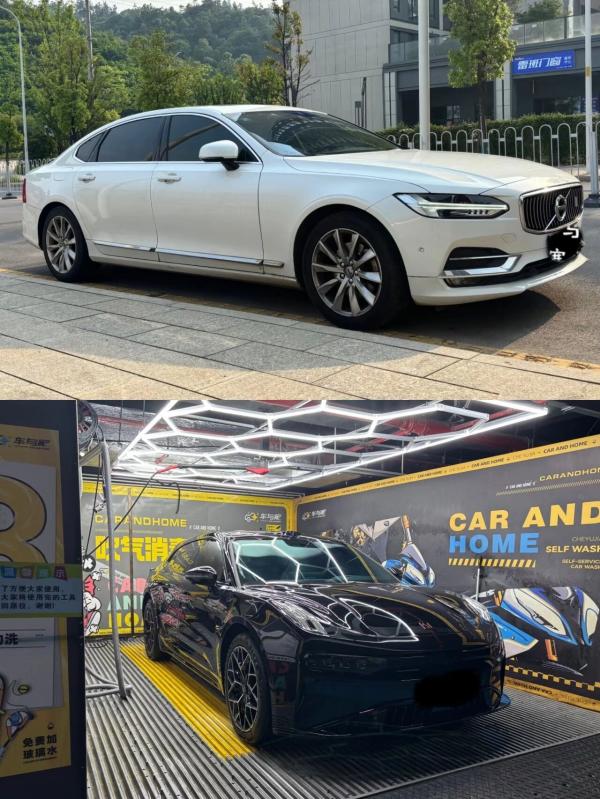
Although reverse upgrades have various benefits, car owners may also encounter prejudice from others during the actual experience.
For example, Maomao told Pangge, 'After swapping from the Camry to the Wuling, I noticed that many drivers on the road seem to have stereotypes about small cars, thinking I'm a novice or a female driver. When driving the Wuling, I often encounter people who change lanes without signaling, which rarely happened when I drove the Camry.'
Is the Car Only for One Person?
Although driving a small car may make one vulnerable to prejudice, the combination of the three factors mentioned above has given the niche behavior of reverse upgrades a broad popular base.
In addition to these three factors, the phenomenon of cars being swapped for less prestigious ones seems to be related to changes in social structure.
China's population census data shows that the number of one-person households in China has reached 125 million, accounting for 25.39% of all households. At the same time, the number of single people aged 15 and above in China is approximately 240 million, accounting for 17% of the total population.
It is evident that the increase in one-person households and single individuals has led many car owners to only consider the driver's experience when changing cars, without needing to cater to passenger needs.
As more and more car owners focus on their personal driving experience, car companies strongly associated with impressing others have suffered severe impacts.
For example, in the first quarter of 2026, Mercedes-Benz, BMW, and Audi, the three major BBA brands, sold 111,600, 144,000, and 127,100 vehicles respectively in the Chinese market, representing year-on-year decreases of 27%, 10%, and 12%.
For the entire year of 2025, the sales of Mercedes-Benz, BMW, and Audi in the Chinese market decreased by 19%, 12.5%, and 5% respectively. The once-unattainable BBA brands are now being overlooked by many car owners, even after lowering their prices.
On the other hand, domestic new energy players in the small car market have achieved impressive sales figures.
In 2025, the Geely Starwish, Wuling Hongguang MINIEV, and BYD Yuan UP sold 465,000, 435,000, and 190,000 vehicles respectively in the Chinese market.
The recently launched Leapmotor A10, with its outstanding cost-effectiveness, achieved over 40,000 orders within 28 days of its launch, setting a new record for Leapmotor's order growth rate.
The increasing number of single-person households has driven the development of the small car market. At the same time, the upgraded needs of multi-child families have also created a broader market for models like MPVs and large SUVs.
Therefore, the current Chinese automotive market seems to be presenting a K-shaped pattern: on one hand, car companies in the large car market are continuously launching cost-effective champions; on the other hand, in the small car sector, car companies are also fiercely competing.
The intense competition in the small car market has also forced car companies to use higher cost-effectiveness to win over potential consumers.
In this context, young people opting for reverse upgrades may want to take their time and wait patiently when facing new car choices, becoming winners by simply waiting for the right opportunity.
-
![]()
Is Zhipu's Trillion-Yuan Market Cap, Despite No Profit, Truly 'Outrageous'?
-
![]()
XiaoPai Unveils Home AI Brain, Paving the Way for Smart Homes to First Grasp 'Home Understanding'
-
![]()
Is the Future of Extended-Range EVs Pure Electric or Li Auto’s 5C Extended-Range? A Li Auto Executive Shares Insights
-
Ant Group’s New Board of Directors: Signaling a New Era?
-
![]()
Google Initiates TPU Sales, as Industry Leaders Eye AI Chips for 'Cost-Effective Tokens'
-
![]()
Input Methods: The Rising Star in AI! WeChat, Doubao, and Qianwen Lead the Charge into the Voice Input Era
-
![]()
Struggling to Sell? Cut It Out! Toyota, Volkswagen, and Changan Lead the Charge in Streamlining, Eliminating Non-Core Products in the Blockbuster Model Era
-
![]()
Arm China and Volcano Engine Join Forces to Expedite Cloud Computing and AI Infrastructure Rollout