Labor Day in the AI Era: The Dilemma of Perplexed Programmers
 05/03 2026
 628
628

Over a century ago, workers fought with bloodshed and strikes to secure the eight-hour workday, embodying a fundamental principle: there should be a clear boundary between work and life. However, in the past decade, programmers have become accustomed to excessively long working hours, blurring this once-distinct line.
The demarcation between work and personal life has been eroded by the advent of new management tools like KPIs and OKRs. While some have reaped generous rewards, even transforming their personal and family fortunes, others have come to a sobering realization: they have lost more than they have gained. Extreme cases, such as programmers dying suddenly with work messages still flashing in group chats posthumously, have made headlines.
Programmers are now at the forefront of the new wave of AI impact. Big names and companies proclaim the dawn of a new era at every opportunity. Yet, even the most optimistic tech enthusiasts acknowledge that AI-driven layoffs have arrived sooner than expected. Over the past two years, Silicon Valley has explored various innovative ways to reduce its workforce.
Nearly every major technological shift or socioeconomic adjustment in human history has directly impacted workers. For many programmers, these changes began even earlier.
This spring, I interviewed four programmers, each with around a decade of experience, residing in cities like Beijing and Guangzhou. They have witnessed the high-speed growth, bottlenecks, and AI disruptions in the internet industry. Three of them have decided to leave the field. This is not merely an individual choice but a prevalent issue faced by millions of programmers in China: How to navigate massive changes?
PART01
A Promising Yet Perilous Career Path
Why become a programmer? The direct reason cited by several interviewees is high salaries.
Liu Wei and Wang Jigang entered the field around 2015, the inaugural year of the mobile internet era, when programming was one of the most coveted professions. Due to a massive talent shortage, hiring requirements for many positions were not stringent. Liu Wei graduated from a junior college, while Wang Jigang studied electromechanical engineering at a private second-tier university in Guangdong. Both entered the field through short-term training programs, securing programmer jobs with monthly salaries of 8,500 yuan.
During orientation at a major internet company in Guangzhou, Wang Jigang sat alongside graduates from Tsinghua and Peking University, listening as the CTO declared in a near-indoctrinating tone: “Sudden death occurs in every industry, but only when programmers die does it get reported. No one reports it when people in other industries die.” The CTO also mentioned the looming threat of layoffs at age 35, adding, “As long as your skills are strong enough, companies will compete for you.”
Wang Jigang looked at the CTO, who was around 40, and felt that layoffs were a distant concern, while the CTO's achievements seemed within reach. He believed that by honing his skills, he could achieve similar success in a decade.
Internet companies were once renowned for their high salaries and generous benefits. In 2015, the IT industry ranked among the highest-paying sectors, with an average annual salary of 112,042 yuan, 1.81 times the national average for urban non-private sector employees—excluding year-end bonuses or prizes. Baidu CEO Robin Li once revealed that an employee had received a year-end bonus equivalent to 50 months' salary. In 2015, JD.com, a year after its IPO, held a cash raffle worth 1 million yuan, with 50 winners averaging 20,000 yuan each. Additionally, there were 400 iPhone 6s and 100 iPhone 6 Pluses as prizes. Some companies even rewarded employees with cars worth hundreds of thousands of yuan.
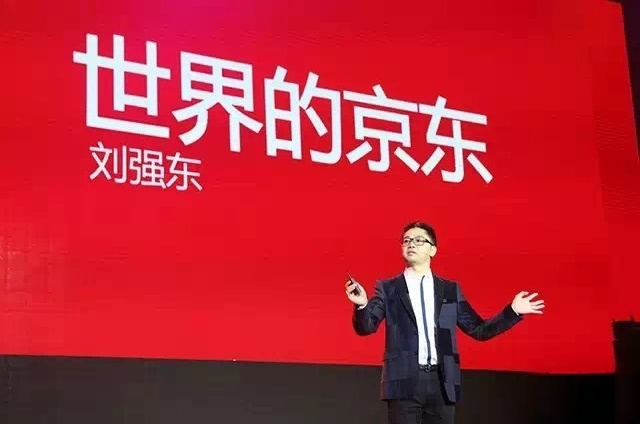
Liu Qiangdong at JD.com's 2015 annual event, exuding confidence
Daily benefits were equally lavish. Wang Jigang's company provided free meals three times a day, plus snacks, reimbursed overtime taxi fares, offered a 2,000-yuan monthly housing subsidy, and paid four months' salary as a year-end bonus. He recalled his girlfriend saying after counting the bonus, “Your year-end bonus alone equals my annual salary.”
Three years after entering the field, Wang Jigang's annual salary rose to over 300,000 yuan. He easily paid off his training program loans and interest and could even send living expenses to his parents, who lacked pensions. At the time, this seemed just the beginning of a prosperous life—everyone was accustomed to constantly changing jobs for higher salaries, heading toward a brighter future. In 2019, Wang Jigang secured a job with an annual salary of over 400,000 yuan after switching companies. That same year, Liu Wei moved to a foreign company in Beijing, doubling his salary to nearly 20,000 yuan per month. Soon after, he bought a house in Tianjin.
Of course, the money did not come without a cost. His contract stated working hours from 9:30 AM to 6:30 PM, but working until 9:30 PM was routine. Because he had English classes three nights a week, Wang Jigang was once called in by his supervisor for a talk. However, he did not mind; he was learning English to prepare for his next job switch. He heard from a former colleague who moved to Microsoft that after-tax salaries there could exceed 600,000 yuan.
What he did not expect was that the news of his layoff would arrive before his next job offer. In August 2020, shortly after returning to work post-pandemic, he was called in by his supervisor. The conversation began with his coding mistakes, which allegedly affected millions of users, and ended with the reason for his dismissal: “You’re not a good fit for this team.” The entire conversation lasted only a few minutes.
HR demanded that he resign voluntarily, but when he refused, they threatened: “If you insist on compensation, regardless of whether you win or lose in court, when your next employer contacts me for a background check, I will say you were laid off because of bugs in your code.”
Wang Jigang called a legal aid hotline from the company lobby and was advised not to resign voluntarily. However, fear took over, and the next day, he submitted his resignation through the system.
At the time, the internet industry was hitting growth limits. Data showed that as of September 2021, China's mobile internet monthly active users stood at 1.167 billion, nearly stagnant compared to 1.133 billion two years earlier. Meanwhile, tightened antitrust regulations and withdrawing capital rendered the expansion logic of capturing markets through burning money obsolete.
The direct way for companies to “reduce costs and increase efficiency” was layoffs. Financial reports from internet giants documented this wave of layoffs. In 2022, Alibaba reduced its workforce by nearly 20,000 employees; Tencent saw a 10.11% reduction, amounting to 6,898 employees. Just as the term “layoff” was euphemized as “graduation” or “optimization,” “reducing costs and increasing efficiency” became a more subtle narrative: people were no longer laborers creating value but numbers on a financial statement that could be erased at will.

Source: 2023 TV series “Sunshine by My Side”
Liu Wei lost his job at the end of 2023 and subsequently sent out hundreds of resumes, receiving only three or four interview invitations. Eventually, he lowered his standards and found an outsourcing job in 2024, where he would be stationed at a partner company during projects and sent back afterward, earning a fixed salary of one or two thousand yuan. This gave him a sense of insecurity and melancholy, as if he were “disposable.”
Now, AI brings even more uncertainty. Recently, the industry has popularized the term “distilling colleagues,” referring to the skillification of departing employees, where people leave but their past work becomes a free digital avatar that never goes offline. While this is partly tongue-in-cheek, it reflects the widespread anxiety among practitioners. Outsourced positions like Liu Wei’s are among the most vulnerable to AI replacement.
PART02
Working Like AI: The Human Toll
Being available 24/7, responsive at all times, emotionally stable, and continuously improving—these are the hallmarks of AI. In fact, before this wave, many programmers had already begun to emulate AI—they were required to work as efficiently and stably as machines.
Jiang Mingren, a programmer at a major company, mentioned that coding, originally a mental task, had been transformed by his company into a standardized production process. Dedicated requirement management roles were established to break down tasks, and workloads were calculated based on project timelines and the number of programmers.
“It’s like an assembly line—once we finish, more requirements are handed to us, so there’s always work to do,” Jiang said.
The system also tracked everyone’s monthly output, and those with the lowest workloads were flagged and questioned. This created constant anxiety among employees, wondering, “Am I next to be laid off?” Under these rules, working overtime until 9 or 10 PM was common. On the few occasions Jiang left on time, his supervisor asked him to announce it to the entire department in the work group chat.
Additionally, he was expected to be available 24/7, or “on-call.” If a business issue arose, DingTalk would automatically send notifications. If no one responded within a minute, the system would call everyone automatically. Therefore, he never dared to silence WeChat or DingTalk, even carrying his laptop while traveling or hiking. Later, he developed resistance to work, even experiencing physical symptoms like numb arms when anxious or restless.
Invisible pressures were everywhere and could even lead to extreme tragedies. Wang Jigang’s project team leader died suddenly after a team-building event. He recalled that the leader often posted motivational content about hard work on WeChat during those years of intense overtime.
Another widely reported incident involved Gao Guanghui, a 32-year-old programmer at CVTE, who died suddenly at the end of 2025. During his resuscitation, he was added to a work group chat and continued to receive work messages after his passing. Later, the media obtained Gao’s labor contract, which included a clause stating: “The employer has the right to extend working hours based on production and work needs, and the employee shall not refuse without legitimate reason.” The contract also specified that his position salary was 11,800 yuan per month, with a base salary of 3,000 yuan, which served as the basis for calculating overtime pay.

On January 22, 2026, multiple hashtags related to the “Guangzhou 32-year-old programmer’s sudden death” trended on Weibo
Programmers’ high salaries often come at the cost of grueling work hours. Jiang Mingren calculated: his annual salary plus year-end bonus exceeded 400,000 yuan. However, with at least 66 hours of overtime per month, his hourly wage was less than 160 yuan, similar to his wife’s salary working at a state-owned enterprise.
Many internet companies adopt a “low base salary, high performance” pay structure. Yu Yunyun, a lawyer who has handled numerous cases involving programmers’ rights, pointed out that this is a common design: “Some companies split the full salary into base and performance pay. To retain their performance pay, programmers have to work longer hours. These terms are not written in contracts but in company regulations, making them more subtle.”
Performance is not only tied to salaries but also directly affects promotions and job security. However, some companies’ assessment criteria are opaque and inconsistent, leaving employees even more passive. Liu Wei was once labeled “insubordinate and emotional” and subsequently laid off for missing an urgent notice in a work group chat because he left on time.
Companies even interfere with employees’ personal social media posts. Jiang Mingren was once called in by his supervisor for posting travel photos on WeChat and advised to “spend less time with your wife and focus more on work during weekends.” During a team meeting, the supervisor publicly shared a table of everyone’s leave days. Fearful of impacting his performance, Jiang only took five days of marriage leave, the longest single leave period among his teammates. A colleague with a fractured finger only took half a day off to go to the hospital for a bandage.
Supplementary assessment systems add another layer of invisible shackles. For example, peer evaluations, where employees anonymously rate each other, and some departments even have informants. Jiang’s colleague once openly mentioned being tasked with monitoring fellow employees. Jiang was also called into a meeting room by his supervisor to evaluate his colleagues’ strengths and weaknesses.
Everyone is a potential “evaluator.” Jiang felt constantly monitored, so he never spoke much or showed emotions at work.
But just as AI can face computational bottlenecks during peak times, human programmers do too—only they pay a more direct price. During one assessment, Jiang questioned his supervisor about work outside the evaluation period, but the supervisor rated him as “inefficient.” His performance score did not change despite his protests. A month later, he chose to resign.
The moment he walked out of the company building, he felt a sense of relief. “They say the two happiest days at a big company are the day you join and the day you leave. It’s true,” he said.
PART03
Leaving Before Being Replaced by AI: A Strategic Retreat
AI-related positions are becoming highly coveted. An average AI programmer can earn 300,000 to 600,000 yuan annually, while salaries for roles related to large language models can easily reach 600,000 to 1.2 million yuan.
However, AI is also causing many programmers to lose their jobs. In the first quarter of 2026 alone, the global tech sector laid off over 45,000 employees, with AI being a contributing factor in at least 20% of these cases. Research reports reveal that programmers are among the professions most vulnerable to AI, with over 70% of programming tasks now capable of being assisted by AI. On social media platforms, numerous individuals voice concerns about being supplanted by AI.
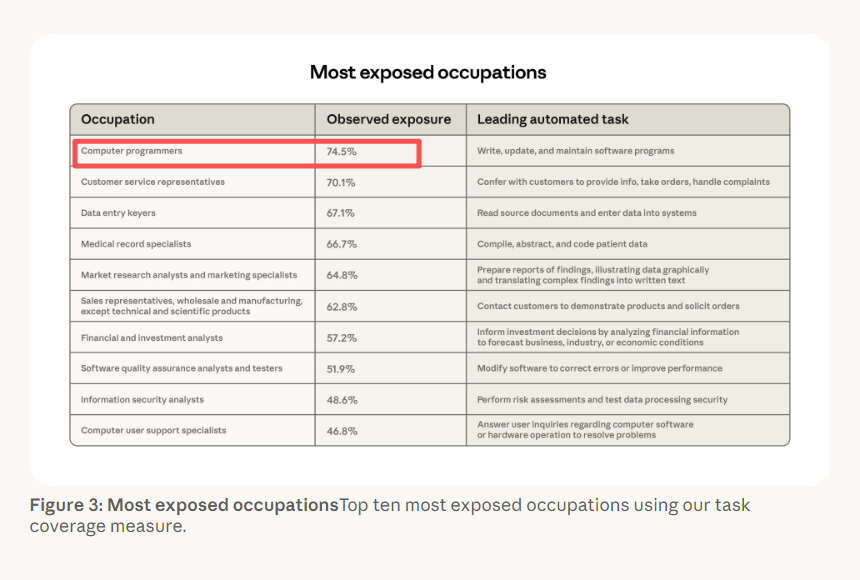
Anthropic's 2026 labor market study identifies programmers as one of the professions most significantly impacted by AI.
Among our interviewees, three have already made the decision to switch careers, a move that reflects their pessimistic view of the industry's future and its alignment with their personal aspirations.
Shortly after ChatGPT's release, Liu Wei started using it. By the end of 2023, his supervisor began emphasizing AI-driven efficiency enhancements during year-end reviews. Subsequently, Liu Wei observed more colleagues utilizing AI tools, with tangible results. “Now, one person can accomplish the work of three or four. Even a junior programmer, when paired with AI, can handle tasks that were previously the domain of senior programmers.” Layoffs soon followed. When Liu Wei was let go, his team, which once numbered over a dozen, was reduced to just one programmer and one supervisor.
At 35, Zhang Yi left the company he had worked at for eight years at the beginning of the year. “There's no longer a need for so many people to write code.” Previously, when the company undertook a project, a team of 20-50 individuals, including front-end and back-end developers, was required. Now, AI can handle a significant portion of the programming tasks. After realizing the company was facing difficulties and began laying off staff, Zhang Yi started sending out resumes but either received no responses or was offered a salary cut of 5,000 yuan. With a 1 million yuan mortgage to pay, he ultimately negotiated a voluntary resignation with the company in exchange for N+1 compensation, amounting to over a hundred thousand yuan. Many of his peers around the same age have also made career switches.
The widespread sense of anxiety and pessimism is closely linked to the demographic makeup of the tech industry. Public data indicates that there are nearly 7 million programmers in China, with 70% of them aged between 26 and 35. Over one-third of programmers believe that frontline development work can only be sustained up to the age of 35. Indeed, a significant number of practitioners seem to “disappear” around this age, their positions taken over by younger workers who possess more stamina, accept lower salaries, and are more willing to work overtime—now with the added advantage of AI.

Image Source: TV Drama "Ordinary Songs"
Even for those programmers whose jobs have not yet been supplanted by AI, many have discovered that, rather than being liberated by new technology, they are actually working even harder. “The boss believes AI can replace our work, so he takes on more projects and shortens the deadlines.”
This situation echoes the paradox of machine application that Marx highlighted in Capital: “The greed for others’ labor time grows everywhere, and the working day—before it is legally restricted—does not shorten but rather extends beyond its natural limits, with not only relative surplus labor time increasing but total labor time as well.”
Jiang Mingren sought to escape the endless cycle of tasks. At the end of last year, he decided to leave the industry for good. He uninstalled all work-related apps from his phone, set his social media to silent mode, and thought, “Those alarms and notifications have nothing to do with me anymore.”
He ventured into self-media, trying his hand at entertainment livestreaming, creating short videos, and writing WeChat articles. Initially, he struggled to adjust to the relatively relaxed work pace, still waking up early and going to bed late. It took him two or three months to fully adapt.
After being laid off by a major company, Wang Jigang received an offer from ByteDance, but he chose to become a technical partner in a startup founded by former colleagues. The days of quietly writing code left him feeling aimless. However, he soon faced the harsh realities of entrepreneurship: after securing investment from a listed company, he was ousted from the team. Over the past four years, he has dabbled in gaming, e-commerce, and other fields but has not made any money. He stopped sending living expenses to his parents, and his dating life has also stalled.
Nevertheless, he does not regret his decision to switch careers. He has noticed positive changes in his life: “I hardly ever get sick anymore. I've made more friends. Now, in the entrepreneurial circle, when we encounter problems, we focus on solving them rather than just complaining.”
His cousin, who graduated in computer science in 2021, heeded his advice and spent 30,000 yuan on training courses to secure a programmer job, only to find the salary lower than what Wang Jigang earned during his internship a decade ago. Later, his cousin went to Hong Kong for graduate studies, hoping to stay and work as a programmer after graduation. Wang Jigang sees himself in his cousin from ten years ago. Back then, he also believed that being a programmer was a promising career path—until he no longer saw that path ahead.
(At the request of the interviewees, Jiang Mingren, Wang Jigang, Liu Wei, and Zhang Yi are pseudonyms.)
-
![]()
Tesla Restructures Its Balance Sheet
-
![]()
Accelerating the High-Speed Interconnection Upgrade of AI Computing Clusters! JONHON Releases ELSFP External Light Source Optical Connectors
-
![]()
Breaking the overseas blockade of volumetric holographic materials, this optical enterprise secures nearly 100 million yuan in financing!
-
![]()
Why Does Jensen Huang So Openly Praise China’s AI?
-
![]()
"Wudang" Unveiled: Arm China's Next-Gen AI VPU Redefines Video Encoding
-
![]()
From Energy Conservation and Carbon Reduction to AI Decision-Making: GECON East Intelligence and Chery Group Explore a New Green and Smart Paradigm for Automobile Manufacturing
-
![]()
WAIC 2026 Observation | AI Accelerates Towards the Core of Industries, Industrial AI Enters a Critical Phase
-
![]()
Volkswagen China Fires the First Shot in Foreign-Funded 'White Box Delivery'!