How Much of Alibaba and ByteDance's 'Model Answers' Can Xiaohongshu Score?
 05/06 2026
 623
623

Xiaohongshu's 'Big Factory' Cosplay
Xiaohongshu: 'Necessity is the mother of invention.'
On April 30th, Xiaohongshu released an internal letter to all employees, announcing a new round of organizational upgrades. The restructured Xiaohongshu is as follows:
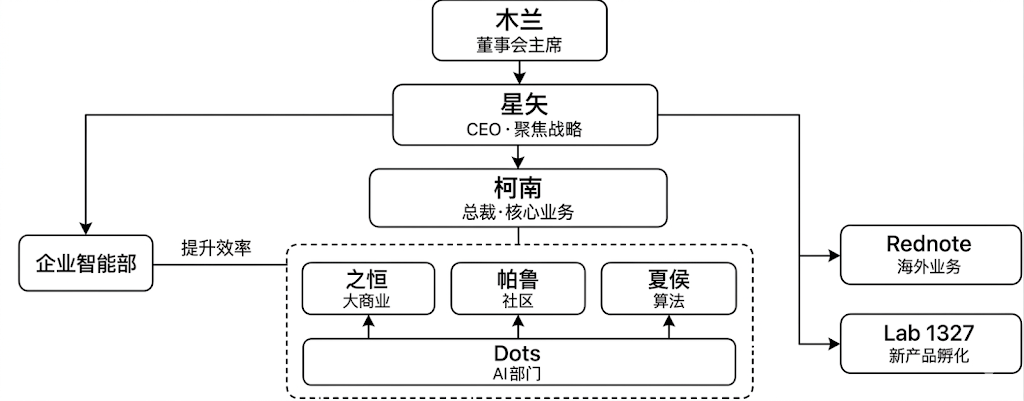
Specifically, this adjustment fully integrates the three major businesses—community, e-commerce, and commercialization—along with the company's technological systems. CMO Zhiheng, Palu, and Xiahou have been appointed as the heads of these three businesses, reporting directly to Xing Shi.
While integrating business departments, Xiaohongshu has also established the top-tier AI division Dots and the Enterprise Intelligence Department, increasing investment in AI from both product technology and organizational perspectives.
Dots aims to build a complete technological system from model research and development, infrastructure, and engineering to products, integrating top AI talent and resources, also under Xing Shi's management. The Enterprise Intelligence Department integrates the former Enterprise Efficiency Department and Data Science Department, collaborating with the Strategy Department and Organization and Personnel Department. The internal letter states that the goal is to lay the foundation for an AI-era organization from four dimensions: intelligence, talent, data, and resources.
If you place this internal letter within the context of organizational transformations in the Chinese internet sector over the past three years, you'll find an interesting parallel: it resembles Wu Yongming's centralization after Alibaba's '1+6+N' model and ByteDance's elevation of AI teams to top-tier divisions like Flow and Seed. However, parallels aside, Xiaohongshu's situation is fundamentally different.
Having Alibaba's ambition is one thing; lacking ByteDance's resources is another.
01
Breaking Down Departmental Silos
Can It Bid Farewell to 'Growing Grass Without Harvesting'?
Many see traces of Alibaba's '1+6+N' model and its current three major business segments in Xiaohongshu's adjustments.
In 2023, Daniel Zhang introduced the '1+6+N' organizational restructuring plan, splitting Alibaba into six business groups—Alibaba Cloud, Taobao & Tmall, Local Services, Cainiao, International Digital Commerce, and Digital Media & Entertainment—plus N independent business companies.
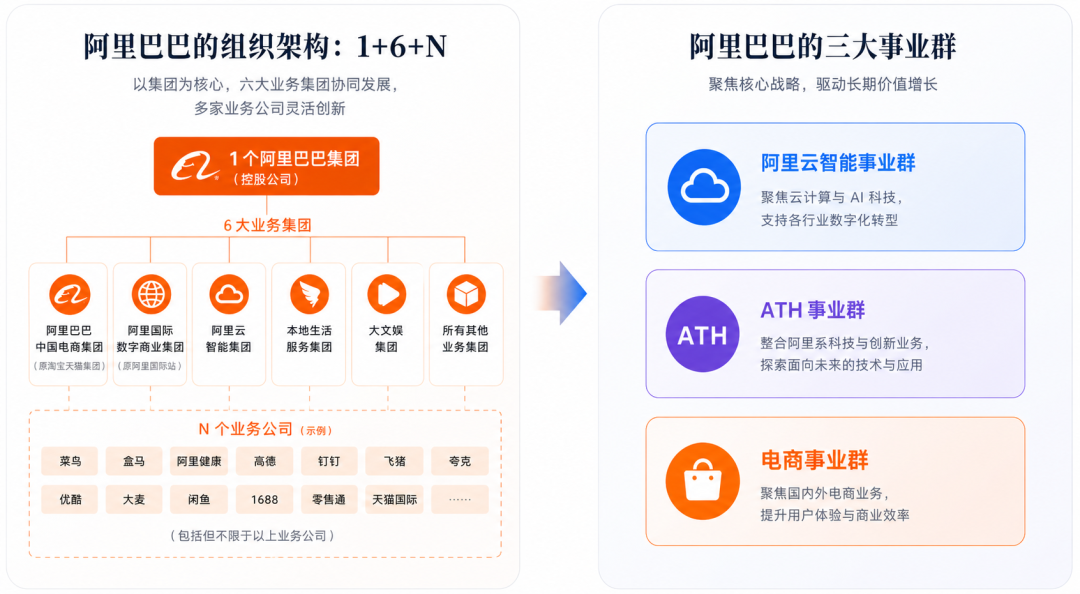
Each business unit had its own board and CEO, with a clear goal: each was responsible for its own profit and loss, with the aim of going public as soon as they matured, while Alibaba functioned as a parent company similar to Huawei Technologies.
However, less than a year into implementation, problems emerged. Synergy costs between business groups skyrocketed. Did Alibaba Cloud want to lower prices for Taobao & Tmall? No, because Taobao & Tmall needed to protect their own cost lines. Did Hema want to use Cainiao's logistics? They couldn't agree on prices. What should have been brothers fighting side by side ended up building their own fortresses, with layers of barriers stifling themselves.
More dangerously, data fragmentation occurred. A user browsing on Taobao in the morning, placing an order on Tmall at noon, and ordering food on Ele.me in the evening had their behavior split across three data pools, making it impossible to form a unified user profile. This led to inaccurate recommendations, low advertising efficiency, and difficult cross-business conversions.
By the end of 2023, Wu Yongming took over and did the opposite of Zhang: he centralized power.
Wu Yongming personally took control of Alibaba Cloud, e-commerce, and AI—three core businesses. In early 2025, Alibaba Cloud Intelligence Group and E-commerce Group became the two pillars; in March 2026, the ATH (AI Large Models and Applications) Group was established as the third pole. The three lifelines no longer had intermediary layers.
Splitting was to stimulate vitality ; merging was because the work wasn't getting done. Xiaohongshu's Xing Shi is following Wu Yongming's path.
In the past, Xiaohongshu's community, e-commerce, and commercialization operated as three parallel organizations. Three teams, three sets of KPIs, three ways of seeing the world.
The community focused on 'user retention,' not wanting too many ads to disrupt the experience. Commercialization focused on 'ad revenue,' wanting more exposure. E-commerce focused on 'GMV,' wanting traffic directed to its livestream rooms first.
These three forces pulled back and forth, ultimately leaving users with a disconnected experience: users saw something good on Xiaohongshu but had to screenshot and search for it on Taobao. Xiaohongshu earned nothing from these transactions.
The pain points are clear from the data. In 2024, ad revenue contributed about 21.6 billion yuan, accounting for 72% of total revenue, up 48% year-on-year. Overreliance on brand advertising has been consistently criticized for its single revenue structure. While e-commerce GMV reached 100 billion yuan, it was just a fraction compared to Douyin's 3.5 trillion yuan in livestream e-commerce and Kuaishou's 1.39 trillion yuan.
More critically, the average internet e-commerce conversion rate is 3%–5%, while Xiaohongshu's livestream e-commerce conversion rate is only one-third of that of leading comprehensive e-commerce platforms.
In short: strong grass-growing ability, weak harvesting ability—this is the core bottleneck that has long capped Xiaohongshu's valuation.
Its per-capita usage time and user stickiness surpass those of Bilibili, yet it fails to produce transactional conversions.
Xing Shi also knows where the problem lies. From testing the 'Red Cat Plan' in 2025 to integrate Taobao external links to internally forming a 'Big Commerce Segment' under Conan's unified responsibility for advertising and transactions, the path is clear: Xiaohongshu doesn't want to be just a middleman for 'grass-growing'; it wants to close the loop from 'grass-growing' to 'harvesting.'
Hence, the final hammer blow: consolidating key decision-making power over core businesses further under Conan.
The difference is that Alibaba centralized all three businesses under the CEO; Xiaohongshu went a step further, nominally having three heads but effectively making Conan the 'chief director' of the community, e-commerce, and commercialization lines. As president, she oversees the entire chain from traffic inlets to transaction outlets.
This is Xing Shi's trump card: using institutional mandates to resolve internal friction. But institutions can break down 'departmental silos'; they can't overcome 'scale disparities.'
Xiaohongshu's real challenge isn't how ingenious its organizational structure is but how to convert its impressive user engagement into real, effective commercial output while reinforcing its community feel. This is the common curse of countless content platforms and the ultimate question mark over whether Xiaohongshu's valuation can convince the next round of investors.
Alibaba's problem is 'how an elephant turns'; Xiaohongshu's problem is 'how to grow up.' Logically, it makes sense, but whether it works depends on how much real money can deliver results.
02
Having Alibaba's Blueprint
But Lacking ByteDance's Ammunition
If consolidating the commercial segment follows in Wu Yongming's footsteps, then establishing the AI division sees Conan tread another path ByteDance has walked.
In this restructuring, Xiaohongshu simultaneously established two major AI organizations: Dots and the Enterprise Intelligence Department. One handles technological implementation, the other organizational infrastructure—a clear division of labor.
Dots' mission is to 'build a complete technological system from model research and development, infrastructure, and engineering to products, integrating top AI talent and resources.' This design, reporting directly to core executives without being tied to business departments, closely resembles ByteDance's Flow and Seed divisions.
ByteDance's AI system is directly controlled by CEO Liang Rubo. The Seed team, led by Dr. Wu Yonghui (poached from Google DeepMind), focuses on foundational large models and reports directly to Liang Rubo. The Flow department focuses on AI application-layer products, iterating rapidly and landing agilely, also reporting directly to the CEO's office.
Xiaohongshu's Dots is trying to wear the same shoes.
But ByteDance's shoes aren't ones everyone can run in. Flow and Seed's ability to operate at high speed relies on two things: a global top-tier AI talent pool and an 'unlimited budget' commitment to investment.
According to Zheshang Securities estimates, ByteDance's AI-related capital expenditures reached 80 billion yuan in 2024 and doubled to about 160 billion yuan in 2025. Xiaohongshu's total revenue for 2025 was just 42 billion yuan—ByteDance spends on AI in one year what Xiaohongshu earns in three to four.
Flow's ability to rapidly land AI products also stems from its immediate access to ByteDance's full-stack capabilities in recommendation algorithms, user growth, and content distribution. This is an AI engine tailored for ByteDance, fueled not by budgets but by over a decade of accumulated data and traffic capital.
Xiaohongshu's AI layout (layout) isn't late. In 2023, it launched the AI painting product 'Trik'; in December 2024, it released the standalone AI search app 'DianDian.'
These small, rapid attempts reflect Xiaohongshu's enthusiasm for AI, but their scale and strategic priority are clearly not on the same level as ByteDance's.
Meanwhile, the 'dark line' Enterprise Intelligence Department integrates the former Enterprise Efficiency Department and Data Science Department, collaborating with the Strategy Department and Organization and Personnel Department. The internal letter positions it as 'laying the foundation for an AI-era organization from four dimensions: intelligence, talent, data, and resources.'
Its logic resembles Alibaba's ATH Group. ATH's core mission is to reduce the production and usage costs of Tokens, allowing Alibaba Cloud, e-commerce, and local services to draw water cheaply from this 'AI well.'
But a vast gulf separates Xiaohongshu from Alibaba.
ATH exists because Alibaba Cloud's services span IaaS, PaaS, SaaS, and AI SaaS. It has self-developed chips, thousand-billion-parameter Tongyi large models, and a vast cloud customer base waiting to buy Tokens.
ATH is essentially an externally outputted AI productivity system, serving not just internal needs but also generating revenue externally—a complete AI commercial closed loop (loop).
Xiaohongshu's Enterprise Intelligence Department currently shows almost no potential for external output or commercialization. It's merely an internal cost-saving and efficiency-enhancing tool department. This positioning fundamentally determines that no matter how ingeniously designed, its resource priority and strategic weight are not on the same level as ATH's.
Conan is not unaware. In a conversation with economist Xue Zhaofeng, she cautiously revealed her understanding of Xiaohongshu's commercialization: communities have their own native and organic growth. Building a commercial system along native user needs and ecological chains is the most suitable path for Xiaohongshu.
This indicates that Xiaohongshu's AI isn't meant to compete with chatbots for users or sell Tokens for profit. It's to make Xiaohongshu's 'grass-growing' more accurate, 'harvesting' smoother, and 'advertising' smarter. Dots builds the technological house; the Enterprise Intelligence Department lays the foundation—one handles 'can it run,' the other 'can it run far.'
But having both departments introduces new structural challenges. Where is the boundary between Dots (technology) and the Enterprise Intelligence Department (infrastructure)? When AI capabilities need to land in specific business scenarios, does Dots directly interface with community, e-commerce, and commercialization, or does it go through the Enterprise Intelligence Department as an intermediary?
How will the two departments collaborate? Will new departmental barriers emerge from the old organizational walls? The internal letter offers no answers.
Crucially, Xiaohongshu is only a mid-sized company.
It can't make AI an independent external business like Alibaba, nor can it use unlimited resources to nurture a top-tier AI team like ByteDance. It uses Alibaba's mindset to design organizations and ByteDance's model to build AI teams but can only sustain this system with mid-sized resources.
When resources can't support both lines simultaneously, which will be let go first? The answer not written in the internal letter may be revealed by financial reports and talent attrition rates in the next two to three quarters.
Still, it's too early to write off. From 'community first' to 'accelerating commercialization,' to integrating the Big Commerce Segment, to now consolidating community, e-commerce, and commercialization, none of Xiaohongshu's adjustments have been perfect. Some have even been mocked by internal employees as 'trying everything.'
But the very act of trying shows the company is striving to find its shape.
In the 2024 internal letter for Xiaohongshu's 11th anniversary, Xing Shi and Mulan wrote: 'These phenomena make me deeply feel the pain of our frontline colleagues. They often have energy but no outlet, watching opportunities slip by.' Conan's promotion is the most concrete response to that letter.
In the AI era, this may be the most precious trait. Technical routes can be trial-and-error; organizational structures can iterate; talent can be nurtured over time. The real danger isn't taking detours but standing still.
- END -
-
![]()
Tesla Restructures Its Balance Sheet
-
![]()
Accelerating the High-Speed Interconnection Upgrade of AI Computing Clusters! JONHON Releases ELSFP External Light Source Optical Connectors
-
![]()
Breaking the overseas blockade of volumetric holographic materials, this optical enterprise secures nearly 100 million yuan in financing!
-
![]()
Why Does Jensen Huang So Openly Praise China’s AI?
-
![]()
"Wudang" Unveiled: Arm China's Next-Gen AI VPU Redefines Video Encoding
-
![]()
From Energy Conservation and Carbon Reduction to AI Decision-Making: GECON East Intelligence and Chery Group Explore a New Green and Smart Paradigm for Automobile Manufacturing
-
![]()
WAIC 2026 Observation | AI Accelerates Towards the Core of Industries, Industrial AI Enters a Critical Phase
-
![]()
Volkswagen China Fires the First Shot in Foreign-Funded 'White Box Delivery'!