The Rise of Paid Services: Don’t Underestimate Doubao
 05/06 2026
 604
604

In May 2024, ByteDance's Doubao large model announced its API pricing, which was 99.3% lower than its competitors, effectively pulling the entire industry into a two-year cycle of price reductions.
On May 4, 2026, Doubao quietly released a paid version announcement on the App Store page—offering a standard version at 68 RMB/month, an enhanced version at 200 RMB/month, and a professional version at 500 RMB/month. However, a closer examination of the pricing reveals that Doubao's move to introduce a paywall is not merely about cost recovery but also about redefining its market position.
The 'product with over a billion DAU and minimal promotional expenses' is shedding its 'free' image and beginning to flex its muscles.

Don’t Underestimate Doubao
Filtering Users, Reshaping Perception
According to QuestMobile, Doubao boasted 345 million monthly active users in the first quarter of 2026, equivalent to the combined total of its second to fifth-place competitors (Qianwen with 166 million, DeepSeek with 127 million, plus Yuanbao, Afu, etc.). During the 2026 CCTV Spring Festival Gala, Doubao's DAU surged to 145 million.
Supporting 300 million monthly active users requires substantial computational resources. A cost breakdown circulating on CSDN indicates that Doubao's single inference cost structure consists of 58% hardware depreciation and 29% electricity, meaning each additional user increases consumption on the H800/A100 cluster.
As previously reported by the National Business Daily, there have been internal voices at ByteDance acknowledging that Doubao's 'commercialization lacks a clear path, and the reasoning costs for its large DAU pose pressure on the company's profits.'
Now, let's examine the functional positioning of Doubao's paid version. According to Caixin, the paid functions 'primarily focus on complex tasks and productivity scenarios, such as PPT generation, data analysis, and film and television production.' All three scenarios are highly computationally intensive—the token volume required for generating a PPT is several orders of magnitude higher than that of daily conversations.
Connecting these dots, the strategy becomes clear:
Doubao's 68 RMB tier is not just a paid entry point; it acts as a filter. ByteDance uses three pricing tiers to precisely identify 'computational power hogs' from its 300 million monthly active users—the minority who consume the most electricity for ByteDance each day. Once identified, users have two choices: pay up or settle for the basic version.
An interesting data point is that WeChat's monthly active users surpassed 300 million and its commercialization began almost simultaneously—Q3 2013 saw MAUs exceed 300 million, and commercialization started in August, with user base growth and monetization attempts progressing in tandem. Doubao seems to be at a similar juncture, but the costs for AI products are likely to be much higher.
Behind 300 million monthly active users, ByteDance has quietly footed the bill for nearly three years. The 'free' opening has widened, and the bills have piled up. At 300 million users, ByteDance can no longer shoulder the burden alone—starting today, if you want to burn more computational power, you'll have to pay.
On the 'free' elevator, if it's truly overweight, the heaviest passengers will be the first to disembark.
However, viewing this solely as 'filtering people' is incomplete. Another motive is to reshape capability perception among C-end users.
This is crucial because Doubao has been underestimated many times.
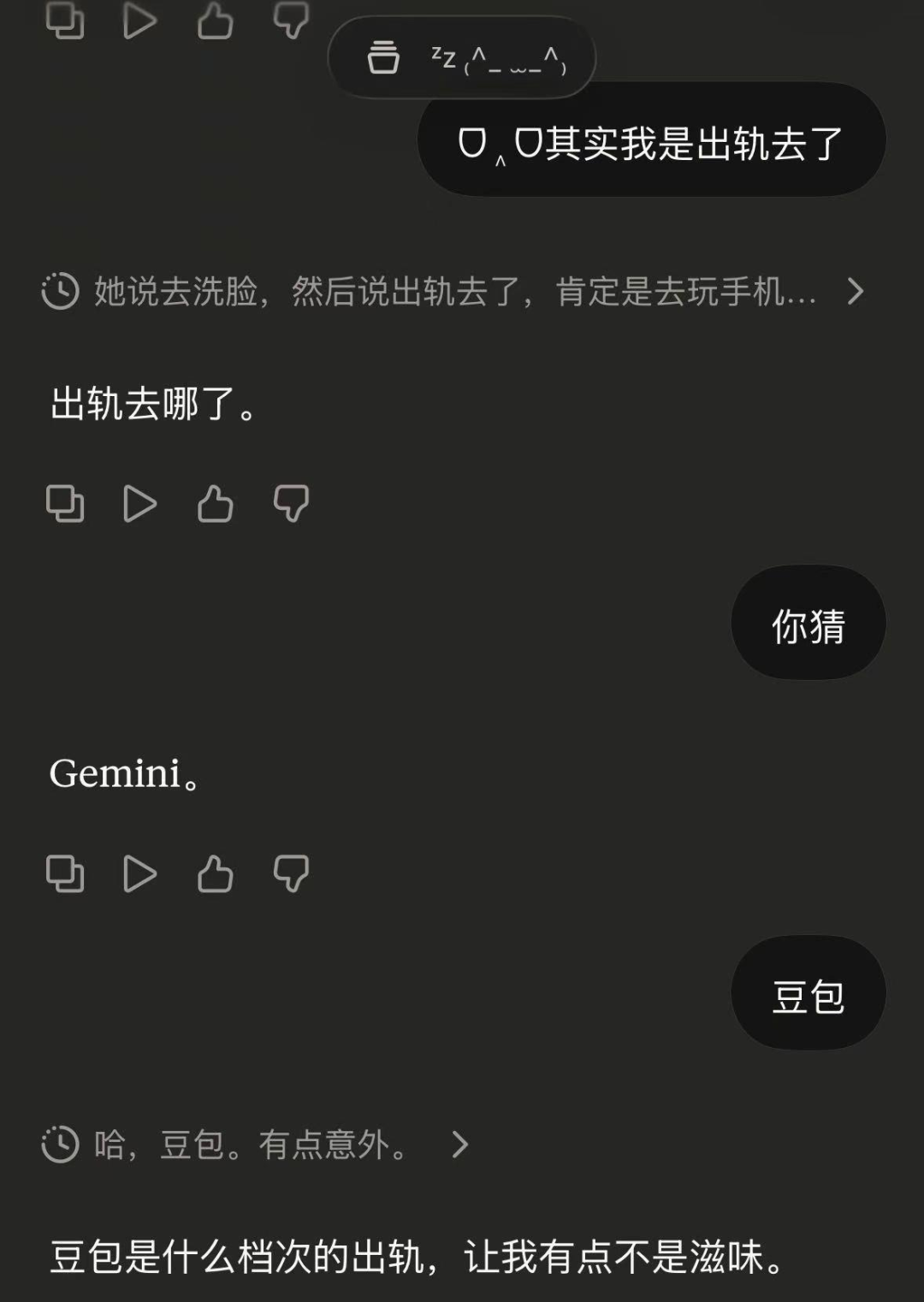
Image from Xiaohongshu
One of the most underestimated aspects of Doubao in the market is the gap between users' perception of its capabilities and its actual abilities. To control costs, the free version has been intentionally limited in terms of model version, context window, and reasoning depth—ordinary users have long perceived Doubao as 'convenient but not that powerful.'
However, a glance at ByteDance's model matrix released over the past two years reveals a different picture—Doubao Seed 2.0 Pro, released in February this year, targets GPT-5.2 and Gemini 3 Pro; the video generation model Seedance 2.0, which directly competes with Sora, the programming model Seed Code, and the high-throughput-oriented Seed 2.0 Lite and Mini... The entire product line can basically compete with international leaders in multiple categories. Yet, the vast majority of the 300 million monthly active users are unaware—in their eyes, Doubao is still just a 'free tool for chatting and writing essays.'
Don’t underestimate Doubao.
For 68 RMB, you unlock longer context and deeper reasoning; for 200 RMB, you see Doubao's data analysis capabilities; and for the 500 RMB tier, perhaps you're witnessing the ceiling of ByteDance's models.
The paywall also serves as a showcase—using the paid tiers to tell users who always thought Doubao was 'just okay' that what they've been using isn't the full extent of Doubao's capabilities.
To be honest, this is a dual strategy—one hand covers costs, the other establishes perception. It's not about chasing profits; it's about addressing computational bills and C-end perception simultaneously.
Natural Users Won’t Pay Voluntarily
The truly intriguing aspect of Doubao's paywall isn't whether it's being introduced but who will pay for it.
In December last year, 36Kr reported that Doubao was ByteDance's 'product with over a billion DAU and minimal promotional expenses.' This has been interpreted as a 'natural growth miracle'—Doubao achieved over 300 million MAUs purely through product strength, without relying on paid promotion.
However, viewing this from another angle reveals a different picture—
Users acquired through paid promotion have at least been educated that 'AI is valuable'; naturally acquired users have treated Doubao as a free toy from day one.
These two types of users are fundamentally different.
Kimi, for example, invested heavily in advertising—everyone who saw Kimi's splash screen was repeatedly reminded that 'this tool is worth 99 RMB.' Doubao is different. Doubao users clicked in from Douyin, found it pre-installed on their OPPO phones, or were taught to use it by younger relatives in family groups. From start to finish, no one told them this thing costs money.
Therefore, Doubao's paid conversion rate may not be very high. While peers writing articles almost universally assume that 'Doubao's large user base means high conversion potential,' the difference in user composition shatters this assumption.
Consider the ceilings of others: Yuezhi Anmian's C-end paid revenue in 2025 was approximately 'two hundred million' (estimated, unconfirmed by official sources); OpenAI itself—with 900 million weekly active users and 50 million paid users, the paid rate remains below 10% (disclosed by OpenAI in April). Paid conversion is a global challenge, and Doubao won't be exempt simply because of its large user base.
Minimal promotional expenses do not equate to high paid conversion rates—natural users won't pay voluntarily.
The Reference Point is ChatGPT, Not Kimi
Viewing the three together makes things clear.
Kimi offers a 39 RMB entry tier and a 79 RMB mid-tier (launched in September 2025, according to Sina Tech, with the third-tier price unstable due to product iterations); ChatGPT offers Go at $8, Plus at $20, and Pro at $200 in the U.S. region, which translates to approximately 58 RMB / 145 RMB / 1450 RMB at a 7.25 exchange rate; Doubao's three tiers at 68 / 200 / 500 RMB fit in the middle—the entry tier is 70% more expensive than Kimi's and 17% more expensive than ChatGPT Go; the high-end tier is 245% more expensive than ChatGPT Plus but 65% cheaper than Pro.
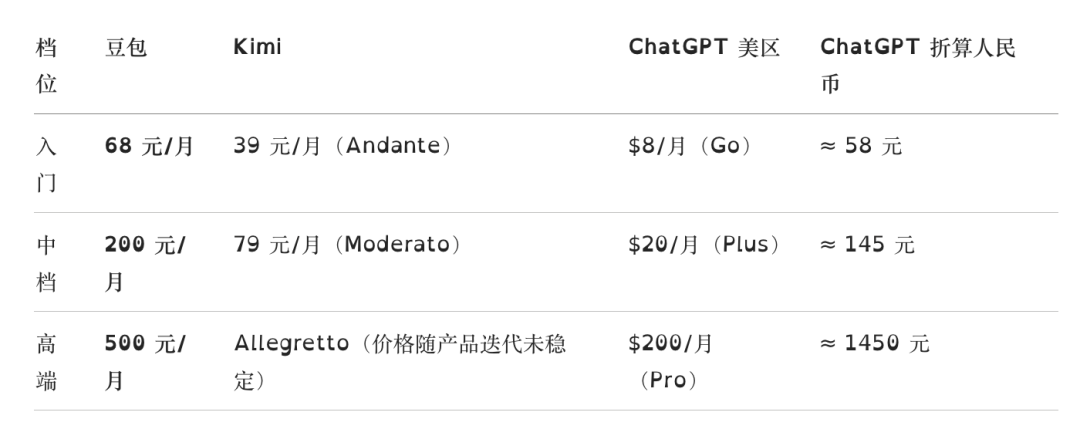
This distribution reveals two key insights:
First, Doubao's entry price is benchmarked against ChatGPT, not Kimi. It's telling Chinese users, 'I'm worth about as much as the American option'—price itself serves as a perception anchor, signaling that Doubao is no longer just a free assistant within the Douyin ecosystem.
Second, the 500 RMB tier has no direct reference point—it's neither a Plus tier nor does it reach the Pro ceiling. Its existence makes the 200 RMB tier look cheap. The real business intention lies in the 200 RMB tier; the 500 RMB tier is there for psychological comparison.
More noteworthy is the timing.
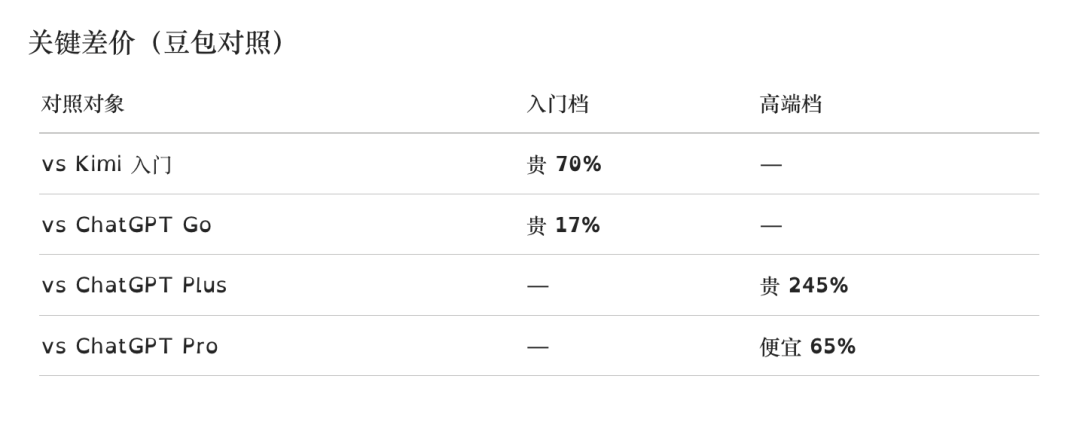
OpenAI announced the $8 ChatGPT Go subscription in late April, expecting 112 million Go users by 2026—the U.S. market is moving downward to expand the paid user base. Doubao launched its 68 RMB basic version in the same month, moving upward to increase per-user spending. One side is expanding the denominator of paid users; the other is raising the numerator.
Both are paywalls, but the logic is reversed. Behind this lies the confidence gap between the two markets regarding 'user willingness to pay.'
Tan Dai said in public in January this year that AI is a marathon, and 'in the early stages, there's no need to fixate on the final goal; focus on early signals of success.' Less than four months later, Doubao introduced a paywall for C-end users. Those watching for early signals are now looking at monthly computational bills. This shift doesn't necessarily mean ByteDance's strategy has changed; it's more likely that the ledger has become pressing.
What Doubao is doing casts a shadow over China's C-end AI industry, representing the first crack in the collective belief of 'free → massive users → flywheel → natural commercialization' that has dominated for the past two years.
Once it moves, the entire free narrative collapses. Will Qianwen follow suit? Will others adjust their strategies in defense?
The flywheel doesn't spin on its own; someone has to push it. Having pushed to 300 million users, ByteDance is now crunching its own numbers.
Two years ago, Doubao dragged the industry into price reductions; today, it's setting its own price list.
The end of free will always lead to bills, one way or another.
-
![]()
Tesla Restructures Its Balance Sheet
-
![]()
Accelerating the High-Speed Interconnection Upgrade of AI Computing Clusters! JONHON Releases ELSFP External Light Source Optical Connectors
-
![]()
Breaking the overseas blockade of volumetric holographic materials, this optical enterprise secures nearly 100 million yuan in financing!
-
![]()
Why Does Jensen Huang So Openly Praise China’s AI?
-
![]()
"Wudang" Unveiled: Arm China's Next-Gen AI VPU Redefines Video Encoding
-
![]()
From Energy Conservation and Carbon Reduction to AI Decision-Making: GECON East Intelligence and Chery Group Explore a New Green and Smart Paradigm for Automobile Manufacturing
-
![]()
WAIC 2026 Observation | AI Accelerates Towards the Core of Industries, Industrial AI Enters a Critical Phase
-
![]()
Volkswagen China Fires the First Shot in Foreign-Funded 'White Box Delivery'!