Why is Doubao Monetizing in the 'Most Pragmatic' Way?
 05/06 2026
 432
432

Someone in the AI Circle Has to Step Up and Play the 'Villain'
Is a National-Level AI App Now Charging Fees?
On May 3, according to a report by Yicai, Doubao, the AI application under ByteDance, is set to launch its first paid monthly subscription service as early as mid-to-late May. The App Store page shows three subscription tiers: Standard at 68 yuan/month (continuous), Enhanced at 200 yuan/month, and Professional at 500 yuan/month, with annual fees reaching up to 5,088 yuan.
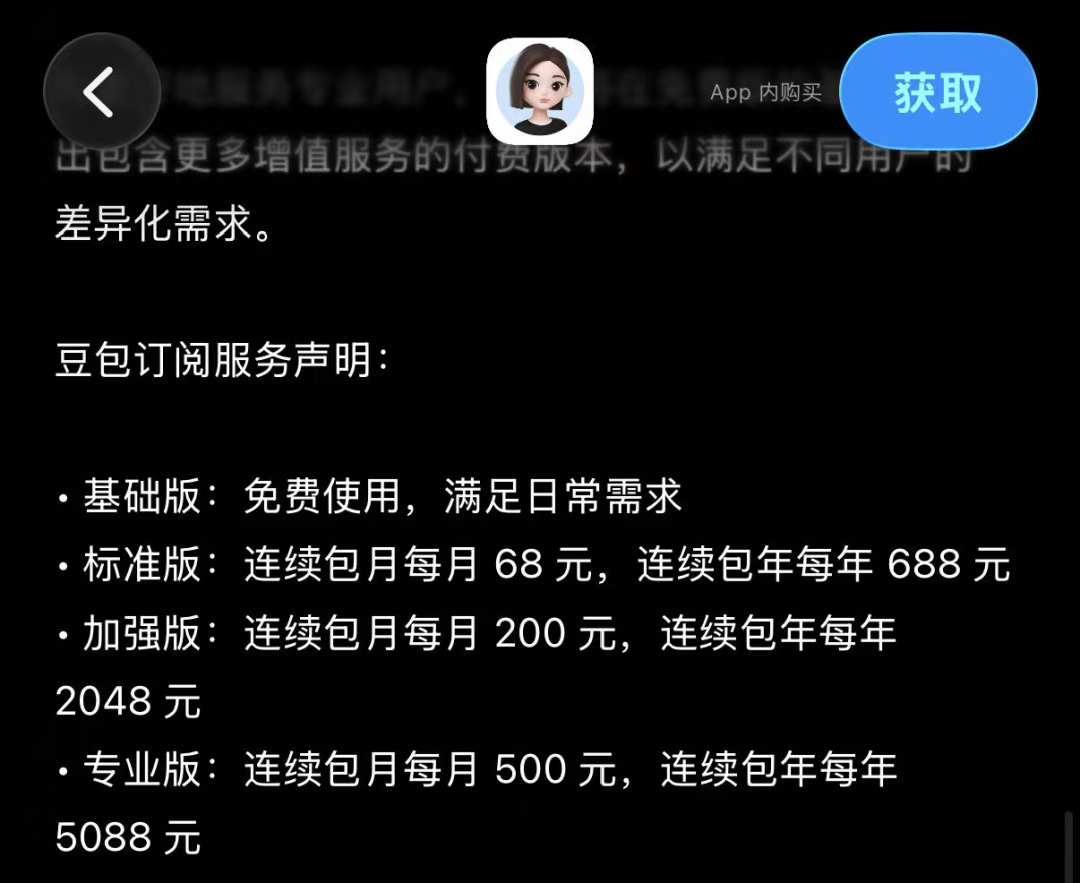
In response to inquiries about paid membership, Doubao's official response emphasized that it will always provide free services while exploring additional value-added services. Details of these plans are currently in the testing phase.
Sources close to Doubao revealed that paid features will primarily focus on complex tasks and productivity scenarios, such as PPT generation, data analysis, and film and television production. As the model's capabilities continue to upgrade, the product can now handle an increasing number of complex, high-value tasks.
However, such tasks require more computational power and inference time. Therefore, Doubao plans to introduce paid services to meet the demands of these complex scenarios, while the free version will continue to serve users' daily needs.
Why is Doubao choosing to test paid services at this juncture? Can it successfully commercialize while ensuring a good user experience?
01
Even ByteDance Can't Afford to Keep Doubao Free
In the internet era, a higher monthly active user (MAU) count generally indicates stronger monetization potential, adhering to the mantra that 'traffic is an asset, and scale is a barrier.'
For an app with sufficiently high MAUs, its marginal costs can approach zero due to economies of scale. Subsequent monetization methods, such as advertising, e-commerce, and game co-publishing, can generate substantial profits through the model of 'making money from someone else's pockets.'
However, in the AI era, a higher MAU count may accelerate a company's 'bankruptcy.' The key difference lies in 'marginal costs.'
Traditional text or short video distribution incurs minimal additional server costs for each new user refreshing their feed. In contrast, AI large models operate on a 'heavy asset, high consumption' model, where every dialogue interaction, long text processing, and image generation results in a linear increase in demand for AI chips.
According to QuestMobile's 'Artificial Intelligence Insights Report for March 2026,' ByteDance is shouldering the heaviest burden in this regard.
In the first quarter of 2026, Doubao led the domestic AI app rankings in quarterly active users, with an absolute advantage of 340 million. The next closest, DeepSeek, had 127 million, followed by Yuanbao with 57.35 million and Kimi with only 8.34 million. Doubao's user base alone surpasses the combined total of the next nine apps.
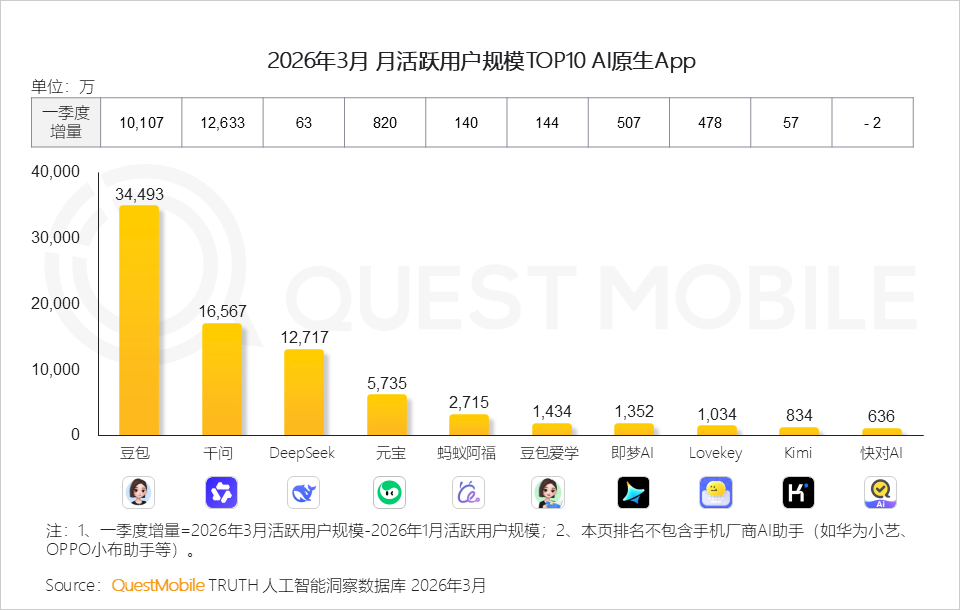
While leading the rankings sounds impressive, 340 million active users translate to hundreds of millions of daily dialogue requests. Every question and answer, every generation, represents tangible computational power consumption. The more users, the faster the money burns.
In the AI era, focusing solely on 'MAU count' is an outdated valuation metric. User scale is merely superficial; the core indicators representing computational power consumption and measuring the operational pressure of large models are the 'water, electricity, and coal' of the AI era—Tokens.
In May 2024, Doubao's large model had an average daily Token consumption of 0.12 trillion. Less than two years later, this figure has skyrocketed to an astonishing 120 trillion. In just two years, consumption has surged 1,000-fold.
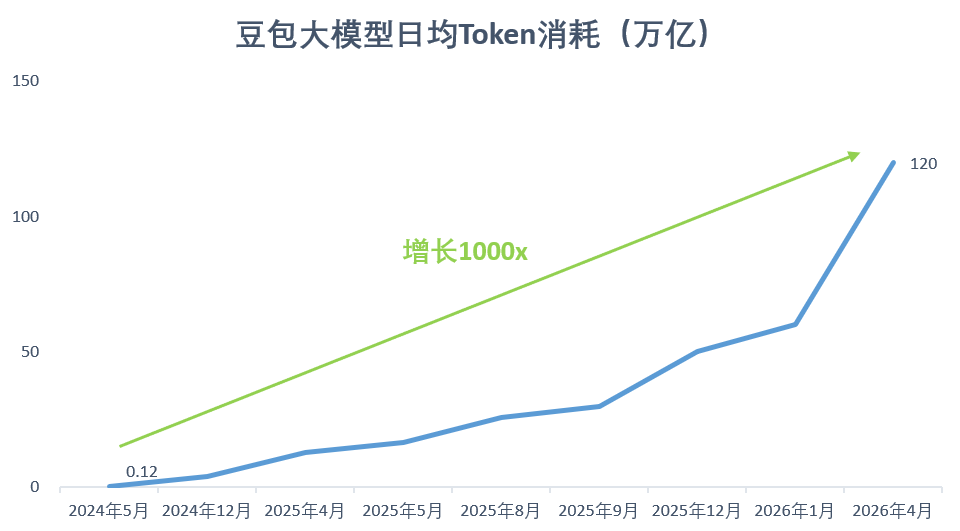
Globally, only absolute leaders like OpenAI and Google have broken through the 'hundred trillion' daily Token consumption mark.
ByteDance has successfully joined the 'first tier' of global large model invocation volumes with Doubao, but it also means shouldering infrastructure cost pressures comparable to Silicon Valley giants. For ByteDance, which faces many constraints in domestic AI infrastructure and can only purchase relatively outdated domestic inference cards, the challenge is far greater than for OA and Google, which can simply buy cards with money.
Moreover, these figures only represent domestic operations and do not include invocations from TikTok and other overseas business units. This means ByteDance has pushed its computational power demands to an extremely high level.
Supporting this daily throughput of 120 trillion Tokens requires substantial capital investment in heavy assets. By 2026, competition among large models has further evolved from algorithmic comparisons to an arms race in computational power infrastructure.
A review of BAT's capital expenditure (Capex) trends over the past three years shows that the three giants were relatively restrained in their spending in 2023. In 2024, with the full rollout of AI strategies, their investments began to grow significantly in tandem. By 2025, ByteDance's Capex growth had obvious outpaced that of its two peers.
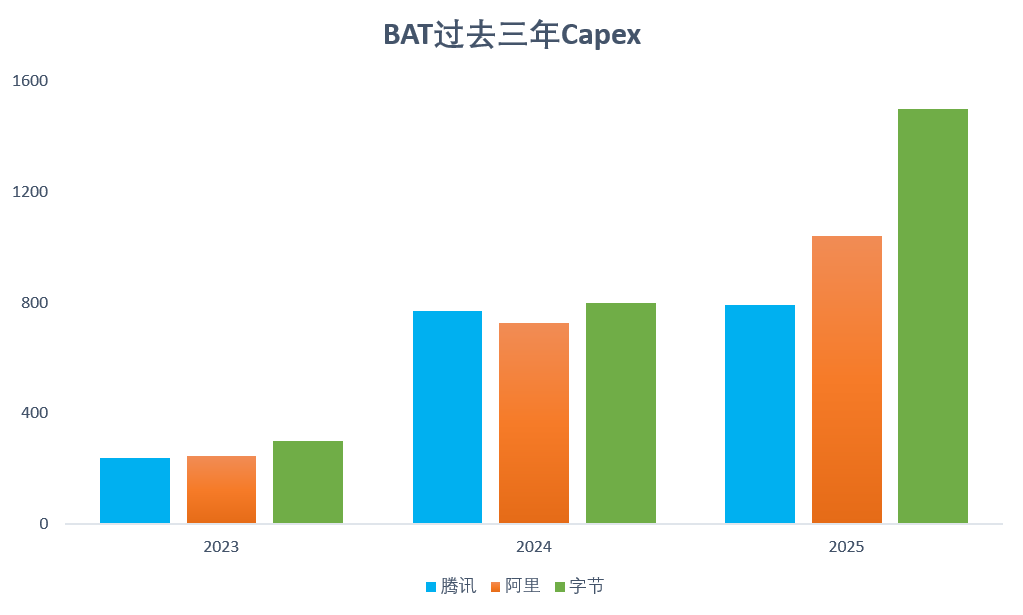
As the world's largest unlisted super unicorn, ByteDance does not need to deliver quarterly profit reports to public shareholders like Alibaba or Tencent, nor does it face harsh scrutiny from capital markets due to short-term profit margin declines. This unlisted independence gives ByteDance the confidence to 'achieve miracles through massive investment' at critical technological turning points.
However, in the face of absolute heavy asset scales, even ByteDance cannot sustain one-way blood transfusions indefinitely. A senior industry analyst told Hyper Focus that 'to win this large model war, ByteDance's current infrastructure investment intensity is fully on par with North American CSPs.'
On one hand, there is the ultra-heavy asset sprint comparable to Silicon Valley giants; on the other, there is the massive Token consumption driven by 340 million domestic users. As the Capex growth curve becomes steeper, ByteDance's only option is to validate the commercialization of high-value tasks.
Thus, Doubao's launch of a Professional tier with an annual fee of up to 5,088 yuan at this juncture is not because ByteDance suddenly lacks funds but is an inevitable result driven by AI economic laws. It marks the official departure of domestic leading large models from the 'burn money for traffic' era, transitioning toward a virtuous commercial cycle where 'computational power costs match user value.'
For ByteDance, exploring commercialization was an inevitable choice.
02
Who Will Pay 5,088 Yuan for an 'Exorbitant' AI?
While the motivation for commercialization is clear, 'should we charge' and 'how to charge' are two different matters.
Examining Doubao's membership strategy in 2026, the biggest challenge ByteDance faces is determining who, in the Chinese market accustomed to free services, would pay an annual fee of up to 5,000 yuan for a generic domestic large model.
Frankly speaking, high-net-worth individuals with extreme productivity demands for AI often seek services like Claude, ChatGPT, or Gemini to pursue ultimate reasoning logic or code generation. The capabilities and mindset of domestic large models as core productivity tools have not yet been established among professional user circles.
In terms of usage, globally, the only driving force compelling users and enterprises to willingly spend money on AI applications is Coding.
Recently, Anthropic's annualized revenue surpassed that of OpenAI. This reversal was supported by Claude's absolute dominance in Coding scenarios, proving that 'coding' is currently the only killer scenario that has achieved massive monetization in the large model track (track).
In comparison, what can Doubao offer to justify an annual fee of up to 5,000 yuan?
Admittedly, the release of Seedance 2.0 in February this year showcased ByteDance's technical prowess to the world. As a top-tier audio-visual joint generation large model, Seedance 2.0 has indeed raised the bar for Doubao in the multimodal field and demonstrated ByteDance's formidable capabilities in video generation.
However, video generation remains a relatively low-frequency creative scenario. Can Doubao truly become an indispensable daily necessity for ordinary people, like Coding, to support such high subscription fees? The answer is clearly questionable.
Moreover, Chinese users have long been accustomed to 'hopping on the train first and paying later,' forming a user base that expects free services. Unlike North America or Europe, where there is a culture of B2C software payments, extracting money from Chinese consumer users is no easy task.
Before Doubao, Kimi had almost succeeded in implementing a 2C membership model. However, the issue lies in the fact that Doubao's scale and user demographics are entirely different from Kimi's.
As the earliest pioneer in domestic large model monetization, Kimi still faces a severe 'zero-sum game' between free and paid users. Under the massive computational power gap, the experience of free users has been virtually 'strategically abandoned.'
On major social platforms, complaints about Kimi 'becoming dumber' and 'freezing' have become daily occurrences.
One user who relies on large models for productivity publicly complained, 'I'm actually used to using Gemini, but I've noticed a significant decline in intelligence over the past few months, so I started trying domestic large models. Kimi is indeed very useful, but its computational power is somewhat lacking.'
'I started with the free version, and uploading a Dozens of pages (dozen-page) PDF often resulted in constant prompts saying 'Kimi is tired.' Later, I subscribed to the 49 yuan monthly membership, thinking I could finally use it unrestricted. However, when using advanced Agents to process several research report datasets in parallel, I quickly hit resource limits and had to wait for a 3-hour cooldown before continuing. Paying for a productivity tool only to use it like a game with skill cooldowns creates an extremely disjointed experience.'
Keep in mind that Kimi's MAU is just over 8 million. At this scale, computational power allocation is already stretched to the limit. Doubao, on the other hand, faces a staggering 345 million MAUs. If this computational power allocation dilemma erupts, it will undoubtedly be amplified infinitely.
If Doubao prioritizes core computing resources for its 5,000 yuan Professional tier clients to preserve their experience, its massive free user base will inevitably face sluggish responses and 'dumbed-down' interactions. For a product that rose to prominence on national-level traffic, a collapse in free user sentiment could risk breaching its foundational moat.
Conversely, if strict computational power isolation cannot be achieved at the AI native cloud's underlying architecture level, how can paid users who have spent a fortune be convinced to wait in line with 300 million free users during peak hours? If free usage is accommodated, how much substantive computational power upgrade can paid users actually enjoy? These are all stark realities.
When assessing Doubao's user monetization potential, its user structure and willingness to pay are also worth exploring.
According to QuestMobile data, as of March 2026, compared to Qianwen and Yuanbao, Doubao has a higher proportion of users born in the 60s-80s (i.e., aged 45-65) and users from fourth- and fifth-tier cities, reaching 17.9% and 9.5%, respectively. Their TGI (Target Group Index) is higher, indicating significantly stronger appeal to users in lower-tier markets (lower-tier markets) than average.
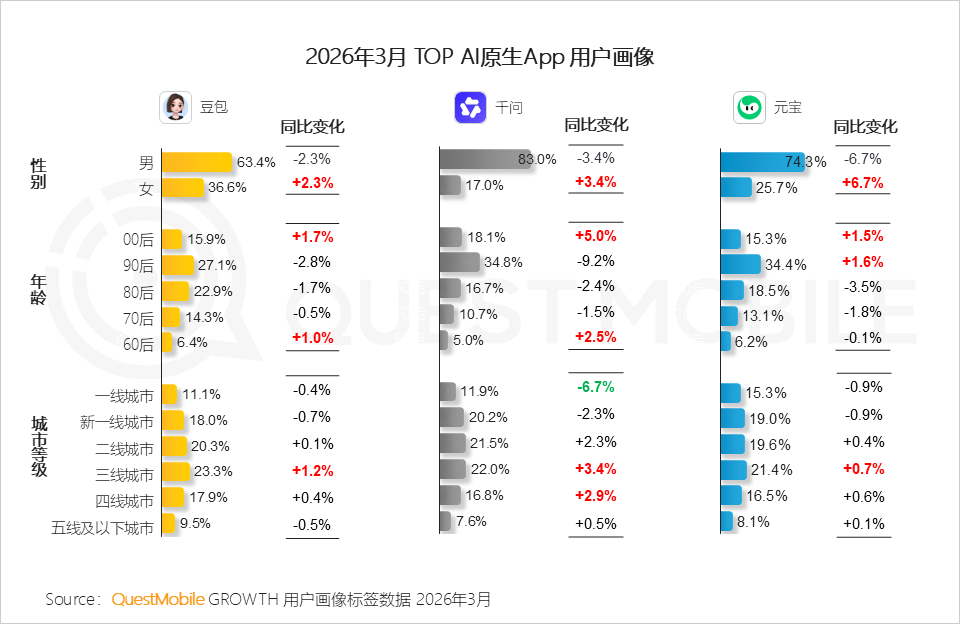
Kimi succeeded in monetization because, over the past two years, it relied on ultra-long text capabilities to precisely attract white-collar workers, researchers, and university students in first- and second-tier cities during its cold start phase. This demographic experiences genuine productivity anxiety and already has a habit of paying for AI SaaS tools.
Besides the challenges of user demographics, massive computational power consumption also imposes rigid constraints on commercialization.
According to data released by Volcano Engine, as of December 2025, Doubao's large model had an average daily Token usage exceeding 50 trillion, a more than 10-fold increase year-on-year. Maintaining real-time inference at this scale under the current architecture incurs daily hardware and energy costs reaching the millions of yuan range.
Against this backdrop, launching a membership plan starting at 68 yuan/month, from a revenue model perspective, even if a 1% paid penetration rate is achieved based on the existing active user structure, monthly subscription revenue would struggle to cover inference costs.
Thus, Doubao's membership launch at this stage resembles more of a strategic exploration by ByteDance in vertical scenarios.
First, establish the payment gateway and open up the commercialization pipeline to gauge the market's true willingness to pay. In the future, as large model capabilities further improve, more irreplaceable value-added services can gradually be integrated into this framework.
As for how wide this path can ultimately become, it depends on whether ByteDance's computational power infrastructure and model iteration speed can outpace this protracted war of attrition.
- END -
-
![]()
Tesla Restructures Its Balance Sheet
-
![]()
Accelerating the High-Speed Interconnection Upgrade of AI Computing Clusters! JONHON Releases ELSFP External Light Source Optical Connectors
-
![]()
Breaking the overseas blockade of volumetric holographic materials, this optical enterprise secures nearly 100 million yuan in financing!
-
![]()
Why Does Jensen Huang So Openly Praise China’s AI?
-
![]()
"Wudang" Unveiled: Arm China's Next-Gen AI VPU Redefines Video Encoding
-
![]()
From Energy Conservation and Carbon Reduction to AI Decision-Making: GECON East Intelligence and Chery Group Explore a New Green and Smart Paradigm for Automobile Manufacturing
-
![]()
WAIC 2026 Observation | AI Accelerates Towards the Core of Industries, Industrial AI Enters a Critical Phase
-
![]()
Volkswagen China Fires the First Shot in Foreign-Funded 'White Box Delivery'!