Generate Games in 5 Minutes with Zero Coding! Astrocade Review: Is This AI Tool Hyped by Google Really That Amazing?
 05/08 2026
 567
567
Create mini-games without learning programming.
In today's AI landscape, AI can generate text, images, audio, and video. So, can AI generate games? All the aforementioned elements appear in games. However, unlike images and videos, games possess the unique attribute of real-time interaction. For AI to generate games, it must deeply understand elements such as rules, items, and win/lose conditions.Recently, an AI gaming startup called Astrocade secured a new round of funding amounting to $56 million, with investors including NVIDIA and Google. Currently, Astrocade, as an AI gaming platform, is live. Users can not only generate games using AI but also play games created by others using AI.
From the perspective of an average user, I am more concerned about the quality of these AI-generated games and whether current AI technology has reached a level where it can disrupt the gaming market. With this curiosity, we downloaded and installed Astrocade to experience it firsthand.
Astrocade is more like a 'short video' gaming platform than a game creation tool
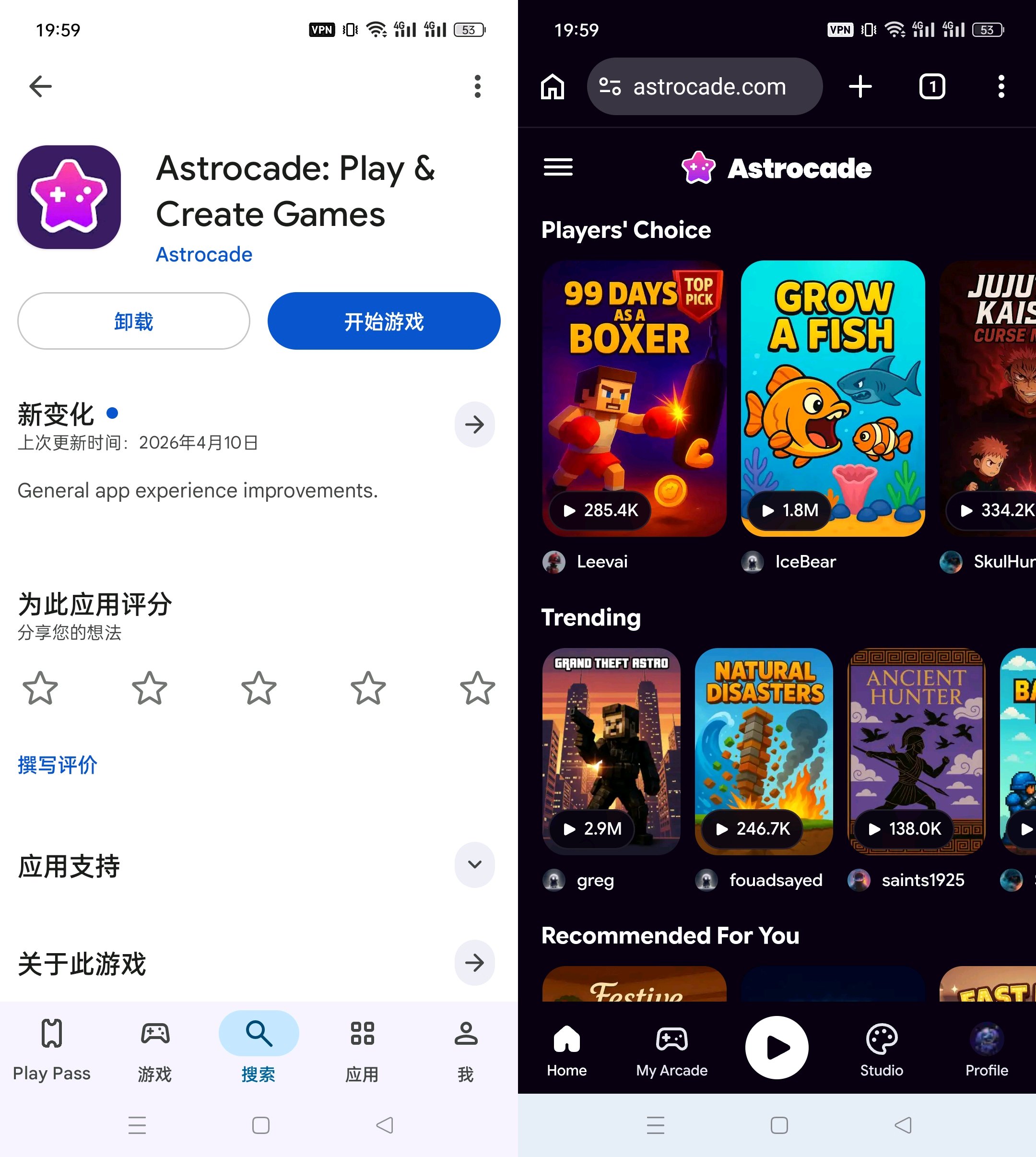
Astrocade is available on both the App Store and Google Play. However, it is not a conventional app but rather a link that redirects users to a browser, leading to Astrocade's online website.
(Image source: Leikeji)
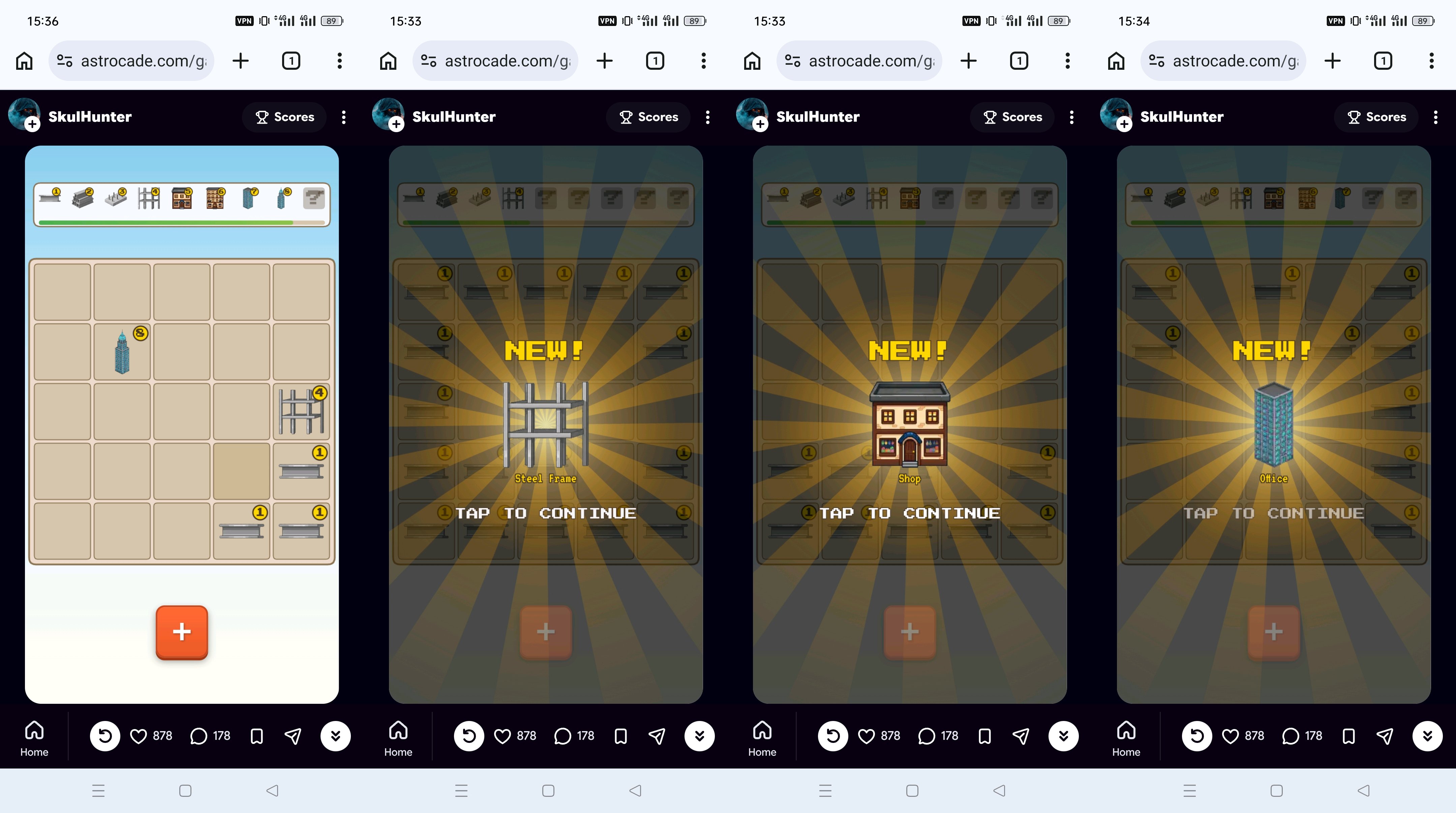
Astrocade's interface lacks the prominent tool-like characteristics of many AI platforms and instead resembles a short video website. The homepage displays a large number of game creations, with two core pieces of information showcased: cover images and view counts. Clearly, the games generated through Astrocade's AI technology are lightweight micro-games with simple graphics and gameplay. I tried several top-ranked AI-generated games, including Pixel MERGE MANIA and MINECRA LITE.
Take Pixel MERGE MANIA, for example. It is a simple puzzle game where players mindlessly combine two basic materials to create a new, slightly more complex material. By repeating this process, players can eventually build a structure.
(Image source: Leikeji)
MINECRA LITE, in terms of both graphics and gameplay, appears to be a game modeled after Minecraft. Of course, its gameplay is not particularly innovative; players simply control their character to mine continuously.
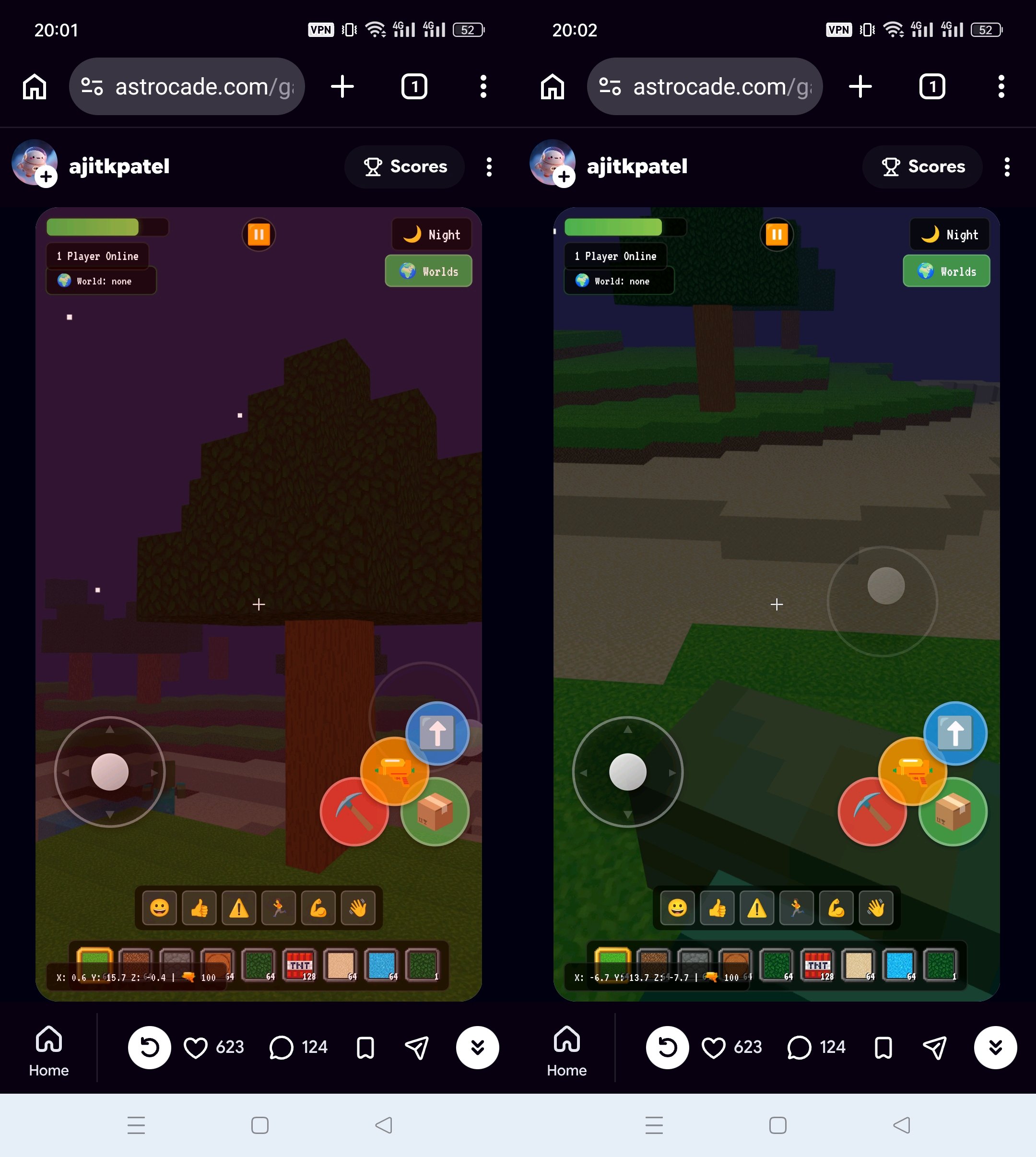
(Image source: Leikeji)
After playing several games consecutively, we gained a clearer understanding of the quality of games on the Astrocade platform. Objectively speaking, the quality of these games is generally average, with most not even reaching the level of WeChat mini-games.
Even within the mobile gaming category, they belong to the lightest weight class. As a result, Astrocade does not even need to develop a proper app; all services and experiences run online.
Of course, we are more concerned about how low the barrier to creating games with Astrocade is. Specifically, the generation process is straightforward. If your requirements are not high, you can simply keep clicking 'Next.'
The platform first asks you to input prompts to generate a game. If you lack inspiration, you can directly click on the provided options. Astrocade offers some preset genres, such as Fantasy Worlds, Sci-fi Adventures, and Cozy Simulation.

(Image source: Leikeji)
After choosing the sci-fi adventure genre, the AI further provided more specific options like Astro-Dash and Alien Garden. After selecting one, you can proceed directly to the generation step. Click the 'Create' button, and the game begins to generate. Astrocade's generation efficiency is high; a game like this can be completed in about five minutes. As for the game quality, it is no different from other user-generated games.
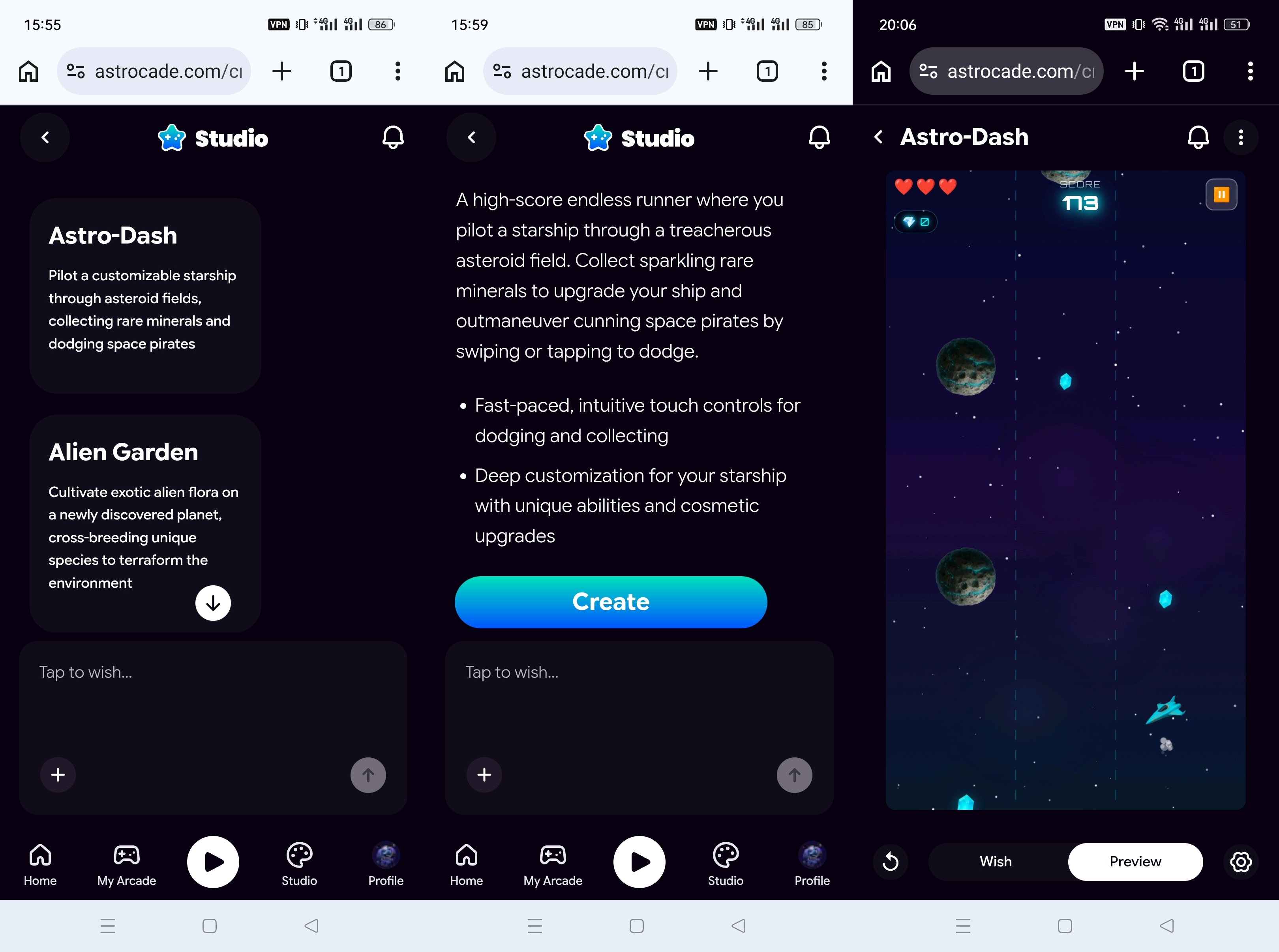
(Image source: Leikeji)
Additionally, I tried using more complex prompts to create a more intricate game. We first asked a large model to provide an English prompt with the goal of creating a Mario-style game, replacing gold coin elements with AI glasses and chips. This level of complexity was suitable for 'testing' Astrocade.
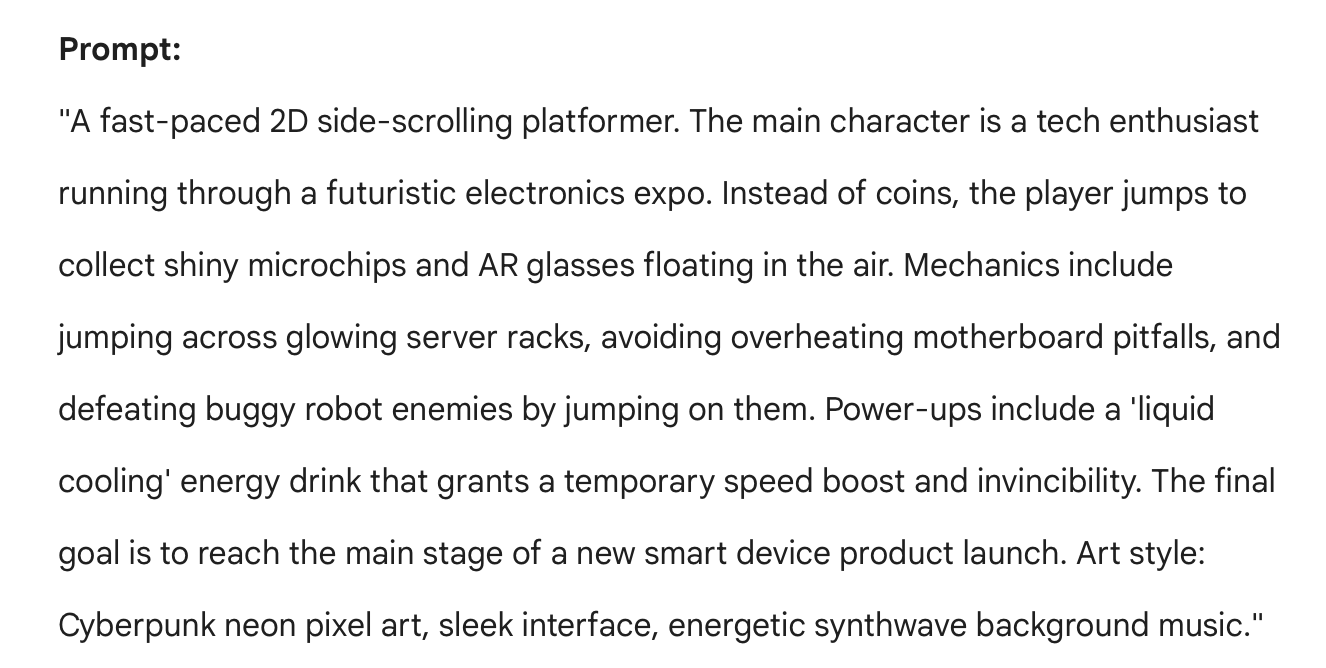
(Image source: Leikeji)
From the results, the game's completion level looked decent at first glance, but there were still many issues when playing. For example, it had a jump button, but the directional buttons were placed in the bottom left corner without being displayed. Moreover, the level design was problematic; the game character couldn't jump over the first obstacle.
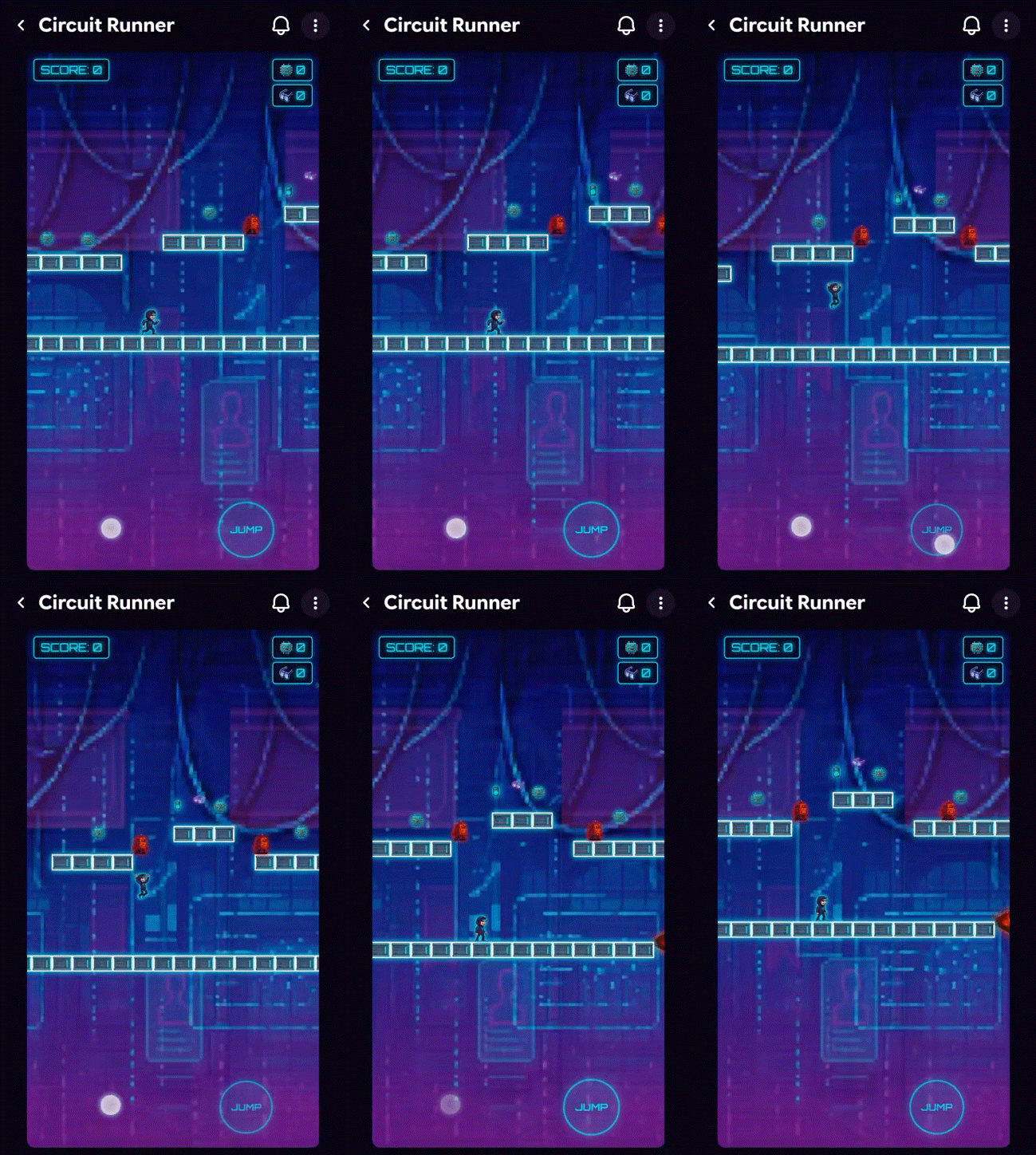
(Image source: Leikeji)
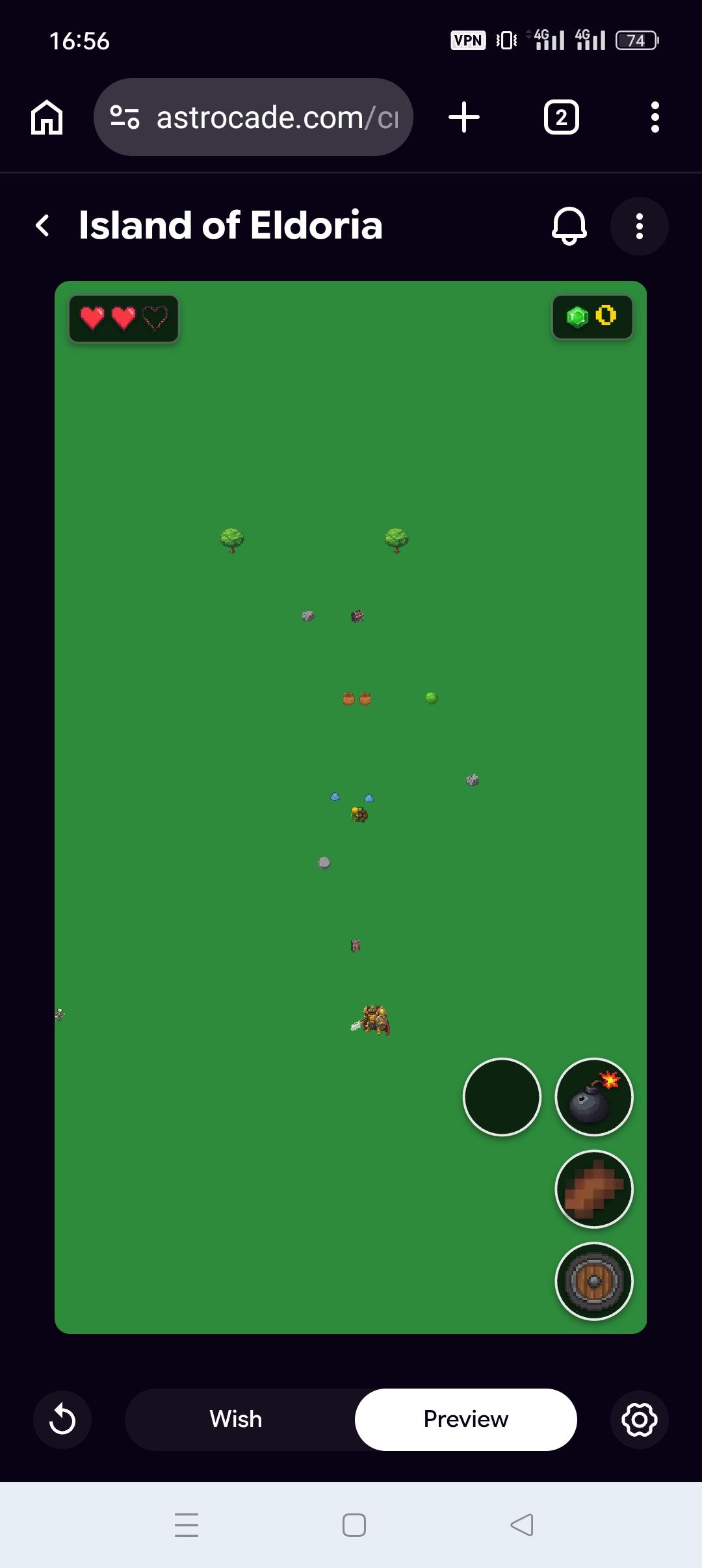
We then tried another game genre, asking it to generate a 2D game similar to The Legend of Zelda: Link's Awakening. Astrocade clearly struggled. Except for achieving a 2D top-down perspective, everything else failed. The game was unplayable, with extremely chaotic elements and randomly placed buttons. It was evident that Astrocade couldn't handle games with slightly more complex gameplay and elements.
(Image source: Leikeji)
Not competing with traditional games, Astrocade aims to open up a new market segment
After thoroughly experiencing games on Astrocade and attempting to create games using its AI platform, we can draw several conclusions.
First, the games generated by Astrocade are super micro-games, officially referred to as 'ambient games.' This setup and positioning's greatest advantage is minimizing the barriers to playing and creating games, attracting a massive user base in a short time while effectively controlling AI computing costs.
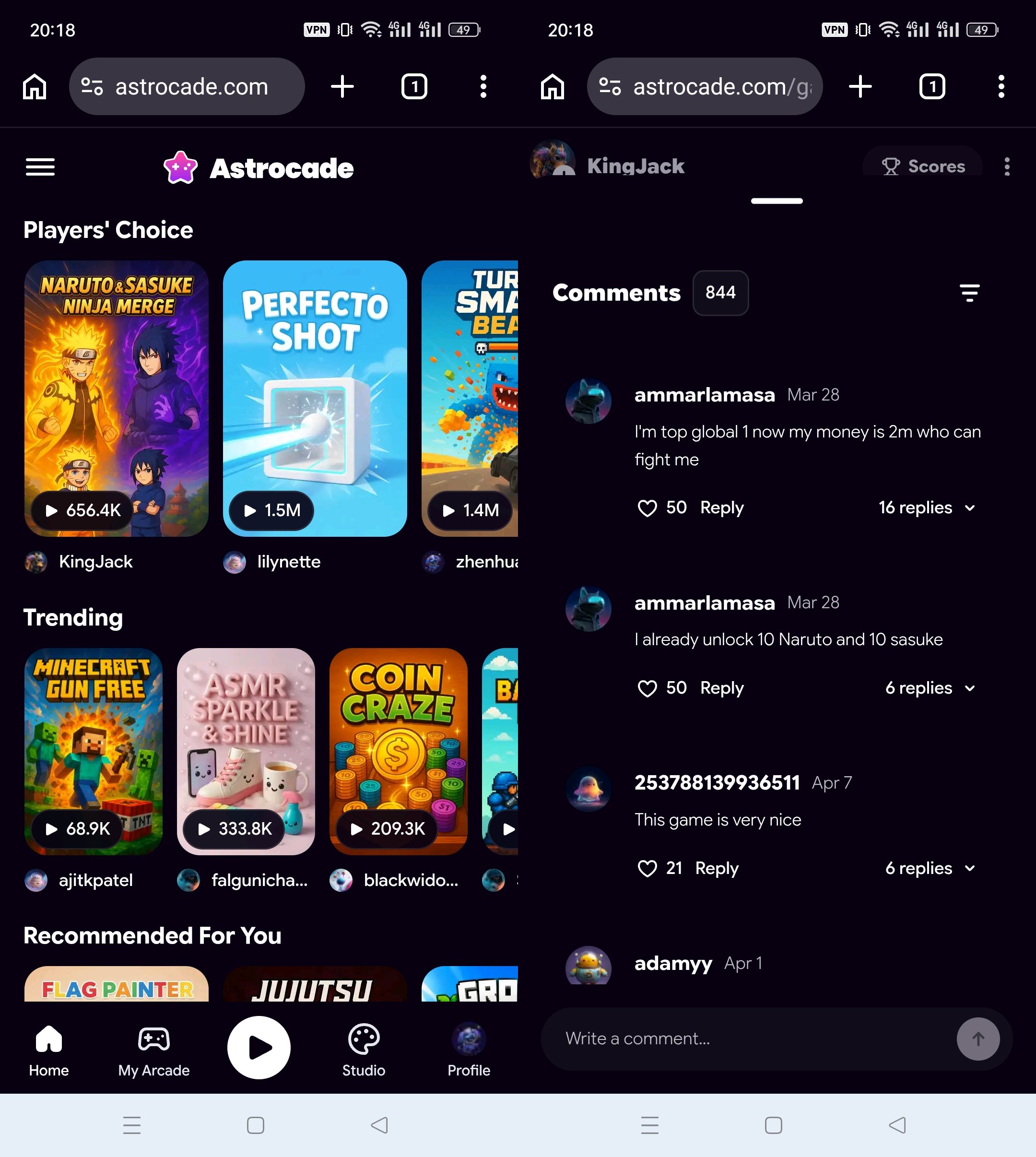
These games generally feature simple gameplay, are extremely easy to pick up, have a broad age range, and are highly casual, with short playtimes. It is evident that Astrocade's operational model resembles that of short videos; algorithms push popular games to the homepage, and users can like, share, and comment. Therefore, Astrocade's social attributes are significant. Once a game becomes popular, it can spread virally across social networks.
(Image source: Leikeji)
Second, Astrocade will not disrupt traditional gaming giants. As we mentioned during testing, Astrocade performs poorly when faced with slightly more complex game creation tasks, only generating unusable 'garbled' products. Whether it's popular mobile games like Honor of Kings and Genshin Impact or AAA titles like Cyberpunk 2077 and Black Myth: Wukong, their complexity is extremely high, requiring significant human involvement. Astrocade plays no role in their production processes.
Additionally, Astrocade may encroach upon the living space of junior game developers. The most profound impression Astrocade left on me is its ability to enable people with absolutely no programming or artistic background to generate a game with zero barriers. Although these games are simple and their quality is not particularly high, they at least provide many creators with the opportunity to quickly turn their ideas into works.
In reality, successful casual mini-games on the internet are not uncommon. For example, in 2013, a Vietnamese developer released the mini-game Flappy Bird on the App Store. This pixel-style game with very simple gameplay quickly became a hit, with over 50 million downloads. By 2014, the developer's daily ad revenue exceeded $50,000. In 2022, the mini-game Yang Le Ge Yang became a sensation in China, generating over 100 million yuan in revenue that year, developed by a small startup company.

(Image source: Flappy Bird)
From today's perspective, games like Flappy Bird and Yang Le Ge Yang could be quickly developed using AI tools like Astrocade. As the barriers facing ordinary creators are eliminated, the technical advantages of junior developers over ordinary people no longer exist.
The popularization of 4G networks and smartphones in the past allowed ordinary people to spread short videos they shot online. Now, the democratization of AI technology and applications enables ordinary people to generate and create mini-games, making 'AI gaming social' platforms commercially viable. This is the core reason why companies like NVIDIA and Google invest in Astrocade.
AI is influencing the gaming industry in other ways
As we mentioned earlier, Astrocade's current capabilities do not affect AAA titles. However, at the same time, the traditional gaming industry is gradually incorporating AI technology into game development.
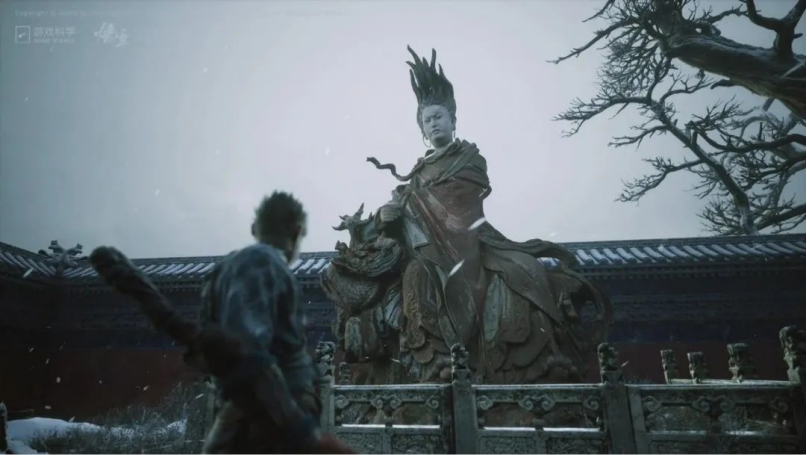
Take Black Myth: Wukong as an example. Its utilization of AI mainly includes assistive design, real-world scanning, and motion capture. Specifically, when designing and drawing game character appearances, the development team already uses AI image generation tools like Stable Diffusion to enhance development efficiency.
Black Myth also involves extensive real-world scanning. When scanning domestic landmarks and transforming them into game scenes, the team also utilizes AI assistance. For motion capture, Black Myth employs computer vision-related technologies, enabling rapid completion without traditional markers and sensors.
(Image source: Game Science)
Similarly, mobile games are extensively using AI. MiHoYo explicitly stated in their job postings that they use AI to assist game development, mentioning specific details such as using large language models to modify game values and using AI to generate and modify 3D models and textures. MiHoYo also requires applicants to be proficient in using AI tools like Stable Diffusion. NetEase does the same; Justice Online features AI NPCs as a selling point, while Sixteen Tones of Yan and Yun (Yan Yun Shi Liu Sheng) incorporates AI functions, allowing players to generate their own game content.
Unlike Astrocade, the traditional gaming industry's utilization of AI remains instrumental, using AI for assistive work. Indeed, at this stage, it is clearly unrealistic for AI to completely replace humans in developing a large-scale game independently.
However, it is worth noting that AI technology itself is rapidly evolving. Even just three or four years ago, if someone claimed that AI could enable a person with no programming background to create mini-games, most people would have considered it a fantasy. But now, Astrocade can automatically generate simple mini-games. In another five or ten years, who can say for sure that AI won't be able to create medium-sized or even large-scale games?
The same sentiment applies: AI will not replace gaming professionals in the short term, but game developers who know how to use AI will undoubtedly be more competitive.
Astrocade, AI Gaming, AI Games
Source: Leikeji
All images in this article are from 123RF's licensed image library.
-
![]()
Tesla Restructures Its Balance Sheet
-
![]()
Accelerating the High-Speed Interconnection Upgrade of AI Computing Clusters! JONHON Releases ELSFP External Light Source Optical Connectors
-
![]()
Breaking the overseas blockade of volumetric holographic materials, this optical enterprise secures nearly 100 million yuan in financing!
-
![]()
Why Does Jensen Huang So Openly Praise China’s AI?
-
![]()
"Wudang" Unveiled: Arm China's Next-Gen AI VPU Redefines Video Encoding
-
![]()
From Energy Conservation and Carbon Reduction to AI Decision-Making: GECON East Intelligence and Chery Group Explore a New Green and Smart Paradigm for Automobile Manufacturing
-
![]()
WAIC 2026 Observation | AI Accelerates Towards the Core of Industries, Industrial AI Enters a Critical Phase
-
![]()
Volkswagen China Fires the First Shot in Foreign-Funded 'White Box Delivery'!