Volkswagen China Fires the First Shot in Foreign-Funded 'White Box Delivery'!
 07/24 2026
 461
461

On July 22, Volkswagen Group announced the deepening of its strategic cooperation with Horizon Robotics. According to the agreement, CARIAD, a subsidiary of Volkswagen, will accelerate the independent research and development of L3 and L4 autonomous driving technologies based on the 'white box licensing' model, leveraging Horizon's AI foundation large model capabilities, and construct a unified AI driving solution for Volkswagen Group.
There are two key terms here: independent research and development and white box delivery. In the past, most automakers received gray box or even black box solutions, where suppliers provided turnkey solutions, and automakers simply affixed their own logos. White box delivery means that Horizon will open up the underlying architecture, basic software, and toolchains of its Journey series chips to Volkswagen, allowing the latter to conduct in-depth secondary development and customization.
This level of openness is almost unprecedented in the history of cooperation between multinational automakers and Chinese technology companies. It has made the outside world realize that, facing the wave of intelligent electric vehicles in China, Volkswagen will no longer be a passive 'learner' but will officially become an active 'participant' in reshaping the rules!
However, what piques curiosity even more is why Horizon is willing to open its technological black box to a multinational giant. And why does Volkswagen have the confidence to meet the challenges posed by this new model? Based on the implementation of their cooperation, what profound impact will it have on the future development of intelligent vehicle driving?
Editor | Li Jiaqi
Image Source | Internet
1. Demand for Tens of Millions of Installations Drives Horizon from 'Black Box' to 'White Box'!
Generally speaking, the common cooperation models in the intelligent driving industry can be divided into two categories: one is black box delivery, where suppliers provide a complete system, and automakers are responsible for acceptance and integration but have limited access to core algorithms and underlying code. The other is white box delivery, where suppliers open up models, algorithm interfaces, and supply chains, allowing automakers to develop independently based on their product positioning, driving style, and target market.
As a leading intelligent driving technology company in the industry, Horizon has been using the latter approach. This is because, for suppliers, white box delivery implies the risk of core technology diffusion and challenges the customer's management capabilities. In the past few years, even cooperation between China's leading domestic new forces and Horizon has mostly remained at the gray box or limited openness level.
The core reason why Horizon is willing to offer its utmost sincerity to Volkswagen traces back to the cooperation foundation laid at the capital level between the two parties. From the announcement in 2022 by CARIAD, a software company under Volkswagen Group, to establish a joint venture with Horizon, to the official launch of CARIAD in 2023, and up to today, the process has spanned nearly four years. During this period, the deep cooperation between the two parties has not been limited to technology but has also formed a long-term stable commercial and capital community.
CARIAD, as the carrier of cooperation between the two parties, is 60% owned by Volkswagen and 40% by Horizon. Additionally, in this deepened cooperation, Horizon simultaneously redeems the excess share conversion rights held by CARIAD, while CARIAD converts its shares in advance, increasing its stake in Horizon to 9.9% and voluntarily locking it for 12 months. The change in equity structure fundamentally alters the traditional game dynamics between Party A and Party B, moving away from a short-term, uncertain procurement relationship towards capability co-construction.
Mutual trust at the capital level is the foundation, but what truly enables white box delivery to move from a paper agreement to an engineering reality lies in the large-scale mass production collaboration between the two parties on black box solutions in the early stages.
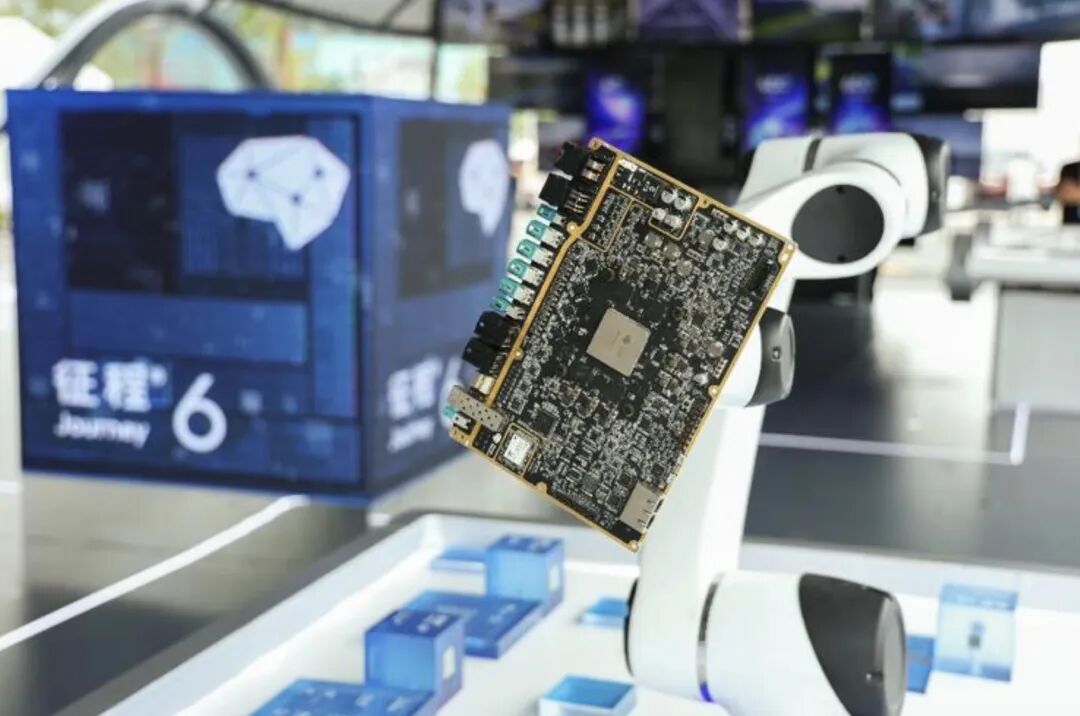
Many people are unaware that before this white box opening, CARIAD's initial Xingyun Intelligent Driving System, built on Horizon's Journey 6M chip, had already been installed in mainstream models such as the Volkswagen Anhui's Zony 06 and Zony 07, achieving mass production and delivery of localized high-frequency functions such as highway pilot assist and memory parking.
During the project collaboration period, the two parties jointly established three supporting systems: a massive scenario annotation database adapted to Chinese road conditions, a localized data closed-loop feedback mechanism, and an OTA remote iteration process tailored to domestic regulations and driving habits. According to relevant sources, to train the perception model's ability to recognize abnormal obstacles and mixed traffic scenarios involving non-motorized vehicles on Chinese roads, the joint data team processed over 2 million annotated segments.
Throughout this process, Volkswagen has not only proven its engineering capabilities to integrate Horizon's underlying technologies but also laid a solid foundation for further unleashing the potential of subsequent technologies through deep collaboration in the early stages.
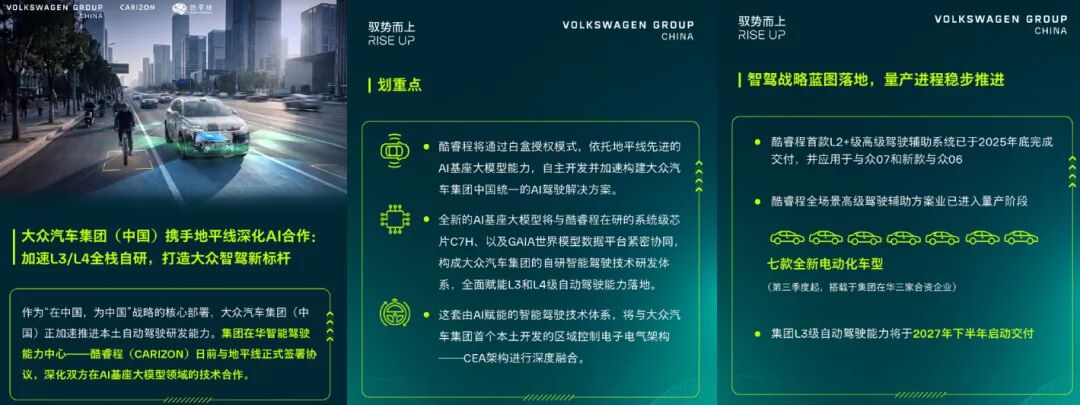
More importantly, for Horizon, binding with Volkswagen, a global giant, itself carries strong commercial drivers. As is well known, Volkswagen, as a global leading automaker with decades of presence in the Chinese market, possesses a vast vehicle matrix and user base in China. Its three joint venture systems consistently maintain annual sales volumes in the millions. According to the plan, after the implementation of this white box cooperation, CARIAD's self-developed solutions will cover seven new electric vehicle models in the third quarter of this year and will be fully rolled out to the entire CEA electronic and electrical architecture product line starting from 2027, creating a long-term demand for the installation of intelligent driving systems on a scale of tens of millions.
With the deepening of cooperation, coupled with Horizon's revenue of RMB 1.93-2.08 billion and a gross profit margin of 60%-66% in the first half of the year, on the one hand, it will further amplify its commercialization space; on the other hand, the massive real-world data transmitted back by Volkswagen from different vehicle classes, price ranges, and geographical driving scenarios can also feed Horizon's large model foundation through the training framework within the white box, continuously widening the gap with other domestic intelligent driving manufacturers on long-tail issues.
2. After Opening the 'Technological Black Box,' How Will Volkswagen Transform Technology into Capability?
Of course, obtaining white box technology permissions is just the first step. The industry is not lacking in cases where, after obtaining open-source frameworks and open technology foundations, adaptation and application prove difficult. Whether Volkswagen can transform this technological foundation into real product competitiveness is the true test. The core reason why Volkswagen dares to take on this heavy underlying technology asset lies in the fact that it has already established a localizable undertake (which can be translated as 'integration' or 'implementation') system that is land (implementable), iterable (iterable), and Can be closed loop (closable).
At the foundation of this system lies the Vehicle software service capability (vehicle software service capabilities) and local decision-making power built up by CARIAD China over the years, providing the basis for integrating white box algorithms at the vehicle level.
In the past, Volkswagen's R&D decision-making power was mainly in Germany, with the Chinese team playing a more supportive role in development. However, since Volkswagen established the CARIAD team in China in 2022, all decision-making power regarding new energy vehicle development, platform architecture, and software development has been transferred to the Chinese team. The VCTC in Hefei has now become Volkswagen's largest R&D center outside of Germany, gathering over 3,000 R&D experts with a total investment exceeding RMB 3.5 billion. Including the R&D forces of joint venture partners, the entire R&D team in China has exceeded 7,000 people. All with a single goal: to create an exclusive technological experience for Chinese customers!
Furthermore, during this process, CARIAD China has established a software adaptation team over the years of localization efforts, adapted to Chinese regulations, in-vehicle hardware, and driving habits. This team helps Volkswagen complete the full digestion of transforming open-source code into exclusive intelligent driving technology capabilities that are controllable, iterable, and scalable for installation within the group. This is also the core reason why Volkswagen can, for the first time, introduce 'white box licensing,' distinguishing itself from other multinational automakers.
Of course, behind this route, one must not overlook the dedicated team support provided by CARIAD as an exclusive R&D carrier in undertaking the full-flow development of the white box.
In this deepened cooperation, CARIAD is not only responsible for the deep development of Horizon's large model white box but also simultaneously advancing the self-developed C7H high-level intelligent driving system-level chip and the construction of the GAIA world model data platform, promoting the formation of a technological closed loop of 'Horizon AI foundation + C7H self-developed chip + GAIA world model + CEA vehicle architecture,' fully empowering Volkswagen's L3 and L4 autonomous driving capabilities.
According to the plan, the GAIA world model built by CARIAD can continuously absorb massive real-world driving data from China, continuously conducting incremental training on the white box foundation model, and narrowing the gap in algorithm scenario coverage with local new forces over the long term. Taking annotation and training efficiency as an example, GAIA's automated cleaning and difficult case mining efficiency is six times that of traditional manual assembly lines, compressing the cycle for a round of targeted incremental training on the white box model to 1/20 of the original, truly achieving monthly OTA iterations.
With a technological framework, talent density, and vehicle resources, Volkswagen's layout around this white box delivery has never been just 'visible and tangible' but is about making this system truly run, transforming technology into perceivable product competitiveness through continuous iteration.
3. The White Box Model Forces Route Differentiation and Reconstructs the Intelligent Driving R&D Logic of Foreign Automakers!
It is worth noting that Volkswagen's deepened cooperation with Horizon around white box licensing is also the first implementation of this model among global multinational automotive groups.
Compared to Mercedes-Benz's MB.OS and BMW's Neue Klasse software architecture, where the top-level design is entirely controlled by the German headquarters, and Toyota and Honda's insistence on self-developed autonomous driving systems, Volkswagen's further deepening with Horizon in the field of intelligent driving essentially establishes a complete automotive intelligence ecosystem in China.
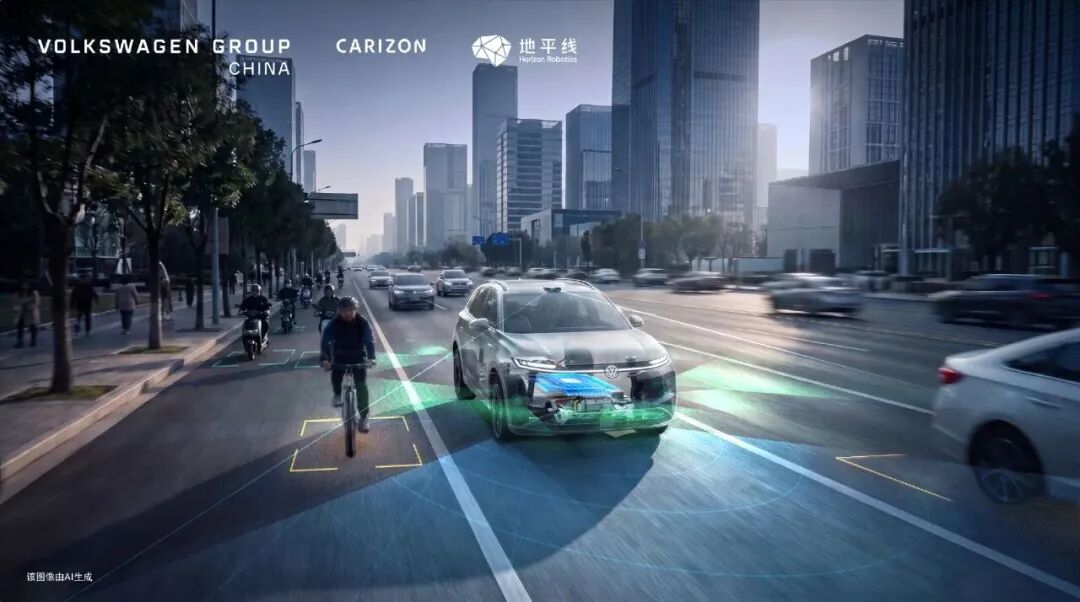
Simply put, Horizon provides the underlying source code of an 'Android-style' operating system, CARIAD is responsible for deeply customizing a system adapted to automotive scenarios based on the source code, while simultaneously self-developing supporting processor chips. Volkswagen, at the vehicle level, is responsible for building a hardware architecture that can smoothly run this system. The three are interlinked, making white box licensing not just an isolated software permission but a complete soft-hard integrated solution that can be mass-produced and implemented.
It fundamentally solves three issues: first, the unification and reinforcement of brand experience; second, the long-tail value for the next 5-10 years; third, a reasonable downward trajectory of the cost curve. Taking the cost curve as an example, Horizon's Journey 6 series is a chip platform specifically opened for 'white box' use, significantly improving the operational efficiency of algorithms on the chip. Compared to some luxury brands that need to stack hardware solutions, Volkswagen's white box model has the opportunity to achieve equal or even superior experiences with a more streamlined hardware configuration.
It is foreseeable that in the future, the development paths of multinational foreign automakers are likely to emerge in two modes: one is the underlying foundation white box co-creation + local full-link self-developed closed-loop route, with Volkswagen as the benchmark; the other is the traditional 'compatibility cooperation' route, quickly filling the gaps in intelligent driving functions with existing mature solutions.
These two approaches may not have absolute advantages or disadvantages, but they will inevitably lead to visible experience differences at the product level in the future. The former will gradually develop an intelligent driving system with unique brand characteristics that can iterate across vehicle models on a unified architecture; while the latter, although capable of quickly obtaining a paper-based function list comparable to competitors at a lower cost in the short term, will face increasing lag in response speed to black box solutions in the long-term competition, given the rapid evolution of Chinese road scenarios, regulatory iterations, and consumers' stringent requirements for smooth driving experiences.
For Volkswagen itself, it has completely broken free from the existing path of foreign automakers being 'passively chasing' in intelligence, using capital to gain trust, mass production to gain openness, and local teams to gain self-developed capabilities, completing the transformation from a solution purchaser to a rule reconstructor participant. For the entire industry, the large-scale implementation of the white box licensing model has also redefined the division of labor boundaries between Chinese and foreign automakers and technology companies, forcing the reconstruction of the intelligent driving R&D logic of the entire foreign automaker sector.
End
With Knowledge and Style, 'Whoosh'~ Let's Go...
-
![]()
Why Does Jensen Huang So Openly Praise China’s AI?
-
![]()
"Wudang" Unveiled: Arm China's Next-Gen AI VPU Redefines Video Encoding
-
![]()
From Energy Conservation and Carbon Reduction to AI Decision-Making: GECON East Intelligence and Chery Group Explore a New Green and Smart Paradigm for Automobile Manufacturing
-
![]()
WAIC 2026 Observation | AI Accelerates Towards the Core of Industries, Industrial AI Enters a Critical Phase
-
![]()
Volkswagen China Fires the First Shot in Foreign-Funded 'White Box Delivery'!
-
![]()
AI Agent Smartphones: The Next Competitive Edge Transcends Large Models
-
![]()
Over 880 Million Yuan Worth of Orders Unveiled, Bidding Launched for Shenzhen Eastern Public Transport
-
![]()
Tesla's Robotaxi Hits the Road: A Monumental Gamble with an Uncertain Future