WAIC 2026 Observation | AI Accelerates Towards the Core of Industries, Industrial AI Enters a Critical Phase
 07/24 2026
 400
400
From July 17 to 20, the Shanghai World Artificial Intelligence Conference (WAIC 2026) once again became a significant window for the global AI industry. At this year's WAIC 2026, one distinct impression stood out: the narrative focus of the conference has quietly shifted.
If previous WAIC editions centered on model parameter competition, multimodal capabilities, and the technological marvels of generative AI, this year's discussions have pivoted to the engineering implementation of Agent architectures, industrial applications of embodied intelligence, and commercial validation of vertical-domain large models. This shift is not merely a rotation of technological hotspots but a structural signal: AI is transitioning from a phase of technological innovation to one of industrial value realization.

Over the past few years, we have witnessed an explosive evolution of foundational models, with large models driving AI to solve problems of 'understanding' and 'generation.' As model capabilities mature, industries are now focusing on how AI can further penetrate business processes, participate in complex decision-making, and enhance real-world operational efficiency.
Manufacturing is emerging as a critical focal point of this trend. As a data-intensive, process-complex, and decision-demanding industry, manufacturing boasts abundant industrial data and high-value application scenarios, making it a vital testing ground for AI's transition from technological innovation to industrial transformation.
AI Agents Move to the Industrial Frontlines: Manufacturing Demands New Intelligent Collaboration Methods
At this year's WAIC, AI Agents have become a key focus of the AI industry. With the continuous enhancement of large model capabilities, AI is evolving from traditional question-answering assistants to intelligent agents capable of understanding goals, invoking tools, and executing tasks. This transformation is prompting enterprises to rethink their AI application strategies.
In the past, companies primarily explored AI Copilot models, leveraging AI to assist employees in tasks such as information retrieval, content generation, and analysis summarization. However, with the advancement of Agent technology, AI is now moving towards Autopilot modes, gradually participating in business process execution and complex task management.
Manufacturing represents a prime application scenario for this trend. Modern manufacturing systems involve multiple complex aspects, including production planning, equipment operation, quality control, and energy management, each requiring extensive analysis and decision-making. For instance, addressing equipment anomalies demands comprehensive judgment based on real-time operational data, historical fault records, process parameter changes, and equipment status. Similarly, resolving quality fluctuations requires correlating multiple variables, such as equipment status, production processes, and inspection results, to identify root causes. Solving these problems necessitates AI with an understanding of industrial processes, capable of connecting data, systems, and businesses to achieve closed-loop optimization from problem detection to execution.
Building on this direction, Geesing Dongzhi continues to explore the application of its Octopus Intelligence Brain industrial intelligent decision-making hub and industrial AI Agents in manufacturing scenarios. By developing intelligent agent capabilities for production, quality, equipment, energy, and logistics, AI is penetrating the core processes of manufacturing, driving the transition from data perception to intelligent decision-making.
The future competition in smart factories will not solely hinge on the quantity of automated equipment but also on the collaborative capabilities of industrial intelligent agents.
From Intelligent Robots to Embodied Intelligence: AI is Reshaping Industrial Hardware Forms
Embodied intelligence is another key focus at WAIC 2026. From intelligent robots to intelligent equipment, the development of embodied intelligence is propelling AI beyond digital boundaries, enabling machines to perceive their environment, understand tasks, and execute actions. This trend reflects AI's deepening integration into the physical world.
Manufacturing is inherently a crucial application domain for embodied intelligence. While automation technologies have addressed production execution challenges, enhancing manufacturing efficiency and stability through robots and automated equipment, the industry's evolving needs are becoming increasingly complex as it advances towards high-end manufacturing. Questions such as how to predict equipment operating conditions in advance, dynamically optimize process parameters, autonomously adjust to abnormalities, and intelligently schedule production resources now exceed the capabilities of traditional automation systems, necessitating AI's involvement in analysis, judgment, and decision optimization during production.
Particularly in high-end manufacturing sectors like semiconductors and new energy, where production processes are complex, equipment is valuable, and process requirements are stringent, the demand for intelligent capabilities is even more urgent. The future direction of manufacturing will involve the deep integration of AI, industrial systems, physical AI, and embodied intelligence, endowing production systems with stronger autonomous operation and continuous optimization capabilities.
Geesing Dongzhi has long focused on the intelligent upgrading of advanced manufacturing. In terms of embodied intelligence, its mature AI+AMHS intelligent logistics solution horizontally covers all material flow scenarios in semiconductor factories, from warehouse storage and inter-production line transportation to machine loading and unloading. Vertically, it leverages AI, multi-source data fusion, and Physical AI technologies as core supports to create an end-to-end closed-loop intelligent material handling decision-making system, ranging from 'brain decision-making' to 'limb execution.'
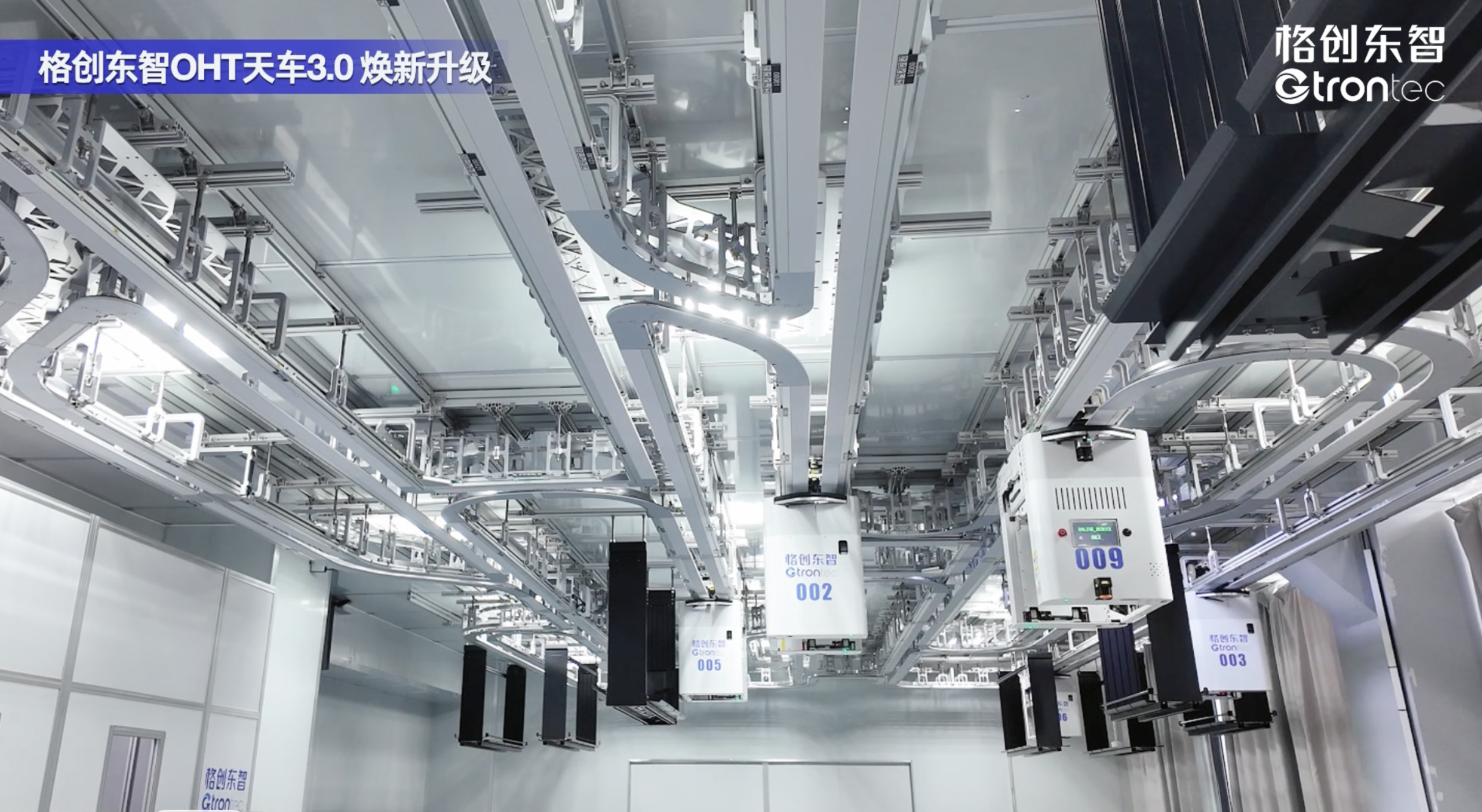
Simultaneously, the company is actively pursuing a strategic extension from physical AI to embodied intelligence, having initiated strategic collaborations with leading embodied intelligence enterprises in the industry. By integrating AI capabilities from system software down to hardware equipment itself, each handling device not only executes instructions but also possesses autonomous perception and local decision-making abilities, truly achieving 'remote planning and local decision-making' to construct a more agile and efficient intelligent production system.
Industry-Specific Large Models Penetrate Vertical Domains: Industrial Knowledge Becomes Key to AI Implementation
Industry-specific large models have emerged as another significant focus at WAIC 2026. With the rapid development of general-purpose large model capabilities, AI is accelerating its entry into vertical industrial domains.
However, manufacturing imposes higher demands on AI. Industrial production encompasses a vast amount of specialized knowledge, including equipment operation patterns, process control logic, quality management experience, and production optimization methods. This knowledge, long precipitate (accumulated) in engineering experience and business processes, determines whether AI can genuinely serve production needs.
Currently, manufacturing enterprises have accumulated substantial data resources, yet the release of data value still faces challenges. Data is scattered across different systems, business knowledge is inadequately precipitate ( precipitate : settled/accumulated, but ' precipitate ' is not typically used to describe knowledge accumulation in English; 'insufficiently documented' or 'lacking in structured knowledge' might be more appropriate, but for simplicity, 'inadequately precipitate ' is translated as 'inadequately precipitate (accumulated/documented)') and production optimization remains highly reliant on human experience. The development of industrial AI necessitates further integration of large model capabilities with industrial knowledge, professional models, and business processes.
Through the collaboration of large and small models, with large models handling complex understanding and reasoning planning and industrial models responsible for professional analysis and precise prediction, AI can possess both general intelligence capabilities and meet the reliability, real-time, and professional requirements of industrial scenarios.
Geesing Dongzhi continues to explore the application of industrial large models, combining general AI capabilities with manufacturing expertise through the collaboration of large and small models. This enables AI not only to analyze data but also to understand manufacturing logic, assisting enterprises in making more complex production decisions and making AI more attuned to industrial needs and production requirements.
Post-WAIC, Industrial AI Competition Enters a New Phase of Industrial Understanding and Value Release
Reviewing the evolution of manufacturing, automation has enhanced production efficiency, and digitization has improved management capabilities. Now, AI is driving manufacturing systems towards further intelligence. The future competitive edge of manufacturing enterprises will not only lie in production scale and equipment capabilities but also in their ability to leverage AI for continuous production system optimization. WAIC showcases the cutting-edge directions of AI development, while the manufacturing floor will determine the ultimate height of AI value realization.
As AI Agents, embodied intelligence, industry-specific large models, and other technologies continue to mature, industrial AI is becoming a crucial bridge connecting AI with the real economy.
Geesing Dongzhi will persist in exploring industrial AI innovations, focusing on the construction of the Octopus Intelligence Brain industrial intelligent decision-making hub, enabling AI to penetrate core manufacturing processes, and driving enterprises from 'seeing' to 'acting,' from automation towards intelligence and autonomy.
-
![]()
Why Does Jensen Huang So Openly Praise China’s AI?
-
![]()
"Wudang" Unveiled: Arm China's Next-Gen AI VPU Redefines Video Encoding
-
![]()
From Energy Conservation and Carbon Reduction to AI Decision-Making: GECON East Intelligence and Chery Group Explore a New Green and Smart Paradigm for Automobile Manufacturing
-
![]()
WAIC 2026 Observation | AI Accelerates Towards the Core of Industries, Industrial AI Enters a Critical Phase
-
![]()
Volkswagen China Fires the First Shot in Foreign-Funded 'White Box Delivery'!
-
![]()
AI Agent Smartphones: The Next Competitive Edge Transcends Large Models
-
![]()
Over 880 Million Yuan Worth of Orders Unveiled, Bidding Launched for Shenzhen Eastern Public Transport
-
![]()
Tesla's Robotaxi Hits the Road: A Monumental Gamble with an Uncertain Future