Breaking the overseas blockade of volumetric holographic materials, this optical enterprise secures nearly 100 million yuan in financing!
 07/24 2026
 379
379
Recently, Nika Optics secured nearly 100 million yuan in Series A financing, with participation from institutions including BOC International Investment, Tianjin Binhai Industrial Fund, Gobi Partners, CITIC New Future Investment, and Zhuhai Allwinner Technology. The funds raised will primarily support the scaling up of production capacity and accelerating technological iterations for the volumetric holographic waveguide production line.

Why did Nika Optics secure this financing? What is its background and strength? Why has it gained favor with investors?
Founded in July 2022 by two young entrepreneurs returning from overseas, Nika Optics was established by co-founder Du Youcheng, who previously worked at Digilens, a global leader in volumetric holographic waveguides. The company focuses on volumetric holographic waveguide technology based on polymer-dispersed liquid crystal (PDLC) materials, a technical approach widely regarded as one of the mainstream solutions for consumer-grade AR devices.
Compared to geometric waveguides and surface relief waveguides, volumetric holographic waveguides offer significant advantages, including preventing display information leakage, resembling ordinary lenses in appearance, high light transmittance, and lightweight structure. The core holographic material formulations have long been blocked overseas, and high-stability mass production equipment remains an industry gap.
Nika Optics' breakthrough lies in its full-stack self-research capabilities. Based on the founding team's years of technical accumulation, the company spent four years in research and development, achieving breakthroughs in three foundational technologies: holographic photoresist materials, autonomous optical design, and holographic lithography equipment. It has now established a self-research system for holographic materials.
According to reports, the core holographic materials have achieved complete domestic self-sufficiency. The light efficiency of its self-developed lenses can reach 1,500 nits/lumen, roughly double that of traditional products on the market, with a light transmittance rate as high as 98%, a thickness of just 0.6 millimeters, and a weight of only 3.1 grams. These hard metrics give it significant competitiveness in the industry.
The next step after technological breakthroughs is to scale up production capacity. On June 13th this year, the world's first automated production line capable of producing millions of volumetric holographic waveguides, designed and built by Nika Optics, officially commenced operations in Tianjin Binhai High-Tech Zone. With an annual capacity of 1 million units, the line features a thousand-level cleanroom and a precision environmental control system, utilizing exclusively customized holographic lithography equipment and process platforms. Combined with the existing 300,000-unit capacity at its Guangzhou base, Nika Optics now has a total annual production capacity of 1.3 million units across both lines.
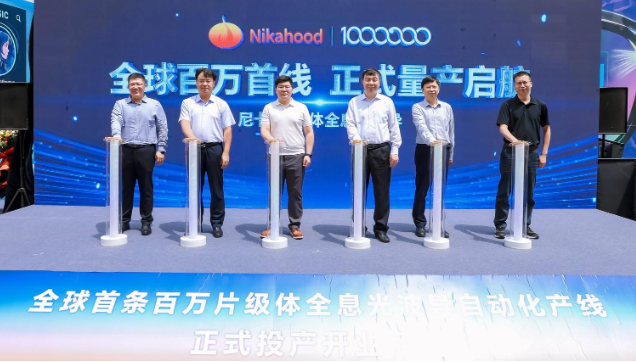
The rapid expansion of production capacity is driven by clear market demand. According to official disclosures, the company currently has over 1 million units in hand orders and anticipates annual production value to reach 60 to 80 million yuan in 2026. It has also established stable partnerships with several leading consumer electronics and automotive manufacturing companies, with products accelerating their entry into international markets.
The speed at which orders convert into production value is a key indicator of technological commercialization success, and the figures presented by Nika Optics are already impressive within the current AR upstream supply chain.
Overall, the completion of Nika Optics' Series A financing round signifies that funding for a new round of capacity expansion and technological breakthroughs is now in place. Official evaluations from Tianjin Binhai High-Tech Zone also highlight that the company has built a three-dimensional capital matrix combining 'state-owned financial capital leadership + industrial capital ecosystem collaboration.'
At this critical juncture where AR glasses transition from concept validation to large-scale deployment, the commercialization progress of volumetric holographic waveguide technology may determine the final direction of optical solutions for next-generation smart terminals. The race around waveguides is just entering its acceleration phase.
-
![]()
Tesla Restructures Its Balance Sheet
-
![]()
Accelerating the High-Speed Interconnection Upgrade of AI Computing Clusters! JONHON Releases ELSFP External Light Source Optical Connectors
-
![]()
Breaking the overseas blockade of volumetric holographic materials, this optical enterprise secures nearly 100 million yuan in financing!
-
![]()
Why Does Jensen Huang So Openly Praise China’s AI?
-
![]()
"Wudang" Unveiled: Arm China's Next-Gen AI VPU Redefines Video Encoding
-
![]()
From Energy Conservation and Carbon Reduction to AI Decision-Making: GECON East Intelligence and Chery Group Explore a New Green and Smart Paradigm for Automobile Manufacturing
-
![]()
WAIC 2026 Observation | AI Accelerates Towards the Core of Industries, Industrial AI Enters a Critical Phase
-
![]()
Volkswagen China Fires the First Shot in Foreign-Funded 'White Box Delivery'!