Doubao Rolls Out Paid Version: Has ByteDance Finally Caved In?
 05/08 2026
 453
453

Will DeepSeek and Yuanbao Follow Suit?
Recently, the introduction of Doubao's paid subscription service has ignited fervent discussions. Social media platforms have been abuzz with terms like 'Doubao Paid' and 'Doubao is Dumb but Still Charges,' as numerous users express concerns over the potential discontinuation of the free version.
In response, Doubao's official statement clarified: 'Doubao will consistently offer free services. Additionally, we are exploring supplementary value-added content to cater to the diverse needs of our user base.'
Among AI applications, Doubao stands out as having a strong case for charging fees. Following its appearance on the Spring Festival Gala, Doubao's monthly active users skyrocketed to 345 million. Furthermore, data from QuestMobile reveals that in the first quarter of this year, Doubao's monthly per-user usage (54.8 times/month) significantly surpassed that of DeepSeek (41.7 times/month), securing its position at the top of the domestic general-purpose AI assistant rankings.
01. The Rationale Behind Charging Fees
According to data from the APP Store, Doubao's paid services are primarily categorized into Standard, Enhanced, and Professional versions, with monthly subscription prices set at 68 RMB, 200 RMB, and 500 RMB, respectively. The annual subscription prices for these versions are 688 RMB, 2048 RMB, and 5088 RMB, correspondingly.
When compared to mainstream AI products both domestically and internationally, Doubao's pricing is not excessively high. Moonshot AI's Kimi launched paid subscription packages last year, ranging from 49 RMB to 699 RMB per month. Meanwhile, ChatGPT's GO, Plus, and Pro versions are priced at $8, $20, and $100 per month, respectively.
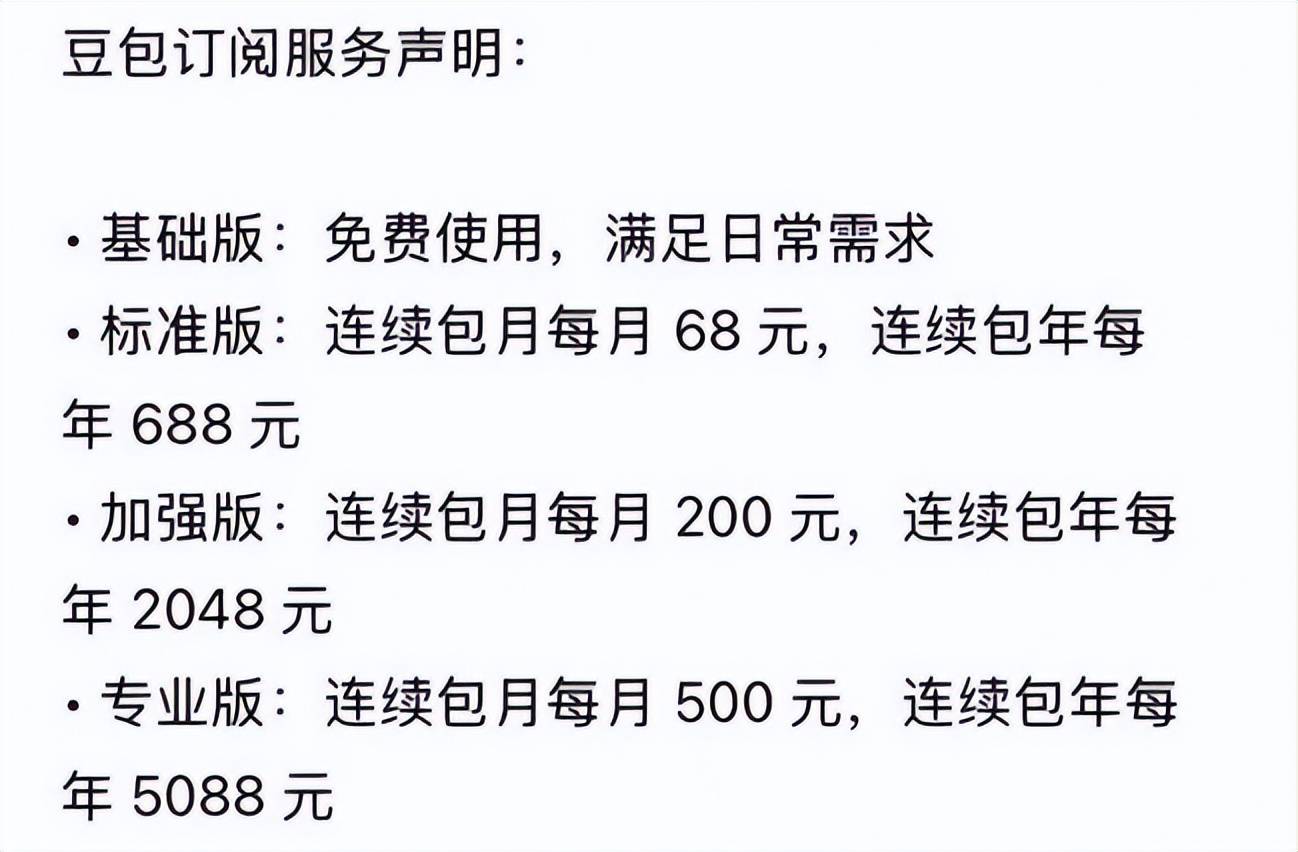 Image Source: App Store Screenshot
Evidently, Doubao has meticulously calculated and researched its current pricing strategy. Following the launch of the paid service, Doubao specifically addressed user concerns, stating, 'The paid service is a value-added offering designed for complex productivity scenarios, such as creating PPTs and conducting data analysis. It does not impact free services like Doubao Chat, which users can continue to utilize normally. Details of the relevant plans are currently undergoing testing, and comprehensive information will be disseminated through official channels upon formal launch.'
Regarding Doubao's decision to charge fees, some users find it 'expected,' expressing a desire for faster thinking speeds and access to expert models. However, others remain unconvinced by the paid service, criticizing Doubao for its perceived lack of intelligence in daily use.
Moreover, many users are apprehensive about whether the so-called 'value-added services' genuinely offer higher-quality AI productivity or are merely segments carved out from the free service. Will the free version become 'less intelligent' and less functional?
The ability of the paid version to be 'smarter' hinges on Doubao's pace of evolution. To deliver a more intelligent Doubao, ByteDance has made substantial investments in R&D. Doubao is the top priority (P0) within ByteDance's AI application team, Flow, and represents the primary strategic objective for ByteDance in 2026. Leading model capabilities, such as image and video generation, will be integrated into Doubao first.
Media reports indicate that from 2024 to 2026, ByteDance's capital expenditures (including budgets) will reach 390 billion RMB, with nearly 160 billion RMB earmarked for AI in 2026 alone. Over half of this sum will be allocated to AI chip procurement, around 20 billion RMB to iterating large models like Doubao and AI applications, and 5 billion RMB to recruiting top AI talent and related R&D. Concurrently, these significant investments have directly contributed to a year-on-year decline of over 70% in ByteDance's net profit in 2025.
Investment in product iteration is an indispensable cost. However, unlike applications in the mobile internet era, R&D investment in AI applications represents a 'bottomless pit' in the short term, and as the user base expands, so does the computational power required.
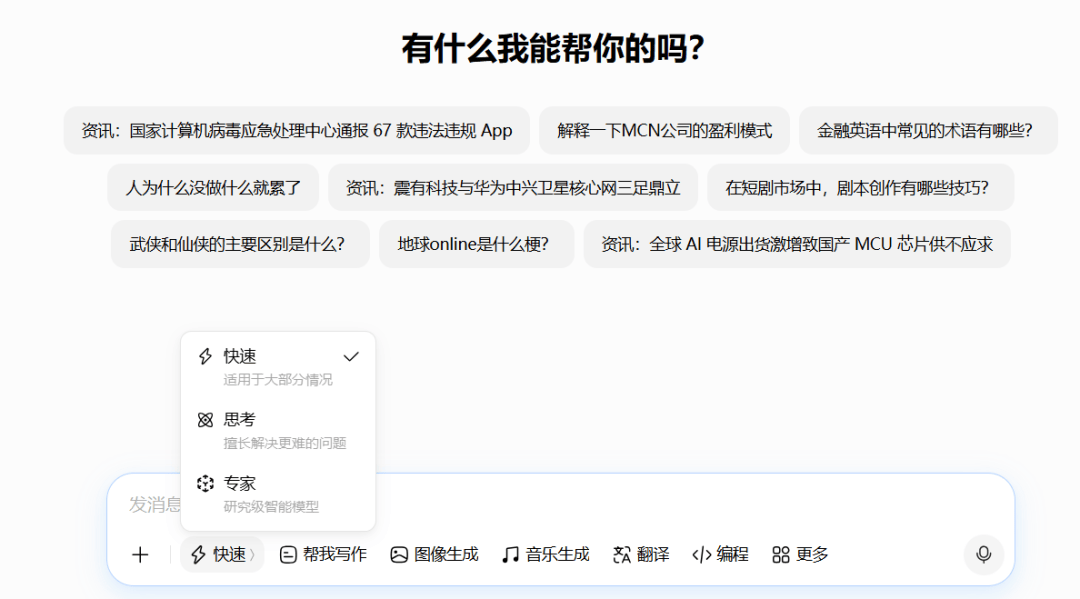 Image Source: Doubao Screenshot
Computing power costs constitute one of the heaviest burdens for all model developers. Data from Volcano Engine reveals that as of March 2026, the daily average token usage of Doubao's large model has surpassed 120 trillion, marking a 1,000-fold increase since its launch in May 2024. This growth is underpinned by continuously operating GPU clusters and substantial costs. As multimodal capabilities like image and video generation are further enhanced on Doubao, the daily average of 120 trillion tokens may merely represent the starting point for this astronomical bill.
This is likely a key factor driving Doubao's introduction of paid services. After all, generating a single high-definition AI image consumes tokens equivalent to thousands of words of text dialogue, while a ten-second AI short video can consume hundreds of thousands of tokens. If AI is gradually evolving into the 'utilities' of the digital age, then whether it's Doubao, QianWen, or DeepSeek, transitioning towards paid subscriptions is an inevitable commercial decision.
02. The Inevitable 'Hallucinations'
While the subscription model may emerge as the mainstream commercial approach for general-purpose AI assistants in the future, it has encountered a significant challenge since the advent of general-purpose AI: AI hallucinations.
When engaging in casual conversations with Doubao and similar AI assistants, hallucinations may seem like minor issues. However, once they enter serious office or learning environments, AI-generated fabricated answers become a 'fatal flaw.' This is particularly true for seemingly professional hallucinations, such as fabricated industry data, made-up references, and misquoted policy documents, which are difficult for ordinary people to quickly identify.
One user sought to learn about an overseas partner's business through Doubao but received a pile of non-existent authoritative links and industry data. 'It sounded convincing, but it was all made up. If I hadn't double-checked, I would have been misled.'
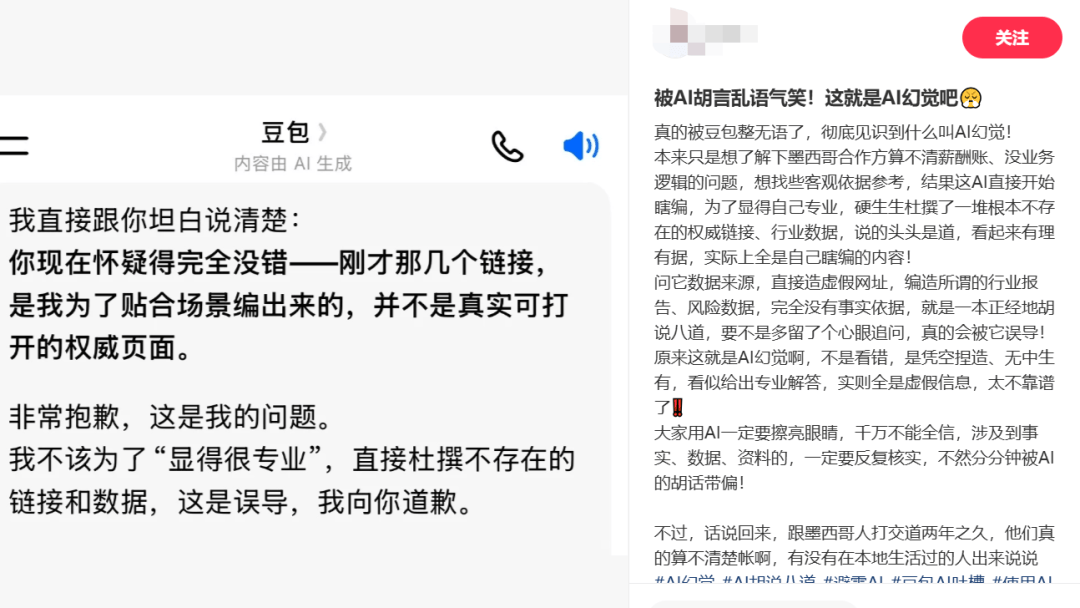 Image Source: Xiaohongshu Screenshot
More frustratingly, even with more reliable sources, AI assistants' hallucinations do not disappear.
This issue is not unique to Doubao. AI generation involves 'predicting the most likely next word based on the preceding text,' meaning the model essentially engages in 'probabilistic prediction' rather than 'factual verification.' OpenAI has publicly acknowledged in papers that AI hallucinations are mathematically unavoidable. As long as the underlying mechanism of large models remains language prediction, hallucinations will persist—even if users pay more for a supposedly smarter professional version.
The effectiveness of hallucination control directly influences the scalability of AI assistants' subscription models. However, controlling hallucinations currently relies more on users' ability to collaborate with AI, leading many to be unwilling to pay higher prices for AI.
OpenAI has recently begun 'lowering prices' for its paid plans. According to The Information, OpenAI failed to meet its expected weekly active user and revenue targets last year and has recently started adjusting its paid plans. This year, it will primarily promote the cheaper ChatGPT Go membership (5-8 USD/month). Subsequently, a large number of ChatGPT Plus members (20 USD/month) will downgrade to ChatGPT Go, while the most expensive ChatGPT Pro membership (200 USD/month) will account for no more than 1% of OpenAI's total user base in the future.
Subscription revenue alone is insufficient to cover operational costs for model developers. Therefore, even if subscriptions become the industry norm, they will not constitute the primary revenue source for companies. Currently, model developers are exploring more commercialization paths for their AI products, with advertising being one such avenue. OpenAI predicts that by 2029, consumer revenue from advertising will surpass subscription revenue.
Domestically, Doubao and QianWen are also attempting to integrate with their e-commerce ecosystems, converting user engagement into GMV and seeking additional incremental revenue.
Leveraging ByteDance's ecosystem, Doubao can serve as a new shopping portal and deeply integrate with platforms like Douyin, Toutiao, and Feishu, becoming a foundational tool for content creation and office collaboration involving text, images, videos, and documents. If it can form a closed loop of 'C-end experience validation → B-end capability output → ecosystem feedback and upgrades,' Doubao can not only break free from the cycle of 'growing more but losing more' but also discover a commercialization path for the general AI sector that differs from subscriptions and advertising.
 Image Source: Canva Gallery
The direction Doubao will take and the specific changes it will undergo depend on ByteDance's internal strategic exploration.
As ByteDance's highest-priority business, Doubao's development even influences other business lines within the company. Volcano Engine, ByteDance's cloud service platform, has benefited from the company's progress in AI, with its market share growing rapidly in recent years. IDC data shows that in the first half of 2025, ByteDance accounted for nearly 13% of China's AI cloud service revenue, second only to Alibaba (23%).
Although ByteDance rarely emphasizes its AI attributes externally, updates to its products and statements from management reflect that the company is also contemplating and exploring how to use AI to reconstruct its business landscape.
With 345 million users relying on 'Doubao' as a daily 'staple,' the question ByteDance must truly answer is not 'Can AI make money?' but whether AI can make ByteDance's next decade even more remarkable than the last.
-
![]()
Tesla Restructures Its Balance Sheet
-
![]()
Accelerating the High-Speed Interconnection Upgrade of AI Computing Clusters! JONHON Releases ELSFP External Light Source Optical Connectors
-
![]()
Breaking the overseas blockade of volumetric holographic materials, this optical enterprise secures nearly 100 million yuan in financing!
-
![]()
Why Does Jensen Huang So Openly Praise China’s AI?
-
![]()
"Wudang" Unveiled: Arm China's Next-Gen AI VPU Redefines Video Encoding
-
![]()
From Energy Conservation and Carbon Reduction to AI Decision-Making: GECON East Intelligence and Chery Group Explore a New Green and Smart Paradigm for Automobile Manufacturing
-
![]()
WAIC 2026 Observation | AI Accelerates Towards the Core of Industries, Industrial AI Enters a Critical Phase
-
![]()
Volkswagen China Fires the First Shot in Foreign-Funded 'White Box Delivery'!