1.8 Trillion xAI 'Disbands': Musk's Sudden Strategic Shift | In-Depth Analysis
 05/09 2026
 503
503
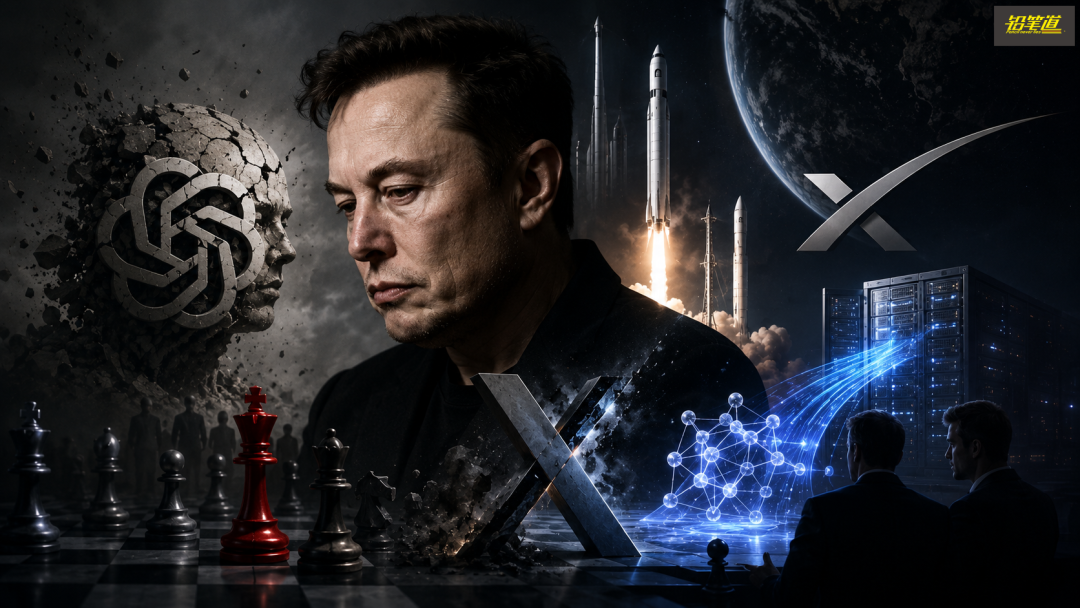
In the early morning hours of May 7 (Beijing Time), Musk made a surprising move in the large model arena.
On that day, he took two decisive actions:
Firstly, he dissolved xAI, a company valued at approximately $250 billion (around 1.8 trillion yuan), and integrated it into the SpaceX ecosystem;
Secondly, he leased a substantial amount of GPU computing resources to Anthropic.
Notably, Anthropic is one of OpenAI's primary competitors in the current landscape.
The news sparked immediate reactions across the global AI community. This is because xAI is no ordinary startup. Founded in 2023, it secured over $12 billion in cumulative funding by 2024 and more than $40 billion (including debt) from 2025 to 2026, bringing its total funding to exceed $50 billion (approximately 350 billion yuan). This makes it one of the most heavily funded AI projects globally.
According to conventional Silicon Valley wisdom, an AI company of this magnitude should continue to raise capital, expand its GPU infrastructure, recruit top talent, and aim for an initial public offering (IPO). However, Musk chose to hit the pause button instead of doubling down.
"This move is essentially a strategic concession. The top three positions in the U.S. large model market are already firmly occupied, and xAI is being pushed to fourth or fifth place with little hope of a comeback," Peng Congyang, founder of Zhixing Yuan, told Pencil News.
Jing Tao, CEO of Chaomeng Infinite, put it even more bluntly:
"This could signal the near-end of the war among large model companies. If even Musk is reassessing his chances of winning, others need to consider: if your capabilities are inferior to xAI's, should you persist in the large model arena?"
Over the past two years, Musk has been a trendsetter for the global AI industry: his ventures into humanoid robots prompted global capital to follow suit; his work on brain-computer interfaces energized the Chinese sector; and after founding xAI, he further fueled the large model funding boom.
Every move Musk makes influences domestic capital and market confidence.
Now, with xAI retrenching, the independent survival space for many second- and third-tier large model companies in China is expected to rapidly diminish.
- 01 - Sudden Strategic Shift
Why did Musk suddenly decide to "retrench"?
Over the past two years, global leading model companies have quickly stratified, with OpenAI, Anthropic, Google, and Meta forming the top tier—while xAI has clearly fallen behind.
"xAI entered the game a bit late," Peng Congyang remarked. 
xAI's flagship product is called Grok.
In July 2023, Musk officially founded xAI; in contrast, OpenAI was established in 2015, and Google DeepMind began operations in 2010, giving them over a decade of accumulated technology, data, talent, and ecosystem development.
What makes this particularly critical is the breakneck speed of large model development, which rapidly amplifies the disadvantage of a late start.
"One day in AI is like a year in the real world," Jing Tao, CEO of Chaomeng Infinite, told Pencil News.
Jing revealed that his team frequently uses various AI models for game development, subscribing to Pro versions of nearly all mainstream AI platforms. His impression is that a model released more than a week ago is barely considered "new" in the industry today.
The reason? The industry's iteration speed has reached an extreme.
Over the past year, from GPT-4o, Claude 3.5, and Gemini to DeepSeek, Kimi, GLM, and MiniMax, nearly all companies have been updating their models on a "monthly" basis.
Each update swiftly alters user and investor perceptions.
"If you're not the strongest, fewer people are willing to use you because no one wants to repeatedly correct errors," Jing said, noting that user tolerance for model capabilities is rapidly declining.
In Peng's view, catching up from behind is extremely difficult.
The large model industry is fundamentally different from the internet era: the "burn money to buy time" approach doesn't work here. This isn't an industry where rapid catch-up is possible through product iteration; it resembles heavy industry instead.
True competitiveness hinges on GPU computing power, data, engineering experience, reinforcement learning capabilities, top-tier talent, and time accumulation. 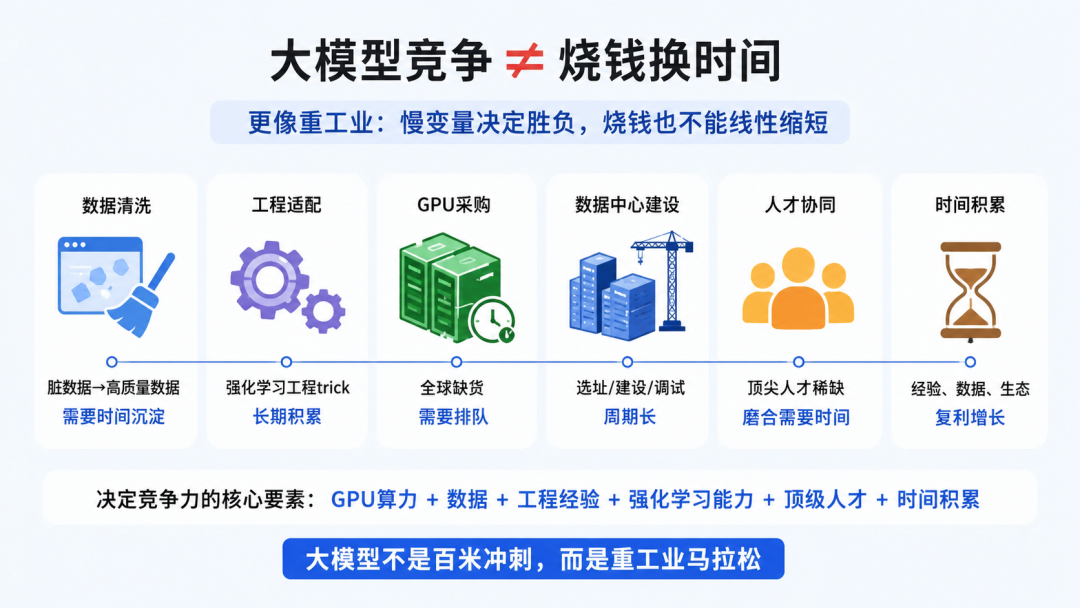
"Data cleaning takes time; engineering adaptations in reinforcement learning require long-term accumulation; GPU procurement involves waiting in line; data center construction takes time; talent coordination also takes time. Money can't linearly shorten these processes," Peng explained.
What's even riskier than a late start is xAI's talent exodus. "The co-founders are practically all gone," Jing remarked.
This founding team, assembled in July 2023, brought together top talent from former OpenAI, DeepMind, and other institutions.
However, since January 2026, the exodus has accelerated. Of xAI's 12 founding members, all 11 co-founders had departed by late March, including key technical leaders like Grok's chief architect Greg Yang and inference lead Tony Wu, leaving only Musk.
In contrast, xAI's competitors continue to attract top talent.
Over the past few months, an unusual phenomenon has emerged in the U.S. AI circle: CTOs and core technical leaders from multiple unicorn companies have resigned to join leading large model firms like Anthropic, even accepting roles as individual contributors (ICs).
For example, Henry Shi, former CTO of Super.com, joined Anthropic last year as Chief Technical Advisor. He later mentioned on X that several unicorn CTOs he knew had transitioned to IC roles at Anthropic.
For a detailed analysis of this phenomenon, read Pencil News' report: Strange Phenomenon: A Group of Genius CTOs Quit to Write Code at AI Giants.
In comparison, while xAI benefits from Musk's brand appeal, its model capabilities and ecosystem expansion speed gradually lag behind.
- 02 - Exiting the Mainstream Battlefield
In the view of multiple interviewees, xAI's merger into SpaceX holds greater significance beyond organizational restructuring—it signals a strategic pivot.
xAI is no ordinary large model company; it served as Musk's core "card" against OpenAI.
Over the past few years, tensions between Musk and OpenAI (particularly CEO Sam Altman) have repeatedly surfaced publicly. As an early co-founder of OpenAI, Musk has repeatedly criticized the organization for straying from its original mission of "AI for all" and "non-profit" principles, leading to prolonged legal and public disputes with OpenAI. 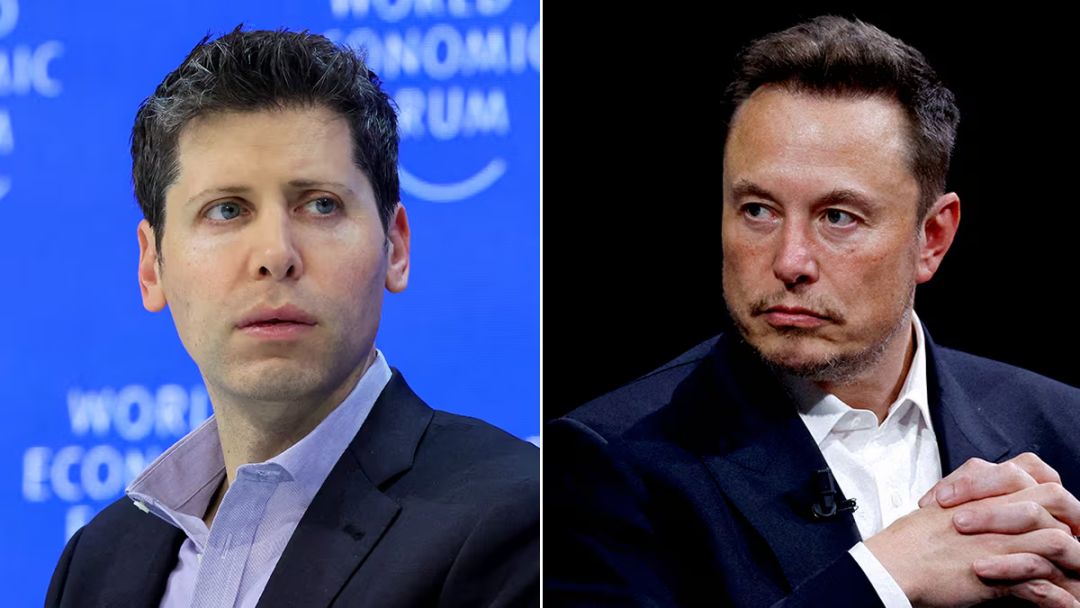
On the left is OpenAI co-founder Sam Altman.
Against this backdrop, Musk founded xAI in July 2023. To outsiders, it pursued a clear objective: challenge OpenAI and compete in the mainstream large model market.
"Originally, it aimed to confront OpenAI head-on, but after falling behind, xAI now resembles a company that can't win the main cake and must carve out new slices," Peng said. Currently, the most core and lucrative AI markets globally have been rapidly dominated by leading companies.
Specific areas include: legal, finance, enterprise services, general-purpose agents, and corporate knowledge bases. However, these highest-value markets have largely been divided among a few top players.
After "exiting the mainstream battlefield," Musk began two initiatives.
Firstly, he continues to counter OpenAI.
A notable move in this adjustment is xAI leasing substantial GPU resources to Anthropic—which happens to be one of OpenAI's biggest rivals.
In Jing's view, this reflects the continuation of Musk's long-standing conflict with OpenAI, despite his dislike for Anthropic, which he has publicly criticized multiple times. "The enemy of my enemy is my friend," Jing said.
Secondly, he seeks a new role for xAI.
This explains why Musk began deeply integrating xAI with SpaceX. "Earth-based AI is temporarily outmatched, so the focus shifts to space," Jing said. 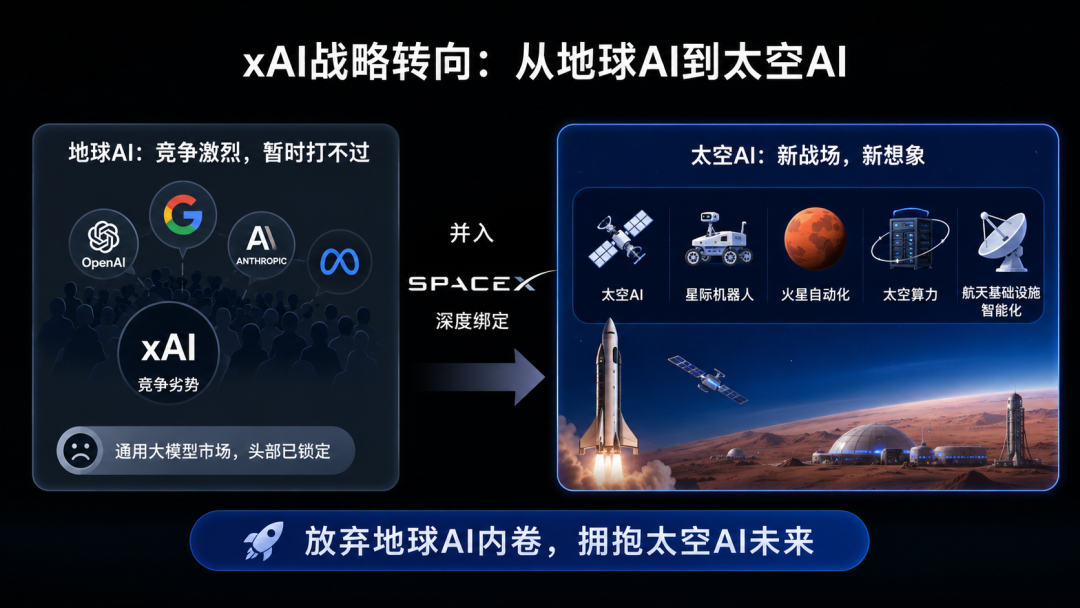
Rather than continuing to compete fiercely in the general large model market, merging with SpaceX at least offers new imaginative possibilities: space AI, interstellar robots, Mars automation, space computing power, and intelligent aerospace infrastructure.
SpaceX itself already possesses unique global scenario resources.
Currently, SpaceX has deployed over 5,000 low-Earth orbit satellites via Starlink, forming one of the world's largest commercial satellite internet systems. Meanwhile, its "Starship" project is advancing next-generation heavy-lift launch systems, with Mars colonization as its core narrative.
These scenarios inherently require substantial automation and AI capabilities, such as satellite network scheduling, space communication optimization, interstellar environmental decision-making, Mars base robot collaboration, and spacecraft autonomous operations.
In the eyes of many industry insiders, this suggests xAI's importance to Musk may have shifted—it is no longer merely his core weapon to "challenge OpenAI" but is becoming the underlying capability platform for SpaceX's "AI transformation."
- 03 - Domestic Impact
xAI's adjustments will also create a "Musk Effect" in China.
"Musk operates on 'believe because you believe.' In contrast, parts of China operate on 'believe because you see Musk,'" Peng said.
Take humanoid robots as an example: before 2022, the domestic market was lukewarm, with skepticism about prospects. In September 2022, Tesla unveiled its Optimus prototype, and Musk publicly championed mass production, completely reversing industry perceptions and prompting domestic capital to rush in.
Such "Musk Effects" have occurred multiple times in China, including in large models, brain-computer interfaces, and smart glasses.
Now that even Musk is "retrenching" in large models, what impact will this have domestically?
"This is a watershed moment. If even Musk can't win, should weaker large model companies continue developing foundational models? Many investors will recalculate accordingly," Peng said.
He further noted that if judged solely by model capabilities, xAI would rank among China's top three. "It's roughly at the level of Zhipu's GLM-5."
Over the past two years, China's market has seen a "hundred-model war" involving companies like Moonshot AI (Kimi), MiniMax, Zhipu, Baichuan, 01.AI, Jueyue Xingchen, SenseTime, Kunlun Wanwei, Chumen Wenwen, iFlytek Spark, 360 Zhinao, and Lanzhou Technology.
Going forward, with xAI's merger into SpaceX as a turning point, China's large model sector may accelerate its differentiation. Companies ranked outside the top three will face increasingly difficult independent survival, with financing and independent IPO prospects greatly diminished.
So, who are China's top three large model players?
From perspectives like market share and user scale, rankings vary slightly across sources.
In the enterprise-grade commercial market, using daily token call volume share as a metric, the top three in China are Alibaba's Tongyi Qianwen (32.1%), Doubao (21.3%), and DeepSeek (18.4%), followed by Wenxin Yiyan, Moonshot AI's Kimi, Zhipu GLM, and MiniMax, according to Frost & Sullivan's industry report in the second half of 2025.
For consumer-end mass users, QuestMobile's Q1 2026 data shows the top three are Doubao, Tongyi Qianwen, and DeepSeek. 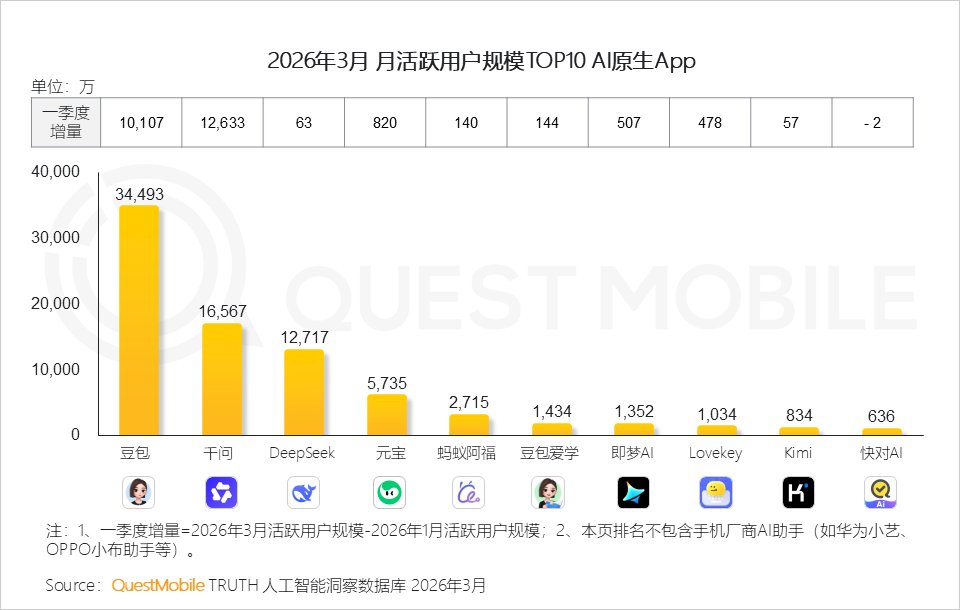
If evaluated by technical metrics, according to CAS's SuperCLUE data (March), the general-purpose leaderboard's top performers are Doubao, DeepSeek, Kimi, Alibaba's Tongyi Qianwen, and Zhipu. 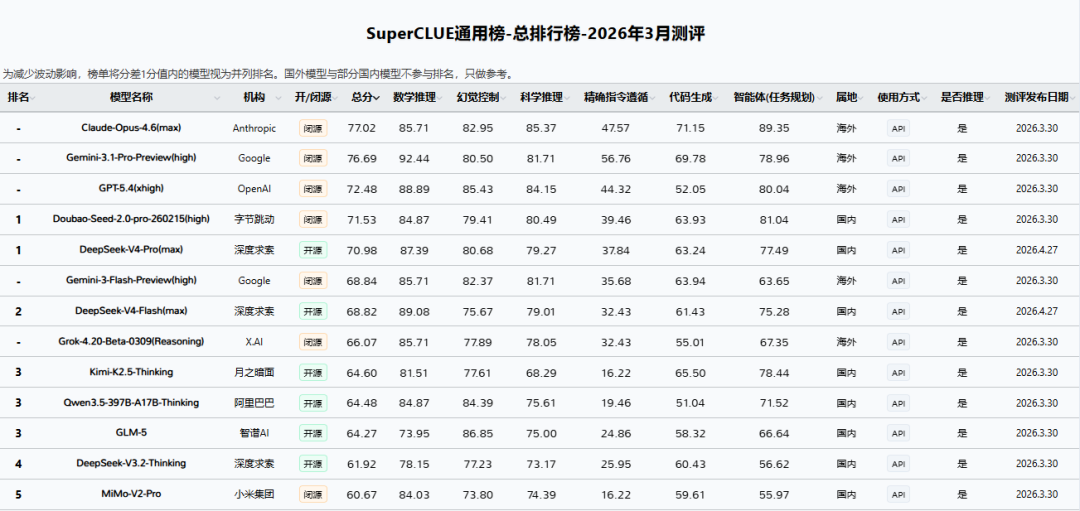
SuperCLUE's General-Purpose Leaderboard (March)
However, in niche scenarios, these rankings vary even more. "If judging purely by model capabilities, I'd rank Kimi K2.6 first; Zhipu GLM-5.1 second; DeepSeek V4 third; and MiniMax fourth," Jing said.
In Jing's view, the real danger isn't "who's temporarily behind" but that the large model industry has entered a "winner-takes-all" phase.
This scenario previously occurred in China's e-commerce sector.
Early on, numerous vertical platforms emerged—selling shoes, maternal and child products, 3C goods, books, etc. However, as comprehensive platforms like Taobao and JD.com rose, most vertical e-commerce companies gradually lost their independent survival space.
Once head platforms form closed loops—encompassing products, traffic, logistics, payments, and user scale—it becomes increasingly difficult for latecomers to catch up.
A similar situation is likely to unfold in the large model industry.
The logic remains the same: once leading models dominate, with capabilities, user scale, token consumption, cash flow, and ecosystems forming closed loops, the gap will only widen.
In this case, the best destination for small and medium-sized model companies may no longer be an independent IPO, but to be acquired by industrial players.
"Many second- and third-tier model companies are likely to be integrated by industrial companies in the future. You have industrial resources, but lack AI capabilities; they have models and teams, but cannot sustain financially. In the end, mergers and acquisitions may occur," said Peng Congyang.
Because once leading players gain advantages in basic resources such as GPUs, data, electricity, data centers, inference costs, and top-tier engineers, capital will no longer continue to burn money to support a clearly lagging player.
The final market will most likely be dominated by only 3-5 super players. The integration of xAI into SpaceX may just be the first landmark event marking the beginning of this phase.
This article does not constitute any investment advice.
-
![]()
Tesla Restructures Its Balance Sheet
-
![]()
Accelerating the High-Speed Interconnection Upgrade of AI Computing Clusters! JONHON Releases ELSFP External Light Source Optical Connectors
-
![]()
Breaking the overseas blockade of volumetric holographic materials, this optical enterprise secures nearly 100 million yuan in financing!
-
![]()
Why Does Jensen Huang So Openly Praise China’s AI?
-
![]()
"Wudang" Unveiled: Arm China's Next-Gen AI VPU Redefines Video Encoding
-
![]()
From Energy Conservation and Carbon Reduction to AI Decision-Making: GECON East Intelligence and Chery Group Explore a New Green and Smart Paradigm for Automobile Manufacturing
-
![]()
WAIC 2026 Observation | AI Accelerates Towards the Core of Industries, Industrial AI Enters a Critical Phase
-
![]()
Volkswagen China Fires the First Shot in Foreign-Funded 'White Box Delivery'!