Does Huawei's Moment Arrive Amid Apple's Leadership Shift?
 05/09 2026
 470
470
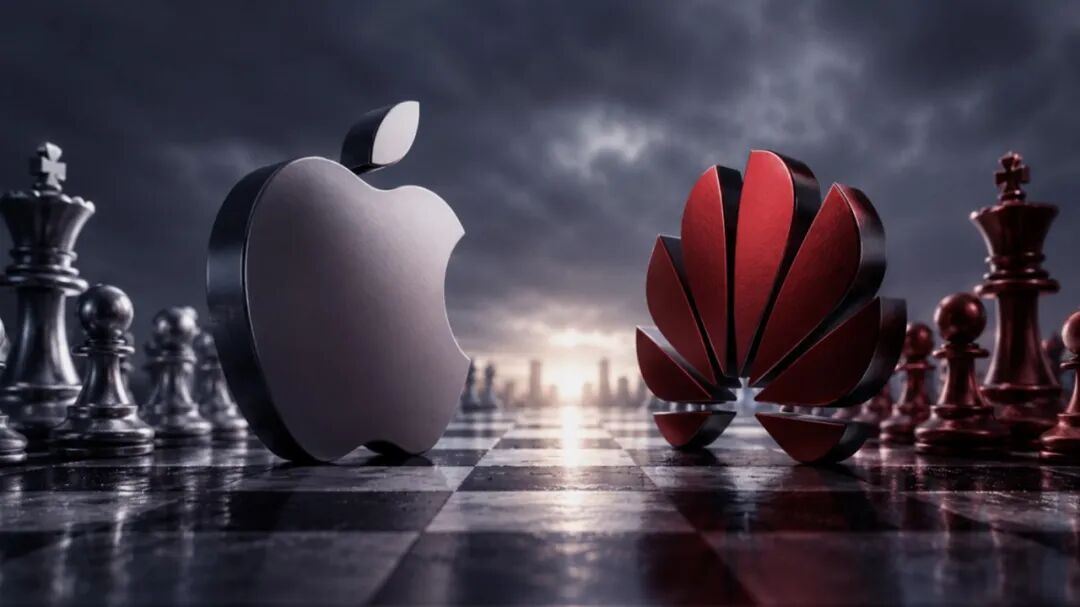
The leadership transition represents more than a mere transfer of power; it's a pivotal turning point.
Last month, Apple marked the end of the Cook era with a succinct statement of fewer than 500 words.
Despite its brevity, the announcement was rich in information. After 15 years at the helm, Tim Cook stepped down as CEO to assume the role of Executive Chairman. His successor is John Ternus, Senior Vice President of Hardware Engineering—a 25-year Apple veteran who has spearheaded iterative updates across iPhone, iPad, AirPods, and Mac product lines.
The tech industry's response was divided. One faction pondered: What lies ahead for Apple in the post-Cook era? The other began to strategize: Could Huawei capitalize on a potential leadership void at Apple?
These speculations are not without merit. Since the resurgence of Huawei's Kirin chip in 2023, Huawei's smartphone counteroffensive in China has intensified, directly challenging Apple's market position. Omdia data reveals that in Q1 2026, Huawei led the Chinese mainland market with a 20% share, closely followed by Apple at 19%—a mere 800,000-unit difference.
Huawei holds a slim lead, and while Apple's growth is impressive, competition looms large. When did Apple's leadership change take place? Can Huawei seize this opportunity? What strategies are Xiaomi, OPPO, and vivo employing?
Delving into these figures reveals a less glamorous reality.
01
Why Did Apple Choose Him?
Let's begin with the new CEO.
John Ternus graduated from the Mechanical Engineering Department at the University of Pennsylvania. His first job after graduation in 1997 was designing equipment at Virtual Research Systems, a VR startup. He joined Apple's product design team in 2001, starting with Mac displays and eventually leading hardware engineering.
An interesting detail: Ternus took two decades to reach the C-suite. In 2021, he became Senior Vice President of Hardware Engineering, entering Apple's core decision-making circle. In Silicon Valley, this is hardly a "rising star" trajectory. Yet Apple's board unanimously approved him as CEO, valuing his proven track record.
Ternus led the transition of iPhones from physical Home buttons to full-screen displays, oversaw the evolution of the M-series chip from "impossible" to standard, and quietly defined the TWS category with AirPods. As he put it, "You might only get one or two chances to participate in truly groundbreaking work. Now, another such moment has arrived."
However, declaring "world-changing" ambitions is easier than delivering on them.
Ternus inherits a $4 trillion Apple that is teetering beneath the surface. VisionPro underperformed expectations—a $3,500 "spatial computing revolution" nearly collapsed two years after launch.
AI poses significant challenges for Apple. Recently, Apple Intelligence was abruptly launched on Chinese iPhones, only to be retracted within six hours due to a server-side error (the feature lacked regulatory approval). This "midnight blunder" exposed Apple's AI struggles in China.
Speaking of China, one figure stands out: 42%.
This growth comes from Apple's latest iPhone 17 series. Omdia data shows Q1 2026 China shipments surged 42% year-over-year to 13.1 million units, with market share jumping from 13% to 19%.
IDC's figures differ slightly but trend similarly: Q1 China shipments totaled approximately 69 million units (-3.3% YoY), with Huawei and Apple as the only top-five brands achieving positive growth.
Whether this momentum can be sustained remains uncertain. Apple faces triple pressures in China: delayed AI features eroding product differentiation, macroeconomic risks, and Huawei's comprehensive offensive.
Any deterioration could rewrite the competitive landscape.
02
Huawei's Three Counteroffensive Axes
Now, let's focus on Huawei. In Q1 2026 China, Huawei shipped 13.9 million units (20% share, +7% YoY). For all of 2025, IDC data shows Huawei topped China with 46.7 million units (16.4% share).
This "comeback" is not uniform. Huawei's offensive centers on three fronts.
First, foldables. In H1 2025, China shipped 4.98 million foldables; Huawei dominated with 3.74 million units (75% share). For the full year, Huawei still commanded 66.6% of China's foldable market. In this global high-end certainty, Huawei reigns supreme.
More critically, form-factor innovation. Huawei's Pura X Max "ultra-foldable" debuted with HarmonyOS 6.1's ambient AI, Kirin 9030 Pro chip, and folding Ultra Armor structure. CounterPoint Research shows Huawei captured 45% of the global foldable share in Q2 2025, outpacing No. 2 Motorola (28%) by 17 points.
Apple's first foldable iPhone, rumored for years, likely won't arrive until 2027. Factoring in ramp-up and validation, Apple faces at least a two-year window. The later Apple launches, the deeper its starting hole.
Second, Huawei's premium candy-bar lineup widens its moat.
Take the Pura 90 series (flagship candy-bar) and Pura X Max (ultra-foldable). The former bets on a 200MP imaging system; the latter on AI interaction. Later this year, the Mate 90 Pro Max will reportedly debut with Kirin 9050 and dual-periscope telephoto lenses. This "Pura for imaging in H1, Mate for performance in H2" rhythm directly challenges iPhone's annual single-flagship strategy.
Finally, HarmonyOS's ecosystem leap from backup to center stage. Harmony devices now exceed 55 million, with over 10 million registered developers, 350,000+ available apps, and 150,000+ daily new devices. From 27 million in late 2025 to 55 million by April 2026, the base doubled in four months. HarmonyOS 6.1 upgrades cover 100+ devices, breaking the "new OS for new models" industry norm.
Once the ecosystem flywheel spins, user exit costs soar.
Huawei's offensive extends beyond phones.
At Huawei's 2026 Qian Kun Tech Conference, a dozen automakers stood alongside, including FAW, Audi China, GAC, Dongfeng, SAIC, and Chery Jaguar Land Rover. ADS 5 high-level autonomous driving began mass adoption. Huawei delineated two clear paths: the "Jie" series led by Harmony Intelligent Mobility, and the "Jing" series by Huawei Qiankun.
At the Beijing Auto Show, models like Dongfeng Yijing X9 and Wuling Huajing S debuted, spanning luxury SUVs to mass-market segments. As cars become "smart terminals on wheels," Huawei gains a card no phone maker can replicate.
What truly rattles Apple is Huawei's parallel ecosystem of "phones + cars + whole-home smart + wearables." The Pura 90 series launch shared the stage with AI glasses, Harmony laptops, smart screens, and wearables. This signals cross-device OS expansion—not just phones, but full-link penetration into homes, offices, and mobility.
Apple has done CarPlay for a decade without building a car. Huawei hasn't built a "Huawei-branded" car, but its tech permeates China's automotive nervous system.
03
Global Share: The Open Ledger and Hidden Ledger
Globally, the picture shifts.
In 2025, IDC data shows Apple led globally with 248 million units (19.7% share), its third consecutive year atop the rankings. Samsung followed with 241 million (+7.9% YoY, the strongest growth among the top five). Xiaomi ranked third with 165 million, while vivo and OPPO split approximately 100 million each.
Huawei didn't crack the global top five. Combining its China #1 rank with global absence underscores heavy reliance on China; overseas phone business remains GMS-restricted. While HarmonyOS solved app replacement domestically, overseas users' Google dependency persists.
Yet Huawei's global influence hasn't vanished—it's shifted battlefields. In foldables, Huawei commands nearly half the global market; in automotive intelligence, Huawei Qiankun supplies more international automakers in China.
Viewed holistically, the answer lies not in "leadership change" itself but in strategic vacuums and tactical timing during transitions.
China's premium market has flipped: Q1 2026 saw Huawei at 20% vs. Apple's 19%. Huawei leads, but the gap is razor-thin; Apple's 42% growth dwarfs Huawei's 7%. Both sprint—Huawei defends its lead, Apple chases momentum. History suggests new CEOs prioritize stability in year one. If Ternus focuses on supply chain efficiency over market expansion in 2026–2027, Huawei could seize premium price tiers.
Meanwhile, the AI tug-of-war in China may tilt. Apple's AI features need strict approval for China; Huawei's Pangu large model + on-device AI already roll out via HarmonyOS 6.1. If Apple lacks core functionality in key markets long-term, even loyal fans may consider switching.
Yet "Huawei's opportunity" shouldn't fixate on Apple's weaknesses. Apple can reverse fortunes with any system-level update.
WWDC 2026 (June) will focus on iOS 27 and AI-powered Siri. Apple plans a standalone Siri chatbot (code-named "Campos") based on Google Gemini, directly challenging ChatGPT. If Apple turns AI into a true system-level moat—not just feature stacking—iOS's lock-in effect will strengthen.
Another issue warrants tracking: Apple's supply chain resilience. Rising memory chip prices drag global phone shipments. Q1 global decline stems from AI industry snapping up capacity, tightening DRAM/NAND supply.
Apple's scale and bargaining power offer relative insulation, but Huawei's self-developed Kirin chips reduce core component bottlenecks—at least domestically.
Ultimately, no one is "capitalizing on mistakes." Apple's transition isn't mere power transfer but a watershed. Cook leaves a $4 trillion cash cow; Ternus faces an Apple future redefined after falling behind in the AI race.
Huawei has opportunities—substantial ones. But they stem from its own tech density, product rhythm, and ecosystem momentum, not Apple's errors.
Q1 China sales are merely a snapshot. Over time, competition will unfold across AI ecosystems, spatial computing, automotive intelligence, and global supply chains. Short-term, foldables and automotive ecosystems offer Huawei's clearest growth; AI remains the wild card; global markets pose the toughest challenge.
Smartphone rivalry is no longer linear "who sells more." Around screen forms, OS, proprietary ecosystems, and multi-device synergy, true differentiation will take two to three years of strategic execution.
Ternus says he's "about to change the world again." Apple must prove it still can.
This article is original to Xinmou.
— END —
-
![]()
Global Hydrogen Vehicle Fleet Reaches 115,000 Units: South Korea Leads, China Follows, U.S. and Japan Lag Behind
-
![]()
Ultra-Luxury Cars Undergo Collective 'Trial'
-
![]()
Net Profit Drops 23%: BMW’s Q1 Performance – Unflashy, Yet Steadfast
-
![]()
Investors Eagerly Anticipate Kimi's Public Debut
-
![]()
xAI, Died of 'Resignation to Fate'
-
![]()
Will Qianwen Follow in Doubao's Footsteps and Implement ROI-Based Charging?
-
![]()
From Free to 5088 Yuan: Unraveling Doubao AI’s ‘Pricing Strategy’ at ByteDance
-
![]()
OpenAI Forays into Smartphone Manufacturing, Apple Suffers $50 Billion Loss in a Single Night