Research on Generating Gigawatt-Level, Sub-10 Femtosecond Visible Light Pulses via Ultrafast Nonlinear Optical Methods
 05/09 2026
 487
487

High-repetition-rate, high-peak-power ultrashort visible light pulse sources are pivotal for advancing ultrafast science and strong-field physics. In ultrafast spectroscopy, these sources enable the investigation of dynamic processes involved in electron-lattice coupling. In strong-field physics, they facilitate the study of nonlinear effects in wide-bandgap dielectrics and the generation of extreme ultraviolet pulses through high-order harmonic driving.
Currently, ultrashort visible light pulses are mainly generated using non-collinear optical parametric amplification (NOPA) or optical parametric chirped pulse amplification (OPCPA). Although these methods can produce few-cycle visible light outputs, their complex optical systems, high costs, and susceptibility to spatial chirp limit their practical applications. Ytterbium-doped laser systems, valued for their high average power and excellent long-term stability, have become essential platforms for ultrafast lasers. However, constrained by their gain bandwidth, the output pulse widths of these systems typically exceed 200 femtoseconds. Therefore, generating high-performance visible light pulses through nonlinear post-compression and frequency conversion techniques based on ytterbium-doped laser systems has become a focal research area in this field.
To tackle these challenges, this study introduces a technical solution that combines two-stage hollow-core fiber (HCF) spectral broadening with frequency doubling [1]. Initially, self-phase modulation (SPM) is employed to achieve spectral broadening and few-cycle compression of near-infrared fundamental pulses. Subsequently, frequency doubling conversion is directly applied to these fundamental pulses. The innovation lies in SPM introducing nearly linear spectral phases in the spectral sideband regions, which allows the frequency-doubled pulses to remain close to the transform limit without the need for complex dispersion compensation systems, thereby significantly reducing device complexity.
As depicted in Fig. 1, the experimental setup comprises a driving laser, a two-stage HCF nonlinear compression module, and a frequency-doubling unit. The driving source is a commercial Yb:KGW regenerative amplifier with the following output parameters: a central wavelength of 1030 nm, a pulse width of 340 fs, a pulse energy of 2 mJ, and a repetition rate of 40 kHz. The laser is first coupled into the first-stage HCF for spectral broadening. After compensation using chirped mirrors, a compressed output of 35 fs and 1.7 mJ is achieved. This pulse is then coupled into the second-stage HCF for further broadening. Following precise dispersion compensation, fundamental pulses with widths of 6-8 fs are obtained, providing the necessary driving conditions for subsequent frequency doubling.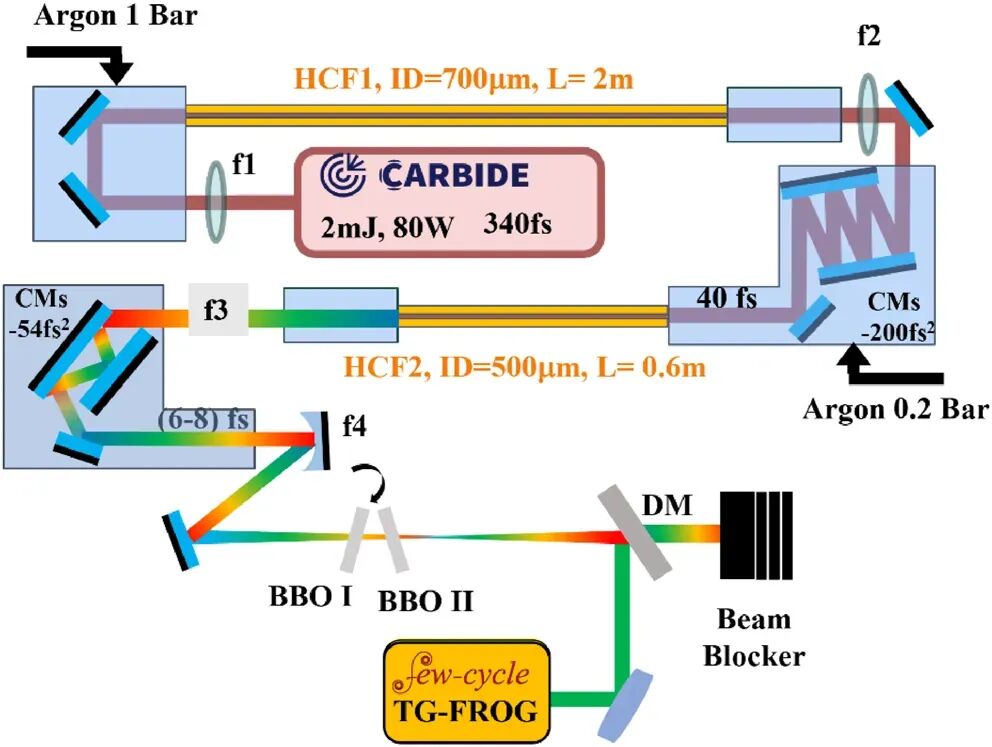
Fig. 1 Schematic diagram of the experimental setup [1]
Utilizing the aforementioned two-stage HCF compression device, the authors conducted a systematic investigation into the generation characteristics of ultrashort visible light pulses through various frequency-doubling strategies. All optical pulses were temporally characterized using temporal gated frequency-resolved optical gating (TG-FROG).
Initially, the 35 fs fundamental pulse compressed in the first stage was used as the pump, focused into a single 220 μm-thick beta barium borate (BBO) crystal. By adjusting the phase-matching angle, tunable outputs in the 420-600 nm range were achieved. Moreover, all pulse widths were below 50 fs, with a pulse energy of 125 μJ obtained at 540 nm, corresponding to a peak power of 3 GW and a conversion efficiency ranging from 6.4% to 32%.
Furthermore, the 6-8 fs pulses compressed in the two-stage process were employed as the pump, and a 100 μm-thick BBO crystal was used for frequency doubling to support a wider phase-matching bandwidth. Within the same 420-600 nm tuning range, the pulse width was further compressed to 15-19 fs, with pulse energies ranging from 1 to 6 μJ. These results confirm the feasibility of reducing crystal thickness to expand the phase-matching bandwidth and achieve shorter pulse width outputs.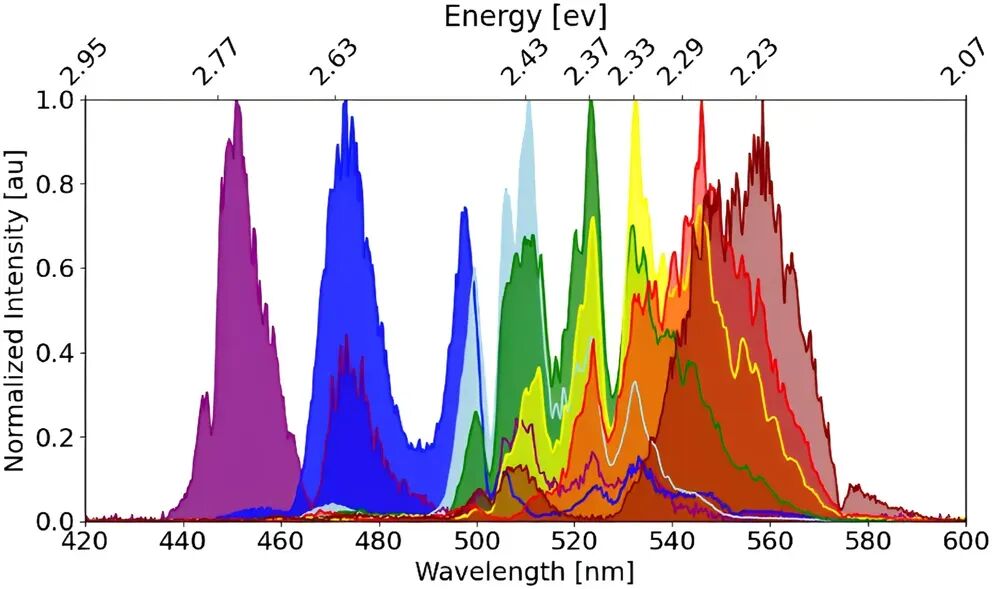 Fig. 2 Tunable visible light output spectra [1]
To further overcome the pulse width compression limitations imposed by the phase-matching bandwidth of single crystals, a "dual-crystal" configuration was adopted. Two 100 μm-thick BBO crystals were arranged in a mirror-like setup to separately optimize the frequency-doubling efficiencies of the blue-shifted and red-shifted portions of the fundamental spectrum, enabling broadband collaborative frequency doubling. Under this configuration, visible light pulses with a width of 9.5 fs were generated, as illustrated in Fig. 3. The pulse energy was 3.1 μJ, corresponding to a peak power of approximately 0.32 GW. These results validate the effectiveness of this approach in generating few-cycle visible light pulses.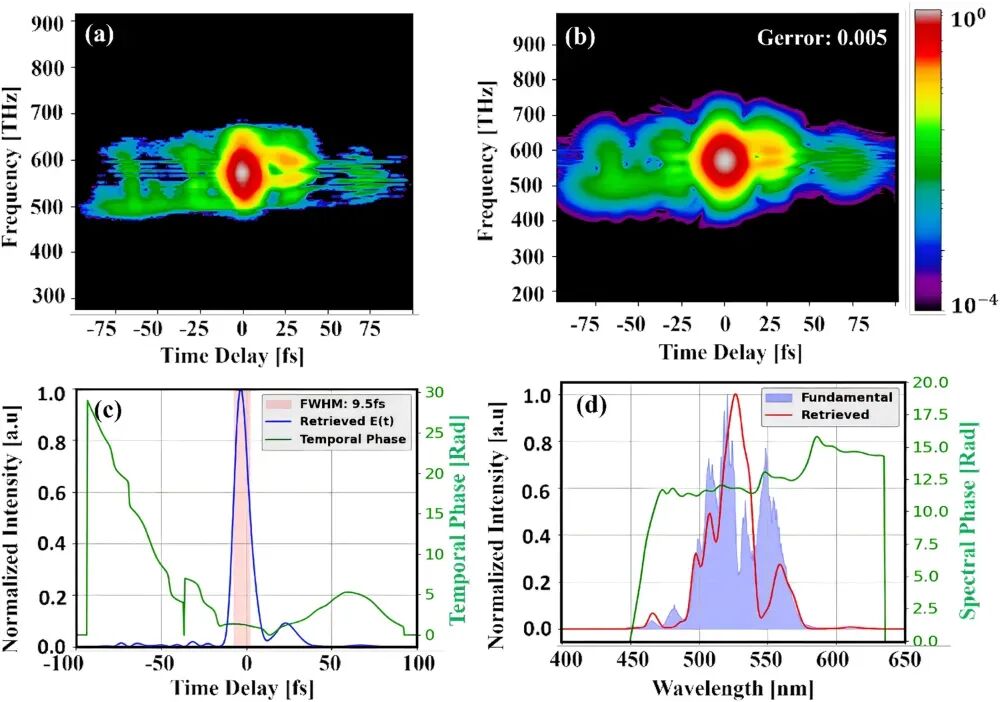 Fig. 3 Temporal and spectral characterization of sub-10 fs visible light pulses [1]
Additionally, system stability tests revealed that, under long-term operation, the relative standard deviation of the output power was 0.96%, indicating excellent stability. Far-field beam profile measurements showed that the output beam closely approximated an ideal Gaussian distribution, reflecting superior beam quality.
In conclusion, this study systematically demonstrates an efficient strategy for generating visible light pulses based on two-stage HCF spectral broadening and second harmonic generation (SHG), achieving multi-pulse width-controlled outputs ranging from sub-50 fs to sub-10 fs. The "dual-crystal" configuration effectively overcomes the phase-matching bandwidth limitations of single crystals. Compared to traditional NOPA/OPCPA systems, this scheme offers significant advantages in terms of system complexity, beam quality, and long-term stability, providing a concise and efficient technical pathway for constructing high-power, ultrashort visible light drivers.
References: [1] Abdolghader P, Scaglia M, Doiron É, et al. Gigawatt level, 10 fs high efficiency visible pulse generation[J]. APL Photonics, 2025, 10(8).
-
![]()
Hunan’s Wealthiest Entrepreneur Eyes Comeback with Apple’s Foldable iPhone
-
![]()
Planning to Secure 1.055 Billion Yuan to Propel AR Optics Forward! Lante Optics Receives Green Light for Private Placement on the Science and Technology Innovation Board
-
![]()
MiniMax: At the Heart of the AI Maelstrom
-
![]()
Securing 600 Million Yuan in Funding: This AR Optics Company Steps into the Limelight!
-
![]()
From a 706% Surge to a $340 Billion Market Cap Plummet: Has MiniMax's Moment Passed?
-
![]()
High Demand, Low Stock Price: Can the Emotional Companion Robot Ease UBTECH’s Worries?
-
![]()
Why Does Yin Qi, Who 'Doesn't Listen to Advice,' Insist on Making AI Agent Smartphones? | Interview with Jieyue Xingchen
-
![]()
AI-Generated Code Reveals Surprise That Thrills China