AI Output Format Revolution: Markdown Faces Backlash, HTML Makes a Comeback
 05/11 2026
 469
469
Each has its pros and cons.
Over the past two years, if we consider which format large models are most adept at delivering content in, the answer is most likely Markdown.
The reason is simple: Markdown is clean and free of redundant formatting. Whether copied into documents, knowledge bases, GitHub, or even directly pasted into the WeChat Official Accounts backend, it works without major issues. In a sense, Markdown has become the generally recognized best markup language for the AI era.
However, with the advent of the Agent era, Markdown's reputation has taken a sharp downturn, while the old-fashioned HTML has started to be fervently recommended by developers. Why has this change occurred? In fact, Agent tools like Anthropic's Claude Artifacts, OpenAI's Codex, and the recently popular Openclaw and Hemers, often deliver outputs that are not just plain text—they could be an SVG animation, a program, or even a complete video.
(Image Source: Cultural Code)
In such cases, Markdown, which is typically presented in plain text, is no longer sufficient. Thariq Shihipar, a member of the Anthropic Claude Code team, also mentioned in his article that compared to Markdown, Claude should use HTML to output results.
But is HTML really better than Markdown? Not necessarily.
The Old Guard's Comeback: Replacing Markdown with 'Versatility'
Markdown isn't exactly new. In 2004, John Gruber proposed Markdown as a text-to-HTML conversion tool for online writers. Simply put, it allows writers to complete their content in a format close to plain text and then convert it into HTML using tools.
From the beginning, Markdown wasn't meant to replace HTML but to lower the barrier to writing HTML. It acts as a more accessible intermediate language, helping writers focus on smoothly producing content without worrying about HTML specifications, which are then handled by tools.
This is why Markdown later became popular in blogs, forums, knowledge bases, development documentation, and GitHub. It relies on very simple writing specifications, with only the most common formatting needs such as headings, lists, quotes, bold text, and links. Writers don't need to worry about anything else.
HTML, on the other hand, has a much longer history. Tim Berners-Lee proposed the concept of the World Wide Web in 1989 and had defined several foundational concepts, including HTML, HTTP, and URL, by the end of 1990. He also created the first browser, editor, and server. In other words, HTML emerged almost simultaneously with the internet.
Compared to Markdown, HTML's drawback is that writers must consider headings, paragraphs, links, images, tables, forms, navigation, buttons, and more while writing, which can disrupt their train of thought. Of course, HTML can also present richer content, as its core is to display a 'mini webpage' with more elements capable of display, interaction, and animation.
Under the same set of prompts, we asked AI to create a resume with fictional names, information, work experience, and educational background, outputting both Markdown and HTML versions. The Markdown version is straightforwardly simple—the information is complete, but an HR receiving this resume might consider it unprofessional. The HTML version is much richer and at least resembles a proper resume.
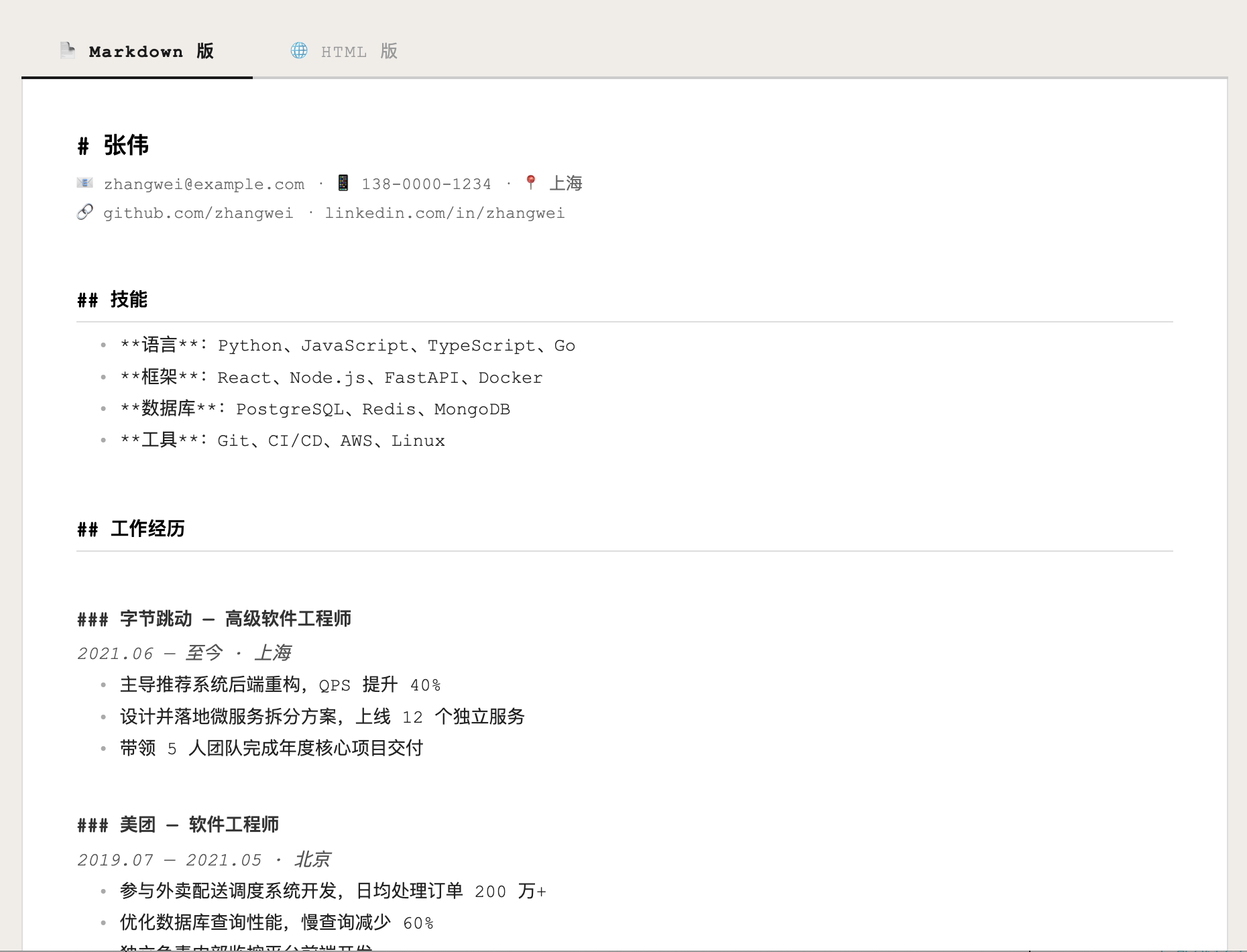
(Image Source: Leikeji Infographics)
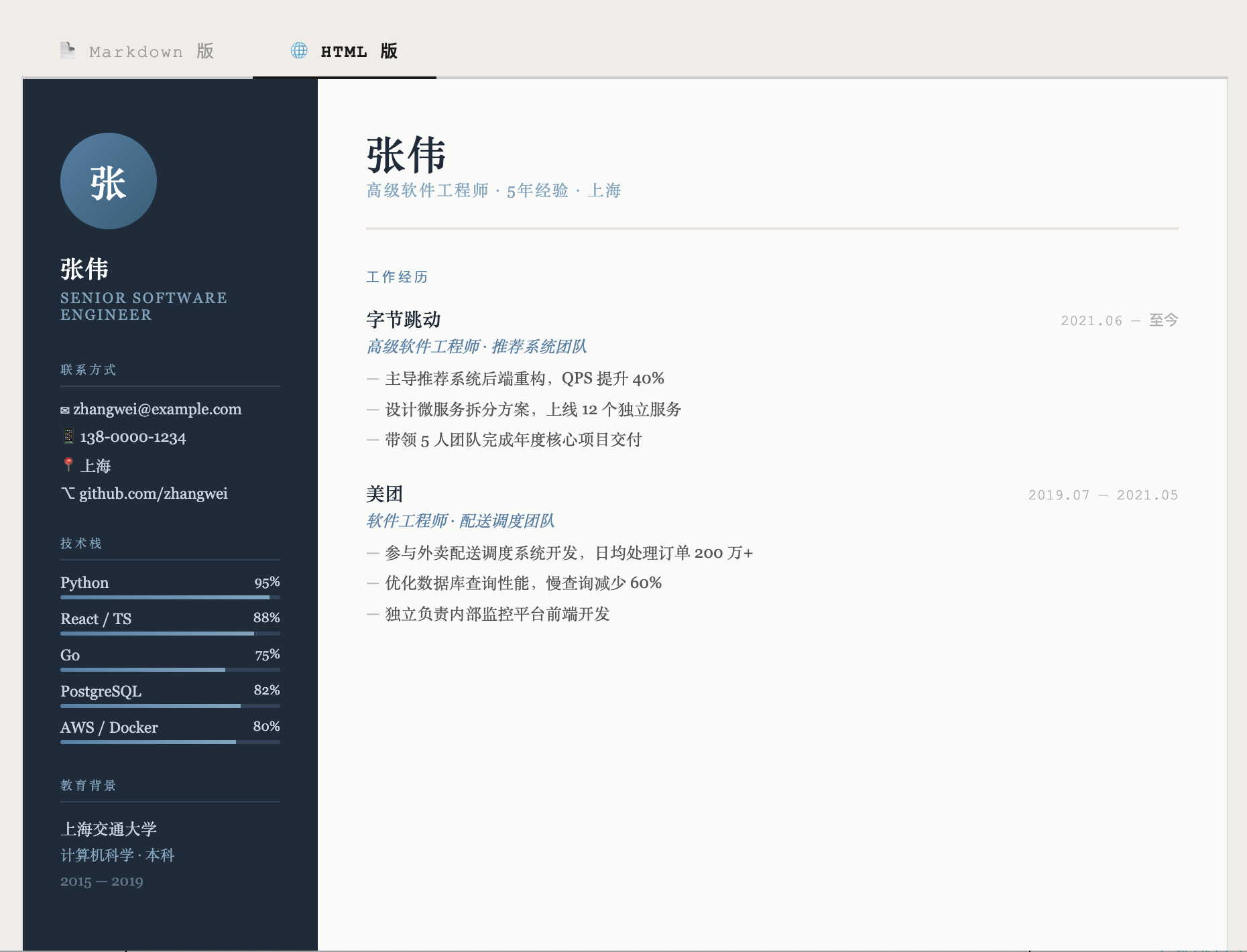
(Image Source: Leikeji Infographics)
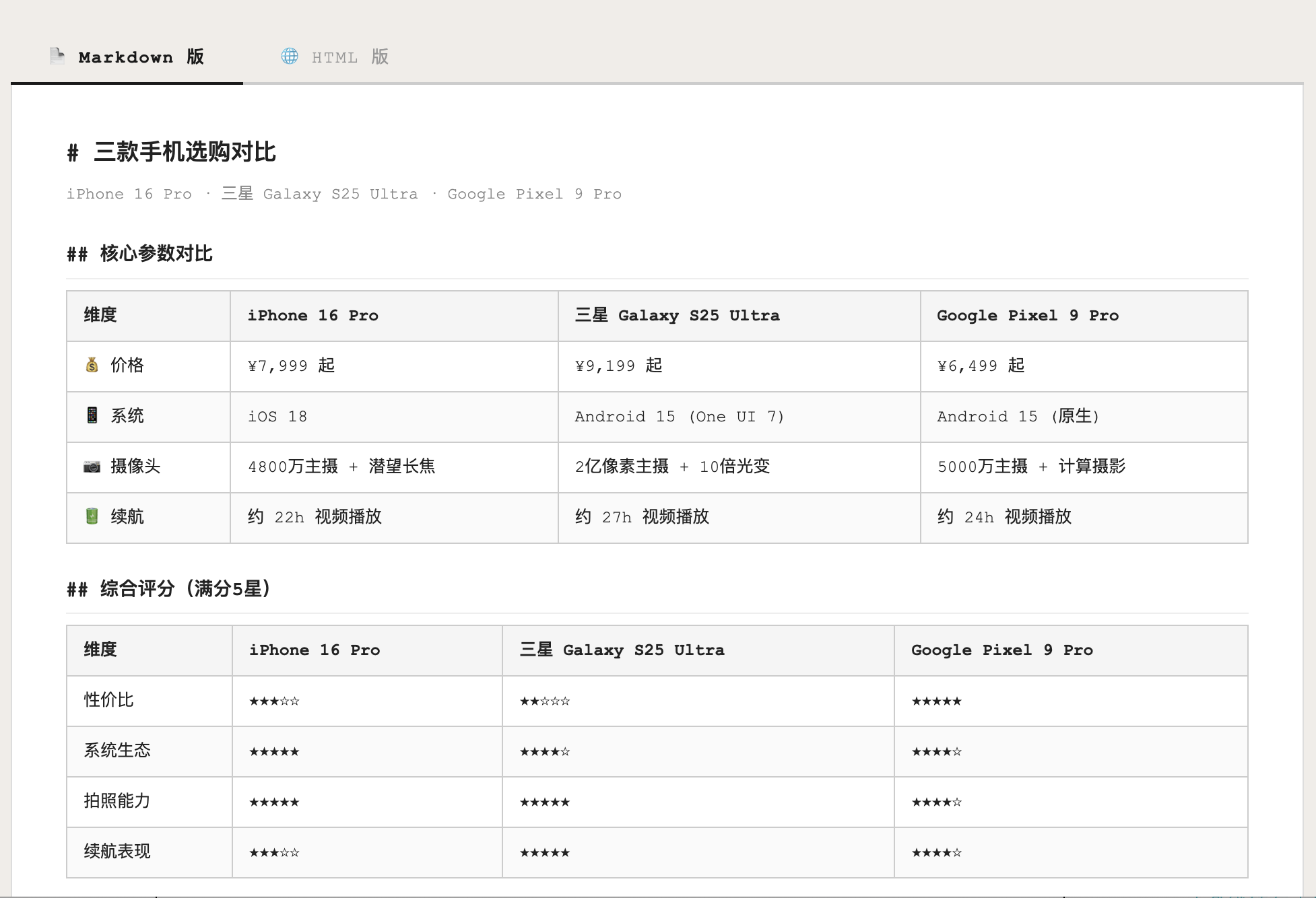
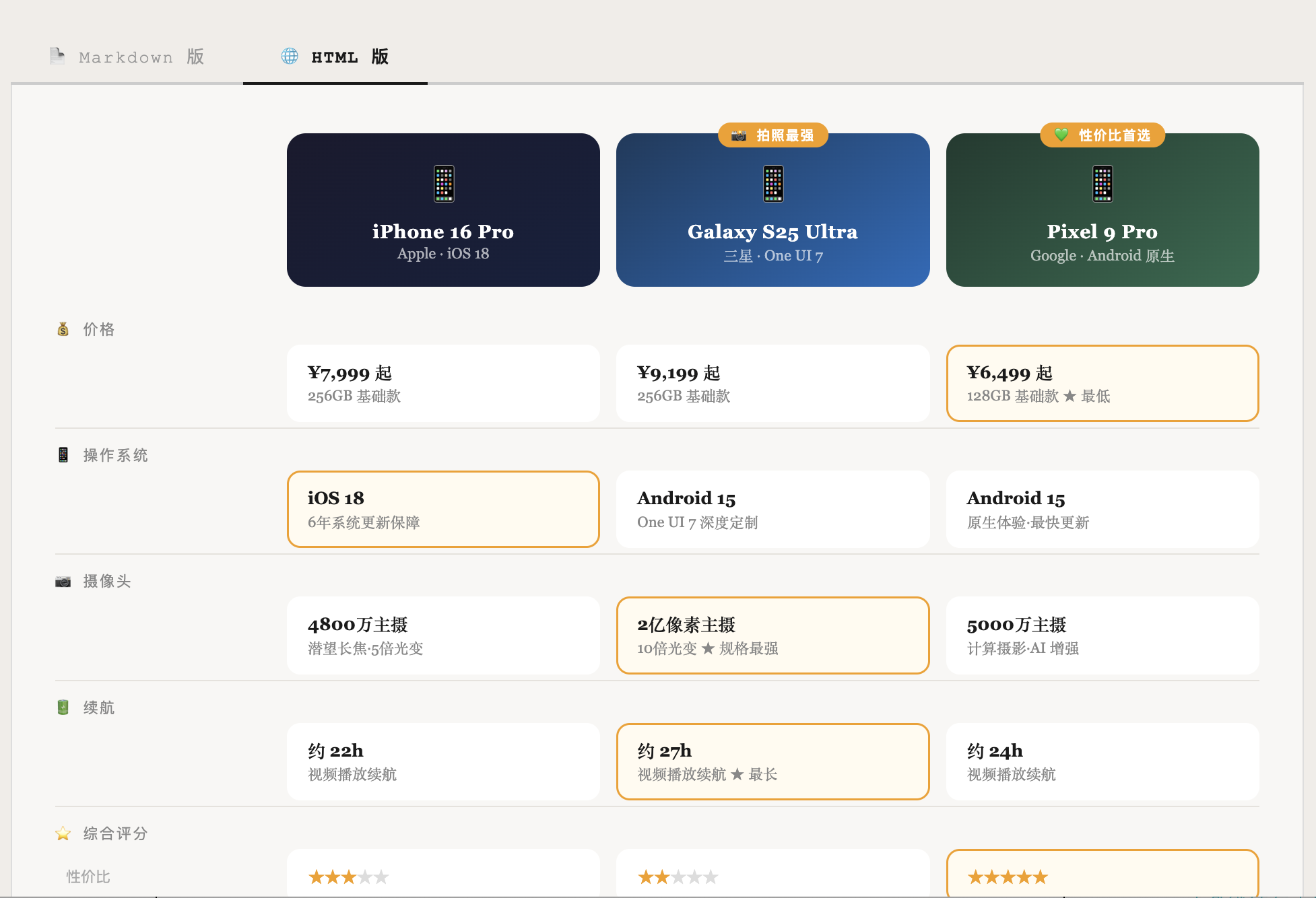
Let's also look at the difference between Markdown and HTML for a common mobile phone buying guide. When creating such charts, Markdown outputs are very standard, with no extra words—parameter information is presented directly and clearly. However, HTML wins in terms of detail richness, such as color choices and the most intuitive way to present recommendation indices.
(Image Source: Leikeji Infographics)
(Image Source: Leikeji Infographics)
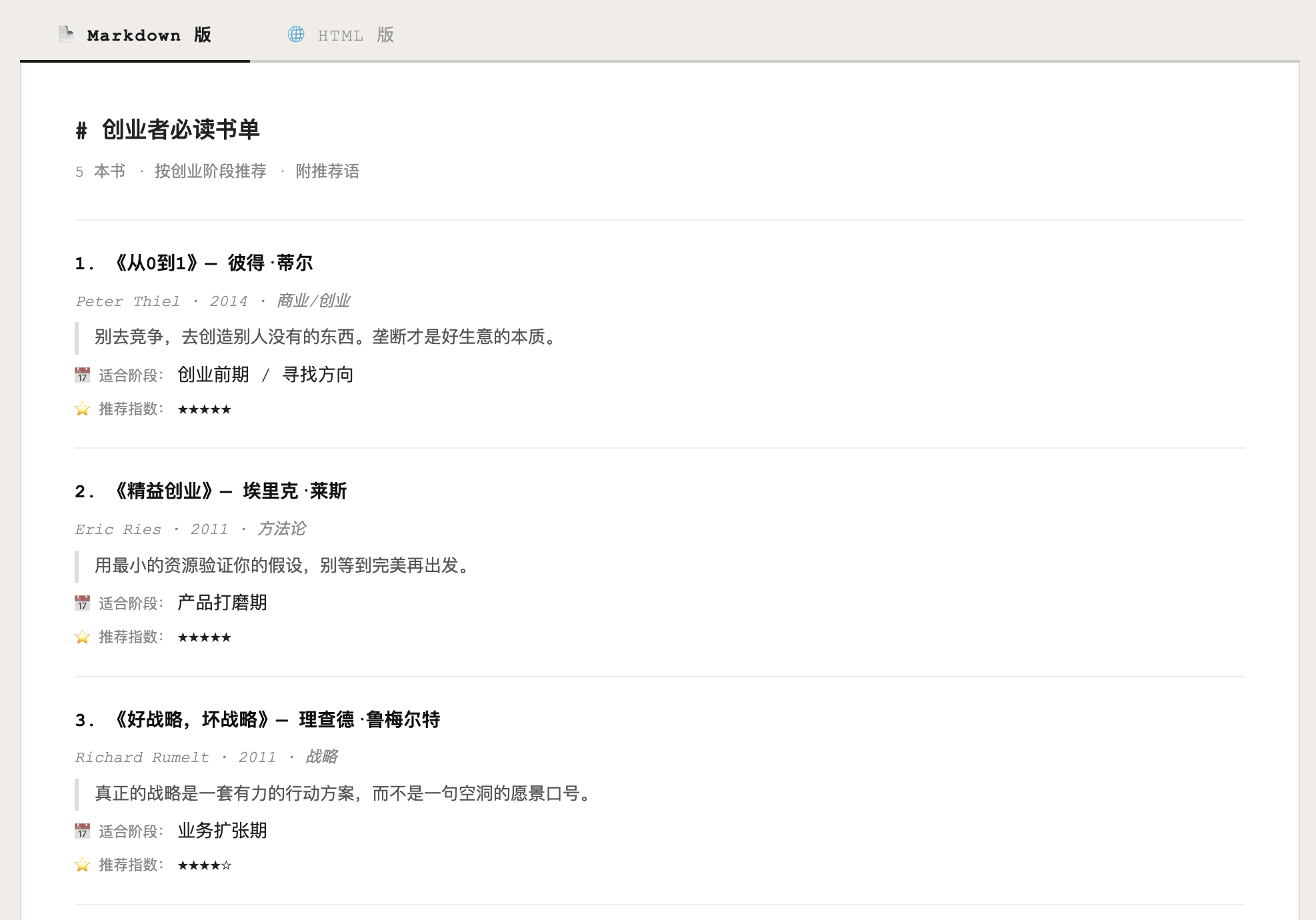
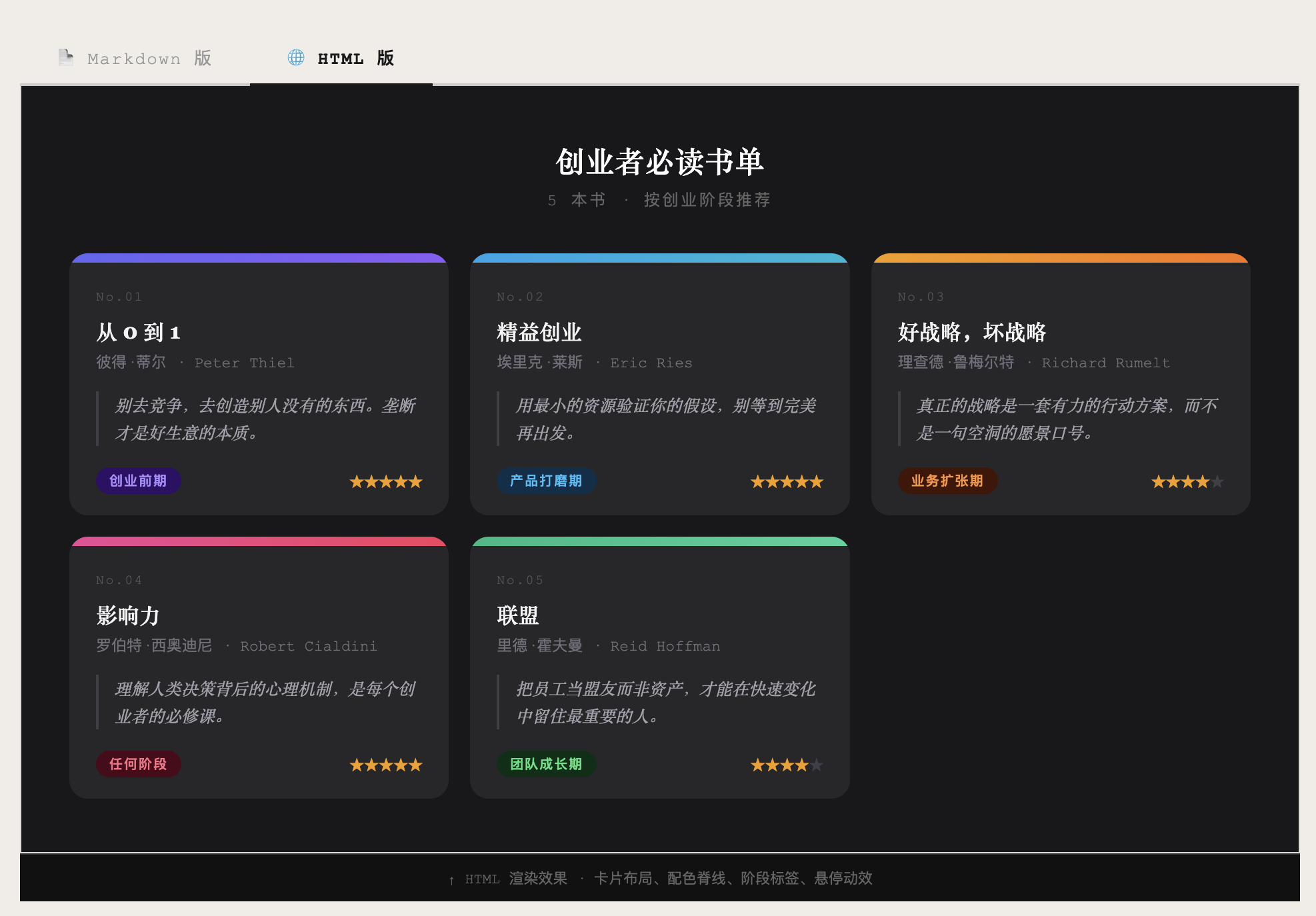
But does HTML completely win? I don't think so. Under the same set of prompts, I asked AI to create a book recommendation list for entrepreneurs. Without much intervention, I believe the Markdown output is clearer this time—book titles, descriptions, and recommendation indices are easily understandable at a glance. The HTML version has great animations and visual effects, but it doesn't help me clearly understand which book I should start with.
(Image Source: Leikeji Infographics)
(Image Source: Leikeji Infographics)
Finally, let's consider technical tutorials. Compared to the previous examples, Markdown has an even greater advantage here. First, technical tutorials are inherently linear reading processes—we need to browse from top to bottom. Markdown's logic aligns perfectly with this, with code blocks directly embedded in steps and notes indented, making it very clear. Even with its high openness, HTML has to be simplified in this scenario, but it still looks less clean than Markdown.
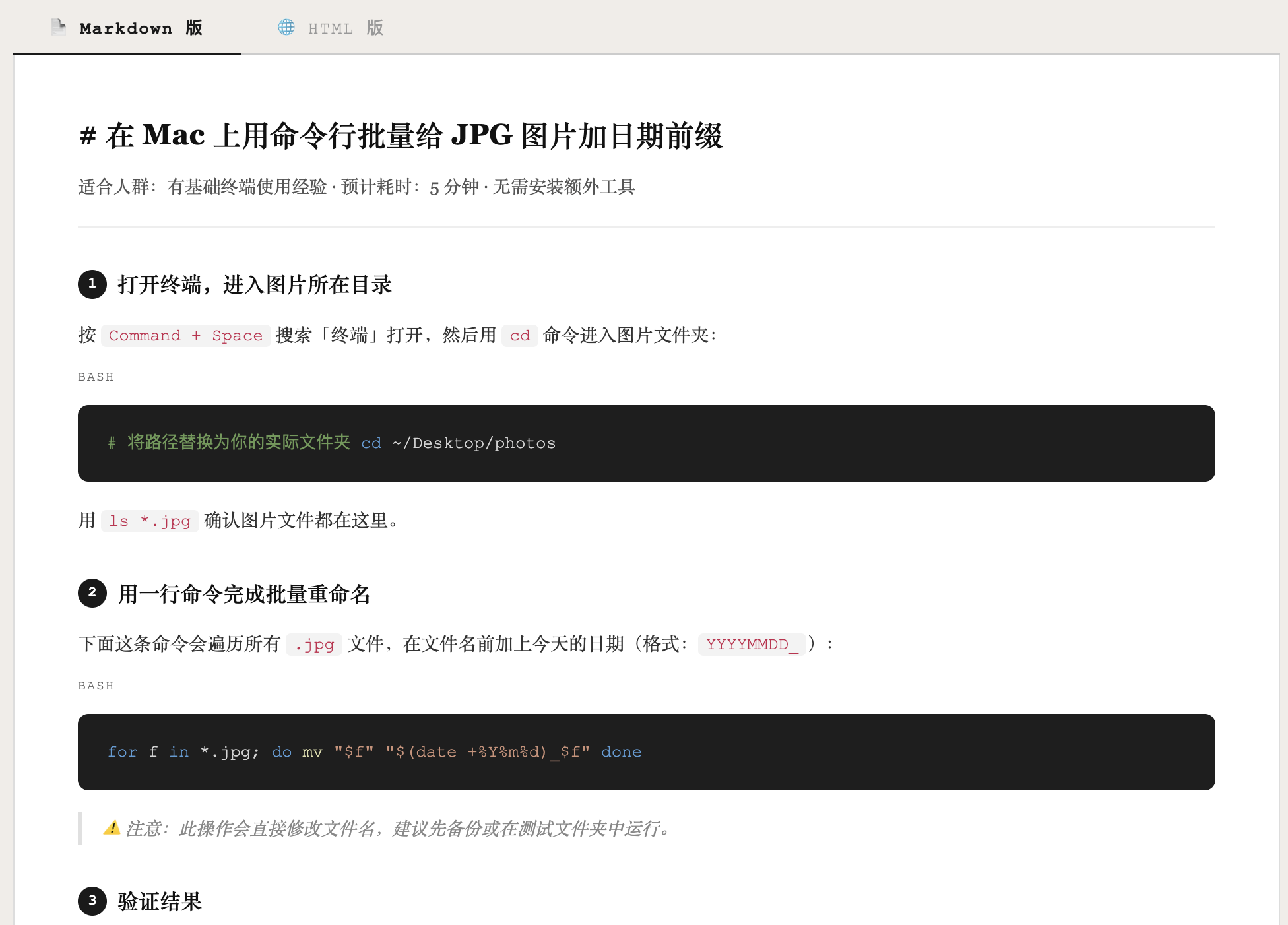
(Image Source: Leikeji Infographics)
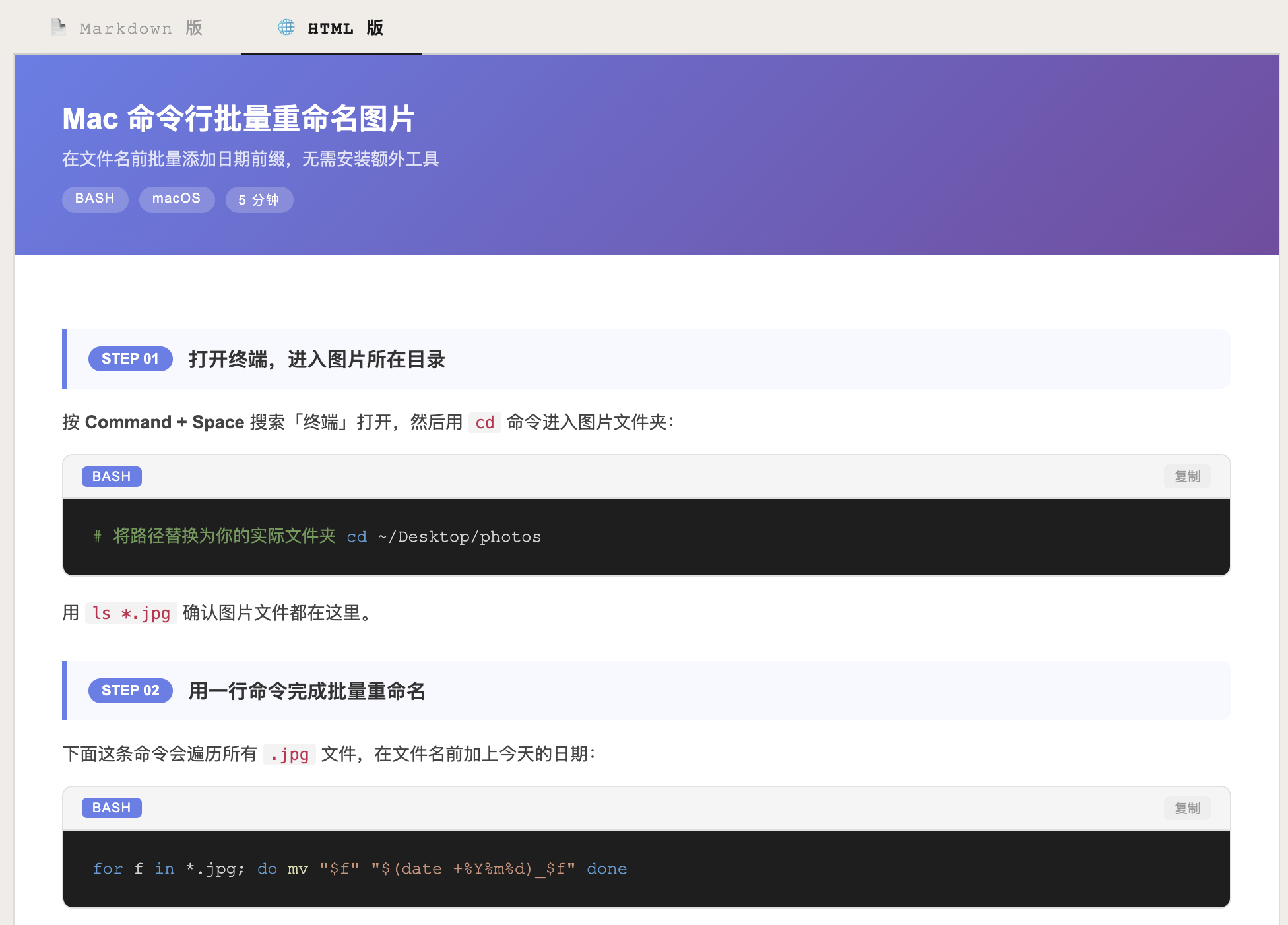
(Image Source: Leikeji Infographics)
In fact, from these practical examples, Markdown hasn't been completely overshadowed by HTML. Especially in data collection and text organization, Markdown presents clearer and simpler results. But why do experts recommend HTML more? I believe HTML can carry more diverse content. For example, in resumes and buying guides, the rich visual effects HTML provides are unmatched by Markdown.
Abandon Markdown? It's Too Early to Say
From the previous experiences, many might ask: Since HTML seems so good, should everyone abandon Markdown and fully embrace HTML? Not necessarily.
In most people's impressions, AI is just a chat window—the output format doesn't matter as long as you understand it. Markdown is more than sufficient in this scenario and even more suitable due to its simplicity. However, if AI is starting to help you get things done, Markdown might not be outstanding enough.
In fact, Markdown was designed from the beginning for 'writers.' You write with it, submit it to a platform, and the platform converts those ## and ** into attractive headings and bold text for users to see. More directly, Markdown inherently needs a 'translator.' HTML, on the other hand, presents results directly—the browser is its runtime environment. Every computer and phone in the world has a browser, so HTML doesn't need anyone to translate it; it is already a finished product.
Imagine asking AI to create a PPT for you. If it outputs Markdown, what you get isn't a PPT but a description of what the PPT looks like. You still need to find software that can read this description, like WPS or Office, to see the actual slides. But if it outputs HTML, you get a complete, ready-to-use product by simply clicking on it.
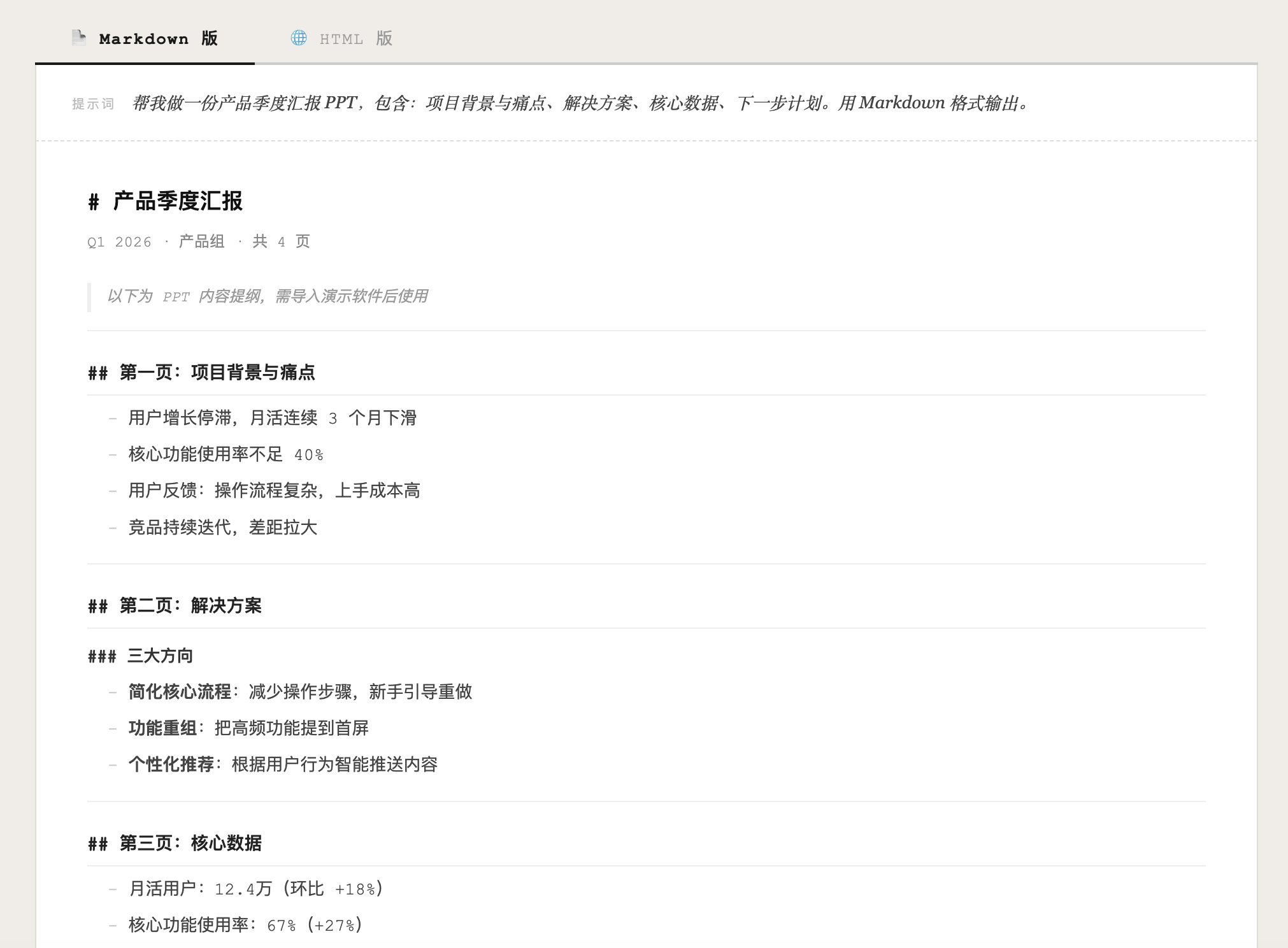
(Image Source: Leikeji Infographics)
This is why almost all experts recommend requesting HTML output on Agents—you get a real result, not a work-in-progress.
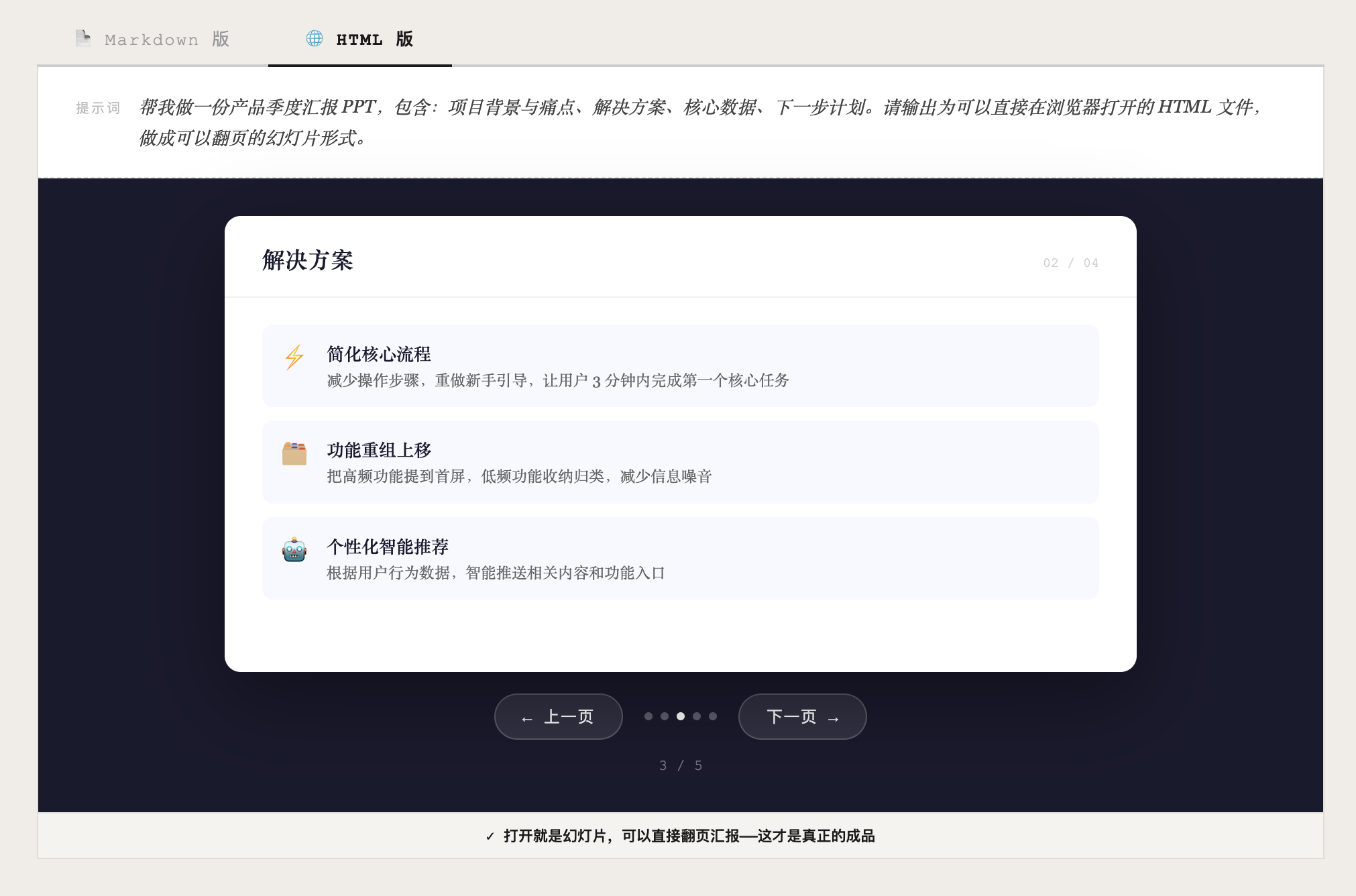
(Image Source: Leikeji Infographics)
Additionally, as mentioned earlier, we are now in the Agent era. We must consider not only collaboration between humans and AI tools but also between AI and AI. One Agent generates content, another receives and displays it, or directly pushes it to users. In this chain, HTML can flow seamlessly and be used immediately upon opening.
However, Markdown's current uses are far more extensive than imagined. Take the classic example: when AI trains, it ingests a large amount of Markdown documentation, such as project descriptions on GitHub, technical blogs, and various open-source documents, mostly in Markdown format. So AI is naturally familiar with Markdown's structure and understands it most smoothly. Many developers also prefer to share their tips in Markdown format, making it easier for other developers to directly feed them to AI.
Therefore, just because HTML is more suitable for most ordinary people's needs to 'get perfect results' in the Agent era doesn't mean Markdown should be abolished. They each have suitable scenarios and usage methods.
Markdown or HTML: That Is the Question
After all this discussion, as ordinary users, should we choose Markdown or HTML when requesting Agent output? It's simple: just consider whether the result is for yourself or to be shared with others.
Take this travel guide example: you ask AI to organize a three-day itinerary for Kyoto for your own use. Markdown is simple and direct, with all information listed clearly, making it easier to read. In this case, forcing AI to output HTML would yield almost no difference from the Markdown version, as HTML's design capabilities are useless here, and the prompts would be harder to write—purely redundant.
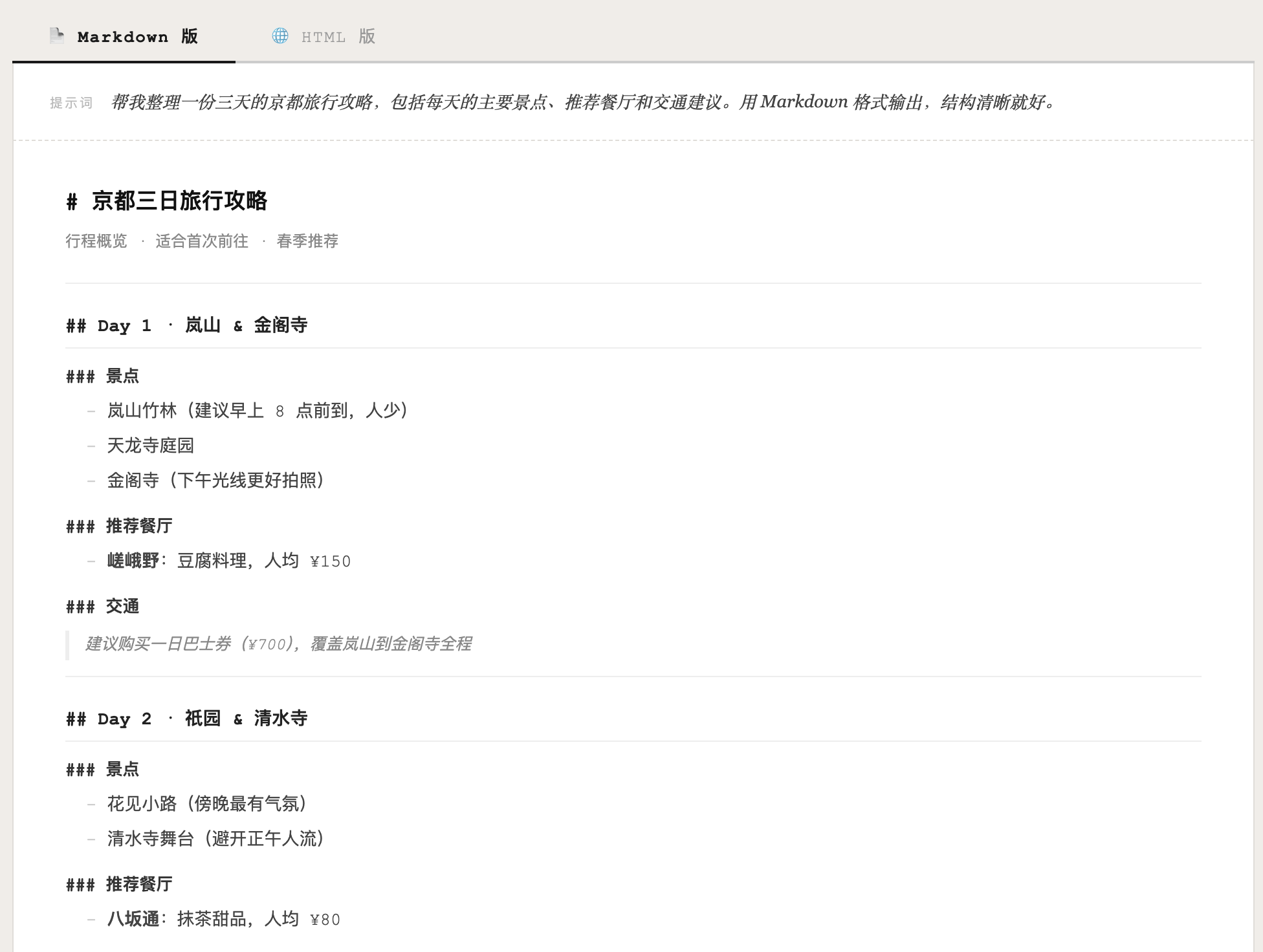
(Image Source: Leikeji Infographics)
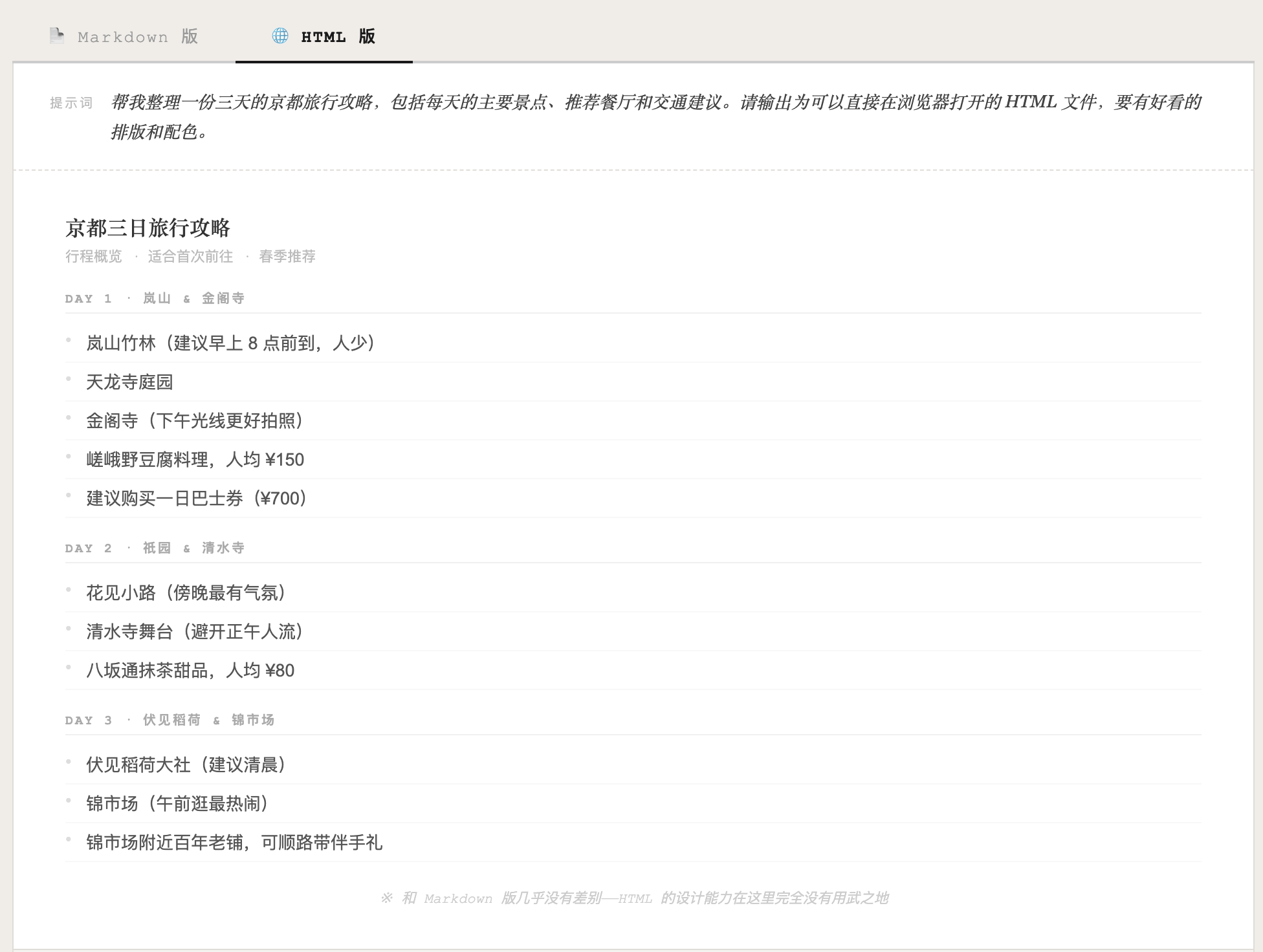
(Image Source: Leikeji Infographics)
If you're sharing it with others, especially in formal settings, HTML works much better. For example, a weekly work report in Markdown can only rely on Emoji to distinguish status, which might seem casual when sent to a leader. The HTML version, with green, yellow, and gray colors for clear visibility and progress bars indicating completion percentages, puts on a good show.
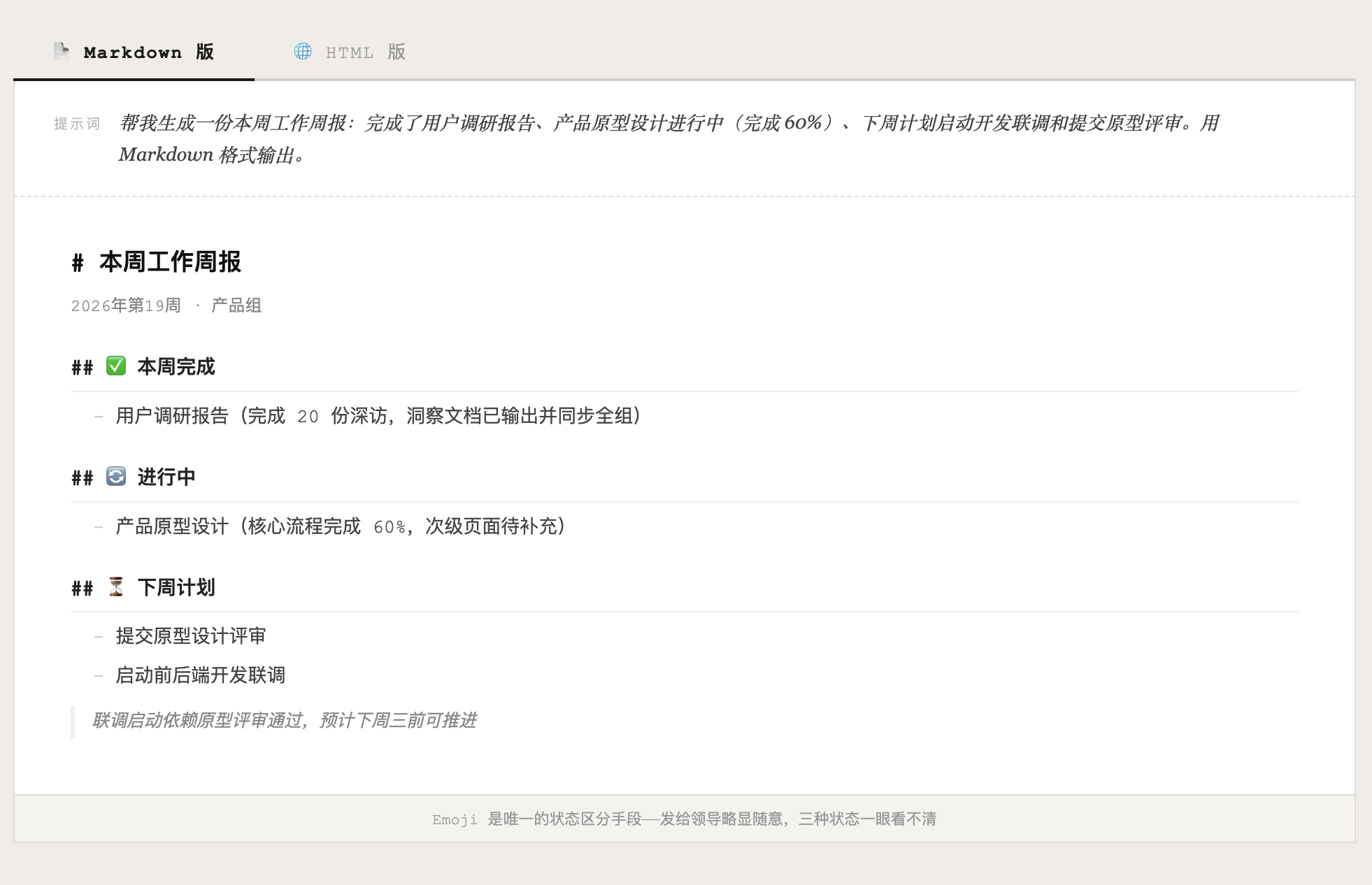
(Image source: Drawn by Leikeji)
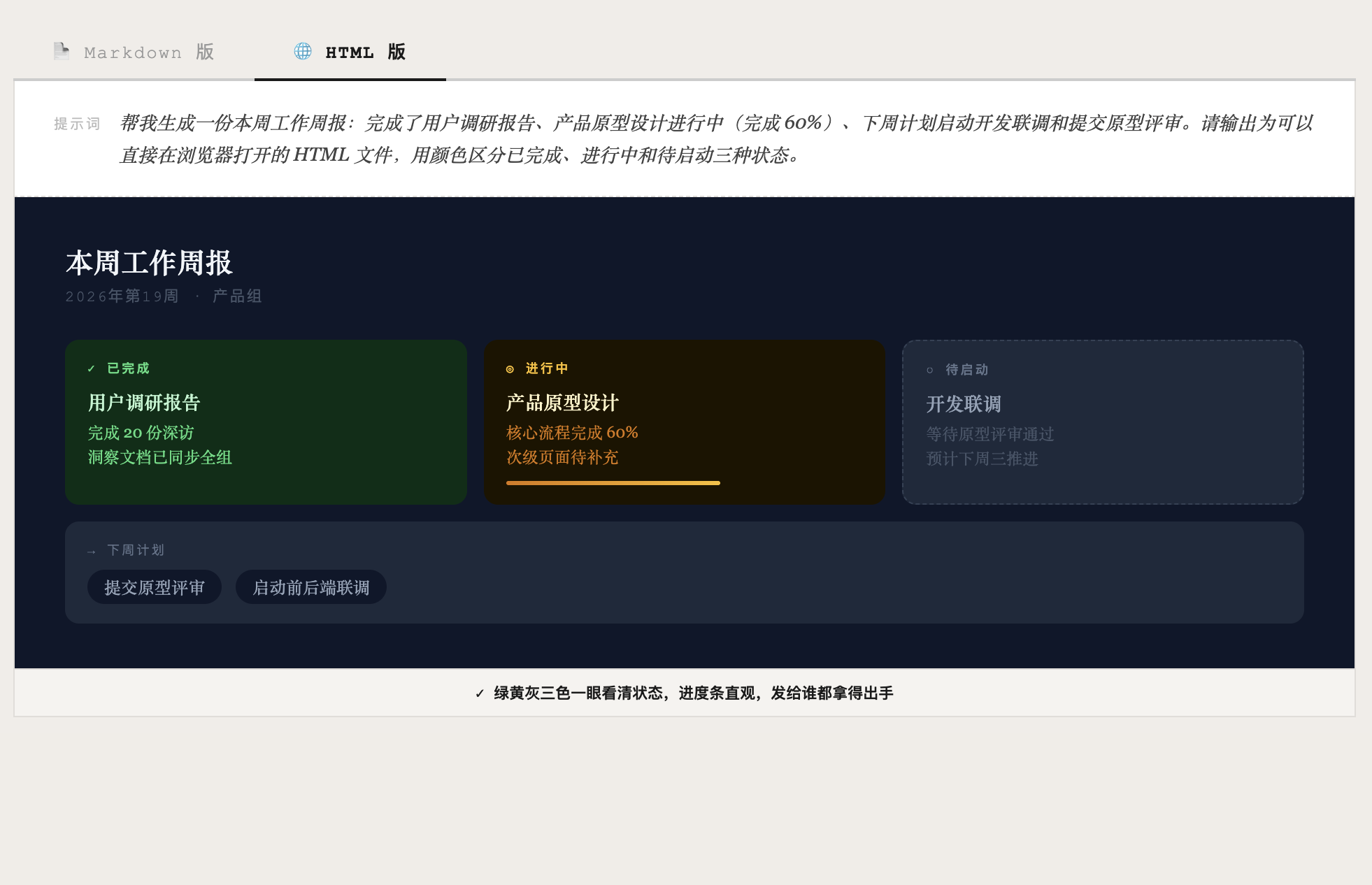
(Image source: Drawn by Leikeji)
Another criterion is whether you need the output to be visually "well-formatted." If you only care about the information itself and don't mind the formatting, Markdown is the way to go. However, if you have a clear vision for the entire layout, including color schemes and animations, then HTML is your only option.
Overall, while HTML is strongly recommended by experts as the output format for agents, we should still choose based on our specific needs. Both Markdown and HTML have their own advantages in different scenarios.
OpenAIAnthropic
Source: Leikeji
Images in this article are from 123RF's licensed library. Source: Leikeji
-
![]()
Tesla Restructures Its Balance Sheet
-
![]()
Accelerating the High-Speed Interconnection Upgrade of AI Computing Clusters! JONHON Releases ELSFP External Light Source Optical Connectors
-
![]()
Breaking the overseas blockade of volumetric holographic materials, this optical enterprise secures nearly 100 million yuan in financing!
-
![]()
Why Does Jensen Huang So Openly Praise China’s AI?
-
![]()
"Wudang" Unveiled: Arm China's Next-Gen AI VPU Redefines Video Encoding
-
![]()
From Energy Conservation and Carbon Reduction to AI Decision-Making: GECON East Intelligence and Chery Group Explore a New Green and Smart Paradigm for Automobile Manufacturing
-
![]()
WAIC 2026 Observation | AI Accelerates Towards the Core of Industries, Industrial AI Enters a Critical Phase
-
![]()
Volkswagen China Fires the First Shot in Foreign-Funded 'White Box Delivery'!