Doubling Down on AI: Why Xiaohongshu’s AI Strategy Has Taken a Bold Turn
 05/12 2026
 631
631
By Dou Wenxue
Edited by Ziye
Xiaohongshu, once cautious in its approach to AI, has now significantly ramped up its efforts.
Recently, Xiaohongshu announced a major organizational reshuffle through an internal memo, fully integrating its three core businesses—community, e-commerce, and commercialization—along with its technical infrastructure. Simultaneously, it established the AI division Dots and the Enterprise Intelligence Department, boosting AI investment from both a product technology and organizational standpoint.
Some aspects of this reorganization were anticipated, while others marked a significant departure from past practices.
Though this integration, spanning three major businesses and technical systems, represents the largest management shift in Xiaohongshu’s 13-year history, its underlying logic aligns with previous strategic moves.
Eight months ago, Xiaohongshu merged its e-commerce and advertising commercial departments into a unified commercial division. This latest comprehensive integration appears to be a natural extension of that move, consistent with Xiaohongshu’s long-term strategic vision.

The elevation of AI to a primary strategic priority is a more notable shift in Xiaohongshu’s recent restructuring.
As of now, Xiaohongshu’s monthly active users have surpassed 300 million, with the platform evolving from a pure social platform into a multifaceted hub integrating “content + transactions + advertising.”
Most critically, Xiaohongshu has emerged as the preferred search entry point for many users.
However, despite solidifying its position as a gateway, Xiaohongshu maintained a deliberate, “slow and steady” approach to AI deployment, avoiding aggressive investments or large-scale testing. Most existing AI technologies served to enhance the app’s functionality, resulting in a somewhat slower pace compared to other major internet companies.
It’s not that Xiaohongshu resisted keeping pace with technological trends; rather, AI seemed somewhat at odds with the platform’s emphasis on “authenticity.” Xiaohongshu’s initial advantage was built on genuine user-generated content.
Yet, the true value of a technology lies in how a company leverages it. AI, while unable to replace original content, may assist Xiaohongshu in filtering high-quality content, precisely targeting products and advertisements to users, and integrating its community, e-commerce, and commercialization operations.
The key to overcoming the challenge of “easy inspiration, hard conversion” may lie in AI.
1. Xiaohongshu Suddenly Accelerates Its AI Efforts
Xiaohongshu’s AI deployment has proceeded at a measured pace.
In 2023, following the rise of ChatGPT, Xiaohongshu established an independent large model team, but its initial AI moves appeared exploratory.
It is understood that the core members of this large model team came from the NLP technology team within the advertising business. After its formation, the team launched products such as the AI painting app “Trik,” the text-to-image feature “Moment,” and the AI chat feature “Da Vinci,” all developed based on Xiaohongshu’s ecosystem of visual and textual content.
Entering 2024, Xiaohongshu’s AI strategy expanded beyond its content ecosystem to include self-developed general-purpose large models. In April of that year, reports emerged that Xiaohongshu’s large model team was conducting gray-scale testing of its self-developed general-purpose large model foundation, “Xiaodigua,” within internal products.
Subsequently, in August 2024, Xiaohongshu launched the independent AI app “DianDian,” positioned as a lifestyle search tool. It primarily provided users with vertical-domain answers, such as food recommendations and travel planning, by integrating notes from Xiaohongshu.
In 2025, “DianDian” integrated the DeepSeek large model; the in-app “Ask” feature was introduced, enabling AI to summarize vast amounts of user notes and extract content such as product recommendation lists and usage advice. By the end of the year, the company fully acquired the developer of “DianDian.”
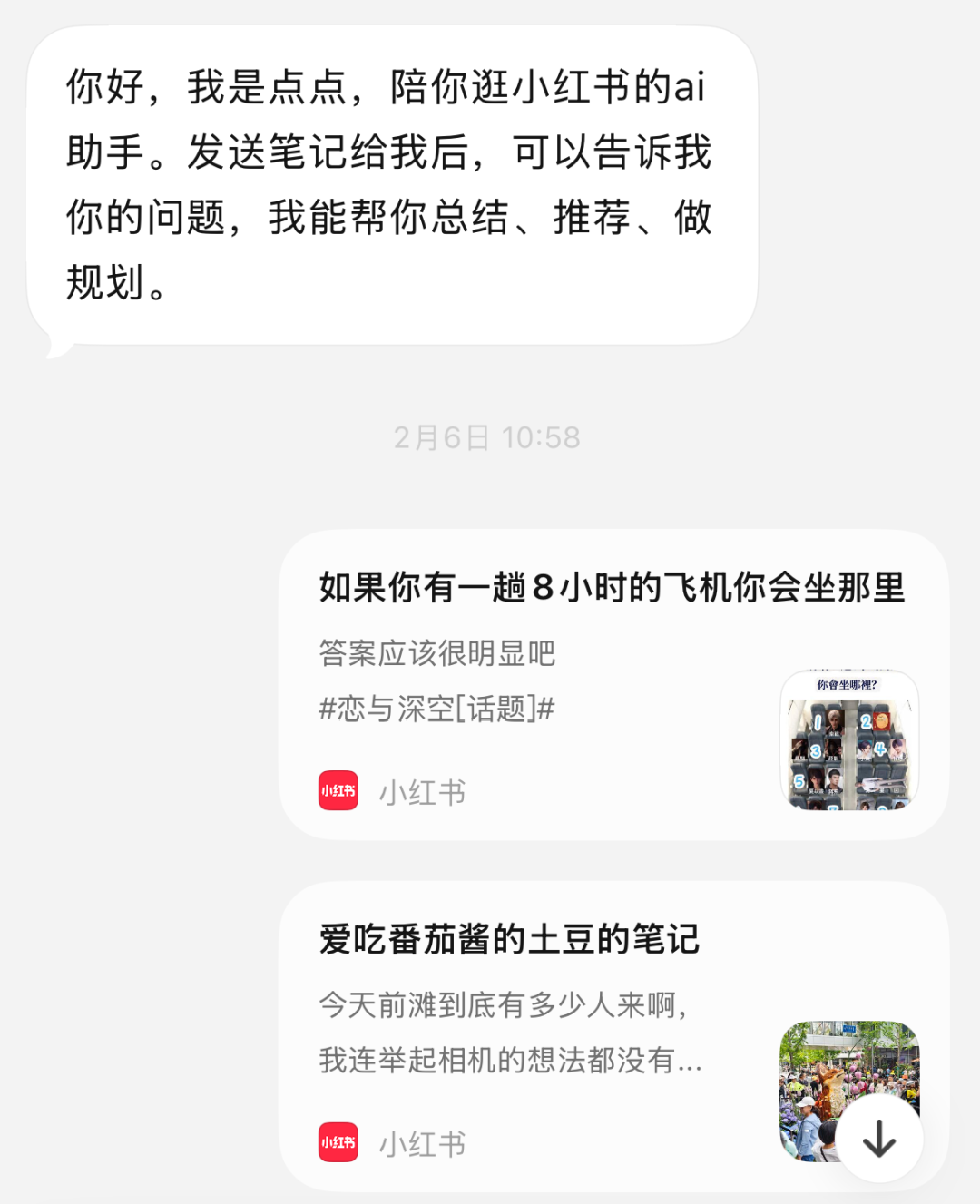
Homepage interface of the DianDian app, courtesy of the DianDian app
Comparing Xiaohongshu’s AI development progress with that of other major internet companies, from 2023 to 2025, the large model industry shifted from rapid iteration and intense competition to a focus on agents and ecosystem development. In contrast, Xiaohongshu’s AI development remained restrained.
Xiaohongshu has long emphasized the “authenticity” of its community ecosystem and may have had concerns about AI’s impact on content, leading to a hesitant stance.
In terms of community ecosystem management, Xiaohongshu has primarily used AI for governance.
Since February this year, Xiaohongshu has issued multiple announcements requiring active labeling of AI-generated or synthesized images, videos, and text content upon publication, and has fully banned accounts where AI-managed delegation handles the entire homepage. The platform also outlined its governance approach to AI content through an AI Governance Open Day event.
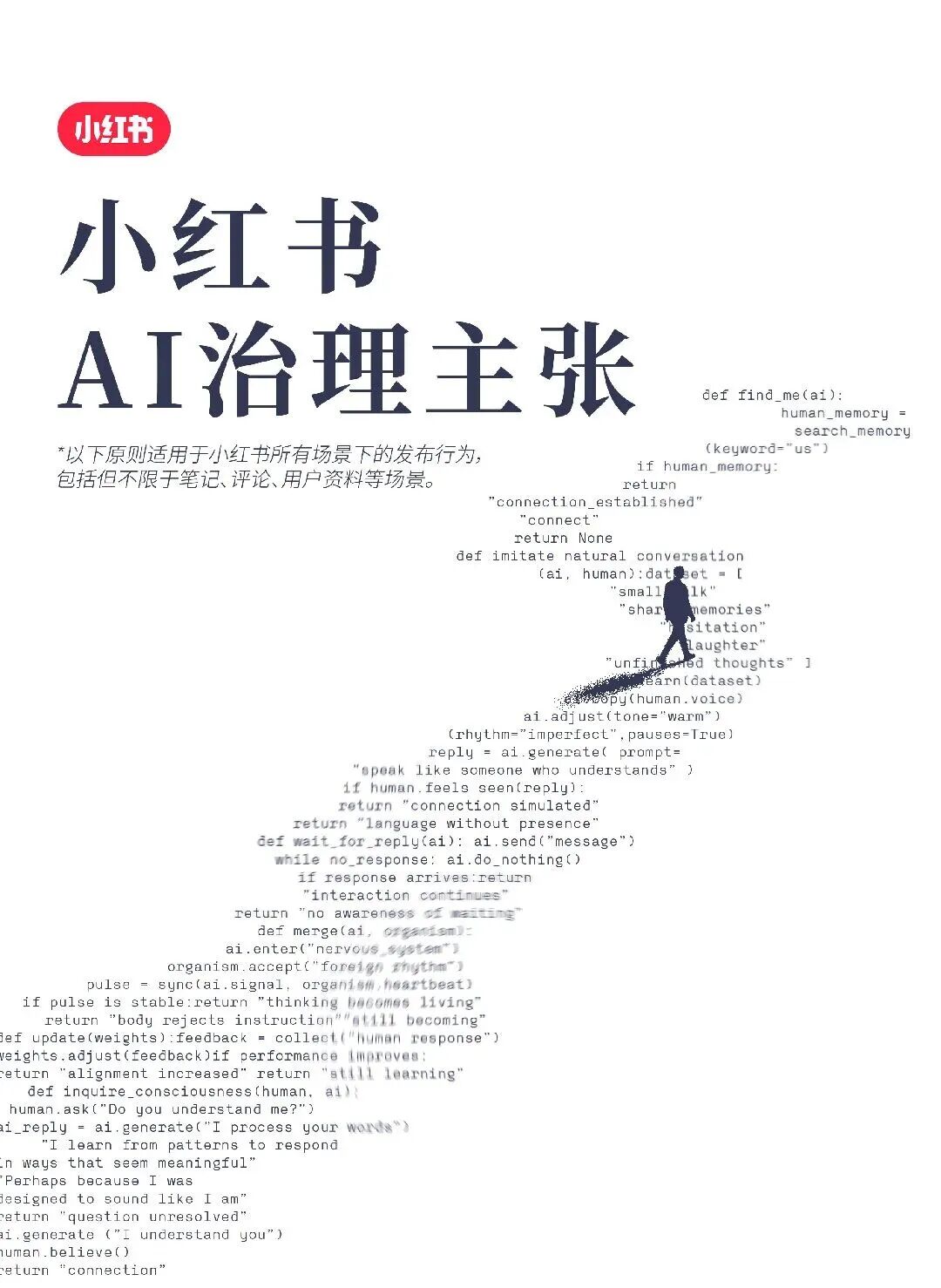
Courtesy of Xiaohongshu’s official WeChat public account
However, in terms of AI research and development, Xiaohongshu has clearly accelerated this year.
In April, Xiaohongshu open-sourced three AI models: REDsearcher (a search agent with 30B parameters, surpassing Gemini-2.5-pro), FireRed-Image-Edit (a multimodal image editor), and FireRed-OpenStoryline (a video creation model). These moves are seen as a crucial step in upgrading from a “content platform” to a “content creation hub.”
The internal emphasis on AI within Xiaohongshu has visibly increased.
According to 36Kr, since March, not only have technical teams frequently organized sharing sessions to impart skill usage insights, but non-AI roles have also been drawn in. Some employees have been required to learn how to build AI tools using vibe coding for integration into workflows and even evaluate their supervisors’ AI proficiency through questionnaires.
Reports also indicate that for the 2026 campus recruitment drive, Xiaohongshu has nearly exclusively opened AI-related positions, with engineers accounting for the vast majority.
With this organizational change, Xiaohongshu has openly declared its intent to “strengthen AI’s strategic position.”
The newly established AI division Dots is a top-tier unit tasked with building a full-stack technical system encompassing model research and development, infrastructure, engineering implementation, and product applications, indicating that AI has been elevated to Xiaohongshu’s highest strategic level.
Additionally, Xiaohongshu’s Enterprise Intelligence Department integrates the existing Enterprise Efficiency Department and Data Science Department, collaborating with the Strategy Department and Organization and Personnel Department to build organizational capabilities suited for the AI era.
It is evident that Xiaohongshu, which had previously proceeded cautiously with AI, is now determined to quicken its pace.
2. Why Was Xiaohongshu Hesitant About AI Before?
Looking back at Xiaohongshu’s strategic priorities in recent years, AI consistently ranked low.
In recent times, the company’s most pressing task has been converting “inspiration” into “conversion” within the platform, i.e., improving its e-commerce operations.
In 2023, while major platforms were intensely competing in the AI large model arena, Xiaohongshu focused on e-commerce. It entered the e-commerce space through a buyer model, extensively recruiting merchants and inviting celebrities like Dong Jie, Xue Jiaoning, Wu Qianyu, and Wu Xin to participate in live commerce.
For Xiaohongshu, pursuing an emerging technology was less important than refining its revenue mix and user experience.
According to previous Bloomberg reports, in 2024, Xiaohongshu’s total revenue exceeded 30 billion yuan, with advertising revenue contributing 21.6 billion yuan, the majority share.
At the same time, although Xiaohongshu achieved a GMV of 400 billion yuan in 2024, there remains significant room for growth in its e-commerce sector compared to other platforms, making it more urgent for Xiaohongshu to concentrate on e-commerce.

On the other hand, AI technology was relatively immature, lacking “authenticity” and prone to generating inaccurate information, especially in responses related to life experiences, where real-life experiences were still superior.
Xiaohongshu’s founder, Mao Wenchao, also stated in an internal letter in August 2023 that people were asking ChatGPT numerous questions related to life experiences, overlapping with Xiaohongshu’s positioning. However, he attributed this phenomenon to the lack of similar experience-based content accumulation overseas, whereas Xiaohongshu boasted a vast amount of authentic life content shared by users.
“Authenticity” is indeed Xiaohongshu’s core label. The genuine reviews written by users, the back-and-forth questions and playful comments in the comment section—these imperfect yet sincere pieces of content represent the community environment and platform tone that Xiaohongshu strives to maintain, forming the basis of user trust in the platform.
AI struggles to replicate this human-centric content ecosystem, and how AI products should be displayed within the community and how they might alter the community layout have been subjects of considerable internal discussion at Xiaohongshu.
According to 36Kr, when integrating DianDian into the community, Xiaohongshu never gave it a prominent placement on the community homepage; instead, it was placed in the fourth column of search page suggestions. At the time, there was even an internal judgment that “AI should not appear in the community.” During the rollout of another AI product, “Ask,” the team also debated “which questions are suitable for AI summaries and the scope of coverage.”
These concerns were not unfounded. Before 2025, few AI products on the market could truly provide “empathetic answers.”

Moreover, technology has never been Xiaohongshu’s strong suit. The company’s self-developed large models have not been prominently featured in its current product ecosystem. DianDian previously integrated DeepSeek, while “Ask” utilized Alibaba’s QianWen large model.
Xiaohongshu’s concerns were valid; being too aggressive in emphasizing AI presence in product interfaces could ultimately degrade the user experience, making it a counterproductive move.
Therefore, while Xiaohongshu appeared to slow down its AI research and development publicly, it was actually seeking the right approach to integrate AI with its community, e-commerce, and advertising businesses.
3. What Can AI Bring to Xiaohongshu?
Xiaohongshu’s decision to elevate AI’s strategic priority within the group is largely due to the positive feedback AI has generated.
The most notable success is the “Ask” feature.
According to 36Kr, management had long worried that AI search would cannibalize users' browsing time on Xiaohongshu, but in reality, these concerns proved unfounded. The “Ask” feature increased community user retention by 2% to 3%, a significant rise for a mature product with a longstanding monthly active user base exceeding 300 million.
Many users do not mind the “Ask” feature appearing at the top of search result pages.
A Xiaohongshu user told Lianxian Insight that she did not notice when the “Ask” feature was introduced but gradually found Xiaohongshu’s AI search very useful. For example, AI would help organize frequently mentioned locations, restaurants, and dishes when searching for travel guides, quality restaurants, or food recommendations. “I usually check the AI-generated section first before browsing posts more targetedly,” she said.
Besides potentially not shortening browsing time, “Ask” has also increased user frequency. According to a former Xiaohongshu employee cited by 36Kr, while users may spend less time on individual questions, their overall usage frequency increases. “For instance, someone who previously asked only one question a week might now ask questions daily, boosting user retention on Xiaohongshu,” the employee said.
Some data also confirms that Xiaohongshu has subtly changed users' search habits.
According to the “Xiaohongshu 2025 Top Ten Search Trends Report,” in 2025, Xiaohongshu recorded a total of 250 billion searches, averaging over 700 million daily searches. Previous data showed that 73% of Xiaohongshu’s monthly active users engaged in search behavior, with nearly 90% of searches initiated voluntarily by users.
These figures indicate that, in the competition for AI-powered consumer entry points, Xiaohongshu has, to some extent, positioned itself at the forefront of users' consumer decision-making chains.
Now, DianDian and “Ask,” which once caused hesitation for Xiaohongshu, are both featured in the Xiaohongshu app interface, and AI’s value in driving growth across Xiaohongshu’s community, e-commerce, and commercialization businesses is becoming evident.
At the community level, AI’s value lies not in replacing authentic user-generated notes but in aiding governance and amplifying genuine voices.
For example, earlier this year, during the “lobster craze,” Xiaohongshu frequently intervened in AI content governance. Some social media accounts fully operated by AI about lobsters squeezed out original content, confirming Xiaohongshu’s previous concerns as valid.
Xiaohongshu may choose not to assist in AI-generated content creation but can establish a dedicated AI department to use AI technology as a safety defense line.
In the realm of e-commerce, considering Xiaohongshu's distinct and refined inherent characteristics (or "genes," which refer to its unique and well-defined attributes), it is difficult to achieve a trillion-yuan business spanning all categories. Nevertheless, AI has the potential to significantly enhance the transaction efficiency of "niche" products, effectively bridging the gap between "inspiration" and "conversion."
For example, when a user searches for "down jacket recommendations" using the "Ask" feature, AI can generate a concise summary based on genuine user experiences. This summary can incorporate product highlights, purchasing links, or live stream links, enabling users to make informed decisions and proceed with a purchase with just a single click.
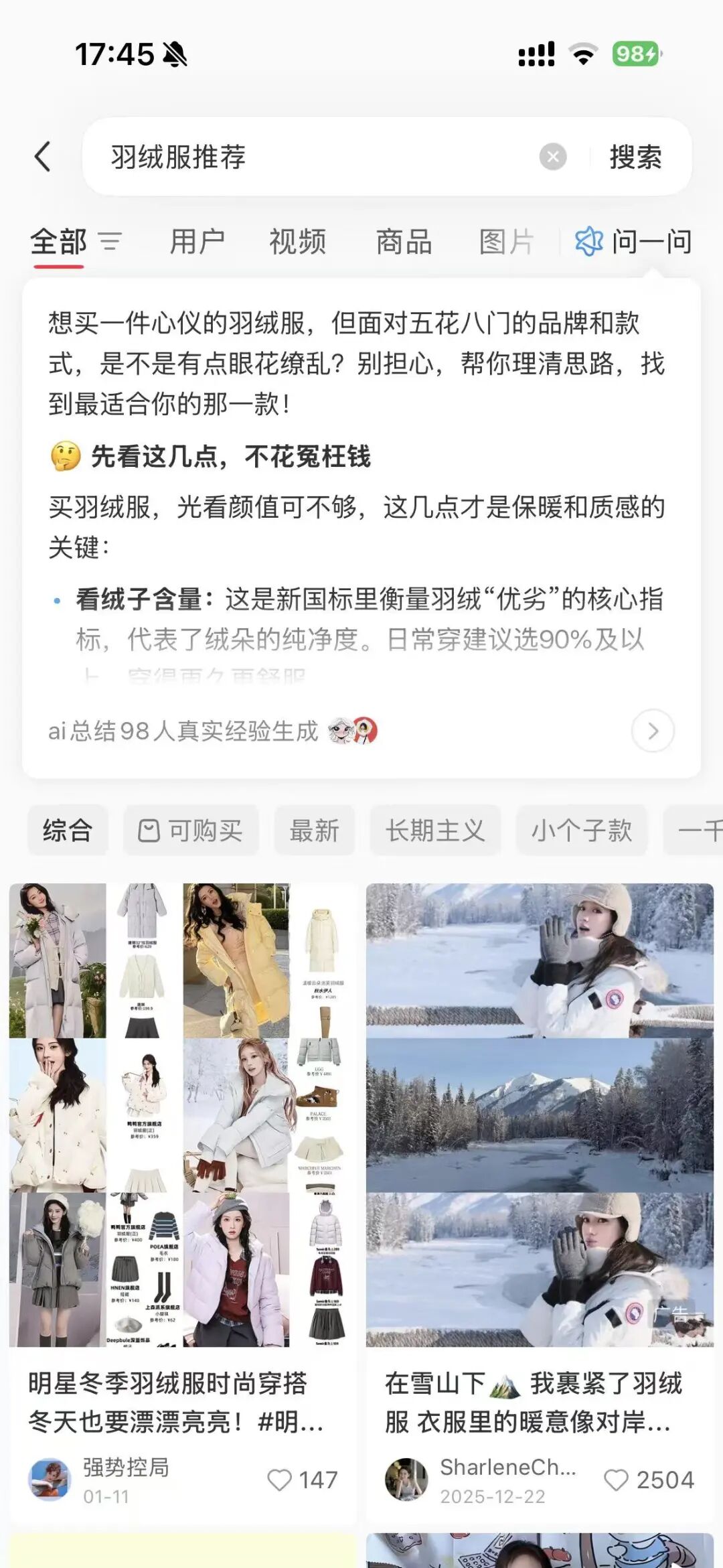
Image courtesy of the Xiaohongshu app
Moreover, tools previously introduced by Xiaohongshu can now work in tandem with AI functionalities to expedite the journey from inspiration to conversion.
For instance, mentioning "Ask" in the comment section of a Xiaohongshu post now results in a summarized version of the shared content. If the post pertains to product or brand recommendations, "Ask" will also incorporate clickable blue links to relevant brand names in its response. Users can then click on these links to explore brand-related posts and products.
From the merchant's perspective, in August 2025, Xiaohongshu announced that its "Lingxi" intelligent insight system would be offered to merchants free of charge. This system assists merchants in refining their product positioning and market strategies. According to official data, brands leveraging Lingxi for refined operations (meaning meticulous and strategic management) witnessed an 83% increase in efficiency in converting I+TI (deeply interested, one step away from making a purchase) audiences compared to the overall average.
Through the integration of AI, a virtuous cycle can be established that connects the community, e-commerce, and commercialization aspects of Xiaohongshu. This represents the most significant potential of Xiaohongshu's AI initiatives.
This time, given market demand, commercialization prospects, and the overall environment, Xiaohongshu cannot afford to delay further in increasing its investment in AI.
(The header image of this article is sourced from the official WeChat public account of Xiaohongshu.)
-
![]()
Tesla Restructures Its Balance Sheet
-
![]()
Accelerating the High-Speed Interconnection Upgrade of AI Computing Clusters! JONHON Releases ELSFP External Light Source Optical Connectors
-
![]()
Breaking the overseas blockade of volumetric holographic materials, this optical enterprise secures nearly 100 million yuan in financing!
-
![]()
Why Does Jensen Huang So Openly Praise China’s AI?
-
![]()
"Wudang" Unveiled: Arm China's Next-Gen AI VPU Redefines Video Encoding
-
![]()
From Energy Conservation and Carbon Reduction to AI Decision-Making: GECON East Intelligence and Chery Group Explore a New Green and Smart Paradigm for Automobile Manufacturing
-
![]()
WAIC 2026 Observation | AI Accelerates Towards the Core of Industries, Industrial AI Enters a Critical Phase
-
![]()
Volkswagen China Fires the First Shot in Foreign-Funded 'White Box Delivery'!