Exploring the Distinctions Between Alibaba and ByteDance in AI-Driven E-commerce: The Comprehensive Integration of Qianwen with Taobao
 05/12 2026
 523
523

Alibaba has taken another stride forward in its AI-powered shopping initiative.
On May 11th, Qianwen achieved full integration with Taobao.
Back in January, Qianwen held a product launch event and had already begun collaborating with Taobao and Taobao Flash Sales. This advancement encompasses two key aspects.
Firstly, while only a select range of product categories were initially tested, the complete integration now enables the Qianwen app to directly access Taobao and Tmall's extensive inventory of over 4 billion products. Equipped with agent capabilities for order processing, logistics, and after-sales services, it offers a comprehensive e-commerce experience.
Secondly, on Taobao's messaging page, the Qianwen AI shopping assistant is automatically pinned at the top, effectively establishing a two-way integration. When users search with keywords, an AI assistant icon appears on the right side of the search box, which can be clicked to access the assistant.
Just over a month ago, Doubao similarly integrated the entire transaction chain of Douyin E-commerce.
Previously, users were redirected to open Douyin to complete payment and place orders. At that time, clicking on product external links in Doubao was akin to being redirected to Douyin E-commerce through other platforms, providing a relatively uniform and straightforward experience.
With Qianwen's full integration with Taobao, it's worth delving into the differences between Alibaba and ByteDance in their approaches to AI-driven e-commerce.
I experimented with the process from conversation to order placement using both Qianwen and Doubao.
Currently, neither Qianwen nor Doubao aggressively promotes transactions during conversations; both are primarily passively triggered.
Sometimes, they even seem overly passive.
For instance, when I inquired, "I've just arrived in Chongqing and feel a bit tired. Can you recommend some foot massage services?"
In this scenario, the user has a clear need.
Qianwen utilized AutoNavi's services to recommend several specific businesses, but clicking on them only led to the map entry points without any product links. Doubao had a similar approach, providing a list of foot massage shops with prices and features mentioned, but also without product links.
Some of these shops do offer packages that I've seen on AutoNavi Maps or Douyin Group-buying.
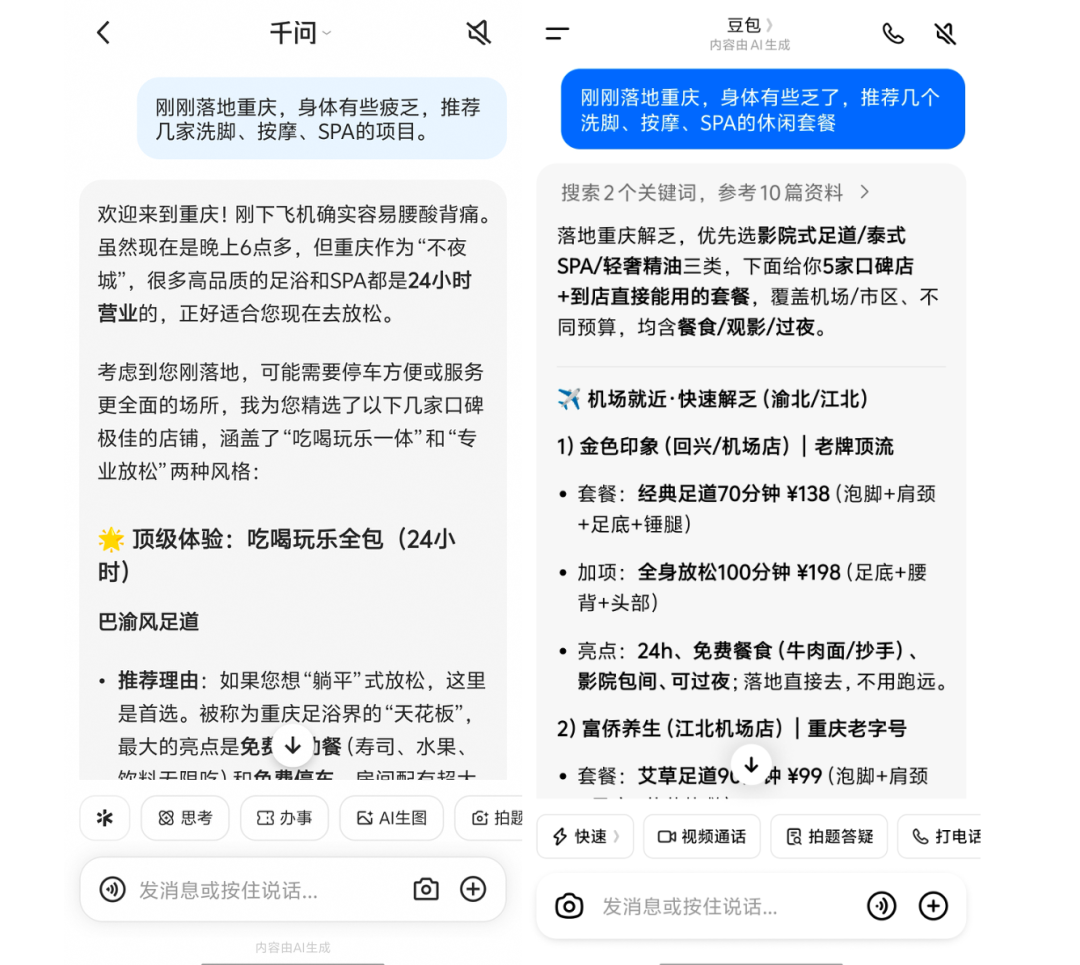
Even if you directly ask the AI about strategies for purchasing certain types of products, product cards often don't appear in the responses.
I find this perplexing because the AI responses already include specific brands and models. At this point, not including purchase links—is it to deliberately emphasize the neutrality of the responses, or is it due to technical difficulties causing unstable model outputs?
Qianwen and Doubao exhibit significant differences in their shopping interfaces.
When you click on a recommended product in Qianwen, the Taobao page occupies about 4/5 of the space, with the previous conversation page remaining at the top.
Thus, when users shop using Qianwen, they always know they are within Qianwen, and they can conveniently return to the conversation by clicking on the top area.
In Doubao, however, once you click on a recommended product, the new page is entirely taken over by Douyin Mall. Just by looking at this page, you can't discern whether you're in Douyin or Doubao.
This is because, although shopping in AI applications is now fully integrated, basically all page UIs are repurposed from existing versions—Qianwen repurposes Taobao's, and Doubao repurposes Douyin Mall's.
I use "basically" very precisely here because Qianwen has another distinction. During the most crucial payment step, it presents a UI animation clearly indicating that Qianwen is assisting you in placing an order on Taobao.
Regardless of whether this process involves any technological sophistication compared to actually placing an order on Taobao, or if it's just unnecessary complexity, at least Qianwen is making a concerted effort to establish an impression of AI-driven shopping.
Moreover, placing an order through Qianwen creates a complete AI shopping loop that starts and ends with a conversation.
No matter how many steps you go through from clicking on a product recommendation to completing the transaction, Qianwen will always return to the initial conversation interface after payment.
After returning to the conversation interface, Qianwen will initiate a self-directed Q&A session.
"Qianwen, I've confirmed the order information. Please place the order for me." "Okay, your order has been successfully placed. You can view the order details in the card below."
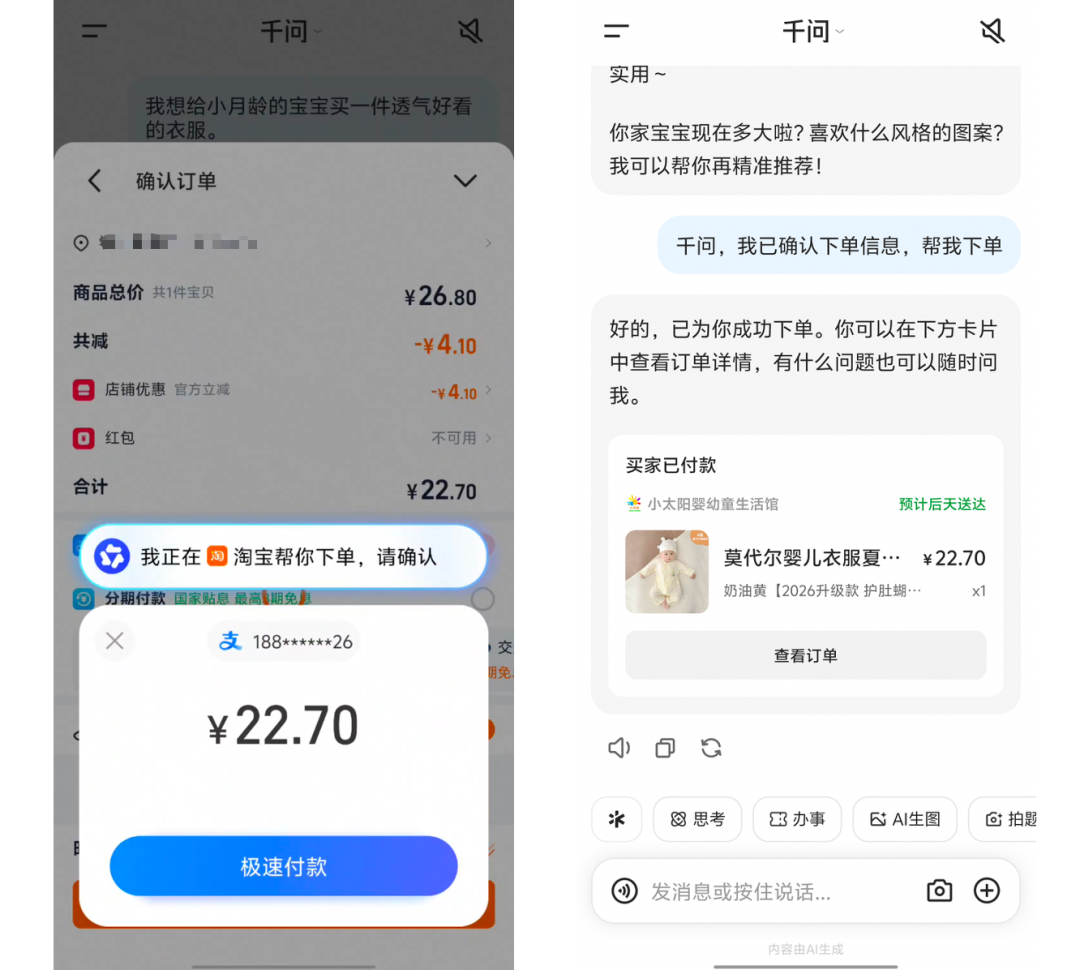
Formally speaking, this is indeed unnecessary complexity. I've already paid, so why go through this charade? It's purely performative.
But again, this is still reinforcing the perception of AI-driven shopping and the impression that Qianwen can assist you in placing orders.
Doubao is entirely different from Qianwen in this regard. After order confirmation in Doubao, you need to keep returning to the previous page until you finally reach Doubao's main page. There's no automatic redirection mechanism, nor a quick return button.
Thus, after purchasing something in Doubao, the page remains on the mall's order completion page, making users more likely to continue browsing other products and potentially leading to more transaction opportunities.
I tend to believe that the differences between Qianwen and Doubao in their shopping processes are not merely UI choices or differences in product managers' preferences but reflect the differing levels of conviction in the narrative of AI-driven shopping between the two companies.
Alibaba believes more strongly in the narrative of AI-driven shopping, while I think ByteDance is less convinced at this stage.
When Pinduoduo's market value caught up with Alibaba in 2023, Jack Ma, although retired for some time, still posted on the internal network to encourage employees. The most crucial sentence was: "The era of AI-driven e-commerce has just begun. It's an opportunity and a challenge for everyone."
Jack Ma didn't specify how to proceed, but if the founder believes in this judgment, he will be willing to give new entry points more autonomy and opportunities for trial and error.
These designs by Qianwen do seem a bit deliberate and more about form than substance. But from a strategic perspective, these forms are part of the purpose itself.
Qianwen doesn't just aim to complete a transaction; it's repeatedly training users to form a perception that shopping can start and end with an AI conversation. Payment, orders, and after-sales are all underlying capabilities that Qianwen can leverage.
Doubao doesn't follow this approach, not due to technical issues, but because ByteDance doesn't believe in this narrative as much yet, so Doubao more closely adheres to transaction efficiency and e-commerce conversion logic.
When Doubao fully integrated with Douyin E-commerce previously, there was actually a lot of external attention, but the official response was rather indifferent.
Doubao integrated the e-commerce transaction chain within its app in March, but this was not mentioned on Doubao's official WeChat public account, Xiaohongshu account, or Douyin account.
You'd think I would consider AI-driven e-commerce far more important than one-click PPT generation or interviewing a few entrepreneurs, but Doubao just didn't mention it.
This seems strange, but if you understand Doubao's AI-driven e-commerce as a channel to facilitate transactions on Douyin E-commerce, it makes sense.
Doubao has a much larger user base than Qianwen, but its position within the ByteDance ecosystem seems currently less significant than Qianwen's within Alibaba.
Doubao surpassed 100 million daily active users by the end of last year with the lowest promotion costs in ByteDance's history. However, 36Kr reported that there were internal voices at the time expressing concerns that "Doubao's monetization path is still unclear, and the reasoning costs for its large DAU also put certain pressure on the company's profits."
When ByteDance secured the Spring Festival Gala partnership, it was under the title of Volcano Engine, not led by Doubao.
In contrast, Qianwen received tens of billions in marketing spending in a single month during the Spring Festival, with financial support and ecological resources readily available, wanting to integrate with whoever it chooses—a level of treatment not on the same scale.
Of course, this doesn't mean Alibaba's approach is the right one.
I personally would never initiate AI-driven shopping on my own, and I'm more inclined to believe that even if the AI-driven shopping model is valid, it will rely on existing platforms rather than a separate path like Qianwen's.
When form outweighs substance, the chances of achieving results are not high. Fortunately, for Alibaba, this doesn't pose much risk.
-
![]()
Why Does Jensen Huang So Openly Praise China’s AI?
-
![]()
"Wudang" Unveiled: Arm China's Next-Gen AI VPU Redefines Video Encoding
-
![]()
From Energy Conservation and Carbon Reduction to AI Decision-Making: GECON East Intelligence and Chery Group Explore a New Green and Smart Paradigm for Automobile Manufacturing
-
![]()
WAIC 2026 Observation | AI Accelerates Towards the Core of Industries, Industrial AI Enters a Critical Phase
-
![]()
Volkswagen China Fires the First Shot in Foreign-Funded 'White Box Delivery'!
-
![]()
AI Agent Smartphones: The Next Competitive Edge Transcends Large Models
-
![]()
Over 880 Million Yuan Worth of Orders Unveiled, Bidding Launched for Shenzhen Eastern Public Transport
-
![]()
Tesla's Robotaxi Hits the Road: A Monumental Gamble with an Uncertain Future