Mobile Phone Makers: Time to Unveil True AI Smartphones
 05/15 2026
 643
643
Source | Bohu Finance (bohuFN)
Recently, research agencies have unveiled the latest reports on the global smartphone market battleground.
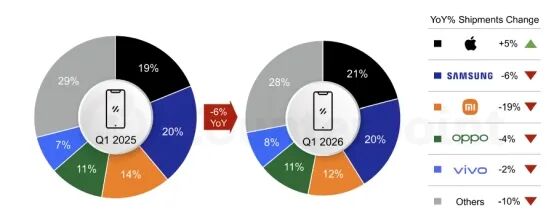
In the first quarter of this year, smartphone shipments witnessed a decline both domestically and internationally. Counterpoint data reveals that the global smartphone market continued to grapple with pressure in the first quarter of 2026, with shipments dropping by 6% year-on-year, halting the upward trajectory seen over the past ten quarters. The domestic market mirrored this trend, with IDC data indicating that smartphone shipments in the first quarter stood at approximately 69.01 million units, marking a year-on-year decrease of 3.3%.
For manufacturers, even the slightest shift in the tides can feel like a monumental burden. Under the dual pressures of supply and demand, all of the top five global manufacturers in the first quarter, except Apple, experienced a downturn.
To compound matters, challenges loom not only in the present but also on the horizon.
Since last year, leading model manufacturers have significantly accelerated their push for AI applications. Despite varying approaches to on-device AI, there's a rare consensus that AI phones represent the pinnacle form for implementing this technology.
ByteDance has emerged as the frontrunner. After collaborating with Nubia last year to launch the Doubao phone, blogger "Smart Chip Insider" revealed that the second-generation Doubao AI phone is slated for release in the first half of 2026, featuring a core upgrade to the fifth-generation Snapdragon 8 Supreme Edition. Based on previous leaks, the second-gen Doubao AI phone will continue to be a joint venture between ByteDance and Nubia, with the latter handling design, manufacturing, and supply chain, while ByteDance focuses on developing the "Doubao Phone Assistant 2.0," deeply integrating large model capabilities into the operating system's core.
According to leaks from Tianfeng International Securities analyst Ming-Chi Kuo, OpenAI also plans to venture into the phone market, collaborating with MediaTek and Qualcomm to develop mobile processors, with Luxshare Precision serving as the exclusive system collaboration design and manufacturer. Mass production is anticipated in 2028.
While AI is not yet a primary driver of consumer purchasing decisions, it will undoubtedly usher in disruptive changes in human-computer interaction, potentially reshaping the entire hardware landscape and traffic distribution logic.
Mobile phone manufacturers must swiftly roll out genuine AI phones that offer superior experiences and capabilities.
01 What Defines an AI Phone?
Recently, official standards for artificial intelligence terminals, including smartphones, have been introduced.
Terminal intelligence is categorized into four levels: L1 Response Level, L2 Tool Level, L3 Assistance Level, and L4 Collaboration Level. L1 can only comprehend simple commands, L2 can execute simple multi-step operations, L3 can understand complex intentions and proactively serve users, while L4 Collaboration Level will be further refined in subsequent revisions based on industry development.
From a practical standpoint, the AI capabilities of most smartphone manufacturers currently fall within the L1-L2 range.
For instance, when the Honor ROBOT PHONE made its debut late last year, the manufacturer emphasized its integrated autonomous interaction, action capabilities, and high-definition imaging functions. Similarly, when promoting the AI capabilities of its annual flagship Find X8 series, OPPO highlighted features like AI One-Click Flash Notes, Memory Search, and Personalized Q&A.
So, how can we grasp the implications of the L3 definition? Here are two examples.
The first is the Doubao phone.
The technical preview version of the Doubao Phone Assistant is an AI assistant based on the Doubao large model, developed in deep collaboration with smartphone manufacturers at the operating system level. It can truly understand and operate the phone to complete tasks, akin to a human.
In the demo video, users can simply issue verbal commands, and the phone can automatically invoke different apps to execute a series of complex operations, such as price comparisons, dining reservations, and itinerary planning. This mirrors the AI phone concept mentioned by iPhone 16, or even surpasses it in power.
Counterpoint analysis indicates that while the error rate remains relatively high for tasks involving multiple applications and complex semantics, the Doubao AI phone excels in understanding user intentions and coordinating across multiple apps for complex tasks.
The second example is Xiaomi's Miclaw.
Following the popularity of lobsters this year, Xiaomi also introduced a phone-related lobster feature. As a smartphone manufacturer, Xiaomi's Miclaw is not a third-party software but operates as an integral part of the operating system. Officially, it has API-level access to over 50 native system tools, enabling it to read and understand information on your phone and provide proactive services, akin to a "butler."
For instance, most people receive numerous text messages daily, some useful and some not. You can ask Miclaw to summarize important messages and unsubscribe from spam marketing texts. Similar to OpenClaw, it can also automatically generate news briefs and other functions.
Simultaneously, Miclaw can integrate with Xiaomi's ecosystem, providing a physical extension for the phone. For example, you can directly use Miclaw to control smart home devices. Miclaw can also monitor and manage smart home devices, making real-time decisions based on the current context.
While it's challenging to predict the mature form of AI phones, based on market products, they should at least possess the following characteristics:
First, a system-level GUI Agent capable of understanding human intentions and solving problems;
Second, the ability to possess global memory based on on-device models, providing services tailored to your personal characteristics, i.e., self-learning;
Third, multimodal perception capabilities to offer proactive services;
Fourth, a powerful on-device model as support, enabling efficient utilization of computing power.
02 Is it Inability or Unwillingness?
While the market often attributes the emergence of Doubao phones to inaction by smartphone manufacturers, it must be acknowledged that manufacturers face their own compelling reasons.
Large model manufacturers develop phones primarily out of their own needs. For instance, in the current environment, smartphones are the most crucial and largest-scale mobile terminals, and only phones can provide comprehensive smart agent services.
However, for the entire mobile internet, the approach of large model manufacturers in developing phones is somewhat controversial.
The most typical example is cross-app invocation, which is highly sensitive to app developers. For the latter, user data, traffic entry points, and content ecosystems are fundamental to their business models. Once these elements are reduced to mere "data," not only will the commercial moats of large companies be disrupted but also the entire platform-centric internet order.
As a result, Doubao phones quickly faced bans from app developers.
Furthermore, while AI represents the future, it is not currently a primary factor influencing user purchasing decisions. Counterpoint reports show that in 2025, over 30% of global smartphone shipments will support GenAI, up from 20% in 2024, primarily in high-end models. It wasn't until March this year that similar AI capabilities were extended to mid-range phones.
For smartphone manufacturers, ensuring consumer experience and data security is paramount. Apple's CEO-designate, Ternus, clearly stated that Apple never considers simply "releasing technology" but focuses on how to leverage technology to provide outstanding products, features, and experiences for users.
Therefore, manufacturers tend to advance more cautiously in product development.
Besides ecosystems and scenarios, manufacturers also face significant disadvantages in model capabilities. Model manufacturers can invest without regard to cost to compete for SOTA (State-of-the-Art), but smartphone manufacturers lack the capacity to do so. The success of Doubao phones not only stems from its collaboration with Nubia but also from its substantial investment in large models and computing power to create benchmark scenarios.
In April this year, Google released the open-source Gemma 4 series, significantly lowering the barrier to on-device AI deployment through architectural innovation, aiming to better apply AI capabilities in smartphone scenarios.
When it comes to advancing AI phones, smartphone manufacturers are essentially "not unwilling but unable."
03 Conclusion
In the first quarter of this year, structural differentiation in the smartphone market has become increasingly pronounced.
After storage manufacturers prioritized capacity for AI, smartphone memory supply tightened, leading to price increases for terminal devices. Nabila Popal pointed out, "In several emerging markets, phone prices have surged by as much as 40%-50%, severely dampening demand in price-sensitive regions."
The result is a market where Apple enjoys a feast while others scrape by on leftovers.
For the entire industry, AI agent functionality is a crucial tool for breaking the deadlock. For smartphone manufacturers, this could be a matter of survival in the long run.
Some manufacturers are also investing in large model development, attempting to leverage AI to accelerate ecosystem interconnection. A typical example is Xiaomi.
This year, Xiaomi has become more active in large models. In late May, Xiaomi officially announced the open-sourcing of the Xiaomi MiMo-V2.5 series large models and launched the "Trillion Token Creator Incentive Program," offering a total of 100 trillion token incentives to developers worldwide for free over 30 days.
Miclaw represents Xiaomi's significant attempt at AI phones.
On the other hand, collaborating with Doubao has also become an option for some major smartphone manufacturers.
According to leaks, the second-generation Doubao phone may reach agreements with some mainstream app developers, significantly improving product completeness and compatibility. Blogger @Digital Chat Station mentioned in a leak that "Honor is in talks with Doubao, and vivo is also in talks with Doubao. Besides these two, other top 5 domestic manufacturers are also in discussions, with a wave of AI OS and Doubao AI phones on the horizon..."
Regardless of the approach, this means we may see more AI phone products released this year.
Reference Sources:
1. Smart Emergence: Exclusive Interview with Honor AI Expert Li Xiangdong: On-Device AI Direction Has Not Converged, but AI Phones Are the Best Carrier
2. Jiemian News: Is OpenAI Making a Phone?
3. 21st Century Business Herald: Smartphone Sales Slump, Global Smartphone Shipments End 10-Quarter Growth Streak
The cover image and accompanying illustrations in this article are owned by their respective copyright holders. If the copyright owners believe that their works are not suitable for public browsing or should not be used free of charge, please contact us promptly, and our platform will make immediate corrections.
-
![]()
AI Agent Smartphones: The Next Competitive Edge Transcends Large Models
-
![]()
Over 880 Million Yuan Worth of Orders Unveiled, Bidding Launched for Shenzhen Eastern Public Transport
-
![]()
Tesla's Robotaxi Hits the Road: A Monumental Gamble with an Uncertain Future
-
![]()
Ford and Geely Forge New Joint Venture in Spain, Sidestepping Changan and JMC
-
![]()
199 RMB! Godox's First Camera Review: Subpar Photography, Transparent Viewfinder Frame is the Highlight
-
![]()
AI Smartphones: A Modern-Day 'Emperor's New Clothes'?
-
![]()
Yonyou Network: A Company Selling 'Transformation' but Struggling in Its Own Transition
-
![]()
Focus | CCCC’s Takeover of Greentown Comes to Fruition: Why Did the 11-Year ‘Control Without Authority’ Era End?