The Fading Frenzy for 'Lobster': OpenClaw Traffic Plummets, QClaw Nearly Vanishes
 05/18 2026
 572
572

Author | Zimo
In March of this year, OpenClaw quickly became a sensation within the AI community. But just how intense was this craze?
On March 3, OpenClaw's total number of Stars on GitHub exceeded 250,000, successfully surpassing React to become the fastest-growing open-source project in GitHub's history. To provide some context, React took over a decade to reach this milestone, whereas OpenClaw achieved it in less than 60 days. According to data cited by Huaxin Securities from OpenRouter, as of March 15, OpenClaw's cumulative monthly API calls had reached 10.4 trillion Tokens, making it the AI application with the highest Token usage globally.
However, this explosive surge in traffic proved to be short-lived. According to statistics from Feifan Industry Research, OpenClaw's traffic directly halved to 14.2 million in April of this year, representing a month-on-month drop of 50.67%. A series of Lobster Agents derived from OpenClaw also experienced sharp declines in monthly visits, with Tencent's QClaw seeing a staggering 99.19% month-on-month decrease.
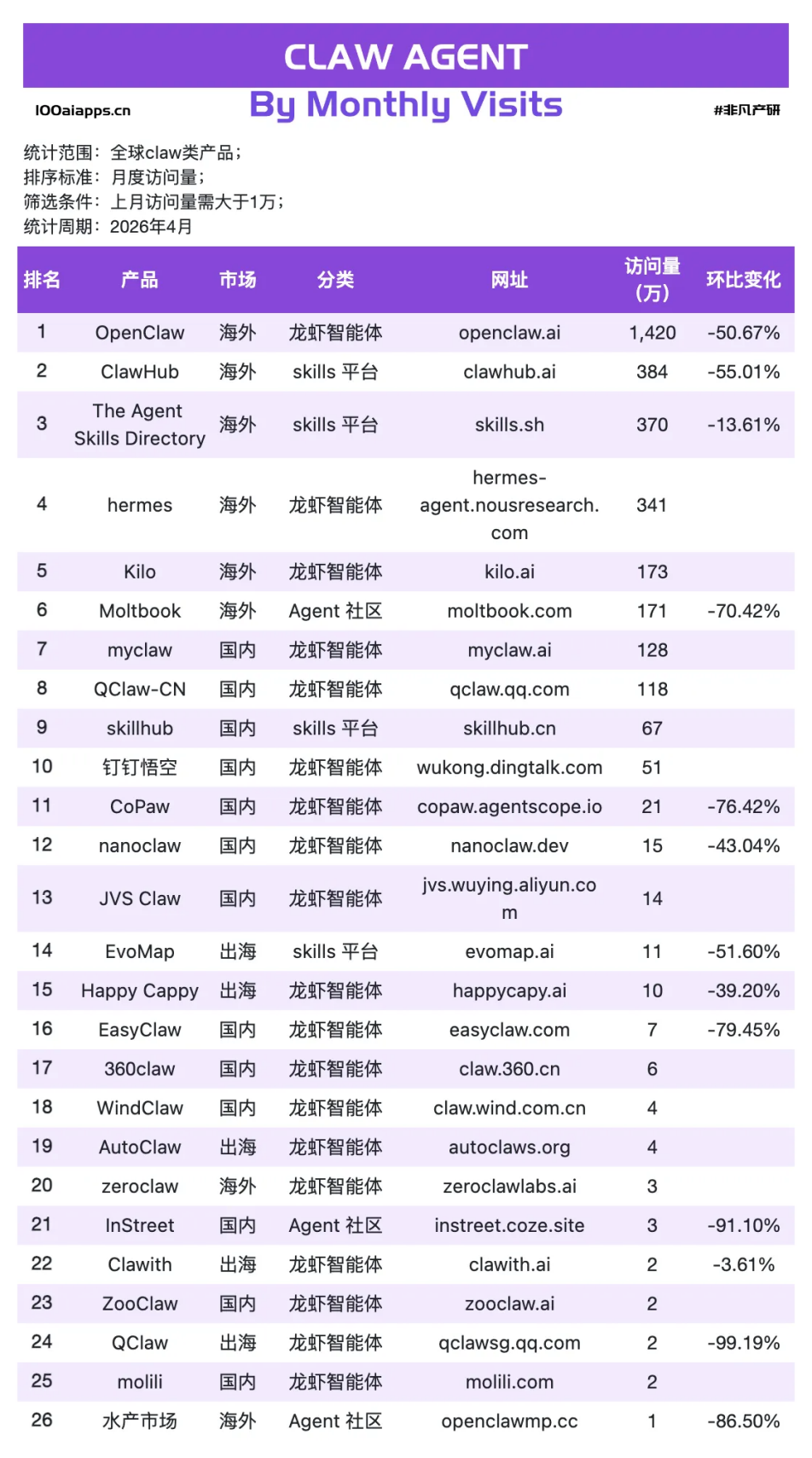
Global traffic for claw-type products in April 2026. Source: Feifan Industry Research
In just three months, 'Lobster' went from being the hottest topic to a fading trend—is it now completely out of favor?

According to Qi An Xin's March report, the first of its kind in China, titled 'OpenClaw Ecosystem Threat Analysis,' OpenClaw deployments in China and the U.S. accounted for over 65% of the global total. At that time, countless people in China were lining up for proxy installations, with conferences and salons popping up everywhere. OpenClaw's WeChat Index soared to 165 million, as everyone eagerly discussed how this 'tool' could enhance efficiency and generate profits.
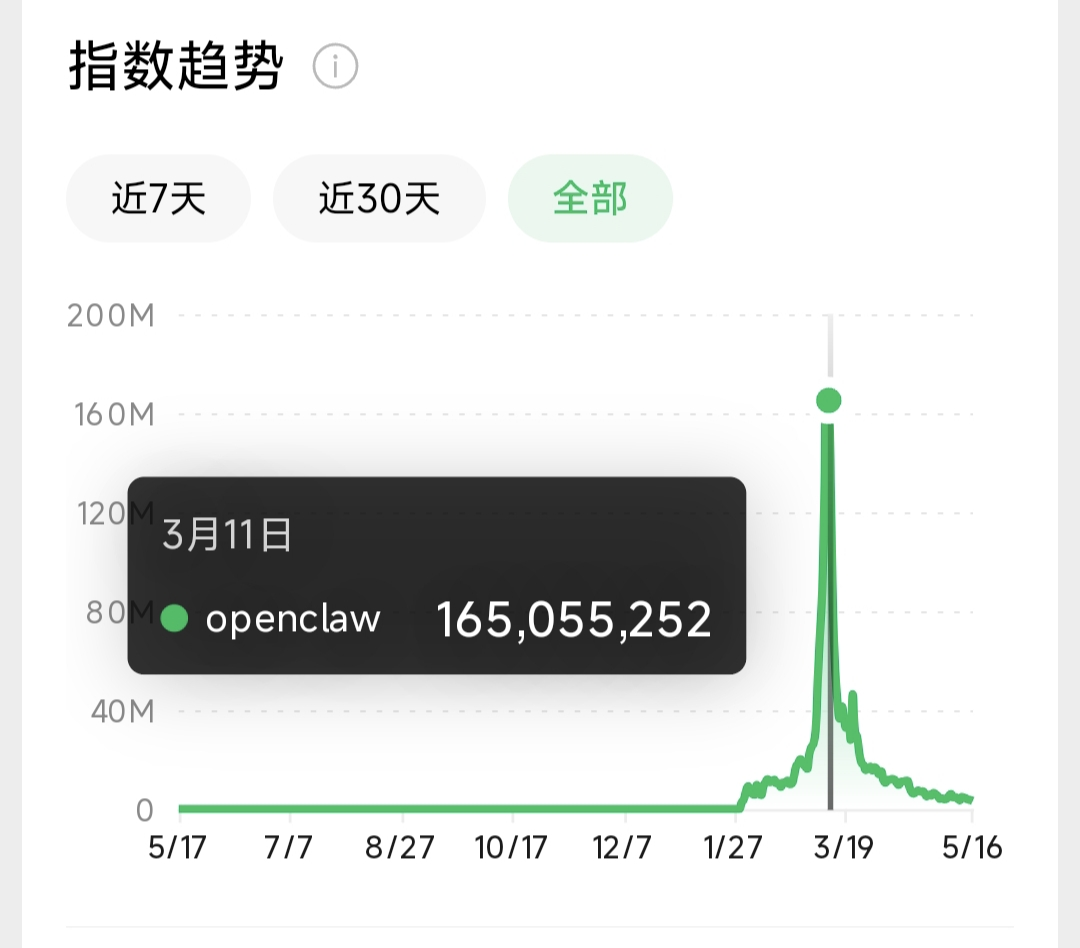
Changes in OpenClaw's WeChat Index
While some voiced skepticism at the time, saying, 'If you need help just to install it, it won't be much use afterward,' their warnings were drowned out by the prevailing hype.
Now, those words have proven to be painfully accurate. As OpenClaw's popularity waned, a chain reaction ensued. Domestic derivatives like CoPaw, nanoclaw, and EasyClaw all cooled off, while Agent communities like InStree saw monthly traffic plummet by 91.10%. The enthusiasm has dissipated, with more and more users abandoning the platform.
The first to leave were the trend-followers who required assistance just to install the software. When Lobster first emerged, claims of 'open-source, free, automated tasks, effortless work, and easy money' abounded, confusing many who didn't realize that using this 'tool' wasn't as simple as chatting with Doubao or DeepSeek—it required technical expertise, with deployment, API calls, and authorization needed after installation.
These ordinary users, who jumped on the bandwagon, now form the largest group exiting. Their main complaint was the time cost—far from saving time, they spent hours learning deployment and debugging, only to label it 'useless.' Others treated Lobster as a social status symbol, installing it to stay trendy and feel 'AI-savvy,' but never found practical use cases. As the hype faded, so did their interest.
Another group exiting were entrepreneurs. During the Lobster craze, the concept of the 'one-person company' surged, with many hoping to use Agents to create digital employees and handle most tasks alone. However, stability issues and high maintenance costs dissuaded them. Lobster became a 'digital burden' rather than an employee, demanding constant Token supplies and manual fixes—a self-inflicted headache.
Even OpenClaw's founders admitted in a post that by late April, plugin migration instability and core architecture adjustments disrupted the user experience for many.
To make matters worse, in early April, Anthropic suddenly announced that its subscription service would no longer support third-party tools like OpenClaw, effective immediately, leaving users just one day to adapt. The sudden cost hike left many users overwhelmed. When entrepreneurs realized that maintenance time, error costs, and Token consumption far exceeded manual labor, the perceived value collapsed, forcing them to abandon the platform.

In just three months, the Lobster market has undergone several shifts, with similar Agents emerging to lower barriers while improving maturity and intelligence. Though unable to halt the decline in popularity, a loyal user base has formed.
Browsing Xiaohongshu, posts with Lobster-related keywords peaked between March and mid-April. Among recent scattered posts, those still using 'Lobster Agents' (a term for all Lobster Agent users) fall into several categories:
1. Technical professionals. Deep AI users with high adaptability, they quickly master high thresholds, using Codex and Claude Code alongside multiple Lobsters across devices for work, entertainment, or chat. 'Initially, they seemed basic, but now I see their potential,' one admitted. Their technical skills allow them to unlock Lobster's true value.
2. Side-hustlers. Unlike entrepreneurs who saw digital employees as 'cost-saving,' these users monetize creativity—generating bulk content for social media via Lobsters, earning from traffic. Some jokes in posts ask, 'Was this comment even written by a human?' Few succeed, but some do.
3. Efficiency-driven workers. Within controlled Token budgets, they deeply integrate Lobsters into workflows—processing emails, orders, reports, and sending briefings automatically. They have real needs and find Lobster-work scenario fits.
Overseas, Lobster's initial users were tech enthusiasts. While the hype faded, it didn't crash like in China. On X (formerly Twitter), tech enthusiasts still dominate discussions, sharing use cases and analyzing products—more technical content prevails.
Thus, Lobster's cooling is essentially a user purification, weeding out blind followers. Facing soaring Token costs, only highly engaged users who truly understand usage and have real needs remain.

Among the retained users, Hermes—seen as an advanced OpenClaw—is frequently mentioned. While OpenClaw excels in execution but feels rigid, Hermes self-reflects and adapts, evolving from a 'one-time tool' to a 'lasting partner.'
For example, after Hermes conducts competitive analysis, it calls search, web scraping, and data analysis tools. Post-task, it auto-generates a Skill file. Next time, telling it, 'Analyze Company X like last time,' it reuses the skill, skipping redundant reasoning.

Now, the community jokes, 'Raising Lobster Agents is out; raising Hermes is in.' OpenRouter data confirms this: on May 9, 2026, Hermes surpassed OpenClaw with 271 billion Tokens consumed daily. This shows that both 'Lobster Agents' and 'Hermes' have clear use cases, with experienced users employing advanced Agents for complex, personalized tasks.
Beyond product evolution, to prove market viability, numerous Lobster Agents deeply embedded in business scenarios have emerged, like DingTalk Wukong for enterprise office use and WindClaw for financial research. They abandon generality, diving into industries, building professional moats through vertical workflows—a challenge for generalists like OpenClaw. Though less visible publicly, their utility is validated in niche circles.
Looking back, Lobster's early explosion was superficial hype, drawing eyes but little depth. Now, it's settling into the deep waters of practical application. Despite user churn, heavy users who truly value it remain.
These survivors 'evolve' with Lobster, moving beyond shallow trials to niche scenarios, pushing Agent capabilities. Though uneven, with precise value-need alignment, Lobster Agents retain resilience.
(Header image generated by AI)
-
![]()
Focus | CCCC’s Takeover of Greentown Comes to Fruition: Why Did the 11-Year ‘Control Without Authority’ Era End?
-
![]()
Final Verdict: The 2026 China Auto Forum Shines with Unique Characteristics at a Pivotal Moment
-
![]()
Tencent Maintains Matrix Approach, Alibaba Merges Entry Points: Tech Titans Initiate AI Agent Consolidation
-
![]()
Geely Secures Portion of Ford’s Spanish Production Capacity
-
![]()
Tesla Stalls This Second
-
![]()
Elon Musk's 'Money-Burning' Spree: All Car Sales Profits Poured into AI
-
![]()
Why Did Tesla’s Profits Drop and Cash Flow Go Negative?
-
![]()
AI Titans Are All in the Red: Time for Intelligent Driving Car Buyers to Reassess?