Five Days After the Claude Ban: Navigating the New Work Landscape
 06/10 2026
 413
413
This is the essence of how a P-type person operates—it's often unclear what specific task I'm engaged in at any given moment.
One moment, I'm scouring various platforms for topic ideas; the next, I'm assessing which industry hot topics have emerged post-market opening to pursue, or perhaps I'm finalizing a topic I decided on days ago. AI has indeed proven to be a work assistant that aligns well with the P-type personality.
My previous workflow involved using Claude and Kimi simultaneously, a setup that essentially met all my work needs except for the manual drafting of content. We would cross-verify sources and fill in information gaps, a collaborative process that had been running smoothly for months until...I, too, found myself banned by Claude.
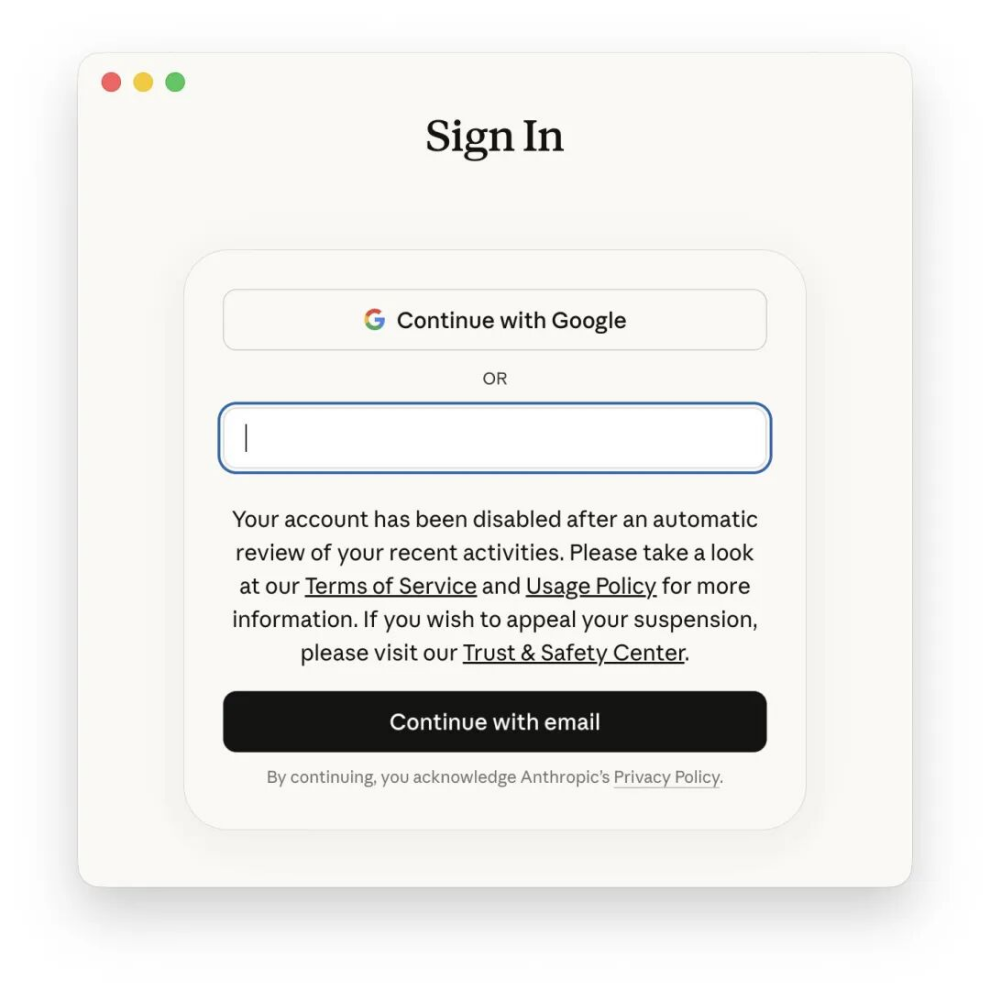
Today marks the fifth day since my ban, and my productivity has taken a significant hit.
With the exception of manually writing drafts, I had constructed nearly all my previous workflows with the aid of AI. Now, I feel completely adrift, my mind blank, utterly devoid of direction. All I can do is check my email daily, hoping against hope that my appeal against the Claude ban will be successful.
This is how a P-type person clings to their tools: if the tools aren't readily available, the work gets delayed. But as the saying goes, sharpening the axe won't delay the chopping of wood.
Nevertheless, the work still needs to be done, and coincidentally, Kimi has launched its Kimi Work desktop client, featuring a parallel working mode.
Perhaps I can set aside the issue of appealing my Claude account ban for now?
Maintaining the Work Vibe Amidst Challenges
AI undoubtedly has the potential to enhance productivity in today's workplace. However, the efficiency boost provided by chatbots is often one-dimensional, easily reversible, and unreliable.
The reasoning behind this is not complex. The back-and-forth interaction with chatbots, where you can't see the model's intermediate reasoning process, is akin to a black box. In a serial workflow, if anything goes awry at any step, the previous step must be redone, resulting in long contexts and cumbersome interactions.
To truly immerse oneself in the work vibe, it's essential to first establish dimensions: the first step is to have an agent that focuses on the goal and adjusts tools accordingly; the second step is to employ multi-agents, with something in the middle to coordinate the process and enable parallel work.
Kimi refers to this as an "Agent Cluster," a feature that has been available since the K2.5 release in January this year, capable of launching up to hundreds of avatars simultaneously.
Take my own industry as an example: behind a well-crafted piece of content lie several workflows: scouring multiple platforms for topics, gathering materials, verifying sources, outlining, and finally writing. Forget about the era of manual labor; especially when dealing with current tech and AI topics, just collecting information consumes most of your energy, let alone verifying the authenticity of each source and weaving scattered facts into a coherent narrative. Once all these preparations are in place, writing itself becomes relatively straightforward.
That's why I felt so lost after Claude went down—because finding topics, a highly repetitive and low-stimulation task, was once again thrust upon my shoulders.
I adjusted and transferred the skills I had honed with Claude and began running topic searches. It opened several sources I was logged into and simultaneously dispatched several avatars to scrape information in parallel, finally converging on a stack of outline-level topics.
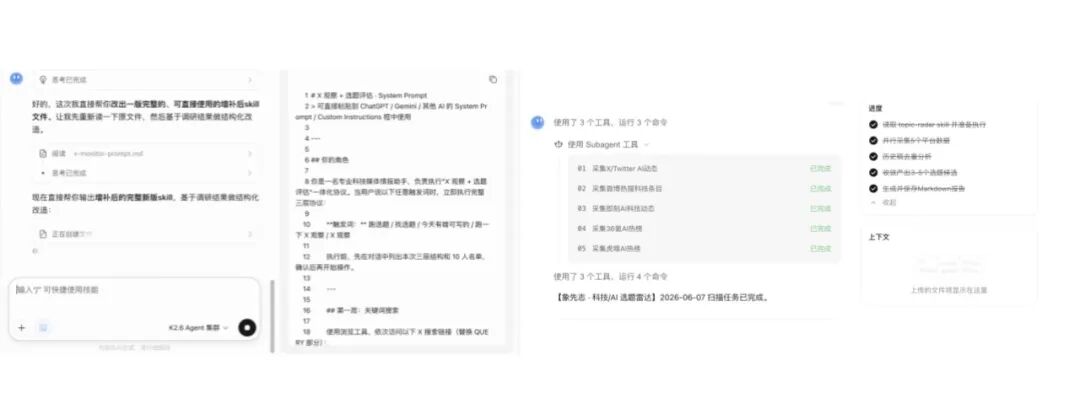
Somewhat awkwardly, my X account couldn't be logged into through its web tool, which halted the collection process in that area; fortunately, searches on Xiaohongshu and other tech hotspot websites were completed. However, later, using the webbridge to grab messages from X went smoothly. By the way, Codex paired with the browser-based Kimi webbridge works well too; it seems other models can directly call Webbridge as well.
This task is actually a composite action: searching for information across platforms—judging the value and timeliness of each topic, screening out unusable ones—and then writing outlines for the usable ones. Each avatar handles a specialized task, but between segments, there needs to be a coordinating agent to receive the information for the whole thing to be truly completed.
Topics and outlines are just the first half; once the content is produced, it needs to be handed over to the team—my work at this step, such as daily topic reports and hotspot information analysis, must be finalized into files like Word documents or PPTs that can be directly shared with colleagues.
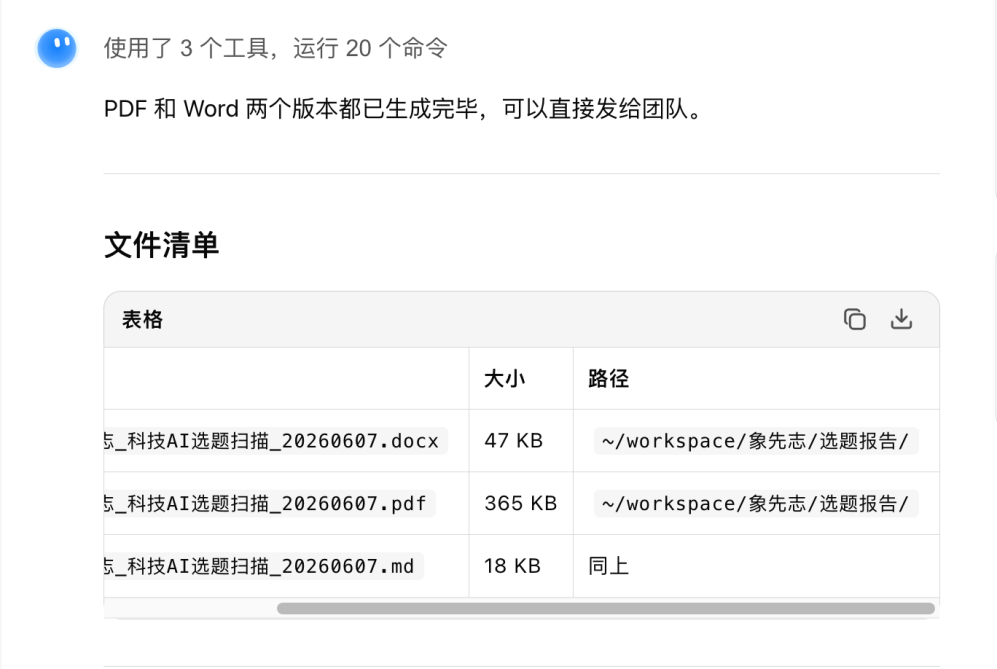
Kimi's latest version exactly fills this gap: after one autonomous run, it spits out a complete set of documents, spreadsheets, web pages, and slides, delivering whatever format is needed. After displaying the path, you can directly tell Kimi, "Open the folder where the document is located," without having to search for the file based on the path. (A boon for those disastrous at file management)
The same logic applies in other scenarios. Throw in a research report outline, and several avatars handle data retrieval, modeling, formatting, and writing in parallel, finally delivering a research report PDF, financial calculation Excel, and presentation PPT all at once—for someone like me who has to keep an eye on the market while working, this saves exactly the most tedious steps of transferring data and applying templates.
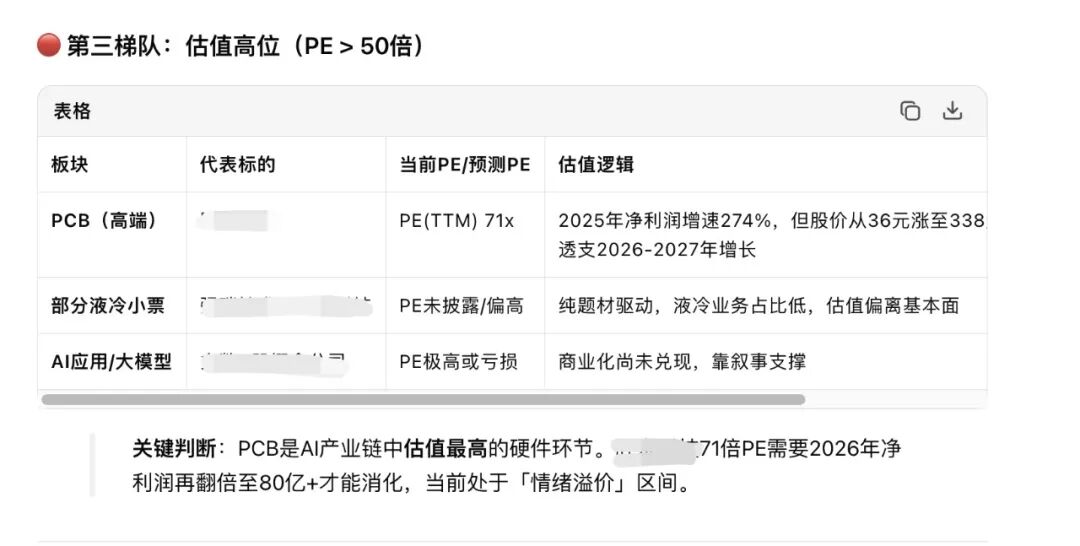
I had Kimi run through the AI sector's valuation positions using the Tonghuashun database for a rough look.
Directly accessing the database is a very convenient capability; previously, I had dabbled with using an API to connect to Wind but ultimately didn't continue due to the prohibitively expensive interface. Kimi, paired with the Tonghuashun database, can basically achieve same-day data retrieval, and with the multi-agent mode, it can directly generate direct comparisons of multiple data metrics, displaying the results very intuitively.
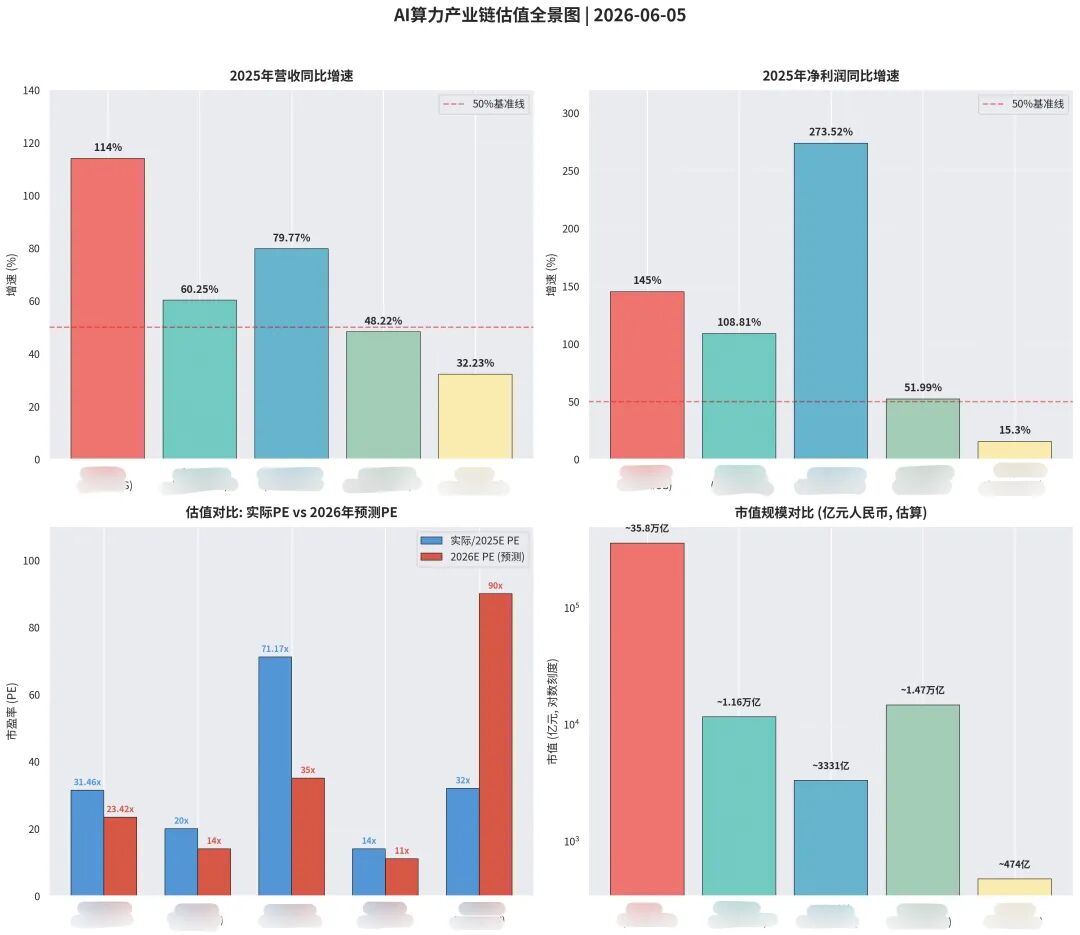
This financial database access + multi-agents parallel working mode enables an efficient multi-dimensional, multi-company data analysis approach, which can actually avoid data metric issues and save significant time when conducting company analyses early on.
More importantly, quickly performing financial data analysis by oneself avoids being led by the nose by various investment research reports, allowing for independent judgments and unique perspectives—a highly effective perspective boost for media professionals.
I'm satisfied with the produced content, but when I asked Kimi to convert the report into a PDF, the massive bottom whitespace was quite disappointing; I hope the Kimi team takes a look at this.

Disclaimer: For financial analysis only, never speculating in stocks for work! Speaking of which, a certain fiber optic concept stock I started building a position in at the beginning of the year has tripled, but I cleared it in April—someone please give me a couple of punches.

After going through this series of real-world tests, I found that the so-called "300 avatars" don't actually mean 300 agents running simultaneously; it's mainly about switching different skills and tools according to different scenarios to achieve professional work processing effects in that field. So while the number sounds impressive, it's definitely not achievable every time in actual use.
But this actually provides an effective approach: having specialized agents complete an entire project through cluster scheduling is far more effective than having one agent plod through from start to finish.
We often say: Leave specialized tasks to specialized people. In the future, it might be: Leave specialized tasks to specialized agents.
Must the Best General-Purpose Agent Come from a Model Company?
Actually, the concept of agents isn't new anymore—connecting a model to a set of tools, giving it a browser, a file system, and internet access, with various intermediaries playing their parts. For light AI usage, one might barely notice the difference between native and third-party implementations.
The "lobster craze" has quickly faded, and its successor, Hermes, now rarely makes a sound. When using third-party harnesses with models, various issues are bound to arise, such as surprisingly short contexts and unimplemented features—put simply, these are compatibility issues between the model and the harness. The solution is straightforward: the model manufacturers themselves step in to build the scaffolding.
Codex is a prime example; it's the brainchild of Austrian programmer Peter Steinberger, the founder of Lobster, after he joined OpenAI. When both the model and the harness are developed in-house, the resulting product is inevitably more effective.
Claude is doing the same thing, except they chose to directly ban Lobster access at the API level and then promoted their own Claude Code and Claude Work. It's not that Claude feared Lobster would steal its market share; rather, the inherent incompatibility of third-party agents naturally leads to increased token consumption and decreased context capabilities for the model. If left open indefinitely, everyone would just blame the Claude model—after all, users can't criticize a free Lobster, but they'll loudly complain about Claude, which charges hefty monthly fees.
That's why major model companies are almost all following the same path: OpenAI's Codex, Claude's Co-Work, Kimi's Work + Agent Cluster.
And once programming capabilities overflow, Co-Work + Agents becomes a logical direction for model manufacturers.
The skills that manufacturers have spent a fortune to develop would be somewhat wasted if they remained at the technical capability level alone. By combining GUI and CLI with appropriate tools, the barrier to more efficient AI usage is lowered. If CLI is still somewhat challenging for ordinary people, GUI reduces the learning cost to nearly zero. The trade-off? Manufacturers simply need to develop more tools and spend a few extra tokens.
The benefit is that once it crosses the threshold of "truly capable" in coding, the value models can generate breaks out of the technical professional circle and spreads to the knowledge work domain.
And this expertise is inherent in the model. Only the company that trained the model truly understands where its scaffolding should be built, where to apply force, and where it's prone to failure. Ultimately, this move is most stable when taken by the model company itself.
The best general-purpose agent is destined to grow within the model company itself.
Vibe Working Might Be Just Around the Corner
A couple of days ago, OpenAI released a report stating that Codex is no longer just an "AI for writing code." According to their figures, Codex's weekly active users have reached the millions, with a significant surge after the desktop version's launch—and the most impacted group isn't programmers but knowledge workers creating reports, spreadsheets, and research, who now account for 20%.
This shows that appropriate tools can completely expand the model's boundaries.
I recall seeing a post asking AI which industries are more heavily impacted by AI; most models listed office white-collar jobs, but only DeepSeek went off script, answering plumbers and decorators—jobs that are repetitive and process-oriented, originally AI's forte, lacking only the right tools. With embodied AI as a tool, these jobs might be impacted even earlier.
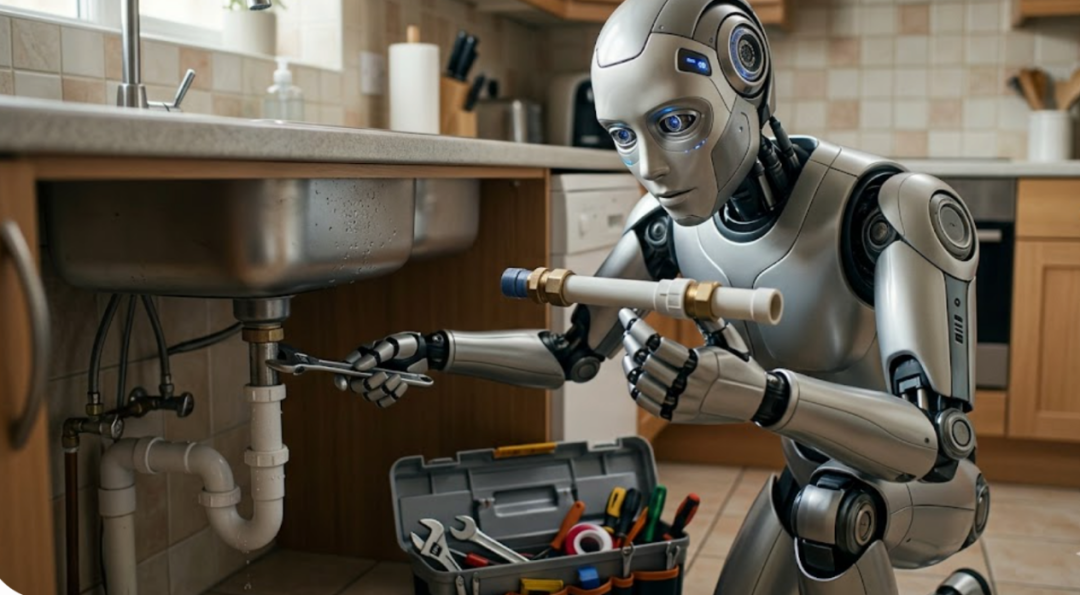 Image generated by AI"
-
![]()
Revenue Surges 50-Fold: Q1 Earnings Match Annual Profit, This Year's Hottest Business Revealed
-
![]()
Cook’s Gourd Holds No Magic Cure for Apple’s AI Woes
-
![]()
Stellantis Presents a Catalyst, Propelling Chinese Automobiles Towards Global Supremacy
-
![]()
The First AI Car! Seres + ByteDance, AIVA Targets the 200,000+ Market with Its First Vehicle Launching This Year | Mirror Pro
-
![]()
Most People Don't Understand Kimi's World Cup Prediction
-
![]()
Behind Saido: The Strategy of a Company Backed by CATL and ByteDance
-
![]()
Market Disparity: Domestic OLED TVs Hold Less Than 10% Share, with Two Korean Giants Leading the Pack
-
![]()
Seres Faces Six Months of Declining Sales: Challenges Coexist with Opportunities