The Battle of Instant Retail: Does Huawei Want Meituan to Win?
 06/10 2026
 354
354
Whoever Buys the Cards is Our Brother
On June 9th, according to sources from Dachang Ribao, Meituan's Core Local Commerce (CLC) underwent an organizational restructuring with the establishment of a new AI Transformation department, focusing on AI to B and AI transformation.
The new department is led by Muyao, the former General Manager of Dianping, who now reports directly to Wang Puzhong, CEO of Meituan's Core Local Commerce, instead of Li Shubin. In other words, this new AI department now operates at the same level as business units such as food delivery and flash sales within the CLC framework.
This indicates that just as the intensity of the instant retail battle begins to subside, Meituan is placing AI at the forefront.
However, the focus may not solely be on how Meituan intends to use AI to transform its food delivery, flash sales, and local services. Once AI is pushed to the front lines of business, another question arises: where will the computing power come from?
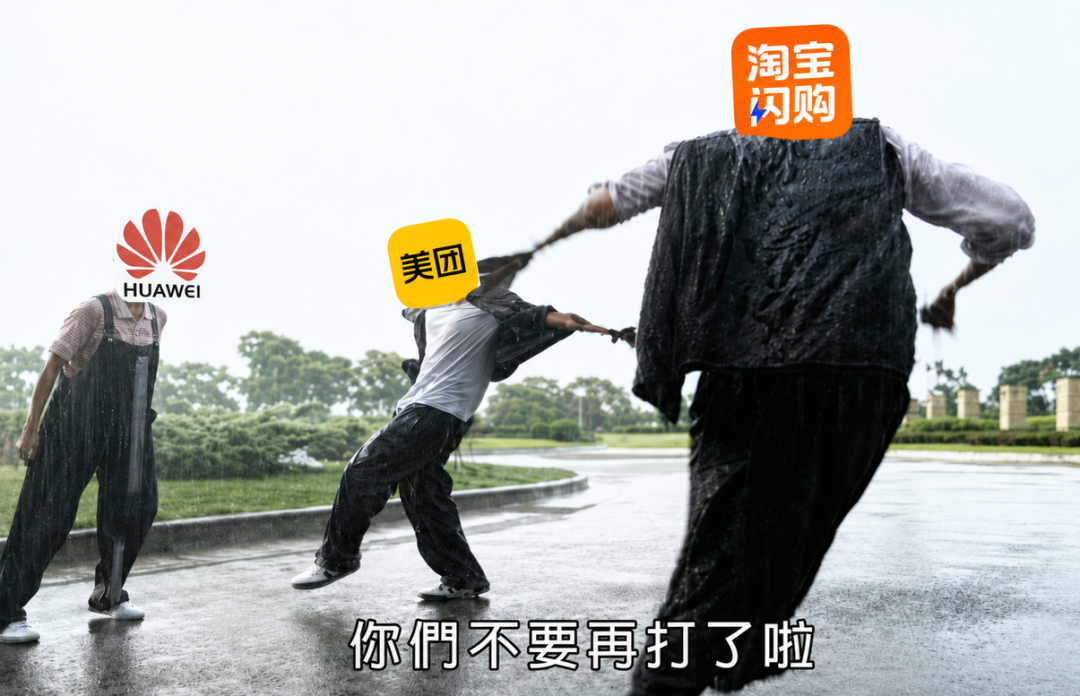
This is precisely why, in this seemingly 30-minute war between Alibaba and Meituan, Huawei might be the one most eager to see Meituan succeed.
01 Wang Xing: A Devout Believer in AI
Meituan's emphasis on AI did not begin with this organizational adjustment.
As early as the Q1 earnings call last year, Wang Xing had already set the tone for Meituan's AI strategy: to attack, not defend. A year later, at a management meeting, Wang Xing stated, "There is no essential difference between mobile internet and the internet, just like roses and peonies; but the difference between AI and the internet is like that between monkeys and flowers."
Wang Xing's two statements are not difficult to understand in the context of Meituan. They imply that Meituan truly believes AI is not just a tool to enhance local services but a means to fundamentally transform the entire transaction system.
Behind food delivery, flash sales, in-store services, and travel are merchants, products, inventory, users, riders, and fulfillment networks. In the end, the battle for instant retail is not just about subsidies but about who can handle more complex supply and higher-frequency demand at a lower cost—a problem that AI excels at solving.
However, statements are just statements. What truly reflects Meituan's commitment to AI is its substantial financial investment.
Since 2023, driven by AI demand, Meituan's quarterly R&D investment has stabilized at around 5 billion yuan after growth. This period coincided with the rapid expansion of flash sales and Meituan's overall prosperity, making it a trendy move among internet giants to invest in AI during this time.
The real change occurred after 2025.
As the instant retail battle intensified, Meituan's profits began to feel significant pressure. In Q2 2025, Meituan's adjusted net profit was only 370 million yuan; it turned into a loss of 18.63 billion yuan in Q3 and 15.14 billion yuan in Q4; by Q1 2026, although the loss narrowed, it still stood at 6.83 billion yuan.
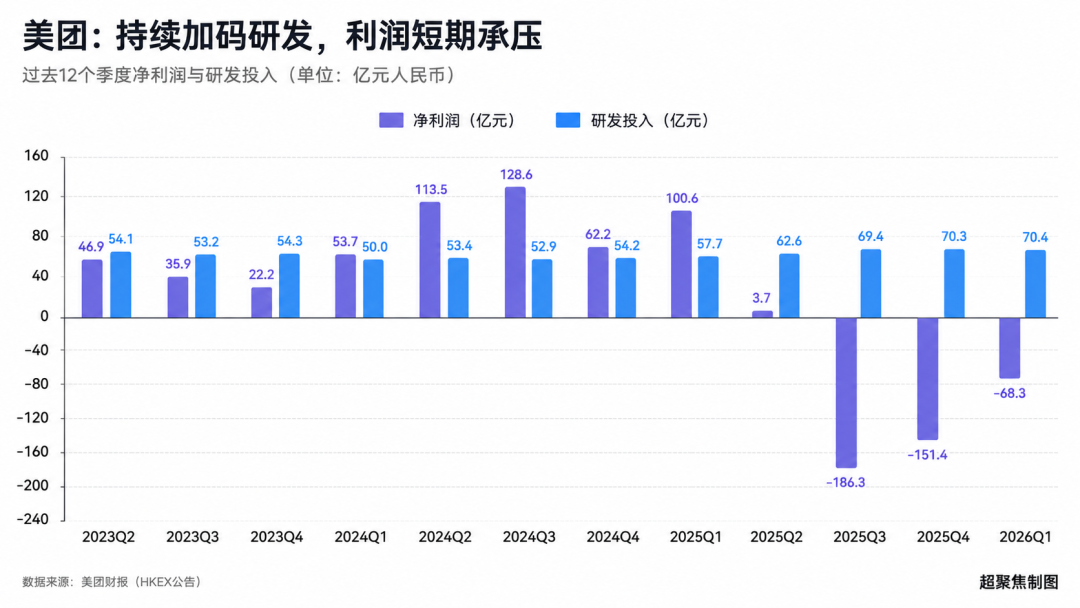
However, the rapid decline in net profit did not affect the pace of R&D investment, which continued to rise: in Q2 2025, Meituan's R&D investment reached 6.26 billion yuan; it further increased to 6.94 billion yuan in Q3; it remained at 7.03 billion yuan in Q4; and in Q1 2026, it was still 7.04 billion yuan.
In other words, during unprofitable times, Meituan became even more willing to spend on AI.
In a sense, this reflects Meituan's attitude toward AI: while spending on subsidies can secure immediate orders, efficiency can only be achieved through systematic improvements, and AI is becoming the most expensive and indispensable part of this system.
In addition to substantial R&D investment, Meituan has also sparked an AI wave internally.
According to previous reports from Shixiang, Meituan is undergoing an AI "Great Leap Forward." Some Meituan employees revealed that AI is highly valued by both Wang Xing and Wang Puzhong, making the promotion of internal AI usage an important strategy for business executives to impress their bosses.
Of course, discussing AI within a large corporation can sometimes feel like a movement. A Meituan mid-level manager told Chaojujiao that AI has become somewhat of a "political task" within Meituan: businesses must find ways to improve efficiency with AI, and management must see which processes have been transformed and how much change has been brought about.
However, many Meituan employees across various business lines believe that Meituan's internal AI capabilities are already relatively mature, not just Staying at the level of slogans (remaining at the slogan level), and have fundamentally changed their work methods.
A Meituan employee surnamed Xiaoliang (pseudonym) told us that content that might have taken three days to produce in the past can now be completed in as little as two hours with the help of an Agent and can be encapsulated as a Skill for reuse. In areas such as customer service, operations, data analysis, content production, and merchant tools, AI can now handle a significant amount of repetitive work, significantly improving frontline efficiency.
In other words, the promotion of AI within Meituan is driven both by top-down pressure and bottom-up practical use. This explains why the AI Transformation department was elevated to a CLC-level department at this time.
However, once AI becomes infrastructure, the next question quickly arises:
Who will provide the computing power for all these AI needs?
02 Meituan: A Fertile "Breadbasket" for Ascend
After Meituan pushes AI to the front lines of business, the first issue it encounters is not models but computing power—this is where Huawei enters the story.
For Meituan, the demand for AI is real, and so is the gap in computing power. Unlike Alibaba or ByteDance, Meituan cannot simultaneously build data centers globally, manufacture its own chips, and digest demand through its own cloud infrastructure. After all, Meituan lacks Alibaba Cloud, Volcano Engine, or a chip foundation like T-Head.
Therefore, to pursue AI, Meituan needs a long-term domestic computing power partner. More interestingly, Huawei also needs customers like Meituan.
For a long time, Huawei's most comfortable business has been with operators, government enterprises, and large clients. However, operator capital expenditures are cyclical, with the "Big Three's" Capex falling from 333.05 billion yuan in 2020 to 285.45 billion yuan in 2025.
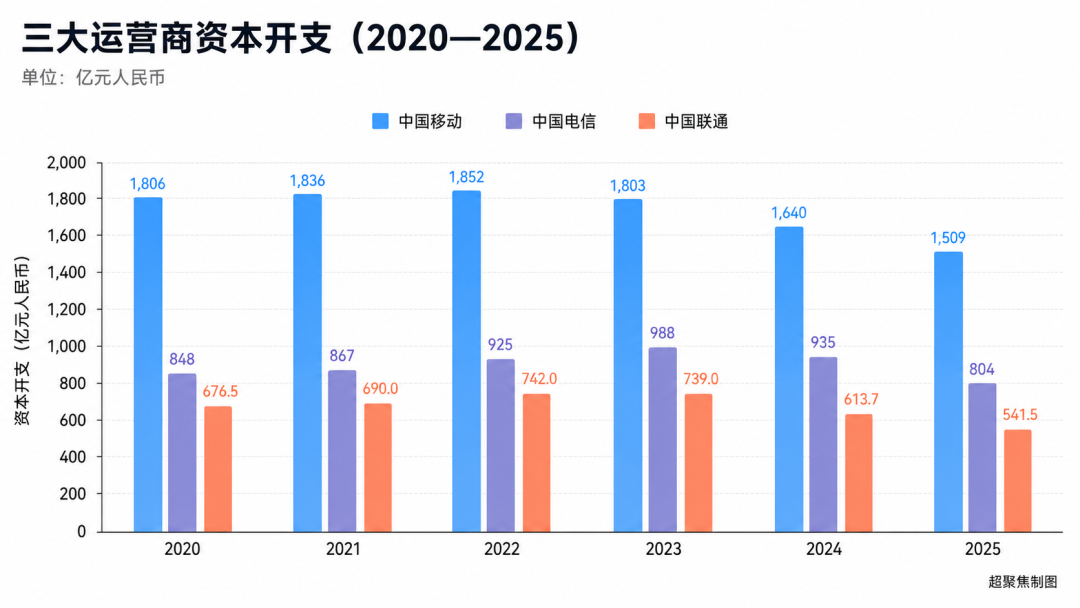
What happens when operators run out of money? Huawei naturally wants to break into the Head Internet (top-tier internet) sector. The problem is, top-tier internet companies are not very receptive.
The story from H100 to H20 shows that when Nvidia cards are available, companies prioritize buying them. When Nvidia cards are unavailable, they may not turn to Huawei but instead try to build their own solutions.
Alibaba is a prime example.
When it comes to computing power, Alibaba has never considered handing over its core assets to Huawei. It has Alibaba Cloud, T-Head, and its own PPU. If Taobao Flash Sales continues to invest in AI, the underlying computing power and infrastructure will inevitably return to Alibaba's own ecosystem.
A source close to Huawei revealed that over the past two years, Ascend has been trying to break into Alibaba, but progress has been slow. Even more awkwardly, with the mass production and sale of PPUs, Alibaba's role in the computing power market has shifted from a potential customer to a competitor, eliminating any chance of penetration.
Although ByteDance has increased its procurement of Ascend amid growing consumption of massive tokens, its ASIC is set to debut in the coming months, indicating a fundamental reluctance to cede strategic autonomy and substantial profits.
In contrast, platforms like Meituan and JD are much more comfortable. They have money, scenarios, genuine AI needs, and a real need for computing power; however, they do not sell cloud services or rush to prove the strength of their AI chips to the market. Their needs are simple: cost reduction, efficiency improvement, and increased fulfillment certainty.
Thus, the collaboration between Meituan and Huawei is like a match made in heaven, sticking together at first sight.
From Huawei's perspective, Meituan winning the instant retail battle means more than just delivering a few extra food orders or flash sales.
The more Meituan wins, the more it needs AI; the more it needs AI, the more computing power it requires; and the more computing power it needs, the greater the opportunity for Huawei to integrate Ascend into China's most complex real-world internet business.
If Taobao Flash Sales wins, the computing power dividends will 100% feed into Alibaba's own technology ecosystem. But if Meituan wins, Huawei has a better chance of securing a seat at the table.
Therefore, in this instant retail battle, which appears to be a 30-minute life portal grab between Alibaba and Meituan, along the hidden computing power line:
Huawei might be the one most eager to see Meituan succeed.
- END -
-
![]()
"Shaking Hands" with WeChat's AI Ecosystem: Didi Paints a New Vision for AI
-
![]()
The Battle of Instant Retail: Does Huawei Want Meituan to Win?
-
![]()
The Success of AITO Underscores Seres' Need for Saido AIVA
-
![]()
Apple's Cook Takes Final Bow: Siri Reimagined, Gemini Steps In, But Capital Markets Remain Unconvinced
-
![]()
Apple’s Cook Bids Adieu: Siri Reinvented, Gemini Joins the Fray, But Are Capital Markets Unimpressed?
-
![]()
Breaking into the AI Computing Power and Low-Altitude Economy Sectors! Tongya Technology Heads for Hong Kong IPO: Tripling Revenue in Three Years, Third in Global Market Share, with Matrix Partners Ch
-
![]()
Will ByteDance’s Collaboration with Saido Follow Huawei’s Footsteps?
-
![]()
Revenue Surges 50-Fold: Q1 Earnings Match Annual Profit, This Year's Hottest Business Revealed