This Generation of Youngsters is Starting to 'Seek AI Guidance'
 06/12 2026
 365
365

The process of applying for volunteer positions is essentially an exploration of one's 'unknown self,' with AI's recommendation logic grounded in matching 'known data.' However, for most 18-year-olds, the question of 'who am I' is precisely what they gradually uncover during the selection process.
Edited by Dr. Qi
In 2026, following the college entrance exams, 12.9 million candidates emerged from the examination halls. After the hugs and flowers exchanged outside the school gates, another, more protracted examination quietly commenced.
Which school to apply to, which major to pursue, and what direction will future life take? This more challenging question is now being profoundly influenced by AI.

Entrusting the First Major Life Decision to AI
Lv Gengqiu, an 18-year-old candidate from Hubei, scored 653 points in last year's college entrance examination. While this score may not seem low, in Hubei's score distribution, it was somewhat awkward as it just barely met the minimum admission score of Renmin University of China the previous year.
Renmin University had always been her dream. Should she pursue it or not? If she did, how should she choose her major? Opting for safety would leave her feeling perpetually one step away from her ideal.
Like many candidates, she was extremely anxious after the scores were released. She scoured almost all available information. Later, in the volunteer application plan recommended by Baidu AI, she discovered a major she had never considered before: Human Resource Management.
"I hadn't even heard of this major at the time," she remarked.
Being cautious, she took this plan to Baidu Tieba to seek advice and inquired with current students at Renmin University of China about the curriculum, career prospects, and the real experience of studying there.
Ultimately, she chose to apply to the School of Labor and Human Resources at Renmin University of China for the Human Resource Management major and was successfully admitted.
Reflecting on this experience, it becomes evident that AI actually served as a new information gateway. AI is responsible for uncovering possibilities, while humans are tasked with verifying them.
Every year, over 12 million candidates in China spend twelve years preparing for an exam but only have a dozen days to decide where to go and what to study for the next four years.
This represents a pivotal juncture of fate under China's college entrance examination system.
The exam itself is fair, but the process of filling out applications has never been equitable.
A candidate in Beijing may have knowledgeable relatives, senior students willing to share experiences, and a family that can afford a professional volunteer planner costing thousands of yuan. In contrast, a child from a county may only be able to rely on their parents and homeroom teacher when facing the same score report, but these individuals may not possess much more knowledge about the process than the child does.
Among the national college entrance examination candidates, 57% hail from county high schools. More than half of the candidates are at a severe information disadvantage when it comes to filling out applications. This information gap translates into a tangible gap in fate.
Over the past two decades, Chinese families have relied on a clear and stable chain of trust for volunteer applications: the homeroom teacher's experience comes first, followed by relatives' reputations, and finally, the admission handbook as a last resort. The essence of this chain is the superposition of a 'network of personal connections' and 'limited experience.'
This system is not scientific, but it has an irreplaceable advantage: the responsible party is clear. This year, this chain is being disrupted by AI.

Major Companies are Betting on It
After the 2026 college entrance examination, Quark, Qianwen, Doubao, Baidu, and Yuanbao almost simultaneously launched or upgraded their AI volunteer application services.
Baidu announced that it would provide free AI volunteer application services to 12.9 million candidates nationwide. Qianwen released a college entrance examination volunteer application agent, also with zero threshold, open to candidates nationwide for free. Doubao also intensively updated its volunteer-related functions before and after the college entrance examination, integrating consulting into the chat dialog box.
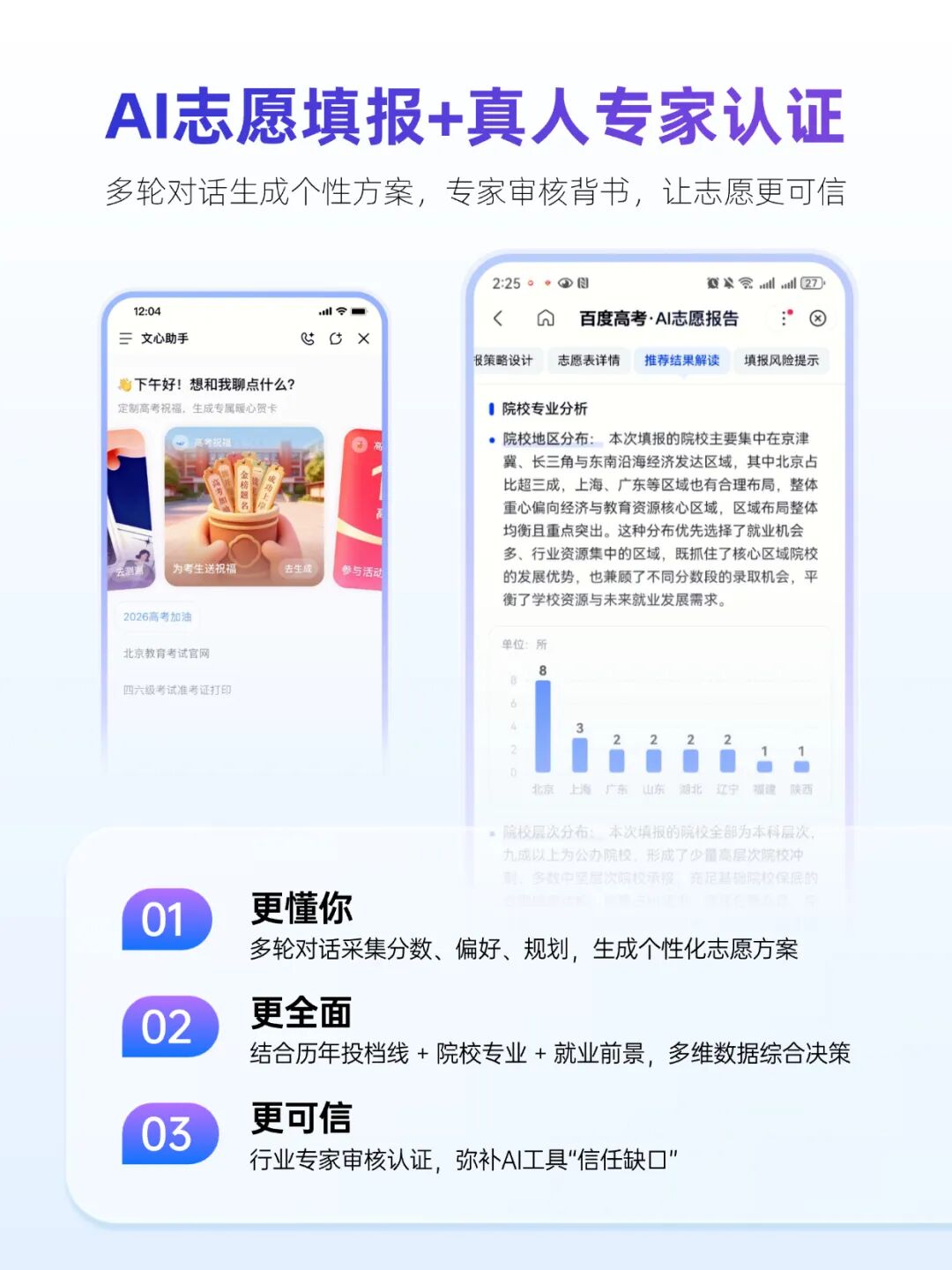
A market that originally belonged to high-priced consultants was collectively infiltrated by major companies this summer.
Volunteer application is almost one of the most ideal application scenarios for AI. It possesses massive amounts of structured data: college admission scores, major employment rates, urban industrial distributions, and the destinations of students with the same scores in previous years. At the same time, it is accompanied by immense decision-making pressure and information anxiety.
For AI, such problems are naturally suited for computation.
How many schools' admission data can a volunteer planner remember? How many families can they serve simultaneously? Can they respond to a query from an anxious parent at 2 AM?
AI can.
From the perspective of information processing capabilities, AI's entry into volunteer application is almost a foregone conclusion.
However, decision-making in the real world is fraught with trade-offs, information asymmetry, and resource competition.
If it were purely a competition of data capabilities, volunteer planners would have already been supplanted by databases long ago.
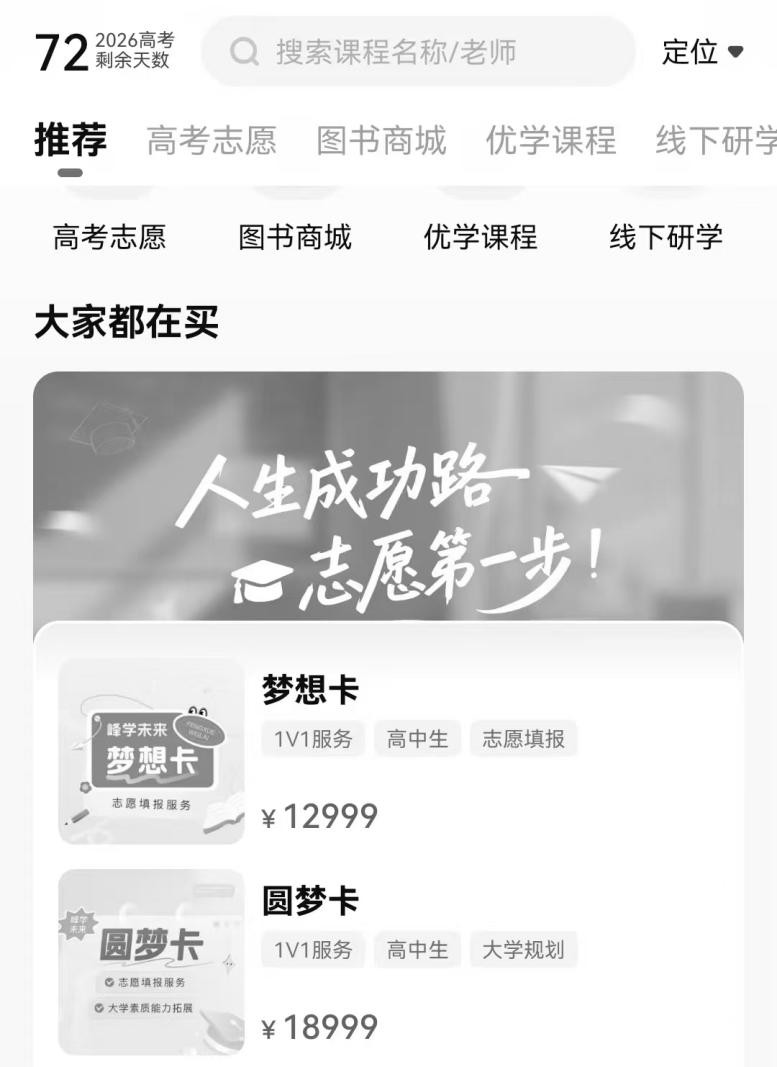
The reality is precisely the opposite. In the 2024 college entrance examination season, Fengxue Weilai's 20,000 service spots sold out in 3 hours, generating approximately 200 million yuan. In 2025, Fengxue Weilai's Dream Card rose to 12,999 yuan, and the Fulfillment Card rose to 18,999 yuan, each increasing by 1,000 yuan from the previous year. Parents were still willing to pay for these services, with multiple provinces selling out within 20 minutes.
The algorithm provides answers but does not shoulder the consequences. This is also the first dilemma AI faces when entering life decision-making scenarios: earning trust.
Consequently, we observe that Baidu has introduced a real-person expert review mechanism, where AI generates plans and experts validate them, hoping to alleviate users' concerns about black-box decision-making with an 'algorithm + real person' approach. Alibaba's Qianwen has launched a college entrance examination volunteer application agent, breaking down volunteer planning into a comprehensive process from score estimation, school selection, to formal application, attempting to build trust through continuous companionship.
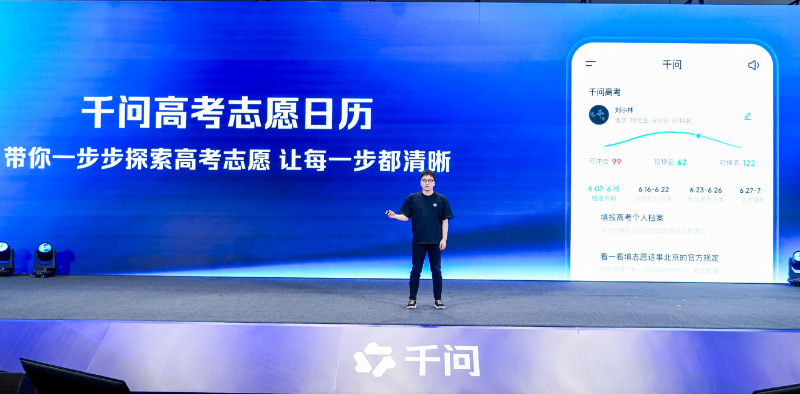
Quark emphasizes its data capabilities amassed from eight years of dedicated college entrance examination services, hoping to gain user recognition through long-term accumulation. Doubao has integrated volunteer consulting directly into the chat dialog box, vying for users' first access point with a lower usage threshold.
Although the product routes may differ, the core objective is to bridge the trust gap.

AI Can Calculate Probabilities, But Not Fate
Volunteer application is challenging because it requires answering simultaneously within a very short time window: Which schools and majors can I get into with my score? And who am I, and who do I aspire to become?
The first question pertains to information, while the second pertains to life.
It must be acknowledged that AI has far surpassed the capabilities of traditional volunteer application tools in processing complex information.
In the past, candidates and parents faced a score report and several thick admission handbooks. Today, AI is beginning to try to understand a specific individual.
Baidu mentioned at its press conference an example of a candidate from Liaoning with a combination of physics, chemistry, and biology, scoring around 600 points, hoping to enter the internet industry in the future while having limited family financial resources.
AI would dissect the constraints behind the decision-making: employment priority, tuition sensitivity, STEM inclination, urban preference... These pieces of information are simultaneously factored into the calculation. Ultimately, what is generated is no longer just a simple list of ambitious, stable, and safe options but a set of decision-making plans tailored to the candidate's real situation.
Zheng Sishou, the product head of Qianwen's business unit, introduced that the college entrance examination volunteer application intelligent agent can continuously understand candidates' interest directions, school goals, and urban preferences during communication, even including MBTI, personality, and special skills, to cater to individuals. Even if two candidates have the same score, subject selection, and province, as long as their needs and preferences differ, the system's customized college entrance examination calendar for them will be completely different.
From this vantage point, AI has indeed made volunteer application more intelligent.
However, no matter how intelligent AI is, it cannot escape the confines of only being able to infer the future based on the past. The more abundant the data on admission scores from previous years, major employment rates, industry salary levels, destinations of students with the same scores, and regional industrial structures, the more precise the recommendations will be.
But all this data stems from the past, while volunteer application is a choice about the future.
A candidate entering university in 2026 will graduate in 2030. If they continue to graduate school, they may not enter the job market until 2033.
In other words, AI is utilizing data from the past few years to assist a young person in betting on their fate for the next seven years.
This resembles probability calculation more than future prediction.
Today's hot industries may not remain hot by the time students graduate. Ten years ago, the hottest industry was mobile internet. Later, it was new energy.
No one knows where the next big trend will emerge in four years. AI doesn't know either. It can summarize trends but cannot foresee changes that have not yet occurred.
More intriguingly, when more and more people start to believe in the same recommendation logic, the recommendations themselves will alter the outcomes.
Today's high employment rates may become the starting point for tomorrow's oversupply. Today's popular majors may also lose their scarcity due to being overly recommended.
Recommendation systems create value by uncovering trends but may also destroy value by amplifying trends.
AI has narrowed the gap in information access but cannot narrow the gap in risk tolerance between different families, let alone shoulder the future for them.
Volunteer application is superficially about choosing schools and majors, but at its core, it is about answering the question, 'Who do I aspire to become?' AI will inquire about your score, interests, urban preferences, career plans, and family conditions and then construct a profile of you.
Compared to past systems that relied solely on score matching, this is already a significant leap forward.
However, a profile does not equate to understanding. AI knows what you like but not why you like it. It knows who you are today but not who you will become in the future.
Volunteer application is essentially an exploration of the 'unknown self,' with AI's recommendation logic grounded in matching 'known data.' However, for most 18-year-olds, the question of 'who am I' is precisely what they gradually uncover during the selection process.
During the four years of university, a course, an internship, a teacher, or a group of friends can all alter a person's life trajectory.
Growth precisely unfolds in those unpredictable realms.
-
![]()
The 'Double-Edged Sword' of Roborock's Operations: Soaring Scale Amid Profit Dilemma Under Heavy Marketing Spend
-
![]()
Agent's 'Anti-Consensus' Strategy in the Second Half: SaaS Companies Carve Out a New Ecological Niche
-
![]()
AI Large Models Compete for the Business of 'Zhang Xuefengs'
-
Chinese Brands Face the 'Twilight of the Gods' and 'Battle of the Gods' at the World Cup
-
![]()
Exclusive | DingTalk's Leadership Change: Next Steps Include Integrating MuleRun
-
![]()
Exclusive | DingTalk's Leadership Change: Next Steps Include Integrating MuleRun
-
![]()
Final Assessment | Domestic Auto Industry’s Performance in the First Five Months: General Stability, Sluggish Domestic Demand, Structural Variations, Robust Exports
-
![]()
New Energy Vehicles Dominate: Penetration Rate Soars Past 60%, Fuel Vehicles Vanish from Top 10; Mid-Year Report Reveals Zero for New Energy in Some Metrics