US Stock IPO | Anthropic and OpenAI File Successively, Three Giants Aim for a Combined $4 Trillion Market Debut
 06/12 2026
 331
331
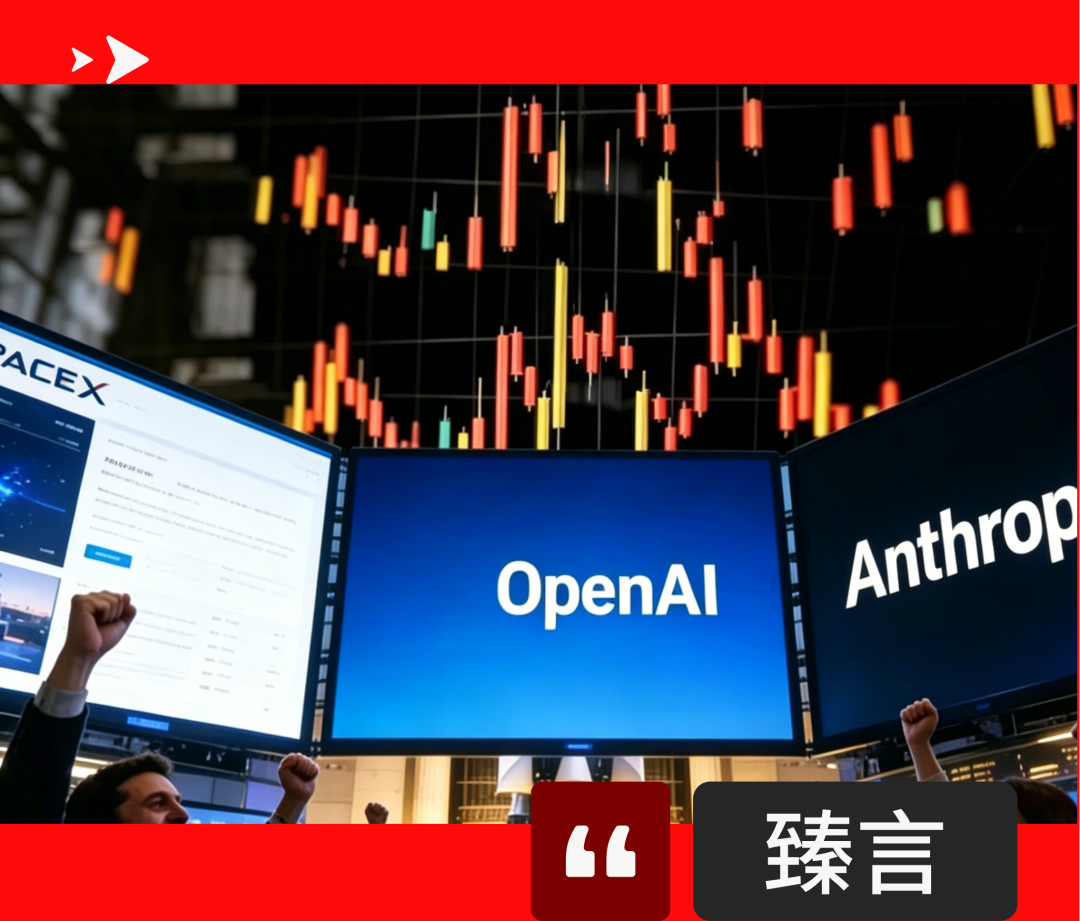
On June 9, 2026 (local time), AI giant OpenAI officially announced it had confidentially submitted a draft S-1 registration statement to the U.S. Securities and Exchange Commission (SEC). Just a week earlier, its closest rival Anthropic completed the same move. With SpaceX set to debut on capital markets on June 12, the largest tech IPO event in global history has officially begun, with the three companies set to inject nearly $4 trillion in combined market value.
Design | Tian
OpenAI: Hypergrowth and Strategic Focus Behind Its Trillion-Dollar Valuation
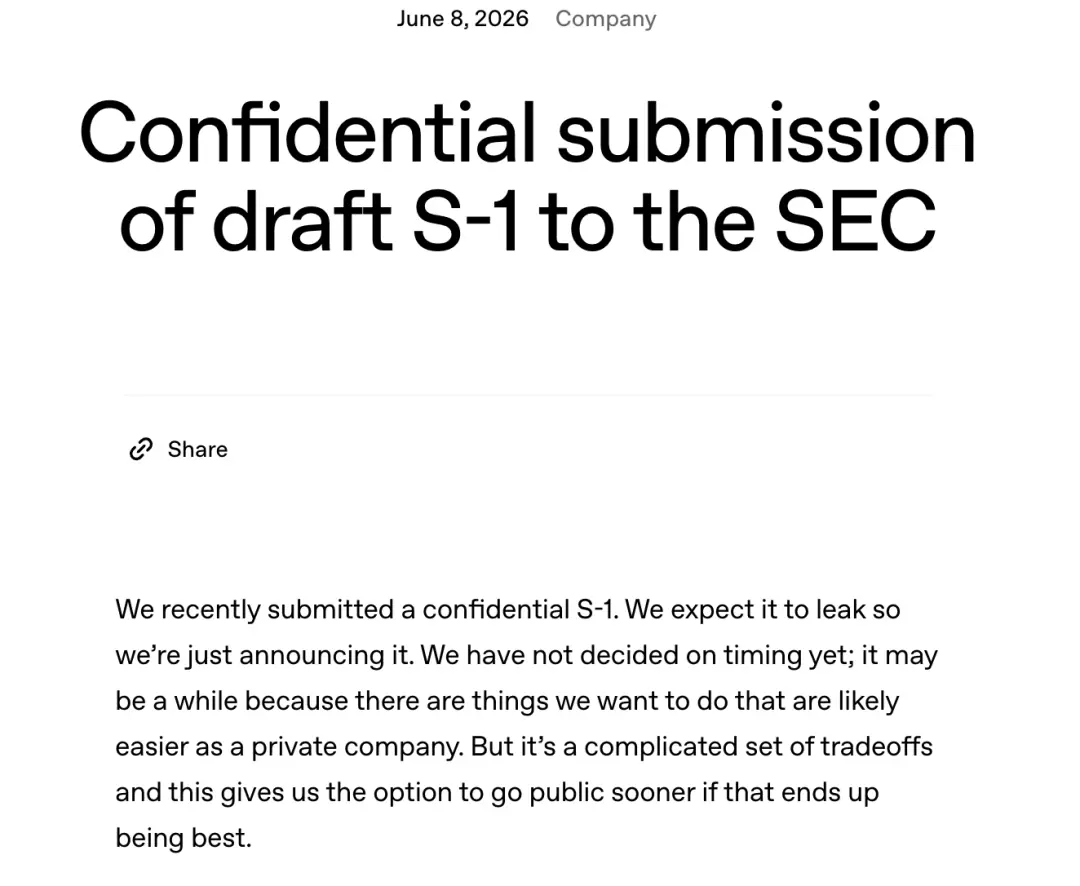
Rumors of OpenAI's IPO had circulated for months before this official confirmation. The company admitted in its statement that the disclosure was prompted by expectations of leaks: 'We haven't set a timeline yet, and this may take time as some things are easier to advance as a private company. But filing gives us the option to go public at the optimal time.'
 Source: openai.com
Valuation Surges 30x in Three Years, Targeting $1 Trillion IPO
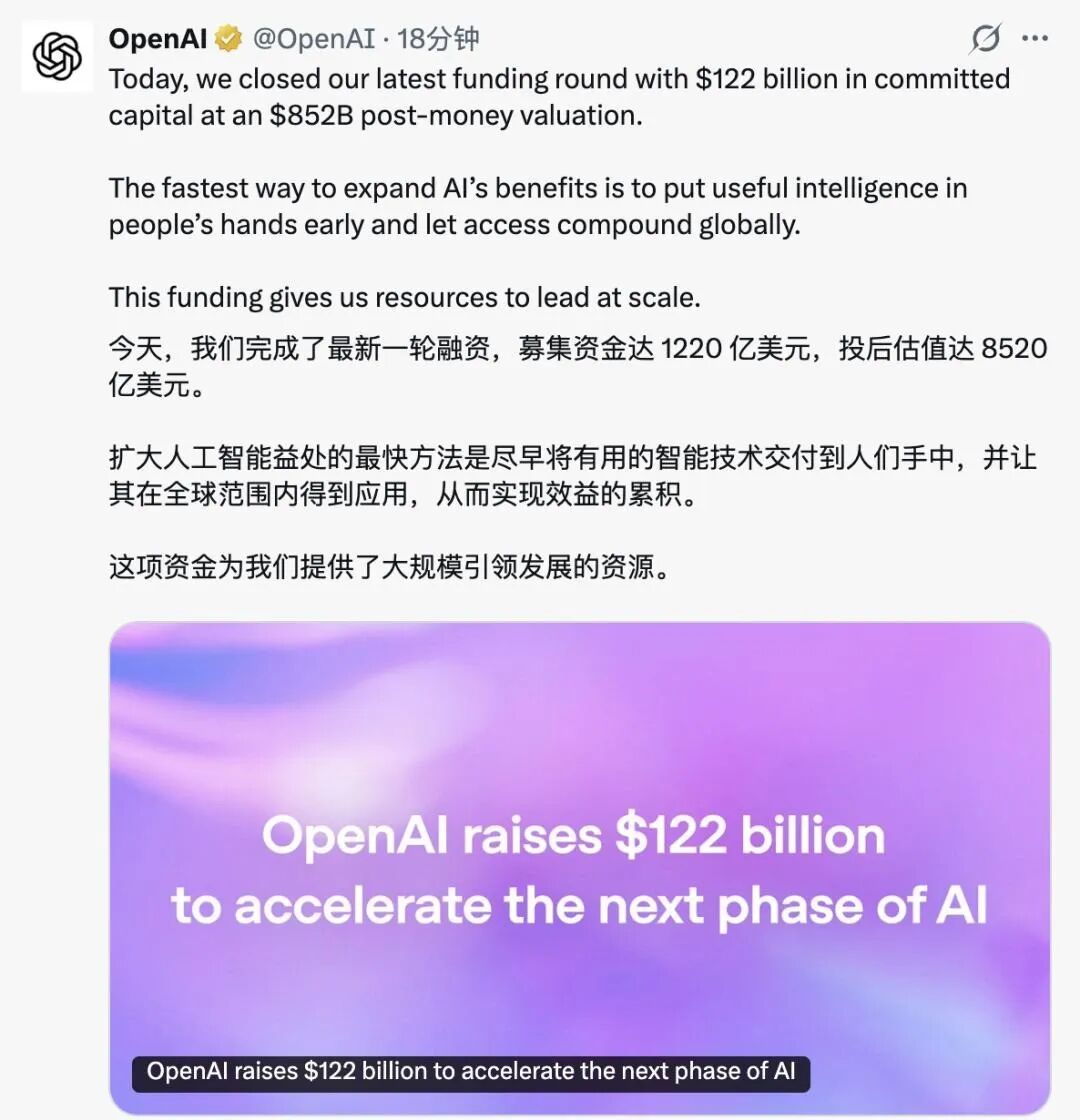
The company's valuation entered exponential growth after ChatGPT's breakthrough: from just ~$28 billion in early 2023 to $300 billion in March 2025's Series A-3 round, and reaching $852 billion in its latest April 2026 funding round. Sources indicate OpenAI plans a pre-IPO tender offer allowing employees to sell shares at the $852 billion valuation. If successful, its target IPO valuation could reach $1 trillion.
 Source: openai.com
Entering 'Phase Three': Shutting Down Peripheral Projects to Focus on Core Battlefields
Concurrent with the IPO filing, CEO Sam Altman published a blog announcing the company's 'third development phase':
Phase 1: Foundational research toward artificial general intelligence (AGI);
Phase 2: Becoming a product company to understand user tool adoption;
Phase 3: Making advanced AI abundant, affordable, safe, and useful to reshape economies around AI.
To achieve this, OpenAI is strategically retrenching: shutting down marginal projects like the text-to-video model Sora while heavily investing in enterprise services and its programming assistant Codex. Altman even stated on social media: 'Feels like Codex is having its ChatGPT moment.'
Financial & User Metrics: 400x Revenue Growth in Four Years
OpenAI's commercialization prowess is equally remarkable:
2022: Annualized revenue <$30 million;
2023: ~$2 billion;
2025: Full-year revenue >$13 billion;
2026 target: $30 billion (131% YoY growth).
As of February 2026, ChatGPT had over 900 million weekly active users—the fastest-growing consumer app in history (reaching 100 million users in just 2 months)—with ~50 million paying users (5.5% penetration), leaving substantial room for growth compared to mature internet platforms' 20%-40% averages.
Anthropic: The Rising AI Challenger Surpassing OpenAI in Valuation
Just a week before OpenAI's filing, Anthropic—its biggest competitor—also confidentially submitted its S-1 to the SEC. More surprisingly, Anthropic's latest private funding round valued it at $965 billion, surpassing OpenAI for the first time, with market expectations of breaking $1 trillion post-IPO.
Founded by former OpenAI core members, Anthropic differentiates through 'safe, controllable AI' in the enterprise market:
Security leadership: Its Claude models excel in data privacy, content safety, and compliance, favored by finance, legal, and other heavily regulated sectors;
Programming strength: Blockbuster product ClaudeCode competes directly with OpenAI's Codex;
Capital backing: Received massive investments from Amazon, Google, and other tech giants with strong ecosystem partners.
Unlike OpenAI's diversified layout (layout), Anthropic focuses on enterprise API services and customized solutions, rapidly gaining share in high-end enterprise markets.
The Grand Convergence: Ushering in a New Era of Global Tech IPOs
The successive filings of OpenAI and Anthropic, alongside SpaceX's imminent market debut, mark a historic convergence. These three super-unicorns representing AI and space tech's highest levels signal frontier tech's entry into scaling (scaled), capitalized maturation, offering global investors a historic window into the next tech revolution's dividends.
As undisputed leaders in their fields, all three companies command capital market confidence through deep tech moats, massive user bases, and clear commercialization paths. Here's a snapshot of their core IPO parameters: Fundraising & Valuation: $200 billion raised, $4 trillion in new market value

Source: Public Information
AI Titans Clash: Who Will Dominate AGI's Future?
The successive IPOs of OpenAI and Anthropic signify AGI's formal entry into public market competition. Each holds distinct advantages, promising fiercer future rivalry. Source: Public Information
For investors, this IPO feast offers historic AI dividend opportunities but carries extreme valuation risks. Sustaining such high valuations requires continuous exceed expectations (outperformance) growth, while AI's rapid tech evolution, competitive shifts, and regulatory uncertainties could materially impact long-term value.
Regardless, OpenAI and Anthropic's listings will mark pivotal AI industry milestones. They signify AI's transition from labs to mass commercialization, with this AGI competition set to profoundly reshape global economies and societies. Risk Warning: This article is for informational sharing only and does not constitute investment advice. All data derives from publicly disclosed information, subject to official company announcements.
Disclaimer:
1. This article compiles publicly available information for factual observation and industry research reference only, not constituting any investment advice or securities offer. Data on companies, stock prices, valuations, and market shares derive from issuer disclosures, HKEX filings, public news reports, and third-party research. No warranty is made regarding completeness or accuracy.
2. Investors bear all risks and consequences from decisions based on this content. Cross-border investments must consider policy, exchange rate, liquidity, and compliance risks due to differing regulatory requirements between Hong Kong and mainland markets.
3. Investment involves risk; decision-making requires caution.
-
![]()
History’s Largest IPO Is Set to Debut—But Chinese Investors Are Shut Out
-
![]()
Should 44 Million Electric Vehicles Be Subject to Road Maintenance Fees If They Don’t Refuel?
-
![]()
US Stock IPO | Anthropic and OpenAI File Successively, Three Giants Aim for a Combined $4 Trillion Market Debut
-
This Smart Toilet Enterprise Holds the Key to AI Computing Power
-
![]()
Breaking News! An AI Company Valued at 5.8 Trillion USD Rushes for IPO with Annual Revenue of 170 Billion USD
-
The Underground 'Computing Battle': How HPC and Large Models Revolutionize Oil Exploration
-
![]()
New Breakthrough! Haiguang Optoelectronics Clears HKEX IPO Hurdle
-
![]()
AI Computing Power Surge Propels Dongtian’s Optoelectronic Communication Business to Soar!