Volunteer Application Agent: Tencent is Restrained, Alibaba is Aggressive
 06/16 2026
 358
358
Author | Wu Xianzhi
Editor | Wang Pan
"Frankly speaking, we have no competitors when it comes to the college entrance examination. It's not that we don't pay attention to others. Over the years, from the first year to now, our team has only focused on understanding user needs and transforming technology into products," said Zheng Sishou, the product leader of Alibaba's QianWen division, who noted that the team has been developing college entrance examination tools for eight years, and AI is making things different.

Before this year, the user preference for college entrance examination volunteer applications leaned towards Kuake. However, after a year of integration and adjustments, QianWen has stepped into the foreground. On June 10, QianWen released a full-cycle volunteer application Agent, with the key term being Agent. Among the similar products from Tencent, Baidu, and Alibaba, both Tencent's Yuanbao Gaokao Tong and Alibaba's QianWen Gaokao focus on Agents. What truly sets QianWen apart is the extension of the product application cycle.
QianWen is supported by the AI Agent framework of thinking, planning, executing, and reflecting, while possessing capabilities for proactive planning, long-term memory, and personalized services. Internally, it is believed that tool-based products cannot address the long-term and personalized needs of college entrance examination volunteer applications, whereas Agents can cover the entire cycle of volunteer applications and even career planning.
The transition from QianWen Gaokao replacing Kuake Gaokao, along with the iterations of other manufacturers' college entrance examination products, reflects the shift from search + tools to large models + Agents.
A Complex Math Problem
College entrance examination volunteer application products tackle a matching-related math problem: finding the optimal solution from a vast amount of information, including nearly 3,000 universities, over 2,000 majors, and potentially hundreds of millions of combinations.
While a standard answer might be found, solving this problem manually is too slow and difficult. Even if there are corresponding experts, their resources are extremely scarce, ultimately necessitating the use of tools.
Before making a decision, candidates must first grasp historical data and estimate probabilities based on previous admission ranks and score differentials. When filling out applications, they are also influenced by multiple factors such as the school's level, the strength of the major, personal interests, location, and employment prospects.
Traditional tools have completed the preprocessing and standardization of information, allowing users to obtain corresponding answers simply by searching. However, in reality, college entrance examination volunteer application is a complex task chain lasting over 20 days. Before scores are released, candidates need to estimate their scores and initially determine their direction based on personal interests.
The most energy-consuming part is after the scores are released, when candidates must match universities, majors, and regions according to their scores, make decisions, and then carefully check for errors. Questions like what parallel volunteer (parallel applications) are, which majors can be applied for with a background in physics, chemistry, and biology, and what expectations parents have, etc., make the real-world game far exceed the first principles of tools being disposable.
In the matter of volunteer applications, human effort is insufficient, and tools are limited, yet it is something AI excels at. AI can estimate the value of combinations in volunteer applications and eliminate obviously inferior ones. Predicting admission probabilities is a natural application scenario for pattern recognition and regression analysis. Finally, recommending individualized plans can actually be covered by AI recommendation systems and multi-objective optimization.
To fill the significant gap left by tools, Tencent and Alibaba have both introduced Agents and provided two distinct solutions.
On June 5, Tencent announced the release of the "Yuanbao Gaokao Tong" Agent for college entrance examination information through Yuanbao and QQ Browser, with the main feature being the College Entrance Examination Consultant Agent. Yuanbao serves as the mobile entry point, while QQ Browser provides the PC entry point. In terms of product usage, candidates input their scores for volunteer recommendations, university and major screenings, and querying past data. Apart from multi-round dialogues and long-term memory, there is not much difference from past products.
Tencent's restrained product strategy is based on certain considerations. Volunteer application is not a life simulation game; the impact of a single choice is very long-term. Companies can only provide auxiliary tools and cannot participate in decision-making.
Five days later, Alibaba's QianWen released its own volunteer application Agent, which was much more aggressive than Tencent's. The product consists of three core capabilities: Volunteer Calendar, Volunteer Report, and Volunteer Q&A. The QianWen Agent breaks down the college entrance examination volunteer application scenario into three core scenarios: timing, reference reports, and dialogue-based fine-tuning, thereby transforming volunteer applications from user-initiated searches to an AI-assisted decision-making process.
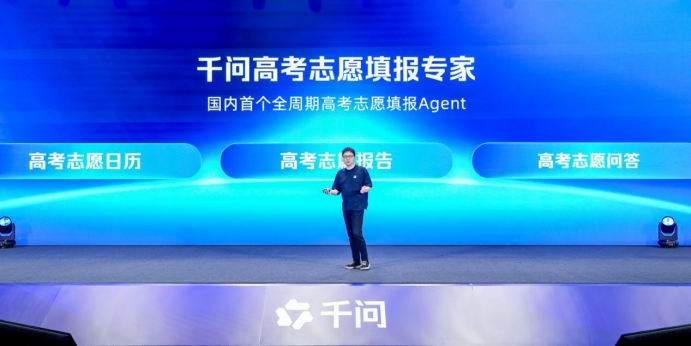
After candidates fill in information such as their province, they enter an automated process. The AI generates a schedule from the first day after the exam to the submission of volunteers and pushes cognitive building, performance positioning, direction exploration, plan pre-selection, and formal application, using structured methods to establish rational cognition for candidates.
In 2025, generative AI entered volunteer applications for the first time, with each company providing the ability to generate reports. However, due to the personalized nature of volunteer applications, it is difficult to simply assess what is good or bad. Therefore, the competition is not just about the accuracy of reports but also the breadth of information provided.
Both QianWen Gaokao and Yuanbao Gaokao Tong provide aggressive, stable, and conservative recommendations with dynamic adjustments, but QianWen sets more constrained recommendations, such as major preferences and special qualifications.
Over the past few years, volunteer Q&A has been the most differentiated feature among various college entrance examination products. The five supports mentioned by QianWen Agent at the conference can be summarized in layman's terms as dialogue memory, data accumulation, conversion of score differentials and ranks, visual display of structured data, and transforming past recommendations into proactive inquiries.
Tools are on the decline, but volunteer applications can only be assisted driving (assisted driving)
Before the advent of large models + Agents, college entrance examination volunteer application products have been engaged in homogeneous competition.
Regardless of which giant launches a product, it essentially outputs the information connectivity capabilities of the internet, completes data accumulation, optimizes algorithm testing, and ultimately lands in a search format. For example, Tencent first piloted the KNN+LM algorithm in 2017, then collected admission, university, and policy data, and launched the New College Entrance Examination Pass in 2021.

Since 2021, college entrance examination volunteer applications, like New Year red envelopes, have gradually become a node for internet companies to showcase their strength, convert traffic, and drive data flywheels. During this period, college entrance examination tools have evolved from search to volunteer applications, and then to generating volunteer reports last year, with uniform product forms.
For example, Kuake Gaokao has gone through search queries, launched the "aggressive, stable, conservative" tool, introduced the volunteer application function, and added generation capabilities last year. Continuously superposition (overlaying) functions has not changed the underlying nature of search + tools. Moreover, for big companies, these tools do not have moats; what is exclusive this year may become infrastructure next year.
The product strategy of QianWen Gaokao Agent implies two commercial intentions.
Tools in homogeneous competition have no moats. Candidates do not care who originally created the "aggressive, stable, conservative" approach; scoreline queries are no longer an evaluation standard for the quality of manufacturers' products but a passing requirement. The internet has long bridged the information gap in comparing university majors. In other words, search + tools have reached the end of diminishing marginal utility.
As long as they remain at the tool level, there are no moats for college entrance examination volunteer applications. The AI-generated volunteer analysis reports launched last year have become standard this year. Homogeneity ultimately leads to an arms race at the functional level, and products cannot form differentiated pricing, with free becoming the norm.
The biggest variable brought by Agents is the reconstruction of interactions themselves. At the tool stage, user behavior is proactive searching, while Agents rely on the reasoning, memory, and tool invocation capabilities of large models, as well as a continuous influx of user information, to drive data flywheels.
Zheng Sishou, the product leader of QianWen division, said, "In the process of developing QianWen, we wanted to more directly enable candidates and parents to discover their needs, preferences, and interests during the Q&A process. This is a different logic from the past, moving from one-way usage to human-like interactions."
Due to the unclear objectives of candidates and parents, it is difficult for tools to intervene in subsequent actions. QianWen's solution is to complete data alignment through multi-round dialogues between humans and AI, a scheme that is not particularly novel: imitating human behavior.

College entrance examination consultants possess data on past college entrance examinations from various regions, enrollment situations of university majors, and rich experience. However, their more important ability is to quickly grasp the situation of candidates and parents. Whether the candidate or the parents have the final say, whether they want to go to the coast or inland, and their job aspirations, etc.
Large models + Agents possess structured and standardized data and can quickly use tools and make judgments. However, if they cannot encourage candidates and parents to actively speak up and provide information, the entire path cannot be completed.
Nevertheless, human-like interactions, strictly speaking, still do not have moats. QianWen Agent also harbors another more ambitious plan.
College entrance examination volunteer applications are a periodic scenario lacking long-term nature. After Agentization, it will continuously expand to more areas along the scope of college entrance examination studies through dialogues and constrained recommendations, completing user habit binding.
Photon Planet has learned that this year's college entrance examination is a test, and QianWen will plan and develop subsequent products based on the test results. For example, updating the calendar and Agent mechanisms to provide a wider range of services. From this perspective, QianWen Gaokao Agent is just one of many entry points for AI to penetrate the learning and growth process.
Spending Tokens to Buy Trust?
QianWen Gaokao Agent does not deviate from Alibaba's AI strategy of "producing Tokens, transporting Tokens, and consuming Tokens."
College entrance examination volunteer applications provide QianWen Agent with a high-consumption, high-concurrency, and ultra-high-trust scenario, which drives C-end user stickiness and invocation volume for QianWen and powers Alibaba Cloud's MaaS platform.
In 2025, when Kuake first launched AI volunteer reports, the generation of 13 million reports required significant computational investment. Zheng Sishou, when discussing computational consumption recently, did not provide any direct response, only stating that "from the group's perspective, there are no restrictions on this matter, and full computational support is provided."
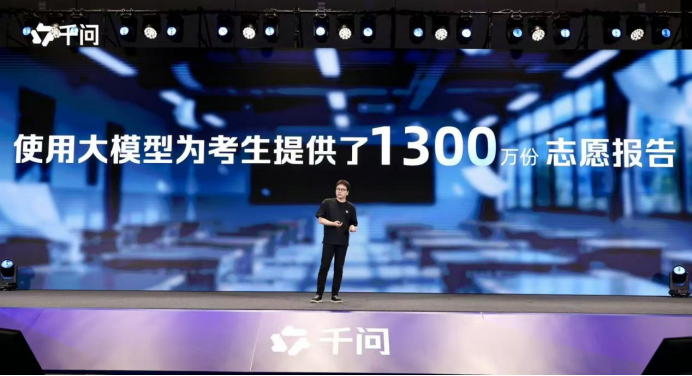
The expenditure on Tokens is considerable and of high quality. Every interaction between candidates and parents involves deep participation, real decision-making, and trust investment. QianWen Gaokao Agent consumes Tokens but gains trust assets in return.
Furthermore, the college entrance examination is one of the national-level high-frequency and rigidity (essential) scenarios. Alibaba attempts to enter each scenario, creating an annual Token consumption event similar to "Double 11," leveraging the accumulation of peaks to cover all aspects of life, learning, and work. The day after the release of QianWen Gaokao Agent, it ventured into the realm of the World Cup.
The scenario behind the college entrance examination is deep, and the accumulation of trust assets can easily convert one-time consumption into long-term dependency. As for how far the World Cup predictions can go, apart from betting on football lotteries, there is no clear follow-up yet.
Perhaps, QianWen just wants to "gamble," who knows?

-
![]()
What is the Future for Domestic Large-Scale AI Models?
-
![]()
Insights into China's Gimbal Camera Market Structure, Player Dynamics, and Development Trends in 2026
-
![]()
Massive Capital Influx! NVIDIA's $25 Billion Bond Issuance Secures $85 Billion in Oversubscribed Demand, How Will the AI Chip Giant Secure Long-Term Liquidity?
-
![]()
Has DJI Caught Up with Insta360?
-
![]()
The Hidden Update of visionOS 27 is Incredible: Uncovering the Major Upgrades Apple Didn't Mention
-
![]()
Volunteer Application Agent: Tencent is Restrained, Alibaba is Aggressive
-
![]()
A Glimmer of Innovation Dances on the Tightrope
-
![]()
The AI Glasses Track is Fully Taking Off: How Far Are We from Them Being 'Must-Haves'?