Massive Capital Influx! NVIDIA's $25 Billion Bond Issuance Secures $85 Billion in Oversubscribed Demand, How Will the AI Chip Giant Secure Long-Term Liquidity?
 06/16 2026
 524
524
 AI Capital Bureau, Tao Shi, June 16
On the evening of June 15 (local time), NVIDIA, the absolute core of global AI computing power, officially announced the issuance of a record-breaking high-grade investment-grade corporate bond.
This marks NVIDIA's first return to the corporate bond credit market in five years since June 2021. The 'lightning bond issuance,' conducted without any traditional bank roadshows, sparked a frenzy on Wall Street. Due to overwhelming demand from global institutional investors, NVIDIA resolute (decisively) raised the planned fundraising amount from $20 billion to $25 billion on the day of issuance.
Even more astonishing is its 'capital-raising' prowess. The bond attracted a staggering $85 billion in subscription funds within an extremely short timeframe, with oversubscription exceeding threefold. Following this major announcement, the secondary market responded extremely positively, with NVIDIA's U.S.-listed stock closing 3.3% higher on Monday. AI Capital Bureau believes this represents not only a significant upgrade in NVIDIA's financial strategy but also a clear revelation of global capital's unique 'risk-averse and arbitrage' mindset in the AI era.
Issuance Details Deconstructed: $25 Billion 'Lightning Fundraising' Swiftly Captures Wall Street Duration
Typically, when a company issues such a massive investment-grade bond, the lead underwriters would need to conduct multi-day or even multi-week roadshows across major global financial centers with management, repeatedly pitching and pricing to institutional investors. However, NVIDIA completely broke with traditional bond market conventions this time.
As CreditSights analyst Andy Li commented after the bond issuance, 'NVIDIA's adoption of a 'Lightning Issuance' strategy comes as no surprise. With its near-monopolistic dominance in the AI chip sector and exceptionally strong financial strength, it doesn't need to exert effort selling itself to investors—global capital is lining up for its commands.'
In terms of technical details for this issuance, NVIDIA partnered with three top Wall Street investment banks—Goldman Sachs, JPMorgan Chase, and Morgan Stanley—as lead underwriters, offering seven different bond tranches with varying maturities. These seven tranches span an extremely wide range, from the shortest 2-year notes to the longest 30-year super-long bonds maturing in 2056. This multi-tier, long-span design aims to precisely capture funds with different duration preferences in the market.
Even more noteworthy is the extremely low financing cost. With the total order book quickly overwhelmed by $85 billion in inflows, the underwriting syndicate gained absolute pricing power. Take the most market-focused 30-year (maturing 2056) long bond as an example: the initial price guidance spread was around 90 basis points (0.9 percentage points) above Treasury benchmark rates. However, as oversubscription funds piled up crazy (wildly), the final issuance spread narrowed significantly by 25 basis points, pricing at just 65 basis points (0.65%) above comparable U.S. Treasury yields.
Under current global macro credit rate conditions, successfully issuing 30-year super-long bonds at such a narrow premium fully underscores Wall Street's strong endorsement of NVIDIA's long-term creditworthiness. NVIDIA's move not only raises capital but also establishes itself as a highly liquid 'credit benchmark' in global credit markets.
Subscription Structure Analysis: 'Atypical Risk Aversion' by Global Sovereign Funds and Tech-Focused Funds
Which funds are frantically buying NVIDIA's bonds? According to internal subscription structures leaked by Wall Street's underwriting syndicate, institutional funds overwhelmingly dominated this feast. Among them, global top-tier sovereign wealth funds (SWFs), large national pension funds, and tech-focused funds from major asset management companies were the most aggressive, making significant concentrated purchases.
On the surface, fixed-income corporate bonds seem somewhat incompatible with the explosive growth pursued in the AI tech frenzy, but seasoned bond traders revealed the underlying logic:
'This bond offers irresistible appeal to giant funds with limited risk appetite. Buying NVIDIA's stock is betting on highly volatile, highly uncertain future growth; buying NVIDIA's bonds, however, represents a 'safe play' to share in AI dividends with extremely low risk. It perfectly avoids the underlying risks commonly found in traditional AI infrastructure construction, such as construction delays, equipment depreciation, and application-side monetization falling short of expectations.'
In 2026, despite cloud giants (Hyperscalers) like Microsoft, Google, and Amazon still aggressively proclaiming 'unlimited AI investment,' for some giant institutional funds with relatively conservative risk appetites or restricted by investment charters from heavily weighting high-valuation stocks, directly allocating to NVIDIA's stock faces volatility pressures from technological iteration and high-position corrections.
In this context, NVIDIA's $25 billion investment-grade bond issuance, with maturities extending up to 30 years, undoubtedly provides an excellent alternative tool. It allows global capital to anchor funds to the balance sheet of this ultimate 'arms dealer' in the AI era in the most certain and stable manner. Combined with NVIDIA's rare bond issuances historically, its assets represent typical 'limited-edition currency' in credit markets, naturally triggering a global capital stampede.
Fund Usage Breakdown: Not for Expansion, but Weaving a Global Liquidity Safety Net
Initially, many retail investors in secondary markets reacted by asking: Is NVIDIA using this money to prepay massive deposits to TSMC to lock in capacity, or even to break convention and build its own fabs?
Nothing could be further from the truth. NVIDIA clearly stated in its preliminary SEC filing that the raised funds would be used for general corporate purposes, including repaying and refinancing existing debt as well as optimizing the overall balance sheet structure.
The market must clearly recognize that NVIDIA is a pure Fabless chip design company. Its high-asset, light-operation model means it doesn't need to spend tens of billions of dollars building physical factories like Intel or TSMC. According to FactSet's latest forecast, NVIDIA's 2026 capital expenditures (Capex) are estimated at $7.9 billion—higher than last year's $6 billion but nowhere near needing bond issuances to fill operational gaps compared to its massive cash inflows.
So why would NVIDIA, with its amazing (astonishing) free cash flow, take on this $25 billion debt? We can analyze this through a set of financial metrics and strategic responses:
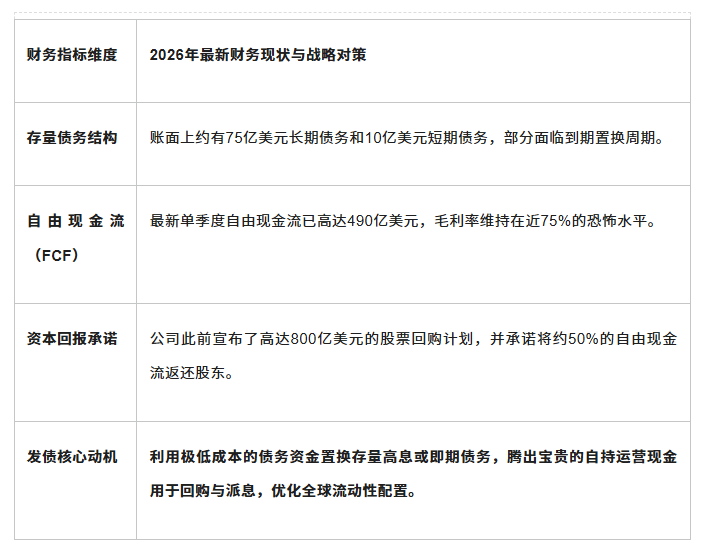
As seen from the table above, this represents a textbook-level 'capital structure optimization.' NVIDIA currently holds massive funds across its global operating entities, but due to cross-border taxation and regional liquidity allocation regulations, directly using operating cash for U.S. domestic stock buybacks or dividends often isn't the most efficient approach.
By issuing record-low-cost bonds in the U.S. debt market, NVIDIA can use 'cheap money' from Wall Street—nearly equivalent to Treasury costs—to refinance existing debt and indirectly support its massive $80 billion buyback program. This ensures its global supply chain maintains absolute cash buffers against geopolitical or industry cycle fluctuations while accelerating domestic capital return plans (boosting earnings per share).
Secondary Market and Industry Implications: Low-Cost Financing Source Alleviates Equity Dilution Pressure
In traditional financial logic, large-scale capital raising (especially equity issuances) is often interpreted as a potential negative signal, suggesting the company may face funding pressures or balance sheet deterioration. However, NVIDIA's $25 billion debt financing triggered a completely opposite 'euphoric' response in secondary markets, with its stock price jumping significantly by 3.3%, indicating shareholders not only didn't panic but highly approved of management's financial wisdom.
The underlying logic lies in 'cost-effective financing channel selection.' For a mega-cap company at the global peak, raising funds through equity financing would directly dilute existing shareholders' equity and might even send negative signals to the market that 'management believes the stock price has peaked.' Conversely, choosing debt financing—especially under highly favorable conditions with extreme oversubscription and narrow spreads—allows NVIDIA to pave the way for future development with extremely cheap financial leverage while completely avoiding the hidden pressure of equity dilution.
Mapping this to the broader AI industry ecosystem, NVIDIA's major move also completely reveals the enormous financial divide between companies in different ecological niches within the current AI industry closed loop (ecosystem):
Cloud giants (Hyperscalers) forced into massive debt to buy chips: Companies like Microsoft, Amazon, Google, and Meta are currently trapped in a fierce AI arms race. According to industry statistics, these tech giants' total capital expenditures for 2026 are projected to hit a historic peak of $700 billion. They're also issuing massive bonds and taking loans in debt markets, but the hundreds of billions raised will mostly become orders for NVIDIA's Hopper/Blackwell/Rubin architecture chips.The water seller (NVIDIA) proactively borrows to allocate liquidity: As the endpoint of the ecological closed loop (ecosystem) and ultimate profit harvester, NVIDIA enjoys an unbeatable 75% gross margin and cash inflows akin to money printing. Its bond issuance isn't to passively cope with survival competition or purchase fixed assets but to proactively optimize capital structure, lock in long-term low-cost liquidity, and accumulate more flexible capital ammunition for new AI ecosystem chain investments (such as strategic investments in Anthropic, OpenAI, xAI, and CoreWeave).AI Capital Bureau Viewpoint: The Era of 'Financial Mastery' for Tech Titans
AI Capital Bureau believes that when a tech giant of this era not only dominates competitors in technological products but also wields absolute dominance and bargaining power in capital markets, its moat completes a perfect closed loop (ecosystem) transition from 'technological' to 'financial.'
NVIDIA's $25 billion corporate bond issuance, with threefold oversubscribed frenzy, declares to the entire capital market: Even amid still-high macro interest rates, top-tier AI core assets remain the 'hard currency' unconditionally pursued by global capital. Through this perfect global liquidity optimization, NVIDIA not only alleviates equity dilution pressure but also secures an unbreakable financial safety barrier for itself over the next three decades. The second half for AI chip giants won't just be a battle of computing density but also this silent yet profound capital Long March (long march).

AI Capital Bureau is a professional observation and analysis platform focusing on capital market dynamics in the artificial intelligence field. We closely track capital operations such as financing, listings, and M&A among AI and embodied intelligence-related companies, conducting in-depth analyses of industry trends and corporate development trajectories to provide valuable insights for industry participants. We are committed to becoming a bridge connecting AI innovation and capital markets, helping Chinese hard-tech companies achieve value discovery and growth.
Risk Warning and Disclaimer: Markets carry risks; invest cautiously. This article does not constitute investment advice and should not be used as practical operational guidance. Trading risks are borne by the investor.
-
![]()
A 3.2% Profit Margin: The Last Vestige of Dignity in the Auto Industry
-
![]()
Why Is Zhihu Unable to Launch Its Own 'Doubao' Like Zhou Yuan Envisions?
-
![]()
Lin Junyang’s Startup Secures $20 Million in First-Round Financing, with Tencent as Investor
-
![]()
DJI Interactive Entertainment Establishes Presence in the Asia Olympic Area with 5,500 Square Meters
-
![]()
Why Rolls-Royce Ditched Its All-Electric Ambitions and Why Ultra-Luxury Cars Are Embracing Hybrids
-
![]()
AI Smartphones: ByteDance Pumps the Brakes, Dreame Steps on the Gas
-
![]()
Ideal Has No Technology? Li Xiang Fires Back: Launching the World's Most Powerful AI Chip, Aligning Intelligent Driving with FSD by Year-End | MIRROR Pro
-
![]()
What is the Future for Domestic Large-Scale AI Models?