Insights into China's Gimbal Camera Market Structure, Player Dynamics, and Development Trends in 2026
 06/16 2026
 587
587
On June 10, Insta360 officially launched its first integrated handheld gimbal camera, the Luna Ultra. After its initial announcement earlier this year, the product underwent multiple rounds of development and refinement, with several delays in its release, yet it maintained high industry attention throughout. Runto Technology believes that Insta360's entry into the consumer-grade handheld gimbal camera market represents a significant strategic move to diversify its imaging product portfolio and explore new growth opportunities.
In terms of pricing, the Luna Ultra is priced at RMB 3,999 for its domestic debut, targeting the mid-to-high-end professional content creation market and directly competing with DJI's similarly positioned products.
In fact, DJI had already released the Osmo Pocket 4 in April 2026. Following Insta360's Luna Ultra launch, DJI signaled another new product release: the Osmo Pocket 4 Pro, set to debut on June 15.
Meanwhile, two major smartphone manufacturers, OPPO and vivo, have also announced their entry into the market. OPPO officially initiated its gimbal camera project, codenamed "Fuyao," on April 17, 2026. Vivo, on the other hand, completed the project initiation (project approval) for its Vlog camera project in late 2025 and aims to launch it by the end of 2026 at the earliest.
It is evident that with the Concentrated appearance (concentrated debut) of multiple high-end products and new entrants, competition in the consumer-grade gimbal camera sector continues to heat up, and the industry landscape is undergoing a new round of reshaping.
The Evolution of Gimbal Cameras: From Auxiliary Tools to Integrated Professional Creation
Based on product form and usage scenarios, Runto Technology categorizes action cameras into four types: traditional action cameras, which prioritize waterproofing and stabilization for outdoor sports; panoramic action cameras, equipped with fisheye lenses for 360-degree panoramic shooting, suitable for immersive content creation; wearable action cameras, designed to be compact and wearable for diverse mounting needs; and handheld gimbal action cameras, featuring integrated mechanical gimbals as their core configuration, emphasizing portability and smooth camera movement.
The development of consumer-grade gimbal cameras has steadily evolved alongside the rise of universal video content creation, with the main focus on simplifying the creative process, enhancing image quality, and expanding applicable scenarios.
In the early stages, mass short-form video creation primarily relied on a separated setup of "smartphone + handheld gimbal." This approach could only address basic image stabilization issues but suffered from cumbersome portability due to device separation, complex setup processes, and limitations imposed by smartphone imaging hardware, resulting in subpar dynamic capture and low-light performance that struggled to meet advanced creative demands.
With the rapid growth of content sectors such as self-media, outdoor shop review (store exploration), and travel documentaries, integrated gimbal cameras emerged to address the pain points of separated devices. By highly integrating gimbals, lenses, image sensors, and displays, they delivered a plug-and-play experience with stable shooting capabilities.
According to Runto Technology's online weekly monitoring data, from Week 1 to Week 22 of 2026 (December 29, 2025, to May 31, 2026), online sales of action cameras in China reached 2.429 million units, with gimbal cameras accounting for 981,000 units, or 40.4%, sharing the market equally with traditional action cameras and forming the foundation of the market.
Weekly Online Sales of China's Action Camera Market (2026W1-W22)
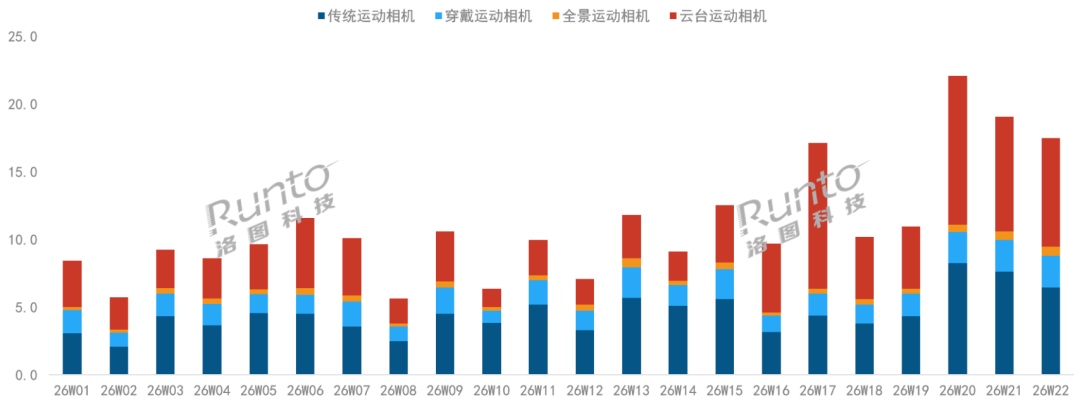
Data Source: Runto Technology Online Weekly Data (Unit: 10,000 units)
Brand Landscape: Oligopoly with Cross-Border Entry from Smartphone Manufacturers
The current domestic handheld gimbal camera market exhibits a clear "polarized and oligopolistic" structure.
In the mid-to-high-end market, DJI dominates the industry through years of deep expertise, leveraging mature gimbal tuning technology, a comprehensive software-hardware ecosystem, a rich accessory lineup, and stable product experiences. It holds significant market influence, brand premium capabilities, and user mindshare advantages.
In contrast, the low-end entry-level market is crowded with numerous white-label and niche brands that heavily imitate DJI's core designs and functional parameters, leading to severe product homogenization. These brands generally lack core imaging algorithms and hardware R&D capabilities, relying solely on ultra-low pricing to capture the lower-tier markets (lower-tier market) in a relatively crude competitive manner.
According to Runto Technology's online data, from Week 1 to Week 22 of 2026 (up to late May), DJI alone accounted for 92.9% of online sales in the gimbal action camera market, with an average product price exceeding RMB 3,000. In contrast, other small and medium-sized brands averaged around RMB 500, creating a complete disconnect in customer segments and product positioning between the two groups.
Regarding the trajectory of market competition, Runto Technology analyzes that in the short term, DJI will continue to dominate the market due to its deep technological accumulate (accumulation) and mature ecosystem. In the medium to long term, with Insta360's entry through differentiated innovation, the industry may break away from a single-oligopoly structure and form a diversification (diversified) competitive landscape featuring "two leaders, emerging contenders, and niche differentiation among smaller brands."
Notably, smartphone manufacturers entering the market possess inherent advantages. First, they can leverage mature imaging algorithms, stabilization technologies, and chip tuning capabilities. Second, they have a vast user base and well-established offline channel ecosystems. Third, the seamless interconnection and data flow between smartphones and cameras precisely meet the current demand for integrated and intelligent content creation.
Product Evolution Towards Scenario-Based, Professional, and Lightweight Designs
Looking ahead at the product level, Runto Technology believes that future gimbal cameras will move beyond superficial competition focused solely on stabilization and basic image quality improvements, instead evolving comprehensively towards scenario-based, professional, and lightweight directions.
At the hardware level, large-sensor, wide-aperture, high-definition recording, and intelligent zoom capabilities will gradually trickle down from mid-to-high-end models to mainstream price segments.
At the functional level, brands will focus on deep optimization for niche scenarios such as solo content creation, outdoor sports, low-light shooting, and first-person perspective recording. Leveraging intelligent tracking, AI algorithm optimization, and multi-form shooting capabilities, they will address users' refined creative pain points.
-
![]()
Two Key Moves in a Month! This Optical Giant is Quietly Shifting Tracks
-
![]()
Strong Alliance Unveiled! CooperVision and Eb Medical Forge Strategic Partnership
-
![]()
Is AI-Powered Shopping Really Worth It or Not Necessary At All?
-
![]()
Doushengsheng: Is It Really 'Stealing the Base'?
-
![]()
Dealer Service Operation Capability | After-sales Customer Retention: Three Key Strategies for Attracting Customers with Competitive Pricing
-
![]()
Revealed: CXMT’s New Wafer Fab Set to Establish Presence Here
-
![]()
Is Ant Afu Facing Its First Leadership Shuffle? Official Statement Dismisses Claims as Baseless
-
![]()
Pixel 11 Specs and Price Leaked Early: Price Hike of $100, Yet Memory Trimmed to 12GB