The AI Glasses Track is Fully Taking Off: How Far Are We from Them Being 'Must-Haves'?
 06/16 2026
 351
351
In 2026, the artificial intelligence hardware sector is experiencing a long-awaited boom, with AI glasses bursting into the public eye as a 'dark horse' and becoming the most talked-about incremental category in consumer electronics. Buoyed by a trifecta of policy support, technological advancements, and demand surges, AI glasses have shed the early shackles of high prices and niche appeal that plagued AR/VR headsets. They are now widely regarded by the industry as the next-generation near-eye computing terminals poised to carry AI large models, following in the footsteps of smartphones.
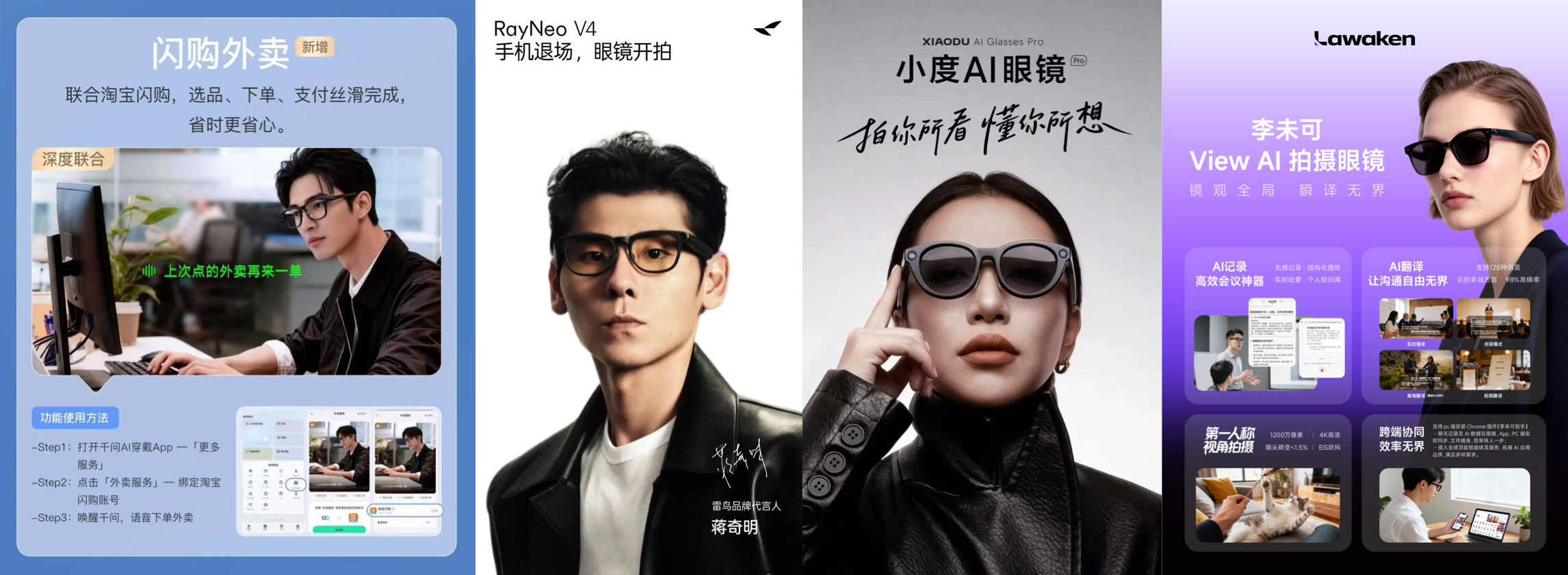
From Google's I/O Conference showcasing audio glasses co-branded with Samsung, Gentle Monster, and Warby Parker, to Meta founder Mark Zuckerberg defining them as 'one of the fastest-growing consumer electronics products ever,' and Apple's new CEO halting Vision Pro follow-ups to pivot fully toward AI glasses... In recent months, global tech giants have nearly simultaneously hit the accelerator on AI glasses. The domestic market is equally competitive, with products like Qianwen AI Glasses, Thunderbird V4, Xiaodu AI Glasses Pro, and Li Weike's AI Glasses (equipped with WakeeMemory) all making their debuts. The 'Hundred Glasses Battle' has shifted from conceptual marketing to practical product rollouts.
As the track remains red-hot, deep-seated industry issues are coming to the fore: Are AI glasses merely new toys for tech enthusiasts, or do they genuinely have the potential to become next-generation computing terminals for the mass market? Has the 'impossible trinity' bottleneck—balancing lightweight design, long battery life, and high performance—been overcome? Behind the fierce brand battles, when will issues like the lack of industry standards and inadequate user privacy regulations be resolved?
Uncertain Landscape, Diverging Paths
The AI glasses market in 2026 has shifted from the entry phase of 'availability' to the positioning phase of 'who is stronger.'
From a competitive standpoint, overseas giants like Meta still dominate the global market's top shares, but domestic brands are rapidly catching up and even leading in certain segments. Within the domestic camp, manufacturers have diverged into multiple differentiated competition paths based on product positioning, technological routes, and ecosystem development.
In terms of market share, Alibaba's Qianwen AI Glasses have delivered impressive results. According to AVC Retail Monitoring Data, from March to April 2026, Qianwen AI Glasses captured a 30.4% retail revenue share in the online market, ranking first.
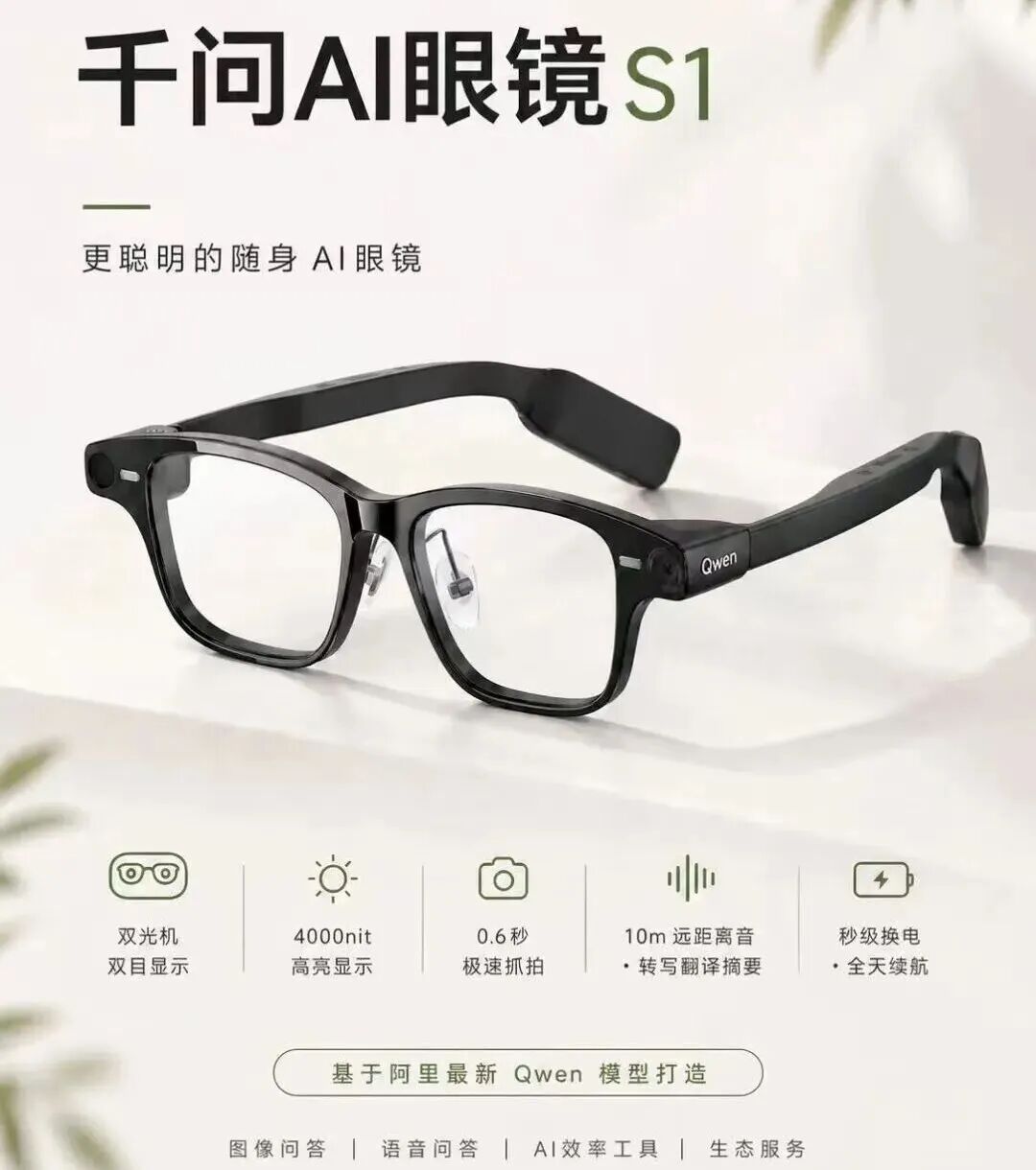
Qianwen AI Glasses are hardware products built by Alibaba around its Tongyi Qianwen large model, featuring a dual product line layout (strategic positioning) of G1 (screenless) and S1 (with screen), which officially went on sale on March 8th this year. The explosive growth of Qianwen AI Glasses reflects a broader trend in the current AI glasses market: the competitive dimension has shifted from hardware specification stacking to AI capabilities and ecosystem service comparisons.
Qianwen AI Glasses deeply integrate with Alibaba's ecosystem services like Taobao, Gaode, Alipay, and Kuake, enabling closed-loop scenarios such as voice-based food ordering, express delivery tracking, and scan-to-pay. This 'hardware + AI large model + lifestyle service ecosystem' trifecta positions Qianwen AI Glasses not just as selling a pair of glasses but also as offering an 'always-on AI secretary' service.
In contrast to Qianwen's ecosystem-driven approach, on May 27th this year, Thunderbird Innovation officially launched the industry's first professional film-grade AR glasses, the Thunderbird GT series, and the new-generation AI filming glasses, Thunderbird V4. These two AI glasses showcase an alternative product route: restraint and focus.
Thunderbird V4 boasts impressive hardware specifications: its body weight is controlled at 38 grams, featuring the first-ever Blue Whale semi-solid-state battery with heteromorphic steel shell encapsulation technology, increasing battery capacity by 57% compared to the previous generation, enabling 11.5 hours of continuous music playback and over two weeks of standby time, while achieving IP67 dust and water resistance for the first time.
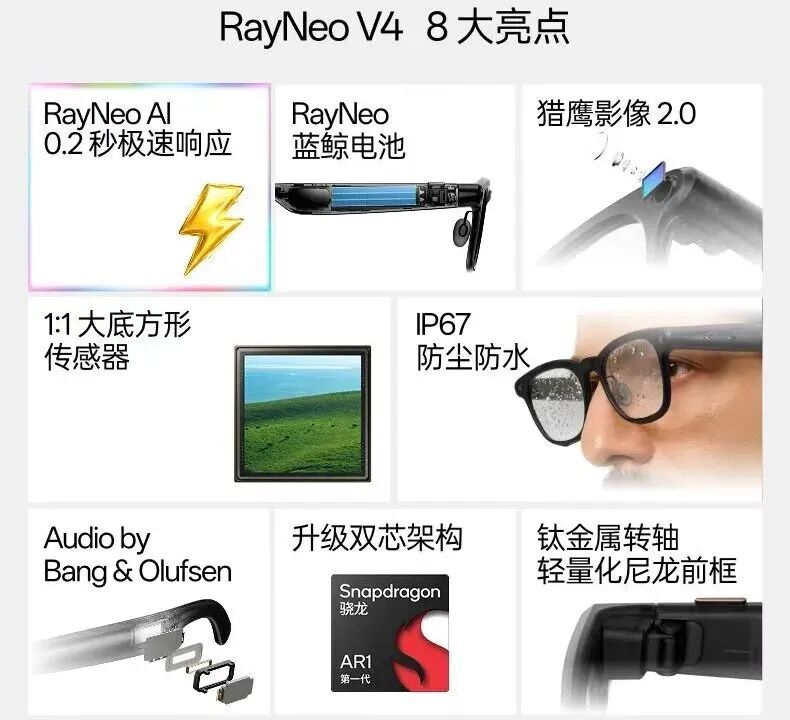
However, Thunderbird Innovation CEO Li Hongwei made a surprising judgment at the launch event: 'Including Thunderbird, we've all overestimated AI's performance capabilities on glasses. We lack reverence for AI.' He then announced that Thunderbird V4 would focus on optimizing foundational experiences, namely AI response speed.
The logic behind this decision stems from a set of data. According to Thunderbird, in 2025 alone, over 200 new features were rolled out across various AI glasses, yet the long-term usage rate by users was less than 6%. Therefore, Thunderbird V4 optimized its AI underlying computing architecture, adopting a dual-chip collaborative solution to address AI latency pain points, transforming the product's AI response shortcoming (weakness) into a core strength.
In contrast to Thunderbird's 'streamlining' strategy, Xiaodu AI Glasses Pro chose a path of restraint in form and depth in scenarios. The product adopts a screenless lightweight architecture, with frame weights around 39g, optimizing various implementation details.
For example, in filming, Xiaodu AI Glasses Pro incorporates intelligent algorithms like EIS (Electronic Image Stabilization) and horizon perception correction to ensure consistently clear and smooth footage, while offering multiple thematic style filters for instant photo output, eliminating the need for post-editing. In calls, it features a five-microphone array and self-developed ENC (Environmental Noise Cancellation) call algorithms to ensure clear communication even in noisy environments. Meanwhile, its reverse sound field anti-leakage system, through acoustic structure overlay and anti-leakage film design, effectively protects call privacy.
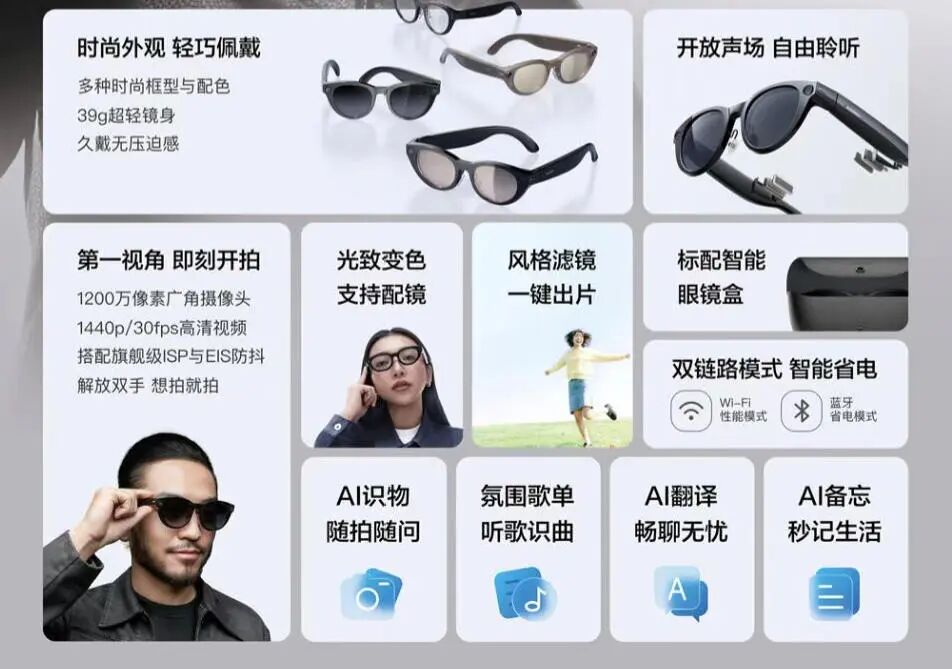
Additionally, Xiaodu AI Glasses Pro is equipped with the 'Super Xiaodu' multimodal AI intelligent assistant, supporting rich functions like AI translation, AI object recognition, AI navigation, AI memos, AI recording, AI smart control, and mood playlists.
It's clear that Xiaodu AI Glasses Pro focuses on daily usability, concentrating limited power consumption and computing power on voice, camera, and multimodal understanding, refining core usage scenarios like translation, filming, and meeting minutes. Xiaodu's route is to first solidify the minimal closed loop of 'wearable - usable - indispensable,' which coincidentally represents the most replicable path for AI glasses to transition from the tech circle to everyday mass use.
New AI glasses brand Li Weike vertically deep cultivation (deeply cultivates) overseas business travel and corporate scenarios, starting from core pain points and deepening core functions like real-time translation, meeting recording, and intelligent navigation. On May 14th this year, Li Weike unveiled the core technology system of Wake-AI 3.0, officially launching WakeeMemory, an AI glasses OS centered on real-world memory, becoming the industry's first brand to build a complete memory system architecture for AI glasses.
It's understood that WakeeMemory enables an intelligent closed-loop chain: Capture (task acquisition) - Structure (structured processing) - Recall (recollection/retrieval) - Act (action transformation), allowing memories not just to be saved but also understood, called upon, and executed, ultimately becoming users' long-term cognitive assets. Li Weike's partner and chief AI scientist, Gu Jian, believes, 'The most crucial AI infrastructure of the future is not computing power but long-term cognitive continuity.'
Currently, Wake-AI 3.0 has partially landed in Li Weike's AI glasses through OTA upgrades. For example, AI recording has been upgraded to 8-hour all-day seamless recording and automatic transformation of scattered voice and conversation content into searchable structured elements, enabling users to quickly retrieve by timeline and creating 'traceable life memories.'
From a broader perspective, the current domestic AI glasses market has gradually divided into four major categories. The first is ecosystem-derived products, represented by Huawei, Xiaomi, and Li Auto, whose product positioning extends existing hardware ecosystems, aiming to enable cross-device collaboration among smartphones, cars, and smart homes, relying on their original hardware user bases for product conversion.
For instance, Huawei AI Glasses deeply integrate with the HarmonyOS ecosystem, equipped with self-developed AI glasses chips and the Xiaoyi intelligent agent; Xiaomi focuses on filming AI glasses, integrating the Super Xiaomi Assistant and Mi Home smart home control; Li Auto's Livis glasses are deeply bound to Li Auto's vehicle infotainment system, enabling intelligent device linkage (linkage) inside and outside the car.
The second category is independent terminal products, represented by manufacturers like Thunderbird Innovation, XREAL, and Rokid, which deeply invest in optical and spatial computing self-research, abandoning reliance on smartphone ecosystems and aiming to create next-generation spatial computing terminals independent of smartphones, with display capabilities as their core competitiveness (competitive edge). They are also among the few domestic forces targeting overseas high-end XR technologies.
The third category is vertical scenario products, emphasizing deep integration of AI capabilities with segmentation (niche) scenario services like translation, gaming, office work, and filming, abandoning the all-in-one approach and focusing on refining products in a single vertical track (track) to form differentiated product barriers.
For example, iFlytek AI Glasses support real-time mutual translation in 122 languages, covering 17 major industry-specific lexicons; Dreame AI Smart Swimming Goggles are equipped with self-developed sports health large models, generating event-training-level exclusive sports plans based on users' real-time sports data; Li Weike's View AI Filming Glasses focus on instant filming, capturing and recording life in 4K high-definition from a first-person perspective, while also supporting real-time translation and photo translation in 128 languages.
The fourth category is internet platform products, where internet giants like Alibaba and Google leverage their self-developed large models and full-link lifestyle service ecosystems to position AI glasses as hardware entry points for software service rollouts, not relying on hardware markup for profit but achieving commercial closure through subsequent subscription services and scenario commissions.
These four types of players are each showing their strengths, but multi-perspective data points to the same conclusion: 2026 may become the turning point year for AI glasses to transition from conceptual verification to mass-scale adoption, with the market unanimously optimistic about AI glasses' shipment prospects.
IDC predicts that global smart glasses market shipments will exceed 23.687 million units in 2026, with China's smart glasses market shipments surpassing 4.915 million units, officially entering a phase of scaling (large-scale) growth. Omdia estimates that currently, the Chinese mainland market accounts for 10.9% of the global AI glasses market share, with shipments nearing 1 million units, making it the world's second-largest market after the United States.
Core Drivers and Privacy Challenges
The leap in AI glasses shipments from hundreds of thousands to tens of millions in just two to three years is not a bubble driven by mere capital hype but the result of synchronized forces from policy support, hardware technological breakthroughs, and the release of pent-up consumer demand. These three variables collectively broke through the cost, experience, and price barriers that previously constrained industry scaling.
In 2026, the implementation of domestic consumption policies became a key catalyst for short-term industry explosion. According to domestic consumer goods trade-in program details, smart glasses products priced under 6,000 yuan are eligible for a 15% purchase subsidy, with a per-unit subsidy cap of 500 yuan and a limit of one unit per consumer. After this policy's implementation, it significantly reduced the trial cost for ordinary consumers.
More critically, unlike mature consumer electronics categories like smartphones and tablets, AI glasses, as an emerging category, entered the national subsidy list for the first time, also reflecting from a top-level design perspective the strategic importance domestic industries place on AI near-eye terminals.
LoTu Technology monitoring data shows that domestic smart glasses market retail volume reached 402,000 units in Q1 2026, up 96% year-on-year, with retail value at 810 million yuan, up 102% year-on-year. Ministry of Commerce data reveals that in April this year, domestic smart glasses online retail value surged 175.2% year-on-year.
On the technological front, the 'impossible trinity' of lightweight design, long battery life, and high performance has long plagued the entire AI glasses industry and was a core reason for the commercial failure of first-generation products like Google Glass. An ideal pair of AI glasses should be comfortable to wear without pressing on the nose, have long-lasting battery life without frequent charging, and possess sufficient computing power for complex tasks like real-time translation and image recognition—three objectives that are inherently contradictory. However, new product releases since 2026 are substantially breaking through this bottleneck.
In terms of weight, domestic AI smart glasses now boast significant lightweight advantages. Huawei AI Glasses, Xiaomi AI Glasses, Kuake G1, Xiaodu AI Glasses Pro, Li Weike AIR AI Audio Glasses, and Li Auto Livis all have frame weights under 40 grams, with Li Weike AIR AI Audio Glasses weighing just 27.6g (excluding lenses). In contrast, the overseas mass-produced representative product, Ray-Ban Meta Gen2, has a frame weight of about 52 grams, making domestic mainstream products nearly 30% lighter.

Battery life improvements are equally notable. Screenless products, due to lower power consumption, generally achieve over 8 hours of battery life, while products with display solutions mostly still offer 2 to 5 hours of single-charge battery life. However, even in the AI+AR glasses segment with displays, battery life issues are gradually improving. For example, Qianwen AI Glasses S1 adopt a hot-swappable dual-battery design, paired with a portable battery swap station, enabling all-day uninterrupted use; Rokid supplements outdoor battery life with a magnetic capsule battery solution.
At the computing power level, the SoC+MCU dual-core heterogeneous architecture has become the mainstream solution in the AI glasses industry. The MCU handles low-power tasks like standby and audio playback, while the SoC takes on high-computing-demand tasks like image recognition and multi-round AI interactions, balancing power consumption and performance through dynamic computing power scheduling.
Therefore, with concentrated breakthroughs in three underlying technologies—low-power chip architecture iteration, photonic waveguide optics mass production, and new battery technology land (implementation)—historical challenges in the AI glasses industry are gradually being resolved, leading to the market's differentiation into two mainstream technological routes: screenless audio glasses and glasses with screens (AR glasses).
However, technological leaps are only a necessary, not sufficient, condition for AI glasses to achieve widespread adoption. A deeper question remains: Why must users 'wear them at all costs'? Is the value provided by AI glasses an irreplaceable necessity, or merely a nice-to-have feature that can be substituted by existing devices like smartphones?
In April this year, IDC's 'Smart Glasses Data Insights and Research Report' divided smart glasses' AI capabilities into three stages: The first stage is 'able to answer,' relying on traditional voice assistant logic to passively respond to instructions; the industry is currently in the 'able to act' stage, where devices can complete practical tasks like translation, meeting recording, and online ordering; the ultimate future form is 'able to proactively act,' where AI anticipates users' potential needs and prepares services in advance. The report also emphasizes that for smart glasses to evolve from mere hardware tools into dedicated personal assistants, the core lies not in large model technology itself but in whether it can fully integrate five key links: multimodal intent recognition, service matching, permission authorization, execution closure, and multi-terminal result feedback.
In addition, AI glasses can meet the huge existing demand for traditional glasses worldwide, forming the foundation of long-term industry demand. According to the World Health Organization, at least 2.2 billion people globally have impaired near or distance vision, with refractive errors being one of the primary causes. The global eyewear market size is projected to reach USD 140 to 150 billion by 2025 (with slight variations across different statistical agencies), showing steady growth. Meanwhile, as an important fashion accessory, the sunglasses market continues to expand at a compound annual growth rate (CAGR) of 5% to 7%.
AI capabilities can be integrated into traditional frames through low-cost solutions, enabling product upgrades from ordinary glasses to smart devices with only a marginal increase in hardware costs, thus possessing potential for replacing existing products. Mark Zuckerberg publicly predicted at Meta's 2026 Annual Shareholder Meeting that the majority of the 1.5 to 2 billion eyeglass wearers worldwide will gradually transition to AI-powered smart glasses.
Despite the industry's rising popularity and intense brand competition, several challenges remain for AI glasses to truly evolve from a 'trendy gadget' into a 'necessity'—challenges that cannot be easily resolved through technical specifications alone.
The primary issue is the lack of privacy regulations and industry standards in the AI glasses sector. First-person cameras raise privacy concerns in public spaces. Current industry self-regulatory measures include mandatory non-deactivable indicator lights for recording/audio states, local processing of sensitive data (lip movements, voiceprint features) without cloud uploads, and magnetic physical covers. However, the bigger problem lies in the absence of legal norms governing the boundaries of use in public spaces and the right to informed consent of those being filmed. This is not a technical issue but directly impacts social acceptability in scenarios such as restaurants, meetings, subways, and airplanes.
For example, on June 6, the Jinan Times reported that a user in Shanghai, surnamed Yun, discovered in the Rokid smart glasses user community that another user had filmed a flight attendant from Spring Airlines while boarding and publicly posted the footage, sparking concerns about smart glasses becoming 'covert filming tools.' On June 8, Rokid issued a statement titled 'Protecting Beauty with Technology: Rokid's Commitment to Community Governance and Privacy Protection,' updating the public on progress and measures, including a comprehensive community overhaul, crackdown on unauthorized peripherals, and hardware-software technology upgrades.
Furthermore, the challenges of myopia adaptation and offline channel fragmentation are prominent. The issue of 'customized prescriptions for individual myopia levels' remains a blind spot for most AI glasses globally. Industry estimates suggest that one of the core reasons for online return rates as high as 30% to 50% in some channels is 'discomfort during wear,' with a significant proportion attributed to inaccurate lens fitting.
Additional industry data shows that China has approximately 100,000 offline eyewear stores, yet less than 1% are capable of fitting AI glasses. Collaborations between channel partners like Doctor Glasses and brands such as Thunderbird Innovation and LAWS are attempts to bridge the 'last mile' of traditional optometry services. This also implies that whoever first establishes a seamless OMO (Online Merge Offline) loop of 'online ordering + offline fitting' may gain a significant edge in penetration over pure online players.
Conclusion
The simultaneous competition between international giants and local manufacturers, the parallel evolution of multiple technological pathways, and continuous breakthroughs in upstream supply chains are propelling AI glasses from a niche tech enthusiast phenomenon to real-world mass-market adoption.
Perhaps the ultimate winner will not be a single manufacturer or technological path but the 'killer scenario' that truly compels users to put down their smartphones and embrace glasses. Until then, the most noteworthy aspect of this 'hundred-glasses race' may not be who sprints fastest but who runs the steadiest, longest, and closest to genuine user needs. (Image sources: Official Weibo accounts of various AI glasses brands)
Risk Disclaimer: This content is compiled based on publicly available information and does not constitute any investment advice.
-
![]()
What is the Future for Domestic Large-Scale AI Models?
-
![]()
Insights into China's Gimbal Camera Market Structure, Player Dynamics, and Development Trends in 2026
-
![]()
Massive Capital Influx! NVIDIA's $25 Billion Bond Issuance Secures $85 Billion in Oversubscribed Demand, How Will the AI Chip Giant Secure Long-Term Liquidity?
-
![]()
Has DJI Caught Up with Insta360?
-
![]()
The Hidden Update of visionOS 27 is Incredible: Uncovering the Major Upgrades Apple Didn't Mention
-
![]()
Volunteer Application Agent: Tencent is Restrained, Alibaba is Aggressive
-
![]()
A Glimmer of Innovation Dances on the Tightrope
-
![]()
The AI Glasses Track is Fully Taking Off: How Far Are We from Them Being 'Must-Haves'?