Momenta | Going Public Not for Money
 06/22 2026
 446
446
The Biggest Risk Comes from the 'Fence-Sitters'
After two years of deliberation, Momenta is finally going public.
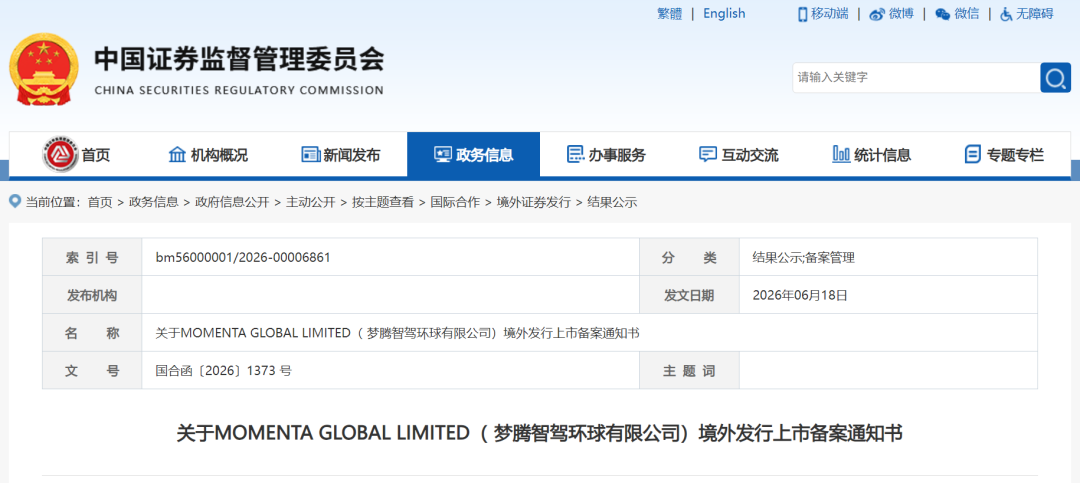
On June 18, according to Record Filing Information (filing information) from the China Securities Regulatory Commission, Momenta Global Limited plans to issue no more than 43.7541 million overseas-listed ordinary shares and go public on the Hong Kong Stock Exchange. Market sources indicate that Momenta aims to raise approximately $1 billion in this round, with a corresponding valuation of about $9 billion.
According to sources close to the deal, Momenta has already passed the listing hearing of the Hong Kong Stock Exchange and is set to launch its offering around June 30.
So, why has Momenta chosen to go public at this juncture? And what is the biggest risk it faces in the future?
01 Momenta Isn't Here Just for the Money
Judging by the scale of fundraising alone, Momenta doesn't seem to be in dire need of cash.
According to Unicorn Early Know, in March this year, when Momenta submitted its prospectus to the Hong Kong Stock Exchange, it planned to raise between $500 million and $1 billion, with an expected IPO valuation exceeding RMB 100 billion. In other words, even at the maximum fundraising amount, it would account for less than 10% of its valuation.
For Momenta, which is still in a high-R&D-investment phase, $500 million to $1 billion is certainly not a small sum. However, when viewed within the framework of a RMB 100 billion valuation, this money seems more like a supplement to its arsenal rather than a life-or-death lifeline.
Moreover, Momenta has never been overly concerned about money.
According to public information, Momenta has undergone roughly five major rounds of financing since its inception, transitioning from early-stage venture capital to later-stage involvement from automakers and industrial capital. The financing structure has gradually shifted from being financially driven to a hybrid model of "industry + capital."
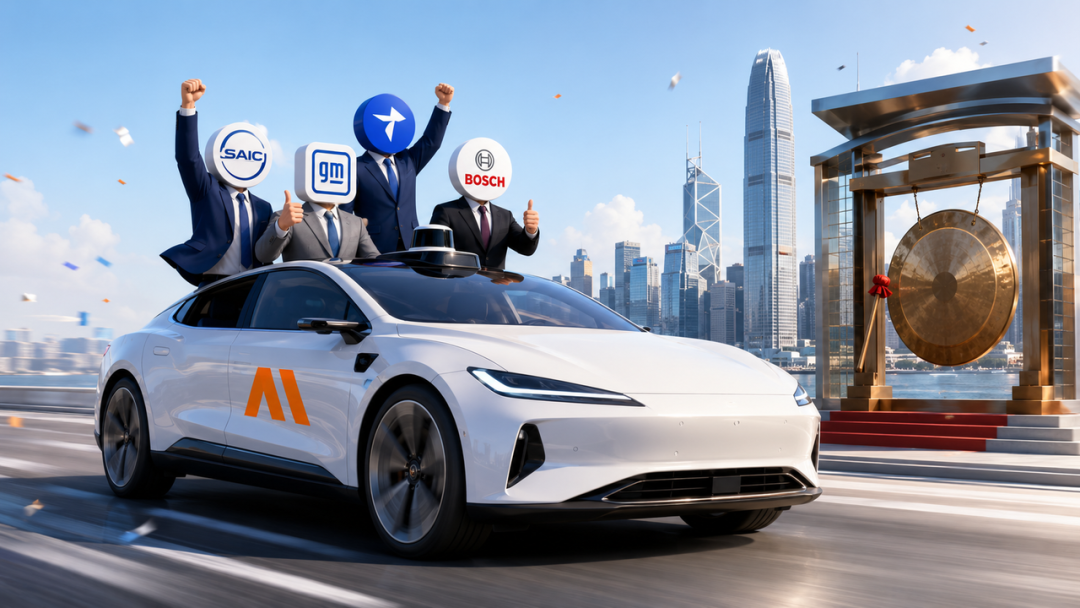
Industrial players such as SAIC, General Motors, Toyota, Mercedes-Benz, and Bosch have, over multiple rounds of financing, joined Momenta's shareholder list and continued to follow their investments, driven by the prospects of high-level intelligent driving solutions, mass production collaboration opportunities, and the potential for future Intelligent tutoring (intelligent transformation catch-up). On the other side, long-term capital players like Temasek, Yunfeng Capital, and Tencent, along with a batch of hard-tech funds and dollar-denominated capital, have also remained actively involved.
Industrial players provide scenarios and collaboration entry points, while capital players provide funds and valuation endorsements, together forming Momenta's luxurious "industry + capital" shareholder lineup.
But the longer the shareholder list grows, the more Momenta needs to go public.
For industrial capital players like SAIC and Bosch, which are interested in Momenta's technology, investing in Momenta is primarily part of their intelligent transformation strategy. Even if they don't exit in the short term, as long as they can reap benefits from mass production collaboration, high-level intelligent driving solutions, and data closed loops, this investment is more than just a financial move.
However, financial investors are different. Whether it's Temasek, Yunfeng Capital, Tencent, or earlier dollar-denominated funds and hard-tech funds, they all ultimately need an exit path. Especially after the autonomous driving sector has cooled from its peak, the difficulty of securing a higher valuation for Momenta in the primary market will only increase.
This is why Momenta is choosing to go public now. Going public isn't just about raising another round of funds; it's about re-pricing the industrial relationships, capital investments, and valuation expectations accumulated over multiple rounds of financing in the public market.
For existing shareholders, it's an exit pathway; for Momenta, it's a valuation anchor.
After all, the valuation of autonomous driving companies is most vulnerable when it remains stuck in the primary market. The primary market can sustain the narrative with industrial resources, technological imagination, and the promise of the next round of financing, but the secondary market asks more directly: How much should a third-party intelligent driving company really be worth?
What Momenta needs to do now is to establish a fair price for itself before the market fully depresses the answer to this question.
02 Momenta's Backers Could Also Be Its Ceiling
Momenta's biggest risk may not come from the technology itself but from its luxurious shareholder list.
Looking at Momenta's financing history over the years, the presence of names like SAIC, General Motors, Toyota, Mercedes-Benz, and Bosch simultaneously behind Momenta serves as a strong industrial endorsement. It indicates that Momenta has truly entered the vision (radar) of automakers and is indeed participating in the mass production process of high-level intelligent driving.
However, from another perspective, the fact that so many competing automakers have simultaneously invested in a single third-party autonomous driving enterprise is itself quite delicate.
SAIC and General Motors have direct competitive relationships in the Chinese market, and it's unlikely that Mercedes-Benz and Toyota would share the same commercial interests in intelligentization (intelligent transformation). More uniquely, these automakers are not only Momenta's shareholders but also potential clients and even important sources of scenarios for training and validating its intelligent driving capabilities.
This differs from the traditional automotive supply chain. In the past, automakers could jointly procure components from Bosch, Continental, and ZF because systems like brakes, steering, and chassis, while important, were more like industrial standard parts. The truly differentiating aspects of a brand still remained in the hands of the automakers themselves.
But urban NOA is different. As Hongmeng's intelligent driving capabilities gain a reputation and car owners become increasingly accepting of autonomous driving, high-level intelligent driving is no longer just a "configuration" but is increasingly approaching the core experience of intelligent electric vehicles. Which car drives more like a seasoned driver, which car is bolder and safer to drive, is directly influencing users' judgments of a brand's level of intelligence.
This puts Momenta in a somewhat awkward position.
The more neutral it is, the easier it is to receive orders from different automakers simultaneously; but the more neutral it is, the harder it is to become a truly Firm bet (firm bet) for any single automaker. Because no automaker wants its core intelligent driving capabilities to rely long-term on an external supplier that serves competitors at the same time.
This also determines that Momenta's real wins are only among those automakers in an intermediate state: those that are unwilling, unable, or too late in the short term to develop full-stack intelligent driving capabilities in-house but still need a competitive urban NOA solution.
But the problem lies here: Momenta isn't earning money from automakers that will never develop intelligent driving capabilities; it's earning money from automakers that haven't yet perfected theirs.
Most true new-energy vehicle manufacturers have long considered intelligent driving a core brand capability. Li Auto, XPeng, and NIO won't easily hand over the most critical intelligent driving experience entirely to third parties because it relates to product definition, user experience, and long-term data closed loops. Traditional automakers were slow to act in the past, so they needed Momenta. But that doesn't mean they will always need Momenta.
SAIC is a prime example.
In 2021, SAIC participated as the lead investor in Momenta's Series C financing and used Momenta's solution in its IM Motors brand. For SAIC at the time, Momenta was an important external grab to fill its high-level intelligent driving capabilities.
But a few years later, SAIC's intelligent transformation strategy no longer relies solely on Momenta. Within the SAIC ecosystem, IM Motors continues to collaborate with Momenta, Wuling can choose DJI's solution, MG can freely introduce Horizon Robotics' technology, and the latest Shangjie brand has brought in Huawei's intelligent driving.
In other words, SAIC hasn't entirely handed over its intelligent driving future to Momenta but is instead placing bets across different brands, price points, and technological routes simultaneously.
This also means that the relationship between Momenta and automakers isn't a one-way bind. Today, it's a shareholder, client, and partner; tomorrow, it could become just one of many options.
Similar issues will arise with General Motors, Toyota, and Mercedes-Benz. Their investment in Momenta doesn't equate to a permanent bet, and their use of its intelligent driving solutions doesn't mean they will rely on it forever. The only differences are each automaker's self-development progress, replacement costs, and current level of dependence on external intelligent driving solutions.
From this perspective, Momenta's IPO is also a "race against time" battle. It needs to complete its pricing anchor in the secondary market during the window when automakers' self-developed capabilities are not yet mature and intelligent driving solutions are not yet standardized.
This path is far more challenging than the journey from Series C to IPO.
- END -
-
![]()
"Current gasoline vehicles are akin to horse-drawn carriages of yesteryear."
-
![]()
Gasoline Vehicles Wait for Electric Vehicles to 'Stumble', Electric Vehicles Anticipate Gasoline Vehicles to 'Decline'
-
Entire 330-Kilometer Area Fully Unveiled! Hengqin Set to Eliminate Safety Officers and Steering Wheels Next Week, Ushering in China’s First Fully Autonomous City
-
![]()
New Energy Vehicle Order Rankings: Insights Revealed
-
![]()
China Invests Nearly 200 Billion Yuan This Year to Boost Car Sales
-
![]()
Oil Prices Revert to 7-Yuan Range: Are Gasoline Cars Getting a Reprieve?
-
![]()
Momenta Secures CSRC Approval: Is It Poised to Be the 'Pioneer in Physical AI Stocks'?
-
![]()
What's the Use of Having a General-Purpose Motion 'Cerebellum' for Humanoid Robots?