China Invests Nearly 200 Billion Yuan This Year to Boost Car Sales
 06/22 2026
 351
351
Lead-in
Introduction
Policies may not be the ultimate solution, but they are undoubtedly a powerful catalyst.
On the eve of the Dragon Boat Festival holiday, a significant announcement stirred up fervent discussions within the automotive industry.
On June 18, it was officially declared that the third batch of special funds, totaling 62.5 billion yuan for consumer goods trade-in programs—commonly referred to as 'national subsidies'—would be disbursed by the end of June. This move is set to inject a much-needed impetus into the sluggish automotive market.
Previously, by 2026, the first two batches of consumer goods trade-in funds, amounting to a total of 125 billion yuan, had been successfully allocated, driving cumulative sales of related products to surpass 820 billion yuan. The policy benefits reached over 110 million people, showcasing a significant industrial stimulus effect. Naturally, the automotive sector, as a major consumer category, emerged as the primary beneficiary of this new policy.
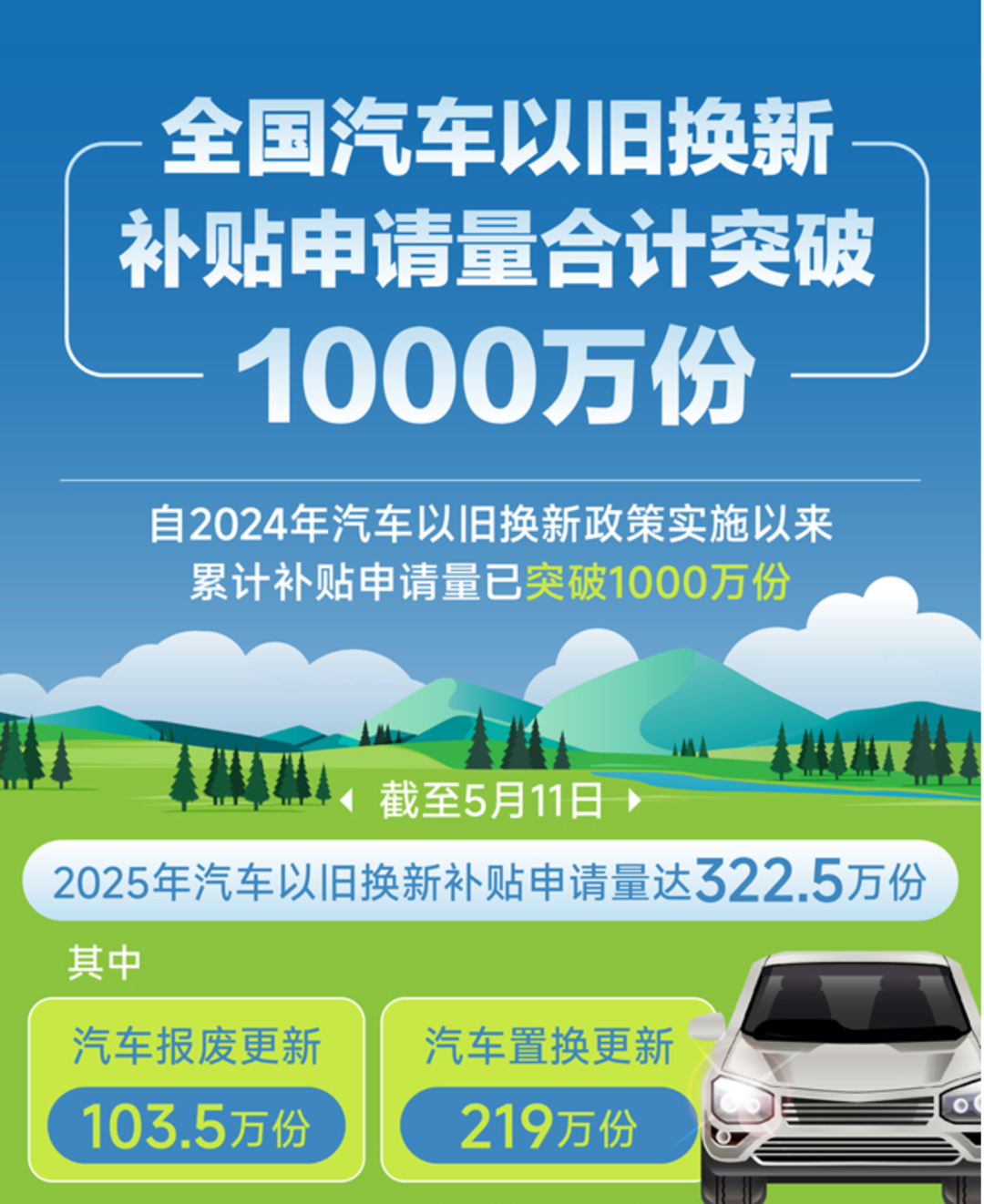
Public data from the Ministry of Commerce indicates that by the end of May 2026, the cumulative number of applications for national automotive trade-in subsidies had exceeded 4.12 million. Notably, in May alone, there were 1.23 million subsidy applications, marking a 13% increase from April. This replacement demand directly propelled new car sales to exceed 1.2 million units, becoming a vital pillar supporting the steady growth of automotive sales in May.
It's crucial to note that this occurred during a traditional off-peak season. Typically, after the May Day holiday, sales at 4S dealerships would wane, and showroom traffic would decline sharply. However, this May, subsidies managed to mitigate the off-season slump. Despite the overall market downturn, retail sales of new energy vehicles (NEVs) reached 980,000 units, with a penetration rate exceeding 60%, setting a new historical record for the same period.
From an annual perspective, as of May 31, the five major categories of consumer goods trade-in programs had driven cumulative sales of 1.1 trillion yuan in 2026, with over 175 million subsidies directly issued to consumers. Since the implementation of the automotive trade-in policy in 2024, the cumulative number of subsidy applications has exceeded 10 million, indicating a substantial impact.
01 Automotive Market Declines by 20%, State Intervenes
This year, the overall growth of the automotive market has been relatively sluggish.
Data reveals that from January to May, domestic passenger vehicle retail sales reached approximately 7.10-7.15 million units, a year-on-year decrease of 19%-19.5%. In May alone, retail sales were 1.51 million units, down 22.1% year-on-year. At this critical juncture of market decline, robust intervention is urgently needed.
The third batch of 62.5 billion yuan in 'national subsidies,' along with the total of 187.5 billion yuan from the first three batches, although not exclusively dedicated to car purchases, provides tangible benefits that the automotive consumption market desperately needs.
Looking back at 2025, the 'national subsidies' for automotive trade-ins had already demonstrated their influence. According to the Ministry of Commerce's annual statistics, the number of national automotive trade-in applications exceeded 11.5 million in 2025. The policy benefits fully penetrated the terminal market, directly driving new car sales to exceed 1.6 trillion yuan, successfully offsetting multiple pressures such as industry price wars and consumer hesitancy.
Based on the positive effects observed in 2025, the state continued to ramp up support for automotive consumption in 2026, introducing the most substantial and widely covered automotive trade-in subsidy policy in recent years.
Compared to previous policies, the highlights of the 2026 national subsidies are evident. Through optimizations such as proportional subsidies, increased subsidy caps, lowered thresholds, and simplified processes, the policy precisely targets the vast existing automotive market.
Specifically, the new policy implements a unified national subsidy standard. Scrapping an old vehicle to purchase a new energy vehicle (NEV) entitles consumers to a subsidy of 12% of the new car's price, up to a maximum of 20,000 yuan. Trading in an old vehicle for an NEV provides an 8% subsidy, up to 15,000 yuan, with similar increases for internal combustion engine vehicle trade-ins.
Simultaneously, the eligibility period for old vehicles has been significantly extended. Gasoline vehicles registered before 2013 and NEVs registered before 2019 are now eligible for trade-ins, bringing a vast number of old vehicles into the replacement scope. Additionally, the subsidy application process has been fully digitized, addressing the pain points of cumbersome procedures and delayed payouts.
Building on this foundation, various regions have introduced local supplementary subsidies. Combined with trade-in discounts and financial interest-free offers from mainstream automakers such as BYD, Tesla, and Geely, a triple benefit of 'national subsidies + provincial subsidies + automaker subsidies' has been formed. The comprehensive discount per vehicle can exceed 30,000 yuan, significantly lowering the threshold for consumers to replace their cars.
Therefore, as the domestic automotive market faced pressure at the beginning of 2026, with overall industry sales declining by about 20% in the first five months and intense competition in the terminal market leading to consumer hesitancy, effective policies were urgently needed to break the deadlock.
The implementation of the third batch of 62.5 billion yuan in special funds came at an opportune moment. As of the end of May, the 4.12 million automotive subsidy applications had already begun to show the pulling effect of the new policy. With the full implementation of the third batch of funds and the continuous follow-up of local supporting policies, the traditional off-peak season in the automotive market in the second half of the year is expected to be reversed to a certain extent, and a new round of concentrated release of replacement demand is anticipated.
02 Cars-to-the-Countryside Initiative Joins Forces to Stimulate Automotive Consumption
Simultaneously with the 62.5 billion yuan trade-in special funds, the 2026 cars-to-the-countryside initiative has also been launched. These two policies jointly inject consumption vitality into lower-tier markets and open up new growth space for the automotive market's recovery in the second half of the year.
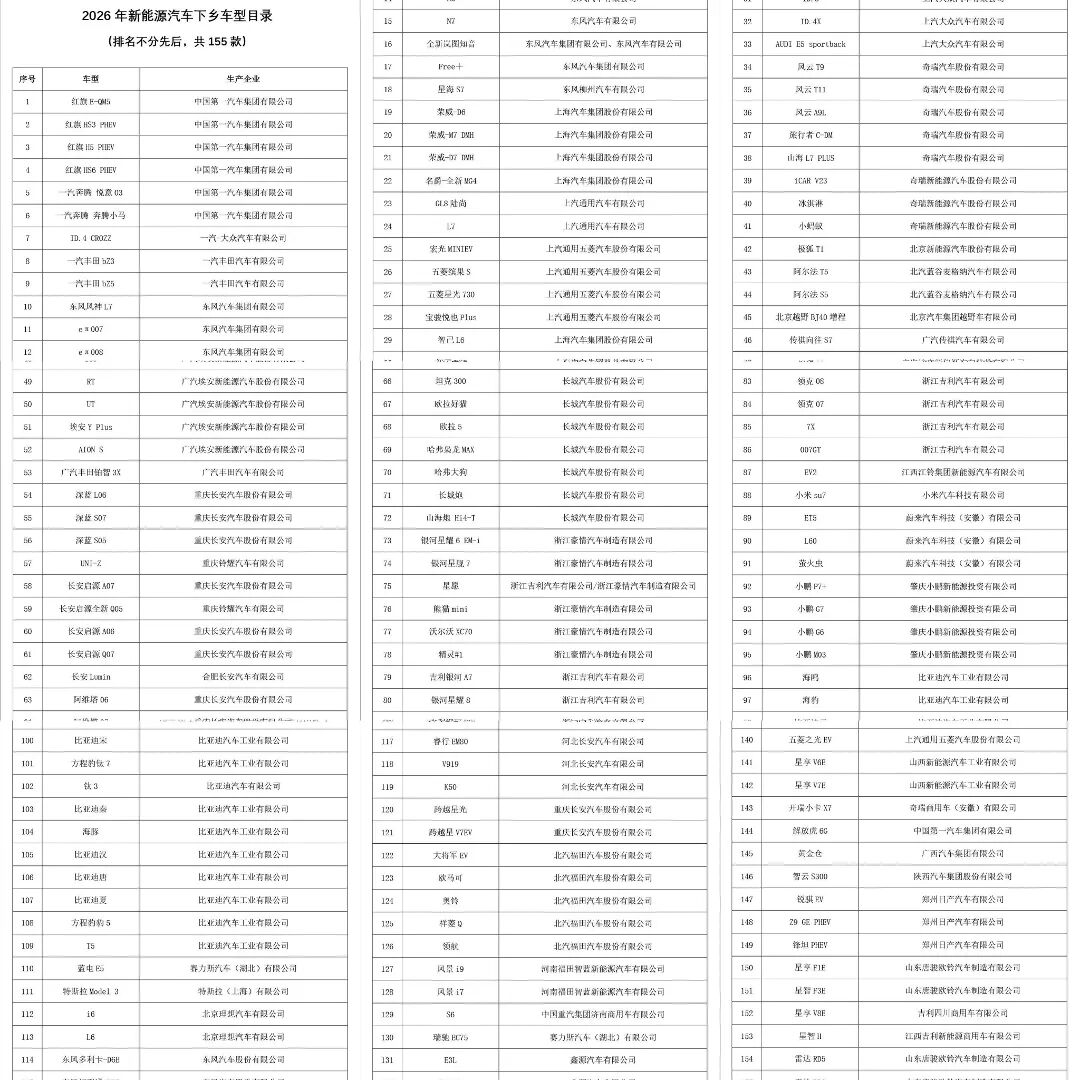
It's worth mentioning that this year's cars-to-the-countryside initiative has been upgraded, abandoning the limitation of focusing mainly on low-end models. A record-high 155 models have been selected, including popular NEVs such as the Xiaomi SU7, MG4, Tesla Model 3, and various BYD models, covering a full price range from 30,000 to 500,000 yuan. This breaks the stereotype of limited choices and low quality for NEVs in lower-tier markets.
Of course, the cars-to-the-countryside initiative is not a new measure. When it was first implemented in 2009, it significantly stimulated the first round of growth in the domestic automotive market through precise policy benefits.
Data shows that after the implementation of the cars-to-the-countryside policy in 2009, rural automotive sales exceeded 1.3 million units for the year, driving consumer spending to exceed 80 billion yuan. This successfully activated the blank space in the domestic lower-tier markets and helped the domestic automotive industry enter a period of rapid growth.
After more than a decade of development, the domestic automotive market has transitioned from a growth market to a competitive inventory market. The market environment for the cars-to-the-countryside initiative has undergone profound changes, making it difficult to replicate the explosive growth seen in 2009.
Nowadays, car ownership in urban and rural households has significantly increased, with replacement demand replacing first-time purchase demand as the mainstream. The average consumption per automotive replacement is much higher than that of consumer electronics and digital products, leading to more cautious decision-making by consumers and a certain slowdown in the replacement pace.
Simultaneously, issues such as insufficient coverage of charging and battery swapping infrastructure in remote towns and rural areas, scarce after-sales maintenance networks, and reduced battery range in northern regions during winter remain core challenges restricting the popularization of NEVs in lower-tier markets.
However, the consumption stimulus brought by the superimposed policy benefits cannot be underestimated.
In 2026, the cars-to-the-countryside initiative is bundled with the heavyweight national trade-in subsidies. Consumers in lower-tier markets who replace their vehicles with NEVs can simultaneously enjoy exclusive benefits from the initiative, substantial national replacement subsidies, local supporting incentives, and automaker discounts. The superimposition of multiple benefits forms a tangible car-buying advantage, significantly alleviating consumer hesitancy and purchasing cost pressures.
From a long-term industry perspective, lower-tier markets remain one of the most potential growth sectors in the domestic automotive market, with a potential market size exceeding 500 billion yuan yet to be fully unlocked. With the subsequent progress in improving charging and battery swapping infrastructure in rural areas and the implementation of intelligent connected vehicle and integrated optical storage charging technologies, the pain points of NEV usage in lower-tier markets will gradually be alleviated.
With the dual policy support of trade-in programs and the cars-to-the-countryside initiative, the accumulated replacement demand in the existing market and the incremental demand in lower-tier markets are expected to be released simultaneously. In the second half of 2026, the domestic automotive market is poised to emerge from its slump and embark on a path of steady recovery.
Editor-in-Chief: Shi Jie Editor: He Zengrong

THE END
-
![]()
Technology Sector's Meteoric Rise | Historic Transformation of A-Share Market Capitalization
-
Automotive Market News: New Energy Vehicles Set to Expand into Rural Areas by 2026!
-
![]()
Exorbitantly Bold! Liang Wenfeng Invests 20 Billion Yuan of His Own Funds and Imposes 'Dictatorial Terms'
-
![]()
FAW-Audi and SAIC-Audi Restructuring: One Maintains Profit from Gasoline Cars, the Other Stakes Future on Electric Vehicles
-
![]()
When Smart Grows Up, Will It Still Be Appealing?
-
![]()
Global Strategy Forum on Automotive Supply Chain Empowerment via Hong Kong's Global Reach Concludes Successfully
-
![]()
In-depth Report on the 2026 Hong Kong Auto Expo | China's Auto Industry Upgrading Systemic Competition in Global Expansion: How Can Hong Kong Empower It?
-
![]()
The decline of fuel vehicles is irreversible, and extended-range and plug-in hybrids may fare even worse