2026 Financial Intelligence Agent Bidding Guide: Comprehensive Deployment Across Banks, Brokerage Firms, and Insurance Sectors
 06/22 2026
 341
341

Currently, the seamless integration of artificial intelligence and financial services is ushering in a new era, with 'intelligence agents' emerging as the cornerstone application. These agents are progressively becoming indispensable for financial institutions, enhancing service quality and efficiency, reshaping business processes, and refining customer service.
When it comes to intelligence agent development, the financial sector has established a well-defined hierarchical framework. Major state-owned banks and leading joint-stock banks typically opt for in-house development of core intelligence agent infrastructure, retaining control over underlying models, platform frameworks, and core business functionalities. Consequently, they have minimal reliance on external bidding and procurement, focusing instead on supplementing computing hardware and niche scenario support services.
Conversely, small and medium-sized banks, along with various non-bank financial entities such as securities firms, insurance companies, and financial leasing firms, find it most practical and efficient to procure mature platforms, vertical scenario intelligence agents, and supporting technical services from external vendors to facilitate their intelligent transformation.
Bidding data, serving as the most direct and objective reflection of institutional procurement needs, documents the construction demands, implementation priorities, and investment preferences of diverse financial entities regarding intelligence agents. It stands as a vital reference point for monitoring the development of financial intelligence agents.
01 Institute has compiled public bidding data for financial intelligence agents from January 1, 2026, to June 15, 2026. This includes various types such as bidding announcements, procurement intentions, solicitations for comments, and exchange announcements. The screening criteria required explicit mention of intelligence agent-related construction content in the title or requirements. After eliminating duplicates, 97 valid samples were identified, covering over 10 categories of licensed financial institutions, including banks, securities firms, insurance companies, financial leasing companies, consumer finance companies, wealth management companies, and payment companies, as well as related market entities such as fintech subsidiaries, financial technology firms, and universities.
Unlike the demand structure in 2025, which centered on underlying platforms with fragmented scenarios, the bidding for financial intelligence agents in 2026 has witnessed a comprehensive rollout. Underlying infrastructure, such as intelligence agent development/application platforms, alongside dozens of business scenarios like risk control and customer service, and supporting operations, are advancing in tandem. The distinct construction approaches of institutions with varying business formats and scales are now fully evident.
01 Overview: Banks Lead in Procurement, with Platform Infrastructure as Core Demand
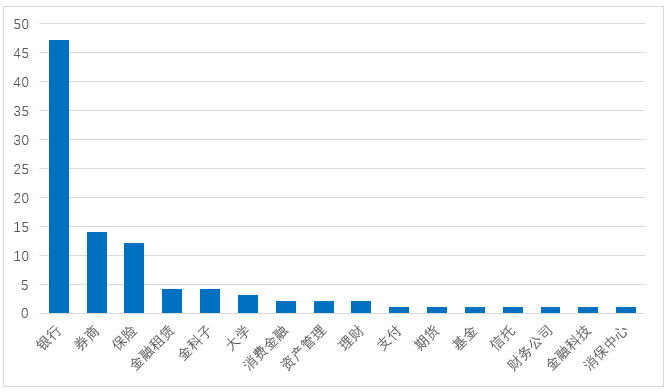
From the perspective of the bidding and purchasing entity structure, banking institutions (including rural credit cooperatives) account for the largest demand in the financial intelligence agent market, with 47 bids, representing 48.5%. Securities and insurance companies follow, with 14 and 12 bids respectively, each constituting over 10% of the total. These three types of institutions collectively account for more than three-quarters of the total bids.
Figure 1: 2026 Statistics on Intelligence Agent Bidding by Various Financial Institutions
Data Source: Enterprise Early Warning Tong, compiled and analyzed by 01 Institute
Financial leasing companies, fintech subsidiaries, consumer finance companies, asset management companies, and wealth management subsidiaries also have multiple bids.
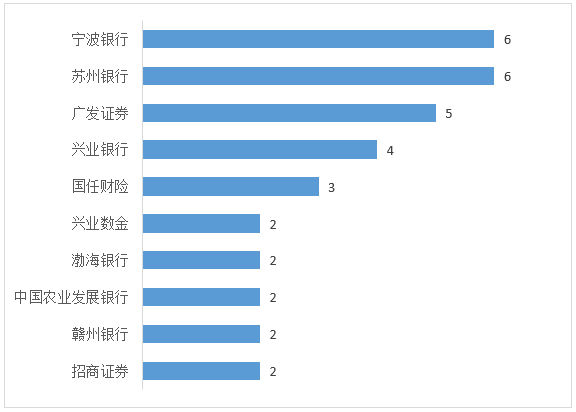
In terms of specific bidding entities, demand is highly fragmented. Ningbo Bank and Suzhou Bank lead with the highest number of financial intelligence agent bids, each with six. Including fintech subsidiaries, Industrial Bank also has six bids. GF Securities and Guoren Property Insurance follow with five and three bids respectively.
Figure 2: Top 10 Financial Intelligence Agent Bids in 2026
Data Source: Enterprise Early Warning Tong, compiled and analyzed by 01 Institute
From the perspective of bidding demands, constructing a unified intelligence agent application/development platform has become an industry-wide consensus, with platform procurement projects accounting for approximately 28.9%, remaining the most mainstream demand at this stage.
Financial institutions have generally recognized that the large-scale implementation of intelligence agents cannot rely on isolated, fragmented small applications. Instead, a unified basic platform and development infrastructure must be established first to unify core capabilities such as large model management, intelligence agent orchestration, tool invocation, knowledge base management, and performance evaluation, laying a solid foundation for subsequent multi-scenario intelligence agent development.
However, compared to the over 60% share of platform procurement projects in 2025, there has been a significant decline, with scenario-based applications now fully rolled out. Among these, risk control and compliance, as well as marketing and customer service, are the most concentrated, accounting for 19.6% and 11.3% respectively.
Figure 3: Word Cloud of Demand for Financial Intelligence Agent Bidding in 2026

Data Source: Enterprise Early Warning Tong, compiled and analyzed by 01 Institute
Front-end marketing and customer service are key scenarios. Bids for bank corporate and retail marketing intelligence agents, securities firm customer engagement and activation intelligence agents, and insurance sales intelligence agents have emerged, primarily aimed at mining marketing leads, providing intelligent script assistance, conducting customer segmentation operations, and enhancing customer service experience, directly addressing pain points such as cumbersome marketing processes and difficulty in acquiring and converting customers.
The middle and back offices have risk control and compliance as their core rigid demands, and these are also the most widespread areas for intelligence agent implementation. Around due diligence, credit granting, loan disbursement review, post-loan management, anti-money laundering, data security, compliance review, and audit supervision, a large number of construction demands for specialized intelligence agents continue to emerge.
Additionally, segmented scenarios such as data processing, document recognition, intelligent operation and maintenance, office approval, and test management are also constantly emerging. The application boundaries of intelligence agents continue to expand, gradually penetrating into every corner of the daily operations of financial institutions.
02 Banks: Leading Institutions Opt for In-House Development, Regional Institutions Outsource Entire Processes
As the core entities of the financial system, banking institutions boast complete business lines, rich data assets, and extremely high compliance requirements. Their demand for intelligence agents spans the entire chain, from intelligence agent platform construction to front-end marketing and customer service, mid-end credit business, and back-end risk control and compliance.
Among them, large state-owned banks focus on in-house research and development at the head office level, with minimal willingness to engage in external public bidding and procurement. Only three bids have been observed, all for specific scenarios or customized projects. For example, Bank of China Shanghai Branch requires third-party integrators to provide a toolchain including an AI database, intelligence agent platform, and intelligent knowledge base for certain needs of its intelligent risk management assistant to enhance the development efficiency of the entire platform. China Construction Bank Guangdong Branch procures an AI intelligence agent development platform for the design, development, and deployment of intelligence agents in campus scenarios. Bank of Communications Suzhou Branch procures a campus service intelligence agent matrix covering student enrollment, fee payment, graduation, and other scenarios.
National joint-stock banks exhibit similar tendencies, with external procurement needs focusing on capability upgrades, functional module supplementation, and localization adaptation of existing platforms. Simultaneously, they concentrate on customized procurement for vertical niche scenarios that are challenging to cover quickly on their own, such as retail marketing and data center operation and maintenance. Additionally, there are procurement needs for compliance-related specialized projects such as intelligence agent asset management and security attack and defense.
For instance, Industrial Bank procures infrastructure management platform services and customizes the development of data center AI intelligence agents, expecting to achieve functions such as predictive maintenance, intelligent alarms, intelligent troubleshooting, and energy-saving optimization, covering the head office's three data centers and all branch computer rooms, representing an intelligent upgrade of the internal operation and maintenance system. It also procures enterprise WeChat operation services, specifically training retail marketing intelligence agents to achieve automated content script generation, customer interaction, and integrated sales and service, addressing the shortage of intelligent tools for retail front-line operations. Furthermore, it builds an intelligence agent plugin marketplace to enhance the intelligence agent development and orchestration capabilities of its self-developed low-code platform.
Industrial Bank's subsidiary, Industrial Digital Finance, has also released two intelligence agent bidding demands, corresponding to corporate governance and risk control (credit granting) scenarios.
China Bohai Bank's two bids both focus on the intelligence agent engineering platform, procuring platform basic software licenses and core functional modules such as intelligence agent application orchestration and knowledge retrieval for localization adaptation, capability upgrades, and license supplementation of its existing self-developed platform.
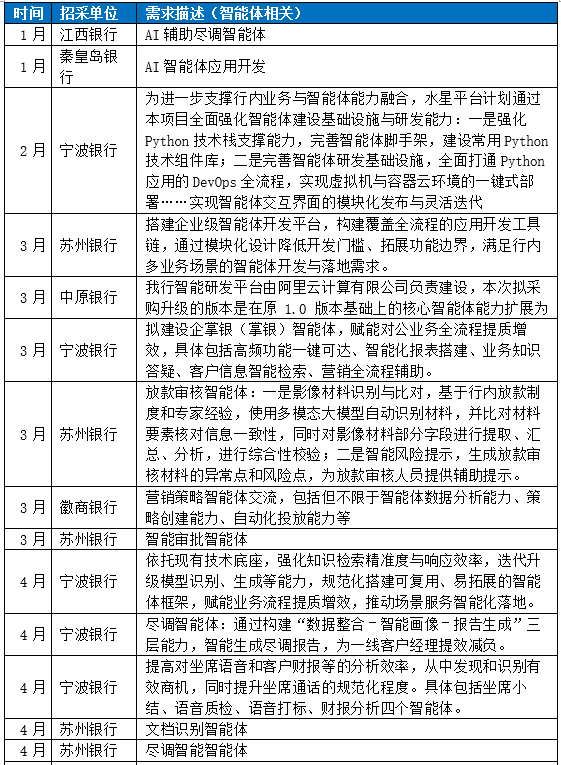
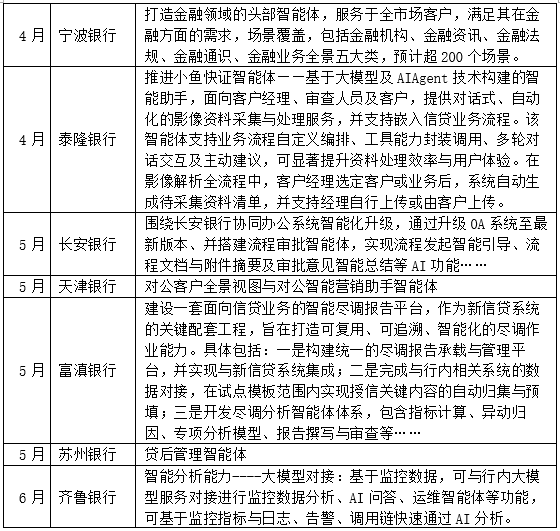
City commercial banks have the most intelligence agent procurement, reaching 21 transactions involving 11 banks. Among them, only Ningbo Bank, Huishang Bank, and Zhongyuan Bank are trillion-level city commercial banks.
Ningbo Bank has implemented nine intelligence agent-related bids within half a year, covering scenarios such as due diligence analysis, corporate online banking corporate services, seat voice business opportunity mining, and financial data labeling. Huishang Bank only conducts a solicitation of opinions for a marketing strategy intelligence agent, including capabilities such as intelligence agent data analysis, strategy creation, and automated delivery. Zhongyuan Bank designates Alibaba Cloud to upgrade its intelligent research and development platform, with the core being the expansion of intelligence agent capabilities.
Small and medium-sized city commercial banks moderately construct lightweight unified intelligence infrastructure to reduce repeated development costs. Simultaneously, they procure vertical exclusive intelligence agents for high-frequency pain points such as the entire credit process, seat operations, and financial review, along with lightweight services such as data labeling and joint co-creation, advancing in small batches in stages.
For example, Suzhou Bank has released six intelligence agent procurement announcements, building an enterprise-level intelligence agent development platform and matching a full set of risk control intelligence agents for loan disbursement review, post-loan management, intelligent approval, document recognition, and credit due diligence, forming a closed-loop credit AI tool system.
Tailong Bank is promoting the Xiaoyu Fast Certificate Intelligence Agent, supporting custom business process orchestration, tool capability encapsulation and invocation, multi-round dialogue interaction, and proactive suggestions, aiming to improve data processing efficiency and user experience.
Rural commercial banks mostly focus on single-function intelligence agents for retail micro-marketing, credit, and data security. For example, Changshu Rural Commercial Bank focuses on the micro-growth main storyline, procuring a marketing multi-intelligence agent collaboration project to build a marketing intelligence matrix covering corporate, retail, and micro business lines, requiring continuous quantification of customer conversion and operational efficiency data for iterative optimization.
In terms of rural credit cooperatives, only Hebei Rural Credit and Qinghai Rural Credit have been observed. The former leans towards systematic procurement, including GPU computing hardware, distributed inference frameworks, and intelligence agent development platforms, requiring localized adaptation of multiple open-source large models and supporting standardized scenario capabilities such as knowledge bases and credit due diligence. The latter procures a system supervision data intelligence agent recognition system.
Table 1: 2026 City Commercial Bank Intelligence Agent Bidding Demands
Data Source: Enterprise Early Warning Tong, compiled by 01 Institute
03 Securities Firms Deepen Investment Advisory Marketing, Insurance Companies Focus on Middle and Back Office Pilots
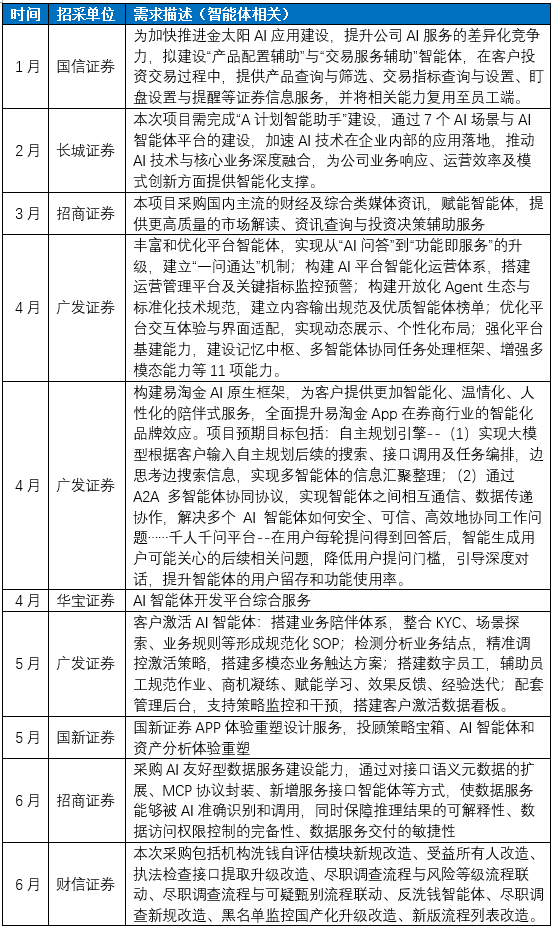
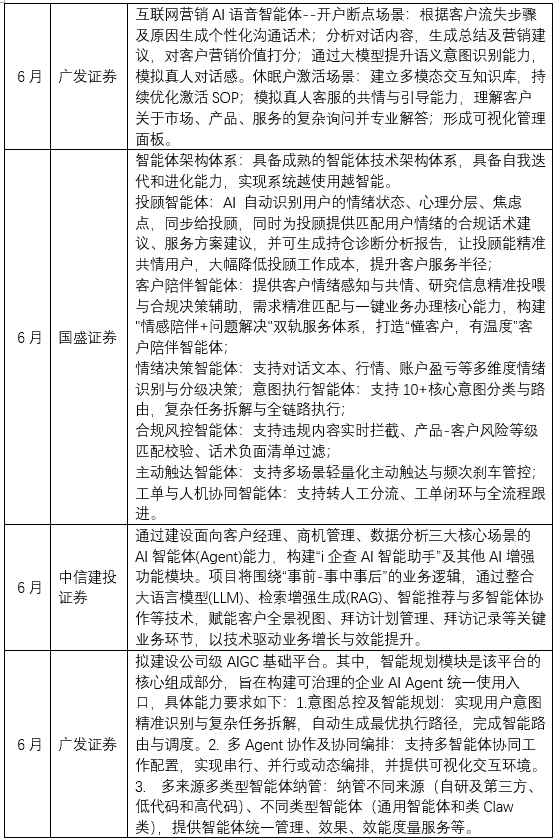
Securities firms primarily concentrate their demands on core business areas, with key implementation scenarios including investment research, investment advisory services, compliance and risk control, as well as customer marketing. These firms have exceptionally high standards for the professionalism and precision of intelligent agents and are more inclined to purchase customized solutions tailored to specific vertical scenarios.
For instance, GF Securities has issued four procurement requests, encompassing the development of the company's AIGC (Artificial Intelligence Generated Content) foundational platform and the establishment of a governable enterprise AI Agent Unified system (assuming the typo in the original text is corrected). The firm also aims to elevate the intelligence level of its Easy Trading App, facilitating information aggregation, organization, and collaborative data transfer among multiple intelligent agents. Furthermore, it seeks to acquire supporting AI intelligent agents for customer activation and AI voice intelligent agents for internet marketing, constructing multimodal interaction and empathetic dialogue systems for dormant account activation and account churn recovery, respectively.
China Merchants Securities focuses on upgrading existing intelligent agents by procuring professional financial news materials to enhance investment decision-making intelligence agents. On the other hand, it connects the invocation links between large models and internal data services through MCP protocol encapsulation and interface intelligent agent transformation, thereby strengthening the underlying data support for investment research intelligence agents.
CITIC Construction Investment Securities is developing AI intelligent agent capabilities for customer managers, business opportunity management, and data analysis scenarios, constructing functional modules such as the 'iEnterprise Check AI Intelligent Assistant' to enhance AI capabilities. Guosheng Securities and Guoxin Securities center their intelligent agent demands around investment advisory services. Meanwhile, Caixin Securities is optimizing its anti-money laundering system, which involves procuring anti-money laundering intelligent agents.
Table 2: 2026 Securities Firm Intelligence Agent Bidding Demands
Data Source: Enterprise Early Warning Tong, compiled by 01 Institute
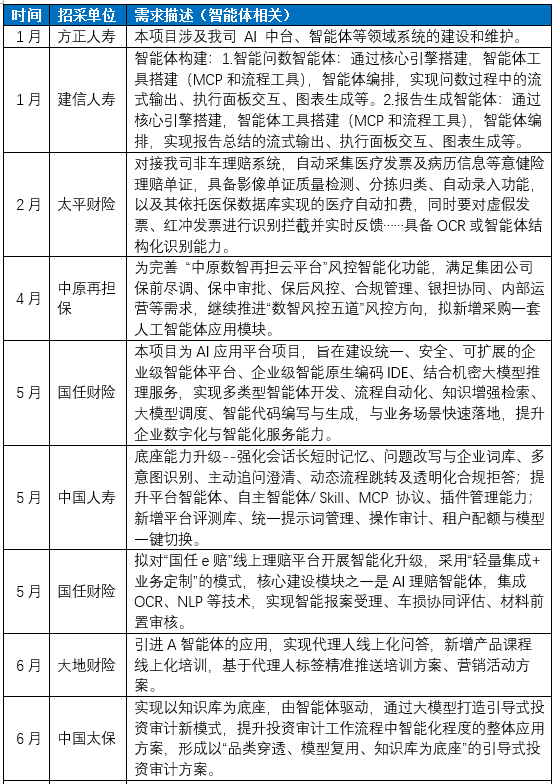
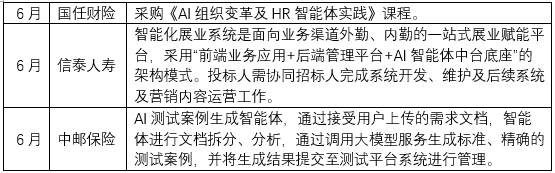
Insurance institutions exhibit relatively conservative investment strategies, primarily focusing on small-scale pilot projects. Their demands are concentrated in middle and back-office scenarios, including underwriting and claims processing, risk control and due diligence, internal operations, investment audits, and compliance management. Simultaneously, procurement demands have shifted from merely implementing technical tools to encompassing internal organizational capabilities and talent development, with multiple procurements of AI intelligent agent training courses and supporting services for organizational transformation.
In terms of typical cases, China Pacific Insurance plans to create a new model of guided investment audits driven by intelligent agents, underpinned by an industry-specific knowledge base. Jianxin Life Insurance intends to develop intelligent data query and report generation agents, addressing core pain points such as fragmented internal data, challenging cross-system data retrieval, and inefficient business analysis report generation through core engine construction, intelligent agent tool and orchestration capability building, and industry-specific vector knowledge base construction.
Guoren Property Insurance has outlined multiple procurement lines related to intelligent agents, covering three directions: platforms, claims processing, and talent development. Firstly, the AI application platform project aims to construct an enterprise-level unified intelligent agent infrastructure, supporting intelligent development IDEs (Integrated Development Environments) and large model inference services. Secondly, the AI claims intelligent agent integrates OCR (Optical Character Recognition) and NLP (Natural Language Processing) technologies to streamline case reporting, vehicle damage assessment, and automatic material review. Thirdly, it promotes technology implementation and cultivates the intelligent capabilities of internal personnel.
Table 3: 2026 Insurance Company Intelligence Agent Bidding Demands
Data Source: Enterprise Early Warning Link, collated by 01CAI.
04 Trend: From Tool Application to Systematization
The preceding sections have examined the bidding preferences, implementation scenarios, and typical projects of various institutions, including state-owned major banks, joint-stock banks, regional banks, securities firms, and insurance companies, categorized by business type. When compared with historical bidding data from 2025, the evolution of demand for financial intelligent agents becomes more apparent.
Firstly, applications are transitioning from general-purpose to vertically specialized. Early demands for general capabilities, such as simple Q&A and document processing, are gradually diminishing. Vertical intelligent agents that deeply integrate financial business rules, regulatory requirements, and industry knowledge have become the mainstream, imposing higher demands on service providers' understanding of financial business and their ability to customize scenarios.
Secondly, the construction model is shifting from isolated and fragmented development to systematized construction featuring a 'unified platform + multi-scenario collaboration.' Institutions are no longer developing individual intelligent agents in isolation but are relying on a unified foundation to enable multi-agent collaboration, data interoperability, and capability sharing, thereby constructing an internal intelligent agent matrix within the enterprise and leveraging cluster effects. Functions such as multi-agent collaboration, intelligent task orchestration, and cross-system scheduling frequently appear in bidding requirements, confirming the development direction of systematized construction.
Finally, the procurement model is upgrading from single software procurement to full lifecycle services encompassing 'technology + development + operation & maintenance + operational training.' Financial institutions are no longer satisfied with merely purchasing a system; instead, they require service providers to offer end-to-end services, including requirement analysis, customized development, deployment and operation & maintenance, performance optimization, and personnel training.
Some projects also include complementary components such as intelligent agent training, workshops, and capability co-construction, indicating that the industry not only values technological implementation but also emphasizes internal talent development and organizational capability alignment to drive the genuine integration of AI technology into the daily operations of enterprises.
-End-
-
![]()
Enflame Technology Clears IPO Hurdle: A Daring Venture into CUDA-Incompatible Realm
-
![]()
Significant Shifts in Home Appliance Market Trends During This Year’s 618 Shopping Festival
-
![]()
Insta360 Fights Back! Standing Up to Black PR Operations", "Insta360 Innovation, Black PR Operations, Patent Litigation, Market Competition, Financial Performance", "Insta360 Innovation, targeted by b
-
![]()
Home Appliance Enterprises: Shifting Focus from Traffic Acquisition to User Retention
-
![]()
Re-imported Cars Dilemma Unveils the Fallacy of Japanese 'Craftsmanship Spirit'
-
![]()
Stepping onto a New Path, Yet Hongqi Faces Familiar Challenges
-
![]()
Should Honda Offer Toshiaki Mibu a Second Chance?
-
![]()
The Qualification Remains, But Where Does Zotye’s Future Lie?